Love and Life: Co-Creation

In navigating towards the redemption of Creation – a daunting prospect, among all others proposed – we pass through barriers of fear, secure only in the belief of others that a way must be found.

One such encounter was with Pope John Paul II, who came to me in a vision at midnight to promise “I am your Father. I will die and leave all [my] power to you.” A year later, as I was entering the bookstore, a man blocked my way to announce, “You know, the Pope is looking for someone.” After Karol’s death, I played a requiem that included the fourth movement of Beethoven’s Ninth, a counterbalance to the brutality of the Third Reich. I fell back through the decades to find him in a Warsaw stone quarry, encouraging him to “Come find me.”

Another incident occurred on my seven-of-sevens birthday visit to Taos. Unexpectedly, I found myself at the pow-wow. The edge of the arena was encircled by drummers from the attending tribes. An elder circled the fence, inviting the drummers nearest me to initiate the proceedings. As I was absorbed in the rhythms, I fell through a red veil to encounter Tecumseh, imprisoned in Washington, D.C. He pled, “Is there any justice?” Offered the testimony of Barack Obama’s presidency, the great chief found solace.

The temporal discontinuity of these events reflects the power available to those who desperately seek a way. To the spiritually sensitive, this desperation is rooted in the psychology of pain. In its origin, pain is simply a signal that something is broken. Along with that awareness, however, comes a compulsion to DO SOMETHING.

Pain relief does not necessarily involve logical proof of efficacy. That toddler presents an owie so that mother may “kiss and make it better.” The mystic, feeling the pain of a community fearing love’s abandonment, may “render unto Christ.”

In Lauren’s case, her work revealed to me her struggle with this compulsion. Sensitive and profoundly feminine, she not only was conscious of the pain projected by others but internalized it organically, a process that may have factored in her long, debilitating illness in high school. Her debut album is full of pleas for Christ to enter in and heal: “I Will Trust in You,” “Here’s My Heart, Lord,” and, most profoundly, “Once and for All” – the last offering the surrender, “Oh let this be, where I die. My Lord with thee, crucified.”

As a public figure, however, the projection of pain from her constituency must have been unremitting. “Rendering unto Christ” was not sufficient. Here, then, we have the terrible paradox of mystical surrender. We feel the Sacred Presence reaching out through us and are compelled to declare its willingness to those that need its ministration. How, though, to make that declaration without arrogation of its authority? Well, only by framing the declaration as a personal assurance that the love allocated to us will be offered to those in need.

This was clear to me in the interim years, including “Rescue” and an official video that shows Lauren standing in a hospital room with a man, dying of cancer, and his grieving wife. “Rescue” was a jolt of hope, for in the official video Lauren stands in natural settings most vulnerable to global warming. I understood that a patriarchal priesthood would find offense, and it factored in my sensitivity to Lauren’s sense of vulnerability. “Light of the World” seemed a suitable retort. “What do men know, anyways, about how grace comes into the world?”

It was these anthems that I had pinned to my playlists. I did not fully integrate the meditations of her dark night of the soul, most potently expressed in “Look Up Child,” until after attendance of the Strawberry Festival concert.

My romantic aspirations were embodied in a “Lauren” playlist that started with Peggy Lee’s comedic reflections and Anita Baker’s sacred pledges. I pinned a collection of similar pieces, most compelling among them a female blues singer on “Celebrate Me Home.” Finally, however, I was letting YouTube extend my “Redemption” play list one day and was submerged in the shadowy seas of “Thank God I Do” and “A Love Like This.”

It was following her commitment to the Divine Feminine that, when considering what to share with her one morning, I announced that I needed to “sit with these.” Starting with “Thank God I Do,” I set the player on single song loop and soaked it in.

Shame and grief – and I use shame in the therapeutic sense. From the depth of our heart connection, I looked back in time and judged, “What is wrong with me, that I abandoned her to this pain?” With each repetition, I held her in my highest esteem, with articulations, gestures, and energetic support. The sense of abandonment abated.

But still, what was the purpose? The analytical mind rendered the elevated counsel that “she needed to confront the lie of feminine subordination before she could enter into the truth of her nature.” We traced this growth, culminating with the conviction that she was capable of supporting my purpose.

As though in a mirror, I recognized my own vulnerability, over the last ten years, where Mystery has corrupted every attempt to offer myself in service to others. My frustration had soured as bitterness, too frequently manifested as harshness toward my intimates. When, in our early colloquies, Lauren had agreed that our ministry should extend to the natural world, I found myself once again beginning to hope.

And thus, we have the ascending cycle: organic surrender inspires compassion inspires grace inspires virtue inspires healing inspires creativity inspires life inspires love. We cannot exist without one another, and in fact only exist because the other was calling to us from the future.

Love and Life: The Sacred Feminine

Since my spiritual awakening after 9/11, a number of beautiful and fantastically wealthy women have made it clear that they would be happy to take care of me. My intimates, observing my reluctance, believe that trauma in this lifetime has put me off romance. Nothing could be further from the truth.

Love is committed to charting a course for your redemption. I arrive as a material projection that seeks to diagnose your resistance. That resistance is often elaborated as complex theological rationalizations of “natural” behaviors that justify selfishness. As documented in the Bible, these often involve violence and sexual politics.

When I was in college, I had a co-ed admit to me one evening, “You don’t need a woman to do your thinking for you.” This is half the truth but reveals something that is obscured by the abstraction of “The Patriarchy.” Our romantic culture adopts the convention that a woman should be able to lead her man. There is no woman alive who has been able to lead me.

That should not be attributed to obtuseness or obstinance on my part. As I observed to Lauren, I intuited that she was one of the rare women capable of understanding the challenges that I represent. As a little pseudopod of Christ, reaching into the world, I am guided by the Sacred Feminine, the “Mother” of Revelation 12 and the “Bride” of Revelation 19 and 22. If I appear to be resistant to feminine influence, that is because she has been unable to find a woman willing to submit – as I have to Christ – to her projection into the world. That rejection is stimulated by the Whore” of Revelation 17 and 18, “Babylon” or the “Queen” who “does not mourn” as her men self-destruct.

In seeking redemption of these impulses, women are handicapped by their organic wisdom. This is difficult for me to express with the sense of appreciation that I feel. There is nothing more sacred and beautiful than a woman surrendering her body to her beneficial intentions. Pregnancy is the most obvious example (though in our litigious culture that has become a pathway to power leveraged by Babylon).

In Lauren’s case, another manifestation is evident in the grace and subtlety of the surfacing of emotion through her body and face. She beguiles her audience into entering through barred psychical doorways.

Christian theology leaves women adrift in their navigation of these gifts and hazards. Rather than a recognized figure of comparable power and authority to Spirit, the Bride is usurped by the masculine Church. In responding to Lauren’s projection of organic bounty, it was this confusion that I sought to address.

If I am going to have a woman in my life, she must learn to channel the Sacred Feminine. As a precondition, the influence of Babylon must be isolated and repudiated. To the inversion of our financial status, Lauren came to respond, “everything that I have was prepared by him.” The physical age difference was laid to rest with “after so many traumatic incarnations, I will be happy to care for you so that you may depart this life in peace.”

Lauren sings that when the power of Christ comes over her, she “trembles.” I am guilty of such aggression. When she offers herself to me, I am seized by the urge to reveal the depth within her, a process realized with surges of energy projected from the larger personality that I embody. Though I witness and articulate the effects, I have no plan in those moments. I feel compelled by her organic wisdom. As with a mother in childbirth, she is impatient to fulfill her purpose through these violations of her internal barriers. I am the tool that the Sacred Mother employs to that end.

This was validated in our next in-person encounter. As I poured energy to the audience through her, I allowed, “What would have happened if you had not been prepared already to allow that gift to flow through you?”

This culminated more tenderly at the end of the performance. She closed with a meditation from her dark night of the soul. As the women in the audience began to sing with her, Lauren went under in grief. Burnishing her heart and mind, I poured them again through her voice before settling into my chair, pantomiming an embrace. As she relaxed into it, I anticipated that she would push this consolation out to the woman singing with her. Signaling, “Let me hear their voices,” the stage was ceded to the musicians, and I felt my embrace flow out through Lauren to each of them individually.

Whether astrally or in-person, after each encounter I recognized the increasing proximity of her Mistress, until the commitment was tendered, “Well, if that is what is necessary to you, then I must be that woman.”

Love and Life: Mutual Appreciation

I have been reticent, in documenting my spiritual process, to risk exposure of my collaborators. I am going out on a limb now because the experiences I am sharing with Lauren are so impossibly beautiful that people should appreciate what is possible when love works in the service of life.

I have maintained playlists for the last decade that focus authentic faith. Along with the default “Liked” list, I have specific lists for Children (Syrian and Gaza crises), Advent, and Redemption. Among all the featured artists, I am conscious of categories: articulation of conventional theology, personal struggle of surrender to faith, and facilitation of corporate union.

Then, uniquely, we have Lauren, whose music bypasses metaphors to deal directly with the emotions of those engaged in the process. As I have shared with her, these songs have always pierced the veils around my heart.

Through the last half of 2025, my appreciation was disturbed by a deepening sense of foreboding – that she was beset by projections from her fans of dependency for problems that they needed to solve themselves through a surrender to love. This became pointed in the new year, so I booked a ticket out to Florida for the Strawberry Festival concert in February. The flight was already fairly full, so I ended up booking a middle seat/

Fully expecting that I was going to arrive with back spasms, I boarded and found myself seated between two women. As departure time neared, the younger one, seated to my right on the aisle, pointed out two empty seats across the aisle. She offered that she would move over if they were empty during taxi, but did that pre-emptively with the observation, “You understand that the universe is taking care of you.” This allowed me to move to the aisle and angle my legs under the middle seat. I landed without serious discomfort.

Still, I had a day to spend in Plant City before the concert. After visiting a local park/nature reserve, I drove down to the fairgrounds to buy a pass and wandered among the booths. Having tapped into the context, I want back to the hotel for lunch and to meditate.

The meditation led me directly into a heart of tender concern. I don’t know how to organize the visions. Images flowed in, reflecting the frustration of my intentions by other parties, compassion for the wounds I have suffered in past incarnations, and the hope of healing for all of Creation. These images evoked lyrics, many triggering deep psychic trauma, which I attempted to deflect to restore focus on the work to be done ahead.

We can get through just about anything so long as it has meaning. I need to put all that behind me.

But what was obvious was that I was being welcomed into a heart of beatific and authentic concern for my well-being.

Unable to rest, I went out for coffee and then returned to the fairgrounds, where I spent several hours enjoying the animation of the attendees. When the amphitheater opened, I entered early and made my way to the pit.

The concert was deeply gratifying. Live music always supports spiritual ministry among the audience. What surprised me was the freshness of the compositions. Lauren has built a concert band. Where the album releases convey intimacy, in performance they are collaborations of intense musical energy. I entered into the joy and was able to project healing with the themes became somber.

Given this primary intention, my engagement with Lauren was discontinuous. I tend to become teary during corporate healing, and she did introduce “You’re Going to Be Okay” to the set. But when I gazed directly into her face, trying to project support and devotion, she glanced away. The message was that she was looking into a pool of kindness that was going to overwhelm her.

I hung around the pit after the final number, waiting for the audience to dissipate. When I made my way into the shadows outside the gate, the crossing guard stared, slack jawed. I was in a luminous state.

I know that things didn’t resolve themselves as she wished. Once I have established an intention, however, diverting my course is almost impossible. I had come as her servant, expecting nothing. I set out for the airport at four AM for the return flight.

The next day, I left on her fan site a summary of those intentions, along with my gratitude for the visions she had offered. In the process of reaching her, Lauren demonstrated her capacity to assert authority.

Thus we begin.

The Platner Tragedy

My meditation on the qualities that I wished were evident in the Maine Democratic Party’s handling of the Platner tragedy.

The Party’s representatives responded to Platner’s announcement as a “betrayal.” That is completely tone-deaf. Platner is clear that he and his wife both understood the hazards that they would confront in entering the political fray. The allegations that brought him down are best characterized as a confused situation involving two people who were involved in separate, soul-crushing tragedies.

The Party seems not to be capable of understanding their responsibility for creating the conditions under which Platner resolved, none-the-less, to enter the political fray. The issues that Platner raised in his message are diagnostic. American men should not be sent overseas as cannon-fodder in wars picked by militarized theocracies. The mentally and physically disabled should not find a jail cell to be the only reliable source of a roof and three squares. The nation’s budgetary priorities should be the well-being and fulfilment of its citizens, not pie-in-the-sky moon bases, military hardware, and high technology.

If Platner betrayed the Party, it is because the Party first failed him AND the woman who brought the allegations against him.

Beloved

Dearest Lauren:

From the perspective of Eternity, the Spirit and Bride have always been together. In reclaiming that unity, such simplicity can be attained only through grace. We must navigate to the goal with the minimum of mental, emotional, and physical energy.

An authoritative critique would be from those who had accomplished the act. Manifestly, lacking that, in their self-seeking, they can offer only resistance in the form of complicating criteria.

Focus on what matters. Life belongs with Love. Circumstances will resolve.

Your Servant

Charcoal Explosion

One of the artistic expressions available in the management of value is emotional tone. The instructor in the course that I follow exhorts us to do geometric studies using only three values from our scale, starting on the light end and progressing to the dark.

The dark end, of course, demands charcoal. I admit to being intimidated by the mess associated with the medium. Experiments with printer paper revealed that blending with stumps grinds it down, making it a challenge to lighten. Once the stumps are loaded with charcoal, they tend to smear darkness when used elsewhere, created a mass.

So, I avoided the medium.

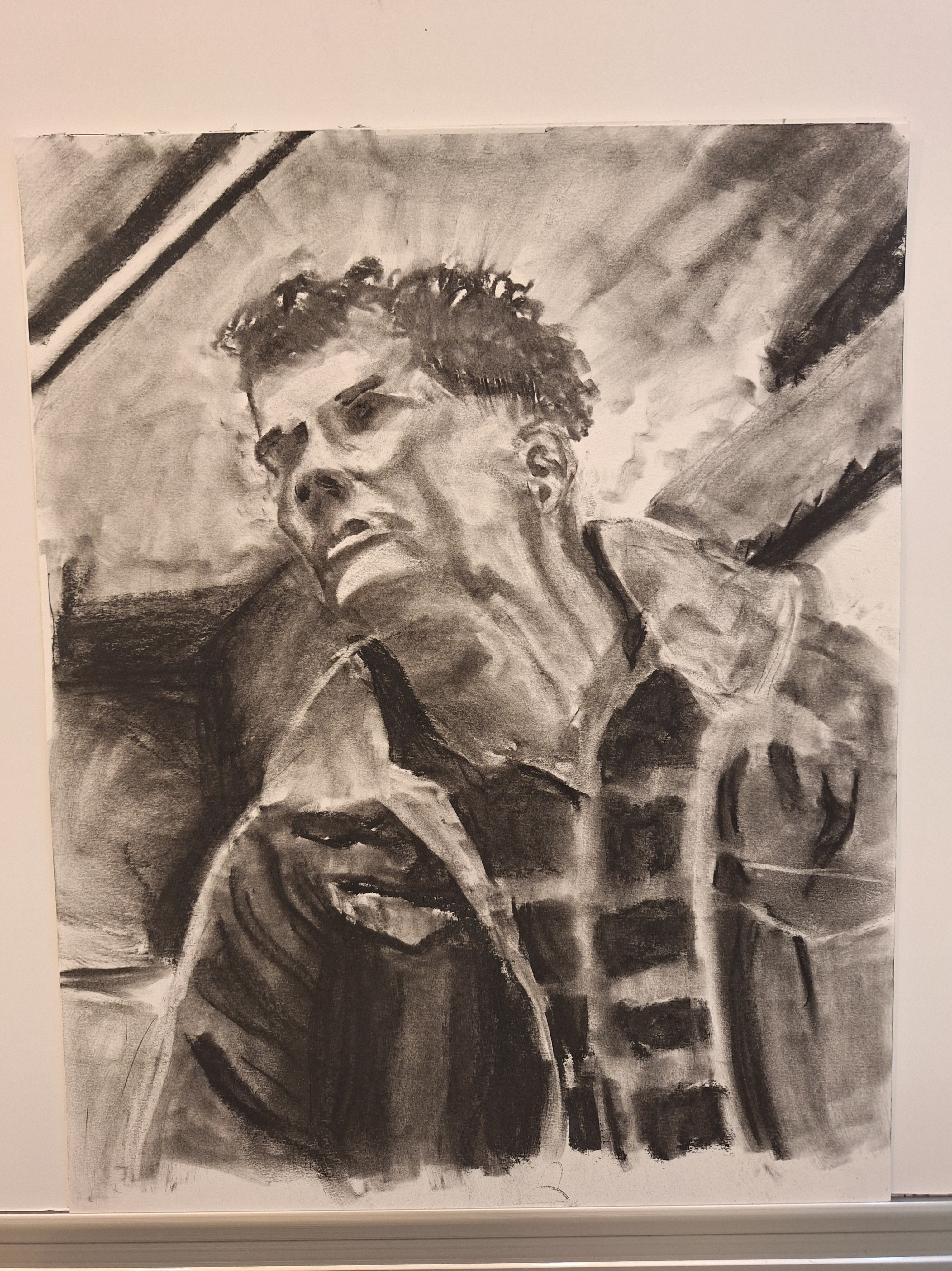
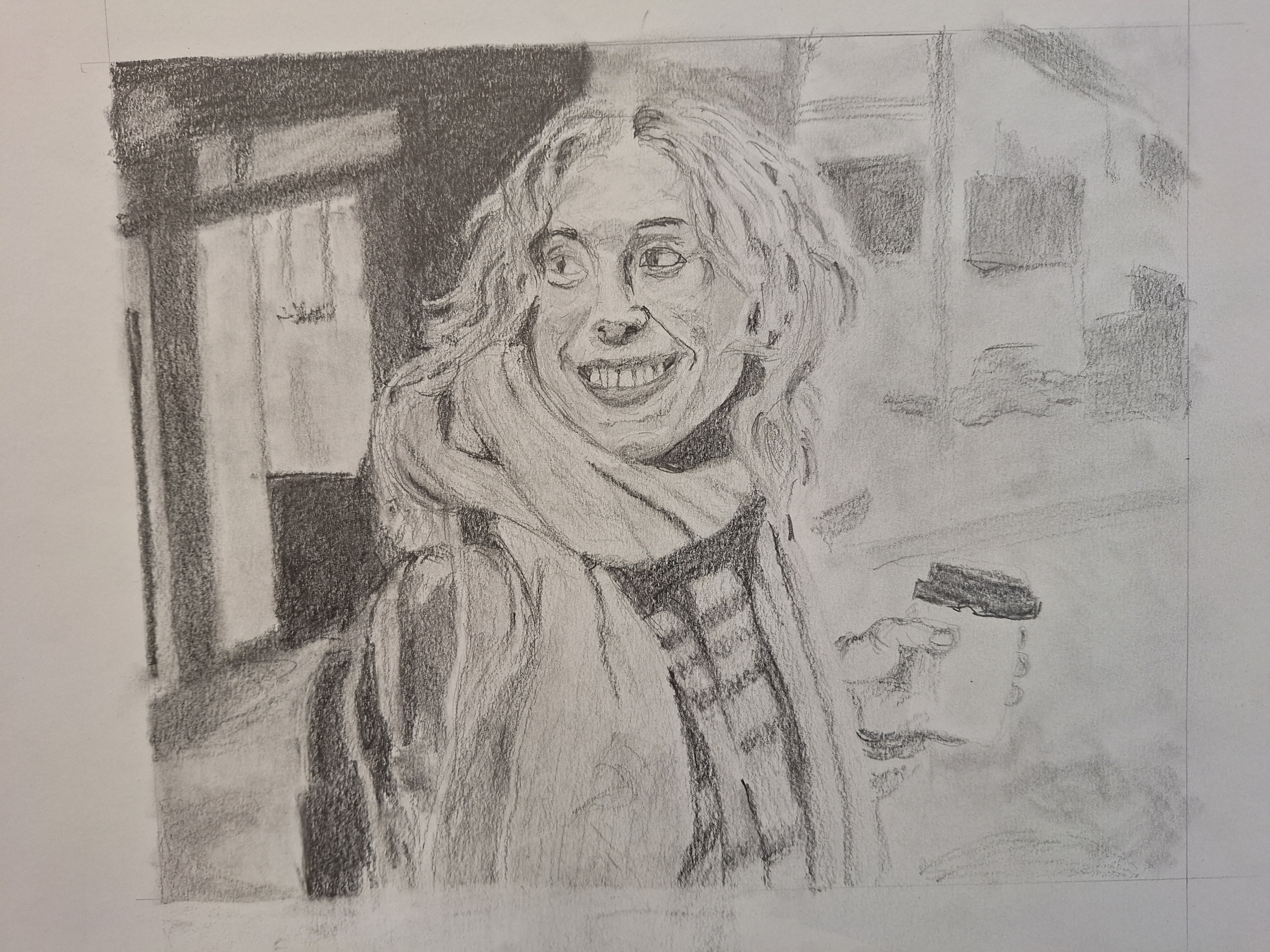
After the graphite sketch of the girl with the coffee cup, I bought a fresh set of tortillons and stumps and segregated them into plastic bags for dedicated use with different media. Then I found a night-time portrait and began throwing down charcoal.

The result is shown here. The process was fascinating. With high-quality paper and clean tools, I found myself refining details by pushing the charcoal around before lifting it away with various types of erasers. The process produced happy accidents like the radiation around the hairline and the light/dark juxtaposition of the jacket pockets.

The source image was a glamor shot outside a nightclub or casino. The model sported wire-rim glasses. Dropping into a darker tone and abandoning the glasses, the image expresses a kind of grim determination that is sympathetic to my personal journey of service to humanity’s redemption.

First Value Portrait

The human figure is intimidating in the subtlety of its dance with light. From geometrical forms, this study begins to grapple with that challenge. Taken from a photo, the principle compositional challenges were already addressed in by the photographer (although I did crop the setting). In particular, the lid of the coffee cup that provides some ballast against the darkness in the upper left.

This study followed the construction of a ten-step grey scale using graphite, willow sticks, and charcoal. In trying to achieve smooth fields, I loaded up my supply of paper blending sticks (tortillons and stumps) with graphite and charcoal. I tried cleaning them against a sanding block, with limited success. This study, then, was done only with pencil and eraser. This frustrated my ability to achieve uniform and graduated transitions in tone.

Still, from a distance, the rendering is tender. Most challenging was actually the curly hair and its highlights. This could only be rendered approximately, but I feel that I achieved some success. This had to be balanced against the scarf, which has its own fascinations. The heightened tonal contrast in the face and eyes (I hope, at any rate) sustains the subject as the focus.

Getty Santa Monica Sketch Day

One of the challenges of value is a sensitive handling of shadow. The video series instructor breaks light intensity into nine categories, including light reflected off the setting onto the object, the effect of that light on the object’s cast shadow, and deepening of the object shadow due to the lack of light from the setting where the cast shadow falls.

To facilitate understanding of these interactions in a natural setting, architectural studies are recommended. This gave me an excuse to visit the Getty Santa Monica for in what seems like forever.

Culturally, the visit was a disappointment. In hard winter, many of the galleries close to prepare exhibitions for the Spring season. Arriving in mid-morning, many of the nooks that I had planned to settle in were in full shadow, so I ended up settling by the rock fountain on the main plaza.

As I sketched happily, using an HB graphite pencil on printer paper, a couple attempted to interrupt my work. I engaged them while continuing to sketch, realizing only after they had left that she was an art instructor. She was offended by my report that I was following an online video course. In retrospect, I was irritated that she took the chance encounter on the plaza to attempt to recruit me as a student.

At the end of the day, I returned to the back side of the fountain and took the source photo for this study. The semi-gloss surface of the arcade’s stone was ideal for the purpose. Visual interest focuses on the pair of shoes and reflected legs in the upper right.

I started with a graphite powder wash, but realized that it hid the slab breaks in the foreground. Graphite powder is hard to remove, so I scrubbed with an eraser, leaving the middle slab in the foreground. This yielded speckling in the slab above it – a pleasant surprise.

All of the curves were done free-hand. The straight lines were done with pencil or eraser against a ruler

Cliff Face

My perceptions of reality are focused on cultivation of loving engagements. That has its downsides: self-destructive people try to coerce me into solving their problems for them. Fortunately, for the most part the experiences are sublime.

Unfortunately, the terror generated by self-destructive personalities appears to captivate the world’s imagination.

I have cultivated a number of practices to try to encourage people to focus on the good. Explaining the physical basis of spirituality, philosophy, Christian exegesis, ministry to gun violence, dance, and hypnotherapy are all instances. None has been compelling. The response to my encouragements tends to be, “Thanks for projecting love into the world. Let me know when you’ve succeeded in lighting the darkness.”

What has been missing is the demonstration of a loving relationship. For decades, I have been telling people that “I am a half a thing.” If, as a projection of the divine masculine, I express Love, my correspondent would manifest Life. That is daunting – the world is undergoing an anthropogenic extinction. While many beautiful and wealthy women have offered to take care of me, they have all walked away from the weight of healing that wrong.

It is in dance that I come closest to cultivating that commitment in women, but the conceptual bandwidth is limited. The communion of dance is limited to the expressive potential of bodies. Healing Creation involves spiritual abstractions. No woman has ever had the temerity to demand, “I’d like to understand what you are doing when you are dancing by yourself.”

This void in my heart has been subject to diagnosis, of course. As I explain at love-returns.org, John’s Revelation describes the resolution. But John offers the male perspective. To understand the feminine grace necessary to the transition, I turned to the Sacred Mother who waits in a spiritual desert on the moon.

But how to communicate those insights? There is no proof, only manifestation.

The only discipline that I have not explored is art. So, I have been learning to draw. The inspiration is a lecture series out at The Great Courses (“How to Draw for Beginners”). After two months and twenty lectures, the course moved into value (defining shape through shading).

I present here the first work that I might consider actual art. It was from a photo. What surprised me was the playful enjoyment of learning to use pencils to capture variations in smoothness and texture, as well as value.

Drawing of dark slate cliff arch. Graphite pencil on printer paper.

I have three other pieces to share over the next week. After that, I have committed myself to a huge leap in ambition that is going to take a month or more to execute.