Darkened Lives Matter

I experienced it first through the grace of a young Caribbean prostitute that I know only as “Princess.” She opened her heart to me during a dance celebration, and I saw spread before me the cane fields, the hearts of the slaves calling out for justice. The only offering I had for them was a caress of inadequate consolation.

“You are not forgotten.”

What else would have been expected, two thousand years into the arduous working out through the flesh of our dependency on sin? What would it be like, to return to that? The familiar molten tears of shame and grief – “they suffer in silence in honor of MY promises!” To see the long years of suffering under the lash set against those few hours of torture. “Who am I?” The tearing at the heart as they shed their burdens, passing through that narrow gate into the kingdom of peace. The great cry, as I lay on the floor consumed by the desolation of the cross, screaming “Whyyyyyyyy!?!? WHYYYYYYYYYYYYY!?!?!”

These thoughts tormented me this morning as I listened to Amy Grant sing “I’m With You.” Recalling the woman that surrenders her child for a few coins in Master’s pocket, weeding the fields where the shoots sprout:

Love is a hunger, a famine in your soul
I thought I planted beauty but it would never grow
Now I’m on my hands and knees
Trying to gather up my dreams
Trying to hold on to anything

Of the genteel middle class, confronting the barbarity of the public lynching:

You do your best to build a higher wall
To keep love safe from any wrecking ball
When the dust has cleared we will
See the house that love rebuilds
Guarding beauty that lives here still

That beauty, in contradiction of the claims of those that ridicule faith, being found in the great convocation in the heart of Christ, the conviction of the faithful overwhelming the scientific fact that for the vast majority their thoughts were not found worthy of recording:

Who can say I’m left with nothing
When I have all of you, all of you
In the way you always love me
I remember

Yes, you were forlorn in a world dominated by those that pillage the fruits of love. But you tendered your devotion to Christ’s promise:

You and me, me and you
Where you go, I’ll go too
I’m with you
I’m with you
Until your heart finds a home
I won’t let you feel alone
I’m with you
I’m with you

Oh, take courage in the remembrance of that future! As Martin Luther King Jr. testified:

And He’s allowed me to go up to the mountain. And I’ve looked over. And I’ve seen the Promised Land. I may not get there with you. But I want you to know tonight, that we, as a people, will get to the promised land!

Discovering Love in a Secular World

My public authorship was initiated after rereading the Bible from the perspective of the angels. This has led me into deep philosophical and theological waters – “ever deepening”, naturally.

Having made a conscious decision to attempt to ground myself in human experience, I found myself at a spirituality book store in Santa Monica. That day, I found two books calling to me: Sera Beak’s Red, Hot and Holy, the subject of several blog posts at the end of last month. While that itself became pretty cosmic, Sera’s honest celebration of sex has helped me to ground myself physically.

The second book was Spickard and Cragg’s A Global History of Christians. I must admit to feeling a little let down by the book. The subtitle reads “How Everyday Believers Experienced Their World.” From that, I was expecting something along the lines of Tolstoy’s experience. Having become disillusioned with sophisticated Russian society, Tolstoy retired to his country estate, where he awakened to faith not through the erudite ministry of the priests, but in seeing how the peasants drew upon Christian teaching to build relationships grounded in decency.

Two hundred pages in, however, it is pretty obvious that the book’s title should have been A Global History of Churches. The book focuses on the dissemination and transformation of institutions and dogmas. In the sense that Christianity was the foundation of Europe’s social contract from 500 to 1900 or so, the title may be forgiven. The way that people saw themselves in relation to their neighbors and government was largely determined by their Church. But the book does not actually delve into the details of their lives to reveal how Christians differed from non-Christians in their behaviors, nor how their behavior was influenced by the evolution of Church teaching.

The book does chart the role of theology in the formation of ideas of the self, mostly through the reflections of theologians concerned with the problem of sin. This leaves a huge psychological gap. I found myself, when considering the appeal of Christianity as an adult, to be profoundly moved by the idea of a God that did not demand sacrifice from worshippers, but rather remembrance for the sacrifice of a brother made in honor of a loving Father. How did this idea impact those living under the rule of Roman patriarchal impunity? I have this strong prejudice that Jesus’s example should have caused many to question and seek to improve unfulfilling relationships, and was hoping to discover answers to this and related questions in the historical survey.

The focus on redemption leads to a different set of questions, with a somewhat narcissistic tone. How do I achieve salvation? What causes me to sin? The common (anthropocentric) reading of the Garden of Eden is ultimately revealed as a caricature of human nature. We were not created in grace to fall into sin. We represent an evolutionary waypoint in a long and difficult process. Perhaps secularism – rejecting the baggage of institutional dogma – was required as a precondition for illumination of that process. Even if not necessary, we are yet today as Christians operating in a world that is preconditioned by the challenges of secularity – the idea that humanity can (or must at least try to) manage itself without recourse to God.

I must admit to being grateful for the historical background that makes apparent the extent of this dilemma. Stripping away the Biblical idea that we are defined by the necessity to achieve redemption from a fallen state, what does it mean to be human? The authors present four modern answers to this problem: Darwin, who held that we are the product of natural competitive forces experienced by all living creatures; Marx, who recognized that culture has created an entirely artificial competitive environment that is propagated not through genetics but social indoctrination; Freud, who identified the enormous challenge of raising our indoctrination from the depths of our subconscious into the light of rational analysis; and the existential philosophers led by Sartre, who championed the goal and practices of self-realization. In its full expression, then, secularism adopts the posture that to be human is to struggle for self-identity against the resistance of other wills.

The Christian response to these thinkers is characterized with reference to three theologians. Tillich elaborated an accommodation of secular thought, in heralding Jesus as the exemplar of self realization. Barth elaborates rejection in asserting that the secular project is doomed because we cannot overcome the bias of our imperfect and fallen perceptions – we require the aid of an eternal, all-loving God. Finally, Niebuhr saw secularism as a prism which could be used to refine our understanding of Biblical metaphors that reveal the strength found in a relationship with the Divine Presence.

All of these men were impressively learned Christian scholars, but as I considered their theology, a single image completely demolished their relevance: the image of a mother nursing a child. I can see where the difficulty arises: Jesus commands “Love the Lord your God with all your heart and with all your soul and with all your mind,” with the prequel somehow elided: “As God seeks to love you…” Thus the image of the bond between the nursing mother and child. A bond of complete trust: unconditional donation of the mother’s self, and from the infant unguarded gratitude for the gift of sustenance.

And so it all seems terribly simple to me: the agency of love in our lives is to give us strength. Who in their right mind would ever choose to reject it? Jesus made it clear, not least in the parable of the prodigal son, that no sin is beyond redemption – all we have to do is turn to God for acceptance and receive gratefully the cloak of his authority.

Of course, the commandment continues “Love your neighbor as yourself.” As loving God allows us to receive God’s love, so we should share the love of God with others. In fact, to sin is to deny love to others. The only measure of the degree to which we have received God’s love, then, is the witness of those that we are given to love. When love has worked its way through us, its power flows through us without resistance to serve others. In love, we both facilitate and stand in guard of each other’s perfection.

As I see it, then, the proposition of Christianity in a secular world is: try to be yourself, and then see what happens when you chose instead the mutuality of love. The power that awaits you there is beyond mere human comprehension.
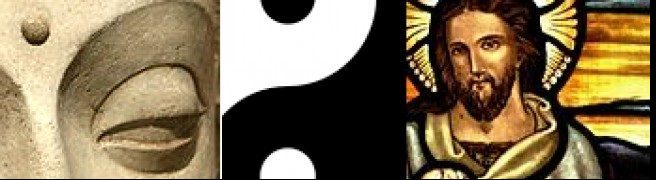
Bronze Age Atheism

Stephen Colbert, practicing Catholic, missed a fat, slow one over the plate in his interview of acerbic atheist Bill Maher. In response to Stephen’s invitation to return to the Catholic Church, Bill spouts the usual “myths invented by people who didn’t know about germs” critique of the Bible.

Well, Bill, that’s a Bronze-Age mentality all right, but practicing Catholics have a lot more material to draw upon, material that focuses on finding a redeeming human purpose in the amoral universe of the scientist. That material was produced as early as St. Augustine in the fifth century, and includes the writings of others such as St. Thomas Aquinas, Miguel de Unamuno, Pierre Teilhard de Chardin and Thomas Merton.

Bill, you might try reading some of it, and giving us an honest critique of modern Catholicism. No, it’s not always what you’ll find in the homilies on Sunday, but homilies are offered to ensure that everyone, no matter their level of education, walks away with something of value.

From the Earth to the Sun and Back Again

One of the hazards of engaging in epistemological debate is that they almost always become religious. We look back through the haze of history, trying to understand the practices by which knowledge is revealed to us, hoping to glean insights that help us heal divisive intellectual conflicts in the present.

Currently, these discussions become religious because our era suffers from an extreme bifurcation in our pursuit of knowledge. In no other era of human history have the two great pursuits of understanding – religion and science – been perceived as diametrically opposed. The linear causality of Einstein stands in contradiction of the gift of prophesy, and the power and predictability of dumb matter seduces us into believing that we can achieve all of our desires right here on Earth. Conversely, science denies us the comfort of meaning, to the extent that some denounce the search for meaning, or go even further to propose that this reality is evidence of a malefic creator.

Given this modern myopia, in looking back at the great episodes of resistance to truth, we tend to focus on the conflict between science and religion. Consider, for example, the succession from geocentric models of the solar system to the heliocentric models. The oppression of Brahe and Galileo is characterized as resistance by a religious elite threatened by the destruction of a Platonic universe whose geometrical perfection (circles moving within circles) was advanced as proof of the existence of the Christian God.

In fact, the history was rather more subtle, and its consideration brings a great deal of insight into the intellectual resistance to the program of this blog, declared on the title bar: “Unifying Science and Spirituality.”

The Greeks advanced both the geocentric and heliocentric models. If the ancients had been capable of building the instruments used by Galileo, they would certainly have settled on the latter. They resolved on the former for entirely practical reasons: they were concerned with using the positions of the stars to calculate the calendar date and the position of objects on the Earth’s surface. Culturally, their needs were absolutely geocentric. To solve this problem, they correlated geographical position with stellar observations and the progression of the seasons. Next, they sought methods for compacting this large body of data in a form that could be used by voyagers. The technology most adaptable to that purpose was the mathematics of circular revolution. Not only was the mathematics of circular revolution relatively simple, it was easy to translate to mechanical form as instruments containing rotating dials.

The “geocentric” model of the heavens was not in essence a philosophical proposition, but a proposition of practical technology. The principle motivation for upending the model was that over the centuries, the circular approximations began to fail. Designs specified in the first century produced the wrong answers in the eleventh century. A more reliable model was necessary, and the application of the new mathematics of elliptical analysis revealed that the heliocentric model fit the data more reliably than did the geocentric model of circular revolution.

As for the resistance of the Church, Galileo insisted on publishing an insulting parody of the Pope with his observations. He made his science a political issue. This was not an idle matter: the Church used the feudal compact to constrain the rapaciousness of those with a monopoly on the instruments of war. Those scientists were well accepted that chose to engage with the Church with the aim of minimizing the social disruption that always comes with new knowledge.

In my own intellectual adventures here on this blog, I find myself confronted by those that tout modern cosmology as proof that the universe is a machine unfolding without purpose from its initial conditions. The foremost intellectual challenge to that conclusion has been “fine tuning” – the delicate balance of the fundamental constants of nature (specifically the relative strengths of the four forces) that must be preserved if life is to survive. The solution to this conundrum has been the “multiverse” variant of the Big Bang theory (the name itself is a mischaracterization). The multiverse proposition holds that universes exist with and without life – we just happen to occupy one in which life is possible.

The random generation of universes in the Big Bang, however, results from the proposition that we can explain all of nature by using two branches of mathematics: group theory and Fourier analysis. Both of these methods are relatively susceptible to hand calculation. What is little understood by the public is that the theorists trumpet their successes and ignore their failures. The application of current theory to study of the hydrogen nucleus is summarized here, and the results are incredibly ugly.

Why is the theory not abandoned? For the same reason that the geocentric theory was not abandoned: physicists and astronomers have used the current theory to justify the construction of multi-billion dollar observatories. As the Church did, they oppose any idea that might destabilize the social order that pays their salaries.

What is scandalous is that the interstellar navel-gazing saps money from problems here on Earth that desperately call for the full commitment of our best and brightest minds. The scientists need to get the heads out of the stars and back onto the Earth.

A Demonstration of Strength

The juxtaposition could hardly have been more jarring: after completing today’s post, at morning break the lead story reported the attacks in France. In the worst violence since WW II, in coordinated attacks jihadists murdered as many as 120 people at three separate locations.

The reference to WW II is notable in revealing how much the world has changed. In relative terms, civil war and ISIL’s terrorist opportunism has brought Syrian suffering comparable to that of European populations during WW II. However, where indifference allowed Hitler to spread war across the continent from 1938 to 1944, cautious intervention in support of the rebels coupled with airstrikes and economic isolation has limited the spread of violence from Syria. As a result, to date the net cost to France of its intervention in the Middle East is tens of thousand of times fewer deaths than it suffered in WW II.

The natural response of the French government to these renewed attacks must be heightened scrutiny of Muslim populations, and Islamic authorities in France should be expected to both increase cooperation with security services and publicly condemn extremist activities.

But how do the events in France reflect on my post this morning, obviously an assertion that peace must be our aim?

While I will not participate in physical violence, I am not a pacifist. We fight cancers with surgery and chemotherapy. Both courses of treatment weaken the body. So with our struggle against terrorism, whether state sponsored (as in Syria and Ukraine) or indigenous, we must reduce its virulence by withholding resources and legitimacy from the perpetrators and seek when possible to destroy the mechanisms of its operation.

But there is more than that to the process. We must maintain vigilance in the spiritual domain to ensure that in the course of executing our campaign of violence, we do not become infected by the mentality that sustains self-justification in the mind of the terrorist. My practice extends even further: in manifesting that discipline, we also gain the power to immerse the jihadist in our knowledge of the benefits of peace.

It is this second battle that I have joined, and I am merciless in my own way. The mentality against which I struggle is ancient, and thrives when the actions of specific individuals are characterized as justifying violent prejudice against entire populations. That was the response of the victors to German resolve in WW I, with WW II the inevitable consequence. It is also the response of the jihadist to global inequity in the allocation of wealth and political influence for the benefit of Western populations that do not comprehend the egregious magnitude of our self-indulgence.

As I see it, every military action should be advertised as a failure of the mechanisms of peace, and reported with regret even when it is successful in reducing the threat of violence on tactical and strategic terms. Even more, I would hope that every announcement would be accompanied with a summary of diplomatic efforts to empower peace-loving peoples seeking to reassert control of regions in turmoil.

So in the months and years to come, I pray that the French people recognize the strength reflected in the asymmetrical results of Middle Eastern intervention. This will almost certainly not be the last such experience they will suffer, in a history dating back to attacks in the ’70s and ’80s, and modern access to secure communications almost guarantees that individuals committed to violence will continue to succeed in their aims. In absolute terms, though, the jihadists and their dependents, isolated and starved of resources in their caliphate, suffer far, far worse.

But to reiterate: it is essential, on the spiritual level, to recognize that the attacks reflect the insanity, in the context of modern technology, of the expression of ancient patterns of predation. While that mentality will lash out more and more violently in its attempts to survive the return of Christ, its impotence is revealed in the increasing brevity of the interruptions it can generate in the creative outpourings that emerge from love.

Working the Truth Out

Among all the proofs of the efficacy of loving, none is more compelling to me than the existence of institutions of learning. I am one of the most favored and grateful recipients of the investment made by others in discovering and sharing the truth.

During my freshman year at UC Berkeley, my dorm roomie was a talented pianist named John Schmay. John would sit down at a piece of music and spin out a million notes in extemporaneous composition that wandered effortlessly across musical genres. He tried to tame the volcano within through meditation at a self-made Buddhist shrine. Inspired by that example, I turned within as well. As the year progressed, through meditation I had a series of conscious transitions, an opening of doors to ever larger realms of truth. I realize now that those transitions were facilitated by others, and reflected a judgment that I would be respectful in my navigation of those halls.

Since leaving the UC system (I worked at Lawrence Livermore National Laboratory for the first eight years of my professional life), I have tried my best to bring the gifts of truth into my work in the commercial world. It is an ongoing struggle. Our hierarchical corporate structure and the legal framework of property rights both support and sustain the exercise of tyranny. This is expressed in a psychology of management prerogatives that extend, in the most aggressive case, to the idea that a supervisor has a right to untrammeled access to the sources of truth in our minds. In my own case, access has been sought through appeals to lust and greed, and when those failed, through raw threat to my survival and the survival of those I love.

Of course, as one that has surrendered fully to Christ, this is all terribly wearisome. I don’t own the truth; I don’t control the truth that flows through me. Having been given the gift of wandering in it, perhaps to a greater degree than anyone now alive, I perceive that remit to be a jewel precious beyond measure, and something that death will not steal from me. It will only interrupt the process of living that allows truth to manifest itself in the world through me.

Paradoxically, upon realizing that none of the afore-mentioned inducements will gain access to the truth that reaches out through me, a subtle psychological shift occurs. Instead of negotiating an exchange of value, the world itself is raised as a threat to the survival of the truth in me. The assertion of authority is not one of merit, but rather a claim of allegiance from one providing protection. Of course, this is always the last resort of the tyrant. When they no longer can command weakness in their subjects, they manufacture enemies without.

What has been essential to me, in working through this resistance, is to recognize that it is not the specific individuals that concern the truth. They are merely attempts to manifest a pattern of relation that has engendered habits of thinking – just as I manifest a pattern of relation (unconditional love) and habits of thinking (a relentless plunging into the veils that hide the truth).

Having exhausted the resistance of ownership, in America the next barrier is the defense industry, the enormously voracious “protector of liberty.”

So last night I awoke to a dream of captivity to Jihadi John, the target of yesterday’s drone strike in Syria. As I was injected into the scenario, I firmly resisted the garb of a victim, instead asserting that I saw this as a demonstration that would undermine the rhetoric of fear. Firmly enmeshed in the illusion of captivity, I shared with the jihadists that I had never finished reading the Qur’an, and asked them to provide me an English translation. With that link established, I offered them the truth as I understood it, opening my heart to reveal the love that I have received, eclipsing in measure any claims of my worth.

In that moment there was a lifting away. Something gave way, an ancient predatory spirit that has roosted in the Middle East.

Gently I asserted to the jihadists, “Isn’t this the goal you desire?” Their affirmation spread throughout the region. I then became one with that spirit that watches the world from outside, gently guiding our hearts, spreading the hope that one day we will stop fearing the consequences of receiving it – foremost being the power that it brings to elaborate wills that are not yet strong enough to resist the self-tyranny that is our self-concern.

And to my countrymen, I then turned to ask, “Did you really believe that the truth needs protection?”

You can run but you can’t hide.

It is that which is.

We were/are/will be that which we were/are/will be.

Abuse in the Linux Kernel Community

Proclamations of concern over the abusiveness of the Linux Kernel Community of been growing louder in the open-source world. Steven Vaughn-Nichols summarizes the concerns in Computerworld. My comment on the matter?


Ancandune remarks wisely on the problem that “rude and hostile” imposes to the transmission of knowledge. I do not necessarily subscribe to his characterization of the motivating psychology. Perfectionists are driven by their own set of hostile interior voices. They don’t just produce something and throw it over the wall – they lie awake at night thinking about all the ways it can blow up in their face. What Linus may be attempting to demonstrate in his communications is how he goes about thinking when he writes code.

Is Linus a healthy person? That’s for him to judge.

The important question is whether the community is healthy. Steve Jobs and Bill Gates had boardrooms filled with over-sized egos to help them manage their succession plans. What is Linus going to do? Anoint a successor? Or will the community devolve into a WWF RAW! donnybrook with the last man standing holding the belt? Another possibility is that the corporations that finance many contributors will step in and appoint a successor.

Linus’s authority arose organically over many years. The community allows him the right to be critical. But it is not being critical of others that conditions his success – it is his ability to think critically. The community should recognize that distinction, and mercilessly criticize and purge those that emulate his style without bearing his gifts or responsibilities.


To illustrate my point regarding self-criticism, here’s the content of an e-mail characterizing a problem we had with the build at work recently:

It’s the usual stupidity – I don’t even remember why I created this file, but it’s just a copy of MotorIDCommander.cpp. It was probably intended to link AutoCommCommander with MotorIDCommander, but I never modified the contents.

Anyways – it’s excluded from the build in debug mode but not in release mode. Khalid is off at physical therapy today with the project file checked out, so I can’t publish a fix. If you can do it locally, that would get you moving forward.

Sorry

Brian

This is like the fourth or fifth time I’ve done this – left a file in the build for release mode after excluding it in debug mode.

Balancing Yoga Bliss

Having played tennis and basketball as my primary fitness outlet for the first fifty years of my life, upon starting yoga I was immediate impressed by the imbalance between the left and right sides of my body. During the first two years of my Bikram practice, that manifested in a number of chronic stress injuries, particularly around the right hip and lower back.

While the problems were impossible to ignore, I was pleased with the gross changes in my body. I lost my fluff, slowly converting it to muscle. That was really a first for me – I had never succeeded in building much muscle mass through weight lifting. Bikram is an isotonic practice, holding postures for up to a minute under strain, and that seems to really agree with my physiology. At this point, the deep wells in my clavicles have been filled in, and a little bit of six-pack is peeking through from under my middle-age padding.

Unfortunately, it wasn’t until the last year that I realized how the two things went together. One way to maintain an isotonic posture is to lock all of your muscles. In my case, that reinforced and even exacerbated muscle imbalances. I would do my best, checking in the mirror after every posture to make certain that my shoulders and hips were aligned. After many “strong” sessions, however, when the lights came on to start practice two days later, I would look in the mirror to find myself twisted completely out of whack. The instructors were a little put out by my laughter and pawing at my eyes in disbelief.

Simply, in most postures the mirror is a liar. You can take a standing bow posture and think that you’re aligned, but in fact one hip is higher or lower, or forward or back. Sometimes it’s your limbs that hide the truth, and sometimes it’s that the mirror only shows you one view of a multi-dimensional picture. Psychologically, then, the breakthrough was to stop letting my eyes lie to me, ignore what my muscles were doing, and focus on where my bones were.

This culminated recently with the realization that for as long as I have been doing yoga, when I bend over I drop my left ribs inside of my hip. I was collapsing on that side while the right side stayed strong. Consciously avoiding that exposed tightness in my left shoulder, which naturally came forward with my ribs. I’ve been dragging it back, resulting this weekend in severe muscle fatigue that extended to the right side of my neck. Camel posture has been a real revelation in this regard, as the tightness in my left shoulder forced me to rebuild the posture from scratch over the last three weeks. I just couldn’t get back as far as I did when I allowed my left side to collapse.

The other major side-effect has been in the right side of my lower back. I’ve always wobbled in the standing series, and assumed that it was just poor muscle coordination. But in projecting my left side forward, I realized that I’ve been stabilizing my vertical alignment by locking the right side of my hip. Particularly in the lower back, the muscles on the right side were significantly shorter than those on the left. I focused on lengthening them during class, but could feel them snapping back as I walked to the car every night. But of course, that was because I was also using my right hip to project my balance forward while walking.

This was resolved two Sundays ago down in Culver City. I went to the dance celebration and spent about an hour-and-a-half walking around the perimeter of the floor, stopping occasionally to raise my feet gently in point, paying particular attention to maintaining proper support in the left side of my chest. It was frickin’ miserable! I wore myself out in half an hour!

Given the muscle fatigue in my back from my maniacal focus on keeping my left shoulder back, I was a little worried about class on Monday night. Indeed, I did have some trouble with forward bends, but as for the rest, I actually had fun for the first time ever. I had been wearing myself out trying to keep from keeling over to the right side, and having gotten the bones into alignment, all the stabilizing muscles can relax until their use is required by a specific posture. The heat no longer bothers me, I recover faster from postures, and I was able to get far more length because I wasn’t fighting locked muscles.

What can I say? Being a poser is to be your own worst enemy. Bliss arrived in learning to feel what my body was doing.

Doh!

Domain Domination

As a person with broad intellectual interests, I might be an anachronism. One of the problems of free market economics is that it exploits our strengths and exacerbates our weaknesses. People that seek a healthy balance don’t fit naturally in the system. Fortunately, I took up my career as a software developer during a sweet spot of sorts – enough infrastructure had been established that we don’t have to worry about the details of how a computer manages memory and peripherals or does arithmetic on different data types, but the industry had not yet become a self-sustaining economic system driven by the generation and sharing of digital data. As a generalist, then, I was valuable as a translator between the digital realm and the “normal” world.

I was struck by the magic of the digital reality. My father enjoyed sharing stories of how he could make programs break in the early days by abusing their input devices, but by the time I had come on the scene, the electrical engineers had succeeded in creating a world in which the computer never seemed to get tired, made your mess disappear without fuss, and always did exactly what you asked. Knowing men, I wasn’t surprised that many were seduced completely by that fantasy. In my case, I was seduced by the fact that if you knew a little about software, you could get any productive person to talk to you in the hopes that they could partner to parlay their expertise into dot-com fortune.

In translating those conversations into software, I was fortunate to have object-oriented development methods to exercise.  It allows me to create software abstractions that correspond well with the goals of my users. In engineering applications, concerned with the operation of actual machinery, object-oriented methods are a particularly strong fit.

That’s not so much the case in the software industry today. Companies such as Google and Facebook have managed to compile huge stores of data, and aspire to correlate that information with economic activity. There’s really no definite theory behind those explorations, so we’ve seen the rise of languages that describe efficiently algorithms that filter, transform and correlate random pieces of data.

The recruiting challenge facing engineering companies is lampooned in a GE ad in which a new hire finds himself competing for attention against the developer of a mobile app that puts fruit hats on pictures of your pet. GE is competing against nascent monopolies (Google and Facebook again the exemplars) that throw money at developers just to keep them out of the hands of their competitors. I faced the same challenge when seeking to grow my current team.

But when exploring the technologies (Haskell, Clojure, and others) used by Google and others for analysis of large data stores, what struck me most was how terribly dry they are. There’s no sense of connection to people and the choices that they make. To me that takes a lot of fun out of my practice.

This has been expressed in my working through of the examples in Troelson’s Pro C# and the .NET 4.5 Framework. Confronted with examples with names like “ExtractAppDomainHostingThread” and “MyAsyncCallbackMethod”, I found myself figuratively tearing out my hair. Yes, these names are self-documenting, in the sense that they forecast accurately what we find in the code, but they aren’t even entertaining much less actually fun.

When Troelson begins exploring how .NET supports an application that has to perform many separate tasks in parallel, he introduces a class called Printer that writes a number to the screen and then waits a short time before writing the next number. By running many Printers in parallel, we can see clearly the unpredictability of the results in the screen output.

Of course I am offended by this whole concept. No Printer in the world ever behaved like this. So, given this class that does something meaningless while wasting time, I renamed it “Useless.” Rather than invoking “PrintNumbers”, I tell my Useless class to “WasteTime.” As methods for corralling wayward tasks are advanced, I further the metaphor with methods such as “WanderIdly” and “LanguishInAQueue.”

My son and I meet most Saturdays for lunch at the Fresh Brothers in the Westlake Village Promenade. When he interrupted my exercises, I talked him through these examples, and he burst out laughing. Now that’s success.

So what’s the developer trapped in the digital world-view to do? My suggestion would be a return to assembly coding. At Los Alamos in the ’50s, my father picked up the habit of trying to read the consonant-rich listings. He would become mightily amused as he punctuated them with lip-smacks and shrill sirens, decorations evolved in the secret society of machine developers trapped on the isolated buttes of New Mexico.

Dialog with John Zande: The TOOAIN Thesis

If you have followed a link here from rationalwiki, please be aware that this dialog is a response to trollish behavior on the part of Mr. Zande in a number of forums in which faith was discussed by people seriously concerned with fundamentalism, many of whom are trying to heal its impact. As Mr. Zande appeared immune to criticisms from some that he was not contributing to the dialog, I found it of interest to deconstruct his teleology with the goal of creating a single point of reference for future discussion. In other words – “Yes, John, we’ve discussed this before – everybody just look at this post over here.” What was of interest to me was that I actually obtained some value from the exercise – the single axiom differentiating our two strains of “logic” is the existence of the soul.

I would hope, in turn, that Mr. Zande would recognize that he gained from an analysis that reveals the shallowness of his parody. I might encourage him to strengthen it, except that there are far more important goals crying out for the investment of his intellectual energy.

The original discussion follows.


This post establishes a forum for dialog with John Zande. The comment from John was originally posted on my New Physics page, but I am relocating it here because it does not address to material there, but posts his own thesis.

Here is my original comment that explains my frustration in trying to dialog with John, and my characterization of the distinction between our points of view:

You choose not to engage the material on my blog and then accuse me of not presenting a formal rebuttal? Well, if you get to control the axioms and terms of debate, how is that possible? Nobody can counter logical deduction if they are not allowed to challenge the argument’s precepts. That is why I pointed you at my site – to fill in the gaps in your precepts.

But to characterize the distinctions: It is obvious to even the casual observer that human initiative has vastly altered the world from its natural condition. I focus on the improvements, you tend to focus on the costs. My thesis is that the improvements are more significant and reflect a divine agency that is engaged in a slow process of healing. Your thesis assigns a hidden malefic intent that will undermine our efforts. I would argue that your justifications are similar to withholding trust in hospitals because every time you look inside you discover sick people, and even to go further claiming that the sick people actually control the doctors.

Ultimately, it comes down to a matter of power. Time will tell which one of us is right. As I see it, your thesis is disempowering. It saps human will. I have enough experience of the power of love in my life that I have absolute faith in the efficacy of the strength it awakens in myself and others.

John’s reply was (I have added point identifiers below to facilitate discussion):

A formal rebuttal would address the central thesis. Your opening sentence to me on the post in question reads: “The proposition of good and evil is not a functional moral dichotomy.” To which I answered directly: “First up, one must disregard all common concepts of morality. Good and bad are meaningless in this thesis, and any deferral to such terrestrial notions will only create confusion.”

https://thesuperstitiousnakedape.wordpress.com/2015/06/08/the-owner-of-all-infernal-names/

Here I am telling you specifically you must disregard any and all ideas of some dualistic universe where forces of good and bad are locked into some eternal battle. That has nothing, nothing at all, to do with the thesis. I went to great lengths to explain this to you, over and over again, but you simply couldn’t get your head out of this notion.

The problem, of course, is you haven’t even read the thesis. If you had you would know there is no Problem of Good, which is what your entire objection seems to be centred on.

And you continue to make the same mistakes:

“But to characterize the distinctions: It is obvious to even the casual observer that human initiative has vastly altered the world from its natural condition. I focus on the improvements, you tend to focus on the costs.”

No. Again, you have no idea what the thesis even says. You’re just shooting blanks. The Creator is thrilled humans (all life, in fact) tries to improve themselves. A ship must be floated and launched before it can be drowned and sunk. Good and evil do not exist. Good is not something distasteful or hurtful to the Creator. Good is not a wave of dissent, a rebellion growing inside Creation like some determined cancer, a tumour. Good is neither a disease nor a corruption, for good is not the equal and opposite of evil but rather an evil (what we humans would call “evil”) unto itself. It is a flavour of evil, a dialect, or perhaps more accurately, a variation in temperature there to be experienced in those moments when there appears to be a temporary reduction of perceptible suffering.

For this reason, good feels real, distinct, because to both the observer and the one directly experiencing the good, it is. It has a presence, an impression of substance, of form and body. It is valid to the touch and capable of moving individuals in miraculous and meaningful ways, and for those who want to believe it to be true they can easily convince themselves that they see good spawning good. And in a manner of speaking, it can, and does. Good can appear to inspire more good. Grooves can be made deeper, channels widened, but the appearance of good birthing good is, at its heart, an illusion. The shadow cast by good acts and good times can expand, pleasure can build upon pleasure, swelling, but it is not a virtuous growth if its source was evil itself. It cannot be considered excellent or righteous if it comes from the perfect corruption.

“Your thesis assigns a hidden malefic intent that will undermine our efforts.”

No, that is not my thesis at all. Not even close. The Creator does not interfere or meddle.

If you were to address the thesis in a meaningful way (meaning after actually “reading” it, rather than simply assuming you know what is in it) you would have to confront three central points:

1) demonstrate (with working examples) that this universe is not a complexity machine tumbling relentlessly forward from a state of ancestral simplicity to contemporary complexity,

2) demonstrate (with working examples) that complexity does not father a wretched and forever diversifying family of more devoted fears and faithful anxieties, more pervasive ailments and skilful parasites, more virulent toxins, more capable diseases, and more affectionate expressions of pain, ruin, psychosis and loss, and

3) demonstrate (with working examples) that the very constitution (the design) of this universe is not profound teleological evidence for the mind of a malevolent designer… an architect who so clearly cherishes His anonymity, and has quite purposefully painted Creation in impenetrable naturalism.

The discussion wanders around a bit, leading eventually to this response to John’s request:

  1. The Christian experience (shared by all mature practitioners of every religion) is that the Creator is not distant and uninvolved, but supports the expression of love. (satisfying criterion 3)
  2. I have offered a model of physics that explains the mechanisms by which this process is elaborated. (satisfying criterion 1)
  3. The most powerful and influential figures in history have been those that preach that there is an escape from this reality into a realm of infinite possibility. To those that understand spiritual experience, this is evidence of the truth of their proclamations. (satisfying criterion 2)
  4. My conclusion, stated at the beginning of this discussion, is that this reality is a hospital – a place of healing for a personality infected with selfishness. (satisfying criterion 2)
  5. That conclusion is backed by my own personal experience including access to spiritual energies that (satisfying criterion 2)
    1. heal my wounded heart when I engage the brokenness of the world, and
    2. empower me to offer healing to others.

As I see it, to TOOAIN hypothesis disempowers you. I reject it because I choose to live in joy. I encourage you to do the same.