Beyond Evil to Good

Miguel de Unamuno, considering the road from masculine frailty to faith, observed in Tragic Sense of Life that all men desire two things:

  • To live forever.
  • To rule the world.

The obvious paradox in these impulses is that most of us (myself being a man) attempt to accomplish the second by beating the crap out of other men – which tends to advance the interruption of our seeking after the first.

Work-arounds abound, the most obvious being to have a gun at the ready whenever an altercation arises. The subtlest is the use of psychological conditioning to get others to do the beating up for us. In totalitarian states, that conditioning takes the form of propaganda against imagined enemies, but is often joined with control over basic necessities. In democratic cultures, the conditioning is typically tied to unattainable visions of sexual conquest. When progeny ensue, hypersensitivity to their vulnerability often becomes the lever used to encourage financial exploitation of others.

Obviously in these systems there will be losers – a great many losers. The power of the impulses identified by Unamuno then manifests in a terrible perversion, expressed by a friend who asserted that the world would “know about him.” He testified ominously:

“Yeah, when a man has nothing to lose, there’s nothing he won’t do. And when the world learns about me, it will be nothing like anything that it’s ever seen before.”

I tried to lighten the air, offering that I knew what he meant, and that my sons were sometimes worried that I was going to just walk off and disappear. When he asked “You mean go live on the streets?” I replied, “No, probably they’d find me out someplace like the Amazon in Ecuador helping the indigenous people deal with the mess that Texaco left behind.”

Ah, the contradictory consequences revealed by Unamuno’s observation!

Some men lose everything, and seek to rule the lives of others by ending them, thus finding immortality in notoriety. I have nothing, and so claim this little piece of the blogosphere, writing about everything for almost nobody, and imagine conquering a little part of the world with a sponge and a squeegee. Some men fear the immigrant, and extrapolate our future against Europe’s tragedies where the Muslim population is ten times proportionately larger than ours. Accepting King’s dictum that “injustice anywhere is a threat to justice everywhere,” I embrace Muslim America as an opportunity for Islamic scholarship to rediscover and reassert the original message of Mohammed (pbuh), and any acts of violence as a cross to be born in conquering fear.

Unamuno’s defense of Christian faith was that we “create this God of love and eternal life by believing in him.” I see that as heresy: we don’t create him; we rather allow his virtues to manifest in our lives. In doing so, we learn to love ourselves and accept love from others, thereby obtaining dominion over the only part of the world that really matters: ourselves. In focusing that strength to the service of loving others, we lessen the burden of their resistance to our survival, and so enter more deeply into their world.

And for those that cannot learn – either those that lash out in violence or those that consume the innocent? What do they become in the end? Not themselves any longer – they become a headline in a newspaper. The history implicit in the personal “why” is lost. They become simply a “what”: 18 in San Bernardino. 49 people dead in Orlando. 3000 dead on 9/11. 47 million during World War II. Their personal history is consumed by the violence they created.

But men like Buddha – who renounced violence to bring a system of self-control to his people – or Jesus – who died to expose the hypocrisy of the military-religious complex – their names are enshrined in the hearts of those they have liberated. They live on in us.

“Judeo-Christian” is an Oxymoron

As Eastern mysticism enters Western culture, its practitioners have adopted Western marketing techniques. Starting from the proposition that Western seekers of enlightenment have been failed by their institutions, the Daoist or Buddhist teacher seeks a rationale for the failure that will entice victims of “Judeo-Christian” spirituality to sample their methods. The central tenet of the narrative is that Judeo-Christianity imposes a view of human nature as fallen into sin that disempowers its followers. In contrast, the Eastern tenets and practices of “mindfulness” open a doorway to self-knowledge and self-control that leads into joyful exploration of life’s possibilities.

Having respect for Eastern methods, I’m not going to dispute the beneficial consequences of its practices. Rather, I want to emphasize that it’s not an “either-or” proposition.

In the Bible, the confusion arises right at the start, in the Garden of Eden with Adam and Eve. As I explain in The Soul Comes First, this is a parable for a community living in direct relation with the spirit of unconditional love. In Vedantic terms, this is to interact with an occupant of the higher astral realms. The problem was not that Adam and Eve partook of the “Tree of Knowledge”, for they were given great knowledge of the world in that era, as necessary to assuming stewardship of the Earth. Rather, it was because they chose to partake of the “Tree of the Knowledge of Good and Evil.” They chose to exercise independent moral judgment. They chose to make mistakes that would cause suffering in others, rather than disciplining themselves to the dictates of love.

The immediate response of the personality described as God is to establish a safe distance. A repeated theme of the Old Testament is the pain caused by the Chosen people to its God, and in the New Testament that culminates in human experience. To love is to give power, and when that power is misused, it causes pain. What is amazing about the devotion of the God of Abraham is the investment made in human maturation in the face of that pain. But to remain in immediate and direct contact with humanity as it went through that process would have been disastrous. Love is an amplifier. It empowers whatever it touches. It needs to keep evil out, lest that destructive force run amok everywhere.

But the devotion to our maturation is clearly visible in the Bible, and follows a logical progression. The story of Abraham and his descendants ends with Joseph, the first man in the book with the strength to be steadfast in danger and to resist his primitive sexual drive. It progresses with Moses, who introduces that Law of Exodus, Deuteronomy and Leviticus to instill the discipline of logic in the Chosen people. In modern psychological terms, God was trying to create a people who were capable of using their cortexes to control the survival instincts of the brain stem and aggressive emotions of the limbic system.

Unfortunately, any fixed system of rules is inevitably corrupted by those responsible for its administration, who find it all too easy to manipulate it to deny rights and even life to those that they wish to control. It was against the corruption of the Judaic system of Law that Jesus set himself, eventually confronting both the Sadducees and Pharisees with this great truth [NIV Matt. 22:34-40]:

Hearing that Jesus had silenced the Sadducees, the Pharisees got together. One of them, an expert in the law, tested him with this question: “Teacher, which is the greatest commandment in the Law?”

Jesus replied: “ ‘Love the Lord your God with all your heart and with all your soul and with all your mind.’ This is the first and greatest commandment. And the second is like it: ‘Love your neighbor as yourself.’ All the Law and the Prophets hang on these two commandments.”

In effect, what he is saying to these experts of legal interpretation is “The Law has taught you to think. Now think about love.”

This is evident throughout Acts in the teachings of the Apostles, foremost among them Paul, but not exclusively. The message is that there is nothing that we can do to attain salvation from this corrupt existence except to call love into our presence. Having been born into corruption, which is to say in a spiritual context of Darwinian competition that requires the theft of resources from other living creatures, the fastest way to healing is to call upon love – which is to say “God.”

Judaism and Christianity are therefore two distinct spiritual practices. Because humanity is composed of individuals, both practices have value to individuals struggling with maturity. For those in thrall to aggression, lust and fear, the discipline of a system of rules still gives strength to the cortex. For those that shine hope into that struggle, love grants not only peace and joy, by a powerful transformative capability that is best exemplified by the devotion still awarded to Jesus, the man who died on the cross to prove that death has no sway over those that surrender to love.

So when looking at Eastern methods, what I see is a way to spiritual maturity without wading through the dangerous waters of Law. I see the possibility of “Veda-Christianity” that guides the seeker far more reliably into the healing spring of love.

Visualization Aids

I have been walking through my response to Ethan Nichtern’s The Road Home. The first two entries end with a “compare and contrast” to Christianity, though I recognize that the threads I emphasize are not typical of most Christian commentators. Given the power to frame the debate, the critical reader might assume also that I have tilted the playing field. For myself, I have been astonished at the degree of compatibility between Christian and Buddhist thought. I have not sought to diminish Ethan’s authority. I feel a great love for him, for reasons that will be revealed below.

Nichtern identifies three distinct stages along the Buddhist path: personal, interpersonal and cultural. The last is the realm of Vajrayana or Tantric practices of visualization. As Nichtern describes it, after having recognized our poor programming and having learned to harmonize our existence with others, in the final stage of the journey the practitioner does the greater work of revitalizing the stories that we tell about the lives that we lead, replacing myths of helplessness with tales of creative accomplishment.

Nichtern’s description of the first two stages of the path are firmly rooted in psychology. In his description of the Vajrayana practices, however, I felt the language to be beautifully poetical — that is to say, inspirational and aspirational rather than logical. I attribute this shift as a reflection of his rejection of mystical experience. Nichtern almost apologizes for the ancient Buddhist practitioners who asserted that their visualizations were personalities resting out of time. To the modern commentator, the ancient view is just not “scientific.” (Of course, here I have dispute that “scientific” consensus.)

While Nichtern claims to remain open to mystical possibilities, in considering the role of Buddhism in social action, he asserts that our struggles are rooted in a human culture that stimulates “scared, selfish and solitary” behaviors (the three S’s) to the detriment of “courage, compassion and connection” (the three C’s). Drawing upon Solnit’s A Paradise Born in Hell, Nichtern observes that in the aftermath of disaster most communities exercise the three C’s until leaders arrive to assert control — as Solnit documents, often with the goal of securing property. Nichtern then advances a variant of original sin, a la Rousseau: primitive man is noble, but human society corrupts that nature. The problems that we confront are self-made, and can be resolved by coordinating personal expressions of mindfulness in social action.

But does the problem originate with humanity? This is consistent with Christian dogma. However, upon careful reading, the book of Genesis clearly indicates that evil did not originate with mankind. The serpent existed before the fall, and in managing Cain’s struggle with selfishness, God says “Sin waits at your door. It desires to have you, but you can master it.”

When we awaken fully to the reality of mystical evolution, it can be terrifying. The forces at play are enormous, far beyond the capacity of any human mind to resist. An accessible analogy is the condition of the citizen in the modern nation-state: the government can easily destroy the individual. So where is hope to be found? In the United States, the liberty of the individual is protected in the construction of our Constitution, which safeguards individual freedom through tension between the three branches of government. So on the chessboard of mystical confrontation: life exists where spirit enters matter. In that melding, spirit is capable of propagation and adaptation, but also runs the risk of becoming mired. The protagonists proceed slowly and deliberately, pursuing their conflict with methods that may wound life, but never desiring to annihilate it, because that would be to annihilate themselves.

The long struggle for justice, extending back to the construction of this reality, has been to secure the fruits of creative collaboration against the destructive whims of predators. Once that is understood, we recognize that while we are hunted, we are also supported, and that support comes from entities that have creative capacities that are being organized to liberate us from evil.

So why reject that reality? Because it hurts. To take a turn of phrase from Madison: “Life is the worst form of experience – except all the other forms.” But before we lose hope, we should invoke Roosevelt: “The only thing we have to fear is fear itself.” The three C’s unlock the powers of the creative mind. When we embrace them fully, there is nothing that can hold us in check, not even death itself. Humanity has the privileged opportunity to facilitate the expression of the creative powers. We should embrace it.

I have met Ethan twice in person, and had the same unusual experience on both occasions. When I approached to shake his hand, his fingers folded inward. I had the strange impression that they were bending around a wound received in a past life. He seemed unable to control his reaction, even when my hand arrived as a brace.

Oh, my brother! I have tried, in my visualizations, to pull those nails from your palms. That burden was not yours. There are greater powers at work than ours. Trust them, and embrace the greatest of human privileges: dispelling the shadow of shame and fear not only from individual human minds, but from human nature itself, and eventually all the sentient minds populating the world that we both love so deeply.

It is, indeed, an honor to walk the road with you.

Running on Empty

Perhaps we shouldn’t be surprised – after all, how many people testify that they turned to spiritual practice because they wanted to share the secrets of their material success and psychological balance. No, even if, as Siddhartha and Jesus did, they seek after solutions for others, most seekers after inner truth do so because they find the world to be unsatisfactory. So most spiritual paths start by attacking that which is considered to be most wrong.

In the case of Buddhism, that process beings with deprogramming. The seeker turns inwards and attempts to break the association between her experience of the present moment and its interpretation by the mind. The goal is to understand the operation of the mind, and to correct its programming so that we can construct more successfully our lives.

As Ethan Nichtern describes this process in “The Road Home”, the currency of the successful life is bodhichitta. Bodhichitta is that ephemeral awareness that human nature is constructed to empower our well-being. All the tools are available to us, if we only apply ourselves to learning the craft of living well.

Nichtern does not expose the contradiction of that process: in order to live well, we must murder our dissatisfied self. Our resolve is fortified by applying the law of cause-and-effect to the history of our lives. When we recognize the connection between our misunderstanding and our dissatisfaction, it becomes clear that we should modify our understanding. While the impact of that change is healing of our relationship with the world, that takes time to manifest. Immediately, the change is in fact a form of self-murder.

I experienced this a number of times in my first year in college. As I expanded my awareness of the world of the intellect, I had dreams of my old self dissolving into this greater realm. That old self wasn’t a bad self, and it inhabited a world that I was comfortable navigating. I knew that I couldn’t go back, and so with growth came mourning for the self that had died.

When she has severed the sense of self from the process of forming judgments about the world, the Buddhist seeker is prepared for a journey into emptiness. Nichtern cautions clearly that this is not to surrender a search for meaning. Rather, it is to recognize that the self – our personal experience – is not the entire measure of meaning.

Nichtern illustrates the problem with a parable of the irritating mother-in-law. Rising from the mat, the meditator considers with satisfaction the clarity of mind that he has attained. Then the phone rings, and mother-in-law demands an audience. Equanimity is replaced with dread and anger.

The wisdom of all great spiritual teachings is that it doesn’t help to project our ill-feeling back on the trigger. That simply reinforces the pattern – obviously they find us irritating as well. Instead, we have to learn to project equanimity into our relationships, both beneficial and hostile. When the latter overwhelm us, we should seek separation.

As Nichtern documents, the Buddhist concept of emptiness has a complex lineage. I also find it to be subtle, almost to opacity. He eventually resorts to a metaphor: the ego is like a cocoon, protected in the shell of hardened ideas, but seeking from deep within to transform into a liberated soul. To become empty is to break out of our cocoon. Our experience becomes “empty” because we are no longer bound by the constraints of the cocoon. To be “empty” is to be free.

But free for what? Nichtern asserts that the Buddhist practitioner, recognizing the interdependence between her well-being and the well-being of others, is motivated to seek after healing for the world as a whole. This is a freedom to, rather than the ideal of freedom from which is so popular in America and expressed to magnificently by W.C. Fields with the comedic line, “Go away kid. You’re botherin’ me.”

Put in this context, I find it valuable to make the leap to a more accessible characterization of the dysfunction addressed by Buddhist practice: quite simply, it is selfishness. When embarking in her practice, the acolyte must learn to surrender the protective cocoon that defines her hostile experience. For her own good, that self must be relinquished, allowing her to emerge into constructive engagement with the world. That engagement necessarily involves relationships, and Buddhism offers that wisdom that attaining healthy relationships requires that we not impose our experience on others. We must seek instead to improve our experience.

In Christian practice, selfishness is recognized as the antidyne of unconditional love. In the material world, selfishness manifests most powerfully as predation — the tendency to say “I don’t care how much effort was required to make this. I don’t care how much it will hurt to lose it. I want it, and I’m going to take it.” In the spiritual realm, selfishness desires nothing but itself, and so is arid, producing nothing of value except by coopting the virtues (interesting, then, that Jesus went into the desert to confront Satan).

When the Christian surrenders to the strength of unconditional love, they conquer selfishness. That condition is characterized, not as emptiness, but as peace, arising from the same source as does Buddhist bodhichitta: the realization that reality is organized to bring us into a life that is both satisfying and rich.

A Christian Reaction to Buddhism

Ethan Nichtern is one of my favorite people, and has an exceptionally clear and gracious understanding of the path he represents. As any wise teacher, he understands that wisdom is rooted in our personal life experience, and so that each of us arrives at wisdom in our own time.

As Nichtern presents in “The Road Home”, Buddhism is a technology for self-introspection and other-relation. Adherents are taught a method for analysis of the operation of their mind. Given Ethan’s lucid description of that method, we could advance a critique of Buddhism through categorical comparison with records of objective and subjective experience. I am hesitant to do this because I know from personal experience that Ethan is reticent, as many spiritual practitioners, to expose deeper truths to minds that have not attained a certain strength and discipline. I believe that he leaves much unsaid about spiritual experience.

I am absolutely convinced that Buddhism is a powerful technology for spiritual self-assessment. While it might seem like a matter of no lasting consequence, just learning to sit in stillness for ten minutes is an important manifestation of both mental strength and discipline. The concern that must be addressed of any spiritual teaching, however, is what guides the application of that strength. Nichtern asserts that most of us are conditioned with self-destructive perceptions, and that when we learn that the world does not actually behave according to those perceptions, we are released into a playful and compassionate exploration of life’s possibilities. However, I have experience with people that attain a certain power and enter into childish exploitation of others. Nichtern does not, by my assessment, advance a proof that exploitation is excluded by Buddhist practice.

But he does offer an experience, describing a night flight cross-country to an empty home. Overcome with sadness, he begins to weep, and does so without self-judgment. Nichtern does not describe his submission as leading to any catharsis, except a certain satisfaction that he was open to the experience of the moment. So why does he advance this as a moment of profound self-connection? What was he connecting to that made this experience stand out from any other?

Perhaps simply that at its deepest throes, he heard his father’s voice reiterating a wisdom believed fervently to be profound, “I live in the center of my awareness.” To me, this is the key: the love that others tender to us is not bound by time or space. It is delivered in the form that we have conditioned ourselves to receive it, in the moments of our greatest receptivity. Love alone has that power, the power to heal and strengthen our souls.

Those that practice exploitation do so at the cost of that great benefit.

I don’t know how Ethan would respond to this characterization. Buddhism is, at its core, a method for linearizing our reaction to experience with the goal of subjecting it to analysis. But we know that is not the way that the mind works. The mind is a parallel-processing device, with many threads of interpretation and analysis combining to produce a reaction. For this reason, Buddhism may be the province of rational thinkers capable of forcing reaction through the logical circuitry of the cortex. In Nichtern’s development, I certainly find support for that conclusion. Even as a Ph.D. physicist and having processed previously the wisdom of Thich Nhat Hahn, I can only read a chapter at a time before needing to rest.

From the Christian perspective, human intelligence is a key and essential capacity in bringing love into the world. Christianity holds, however, that while our lives appear to drown with sorrow, this reality is suffused with a divine love that will nurture us if we honor its constraints, foremost of which is that we not use its power willfully to cause pain. This gift and covenant is what Christians honor in their worship of “God.”

Now, as I have said, I find much in Nichtern’s writing that suggests that he has experienced the power of this love. So why the reticence? Perhaps it is found in his assertion that Buddhism is not a religion, in that it does not “tell people what to believe.” But it is exactly a connection with divine love that is needed by those that cannot draw upon mental discipline, but must rely upon the urgings of their hearts.

Nichtern characterizes the problem of karma, or negative conditioning, as a problem of self-trust. Through the development of that trust, he records that he eventually recognized the full depth of his father’s love, and perhaps thus freed himself from the negative conditioning of growing up in a broken home. Did he understand the experience that way? In other words, has he learned to trust in the love of others?

Buddhism strikes me as a tradition rooted in a failure of that trust. It asserts that we must first learn to love ourselves before learning to enter confidently into relation with others. Christianity takes the opposite approach. It teaches, “Abandon yourself to divine love. Surrender yourself to trust in that presence. Allow it to guide you, heal you, and use you to do great works of healing in the world, and thus to enjoy the admiration and gratitude of others.”

I find this to be compelling. The reason that we have to work so terribly hard to understand our reaction to our perceptions is because we are trapped in our viewpoint. It is so much easier for an outsider to see us in the context of our relationships. If that outsider is trust-worthy, they can offer us insights that would take us years to achieve on our own. So why not draw upon the strength of the only completely trustworthy guide, the presence of divine love that awaits our embrace?

I know that in human relationships, Nichtern would identify with this truth. When I met him at a Buddhist Geek’s conference, he stood out as the contrary voice that insisted that growth to maturity required the sangha, or spiritual community.

Considering that context, Nichtern does allude to the burdens of the role of the disciplined mind. I expressed them once to another Buddhist who complained that his meditative practice was regressing. He found himself struggling to prevent extraneous thoughts from entering his mind. I suggested that he simply send them metta, or an offering of acceptance and love. I then explained that in my experience those voices were not extraneous, but the thoughts of people reaching out for strength. I encouraged the gentleman to embrace this new and incredibly important stage of his practice.

The final stage of Buddhist discipline, the Vajrayana tradition of Tantric practices, organizes the collaborative generation of reservoirs of positive intention. At the workshop during which he warned me against the path of the “suicide bodhisattva”, Ethan introduced the practitioners to White Tara, the Buddhist manifestation of loving kindness. While many Christians might have considered this to be an invitation to demonic worship, I recognize it as just another engagement with the divine emissaries that Christians characterize as angels. Consequently I believe that Buddhism must come in contact with the power of the ultimate “suicide bodhisattva”, Jesus of Nazareth.

A truth that I am fairly certain Nichtern has not internalized, or reserved in his writing to this point, is that our bodies are wonderfully designed to channel love to create healing. Submitting to the action of tears, feeling deeply our sorrow: those are practices that inform love when and where it needs to do its work. Christ was the ultimate manifestation of this truth: after preaching that there was nothing we can do either to alienate God or to gain preferential claims on his love, Jesus surrendered body, mind and spirit to the purpose of healing humanity of the self-destructive consequences of the predatory programming that we brought forward from our Darwinian past. In his resurrection, he delivered compelling proof of the power of love for those that rely upon their hearts, and thus must trust in faith.

In the eventuality of their encounter with Christ, I am confident that the power of the Buddhist collective and its Tantric constructs will be a magnificent aid to those of simple faith. I am also confident that Nichtern, whether or not he understands it as such, already guides others to the love that secures their peace of mind.
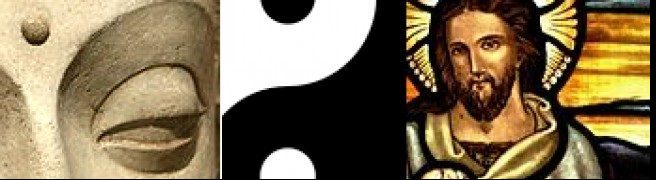
He Will Reign – Won’t He?

One of the challenges in building a brand is to ensure that prospects receive a consistent message concerning value proposition. The Church fathers and Emperor Constantine addressed this problem in the fourth century, establishing the Nicean dogma and creed that the Catholic Church and its heretical variants enforced through preaching, training and – in the breach, until recently – torture and death.

Normally, we’d talk of offended authority as “spinning in the grave.” In this case, given the last, we must be glad for Jesus’s resurrection, because otherwise the globe would have been whirling around his tomb.

The early Church fathers, confronted with the evidence of civil decay following the decline of the Roman Empire, seem to have concluded that empire was a part of God’s plan of salvation. They spent the twelve centuries following Nicea working to centralize political authority in Europe. At the end of that era, Renaissance Europe sprouted a dozen kingdoms capable of reproducing the accomplishments of Rome. Their response to Church meddling was to interfere in Papal selection, and when coming out on the losing end of that struggle, to support the rise of reforming heresies.

So what might Christ think of that?

In Scripture, I see three high points in the relationship between Humanity and God. The first is in Eden, where Adam and Eve experienced the ravishing grace of a direct relationship with God. Next is the era of Judges immediately following the entry into the Promised Land. The Hebrews as a people lived in gratitude for the Father’s gift, and when their occupancy was threatened, God found heroes to guide them through danger. That era ended with the people throwing their trust onto the human institution of monarchy. In the final act, Jesus arrives to expose the iniquity of the human institutions of his day, and proclaims that redemption is not bound by any contract or tradition, but is available to all the peoples of the Earth.

The modern Dominionist interprets this proclamation as a call to spread the institutions of Christianity across all the globe. The question is: what is the true church? Or is it simply enough that each individual should recognize Christ as lord and master in his heart?

Jesus is a little coy on this point, stating [John 10:14-16]:

I am the good shepherd; I know my sheep and my sheep know me — just as the Father knows me and I know the Father — and I lay down my life for the sheep. I have other sheep that are not of this sheep pen. I must bring them also.

In The Soul Comes First, I consider the parallels between the spiritual trajectory in Judaism (culminating with Jesus) and Buddhism. In Islam and Christ, I examine the choices made in the formulation of Islam, choices made to facilitate such developments in cultures still practicing polytheism.

These insights, supported by the evolution of the covenant recorded in the Bible, lead me to the conclusion that Unconditional Love reaching to us from Christ meets us where we are. It does not care about structures and institutions, and in fact idolatry is often evident in human attempts to sustain those forms. Rather, as Jesus says, it enters into our lives in twos that grow into threes, thereby empowering us to care for one another.

Witnessing the end of this process, John testifies of the “New Jerusalem”, that {NIV Rev. 21:22]:

I did not see a temple in the city, because the Lord God Almighty and the Lamb are its temple.

Remember that Jesus does not ask us to submit, but to learn [NIV Matt 11:29]:

Take my yoke upon you and learn from me, for I am gentle and humble in heart, and you will find rest for your souls.

And [Math 20:28]

…the Son of Man did not come to be served, but to serve, and to give his life as a ransom for many.

The temple of God is the individual human heart. His age is consummated when we allow his sensibility to enter into us. As I said recently to a priest:

Sometimes words serve no purpose, and the only thing I can do is to allow the broken heart of Christ within me to speak for itself.

It is when we offer our hearts as he did, offering them in the service of supporting the weary and burdened, that his will for us is achieved. This is a service beyond understanding, for we cannot explain all the suffering in the world. It is beyond us, having its origins billions of years ago, and woven into our living through the predatory competition that is Darwinian evolution. All that we can do, as Jesus did, is to offer ourselves in the service of healing the wounds it has created.

So is the modern fragmentation of Christianity – exposing contradictory messages that erode faith – is that fragmentation a problem? Or should it be interpreted as the process by which Christ dissolves the human institutions that stand between the seeker and Unconditional Love? If Eden was the ideal, should we not be seeking to recreate that ideal for every man and every woman? And if that is the goal, how can we doubt Christ’s word that he will gather all of his flocks – all of those traditions that declare a covenant and discipline that opens our hearts to the power of Divine Love – how can we believe that any one of them will be unreconciled to Christ? Or judge any of them as inferior to our own path?

Spirituality without Religion: Hope or Hoax?

Sam Harris has amassed a fortune decrying religion. His latest best-seller, Waking Up: A Guide to Spirituality without Religion, describes a journey that I must herald as a step towards personal maturity. I won’t consider the details, because his preface was enough to let me know that he’s got a long, long way to go. Harris asserts that our minds are the only tools that we have to manage life’s challenges. That’s a sort of lobotomy, and the best response I can offer is that of Hume. Following Hobbes’s characterization that the experience of most is of:

continual fear and danger of violent death, and the life of man solitary, poor, nasty, brutish and short

Hume diagnosed that Hobbes had forgotten “the operation of his own heart.”

That may seem a small point, but a compassionate heart is the singular difference between a monstrous ego and a great personality. In its lack, the rational mind tends to the conclusion that everything that violates its logic is error, possesses no value, and thus should be destroyed.

This is the conclusion that the anti-religious have indulged in for far too long.

Now I hope that Harris will eventually confront the errors of the axioms that allow him to conclude that religion has no value. Foremost is the confusion of correlation with causation: the fact that the brain is essential to the physical manifestation of our will does not mean that our will arises from the brain. The soul does exist. When that is recognized, the heart becomes full, and logic leads us to a different set of conclusions.

For example: Harris’s book bears the picture of a face superimposed on the cloudy heavens. What happens when spirits collide in that space? How do we negotiate conflicts? Only by resort to institutional structures staffed by experienced arbiters. That is religion.

The second erroneous axiom is that the mythical aspect of scripture proves the unscientific world view of our intellectual predecessors. Far be that from the truth: those men and women were investigating aspects of reality that Harris has yet to encounter, and doing it using practices that, if one strips away the branding, are scientific in their core. That wisdom was transmitted to us from the past through – you guessed it – religion. The alternative offered us in the modern age – schools – are prey to short-term political fashion, also known as propaganda, and pit students in a competition that places knowledge above compassion.

The alternatives to religion that Harris offers, at least in his preface, are use of psychotropic substances (a.k.a. – illegal drugs) and meditation. The former is pathetic: I raised my sons with the wisdom that love is the anti-drug. Using drugs to temporarily achieve an elevated psychological state is no substitute for submitting to the discipline required to sustain loving relationships. Lacking that discipline, the craving for love, which is built deep into our hearts, leads to abuse of drugs and self-destruction. What institutional structures confront us most meaningfully with the practice of emotional discipline? Well – religions.

Meditation is where I find hope for Harris. Meditation serves to reveal the preconditioning of our minds that prevents us from accurately perceiving experience. Through it, as Deepak Chopra inveighs in The Future of God, the seeker after truth eventually confronts the reality that love exists even when no person is present, even when no drug stimulates our senses and minds, even when we do nothing. That is the nature of God – and for reasons I have outlined elsewhere, that is the only God that could ever exist. Nothing but unconditional love can bind together things that want to be apart: the Greek word religio meaning to bind anew.

When Harris encounters that presence, I am certain that he will want to find a place in which to share his joy. That would be, of course, to find religion.

Why Monotheism?

When I was in high school in the ‘70s, global politics was dominated by a penis-envy contest called Mutually Assured Destruction. The Soviet Union and the United States amassed huge stock-piles of nuclear weapons that Carl Sagan concluded could wipe out the enemy without even falling on their territory. Simply setting them all off at ground level would raise enough dust in the stratosphere to cause a global winter. The collapse in food supplies would push humanity to the brink of extinction. That the instigator of the war would share the fate of their enemy justified the acronym ‘MAD’. But there were a lot of institutions that spent a lot of money building weapons delivery systems that were faster, more lethal and more accurate – money that might have been better spent improving the educational and living standards.

While Khrushchev threatened that the Warsaw Pact would bury the West under the weight of Soviet armor (pounding his shoe on the table for rhetorical effect), ultimately it was America that buried Russia under a mountain of dollars. Remember – this wasn’t a strategic conflict with concrete goals. It was a penis-envy contest, and letting the other guy get away with more was unacceptable. So Russia bankrupted itself attempting to match the West weapons-system for weapons-system. The United States cynically engaged this policy of “escalation” in many theaters of conflict. Simply introduce more and more sophisticated weapons systems, until the enemy was financially exhausted, then bring them to the table to figure out how to make money together.

We’ve seen this same logic invade our religious arguments over the last hundred years. You know, “My God is greater than yours.” At one point, the Buddhists prided themselves on remaining above the fray, but when I went down to Deer Park Monastery five years back, the speaker was proud to observe that Buddhism had never instigated a war, unlike those Christians and Muslims. I wondered to myself whether Buddhists were running any countries, and now recent events in Myanmar seem to bear out the corrupting influence of political authority.

Religious breast-beating can be traced to theological escalation. Polytheism was accepted practice in the ancient world, and those that cultivated relationships with multiple gods would have been likely to consider themselves shorted in a relationship with a single god. What if the one god doesn’t approve of your goals? Why wouldn’t you want to bargain with another deity? The response from monotheism was often to assert that “Our one God is more powerful than all those other gods put together. In fact, our God is the god of all things seen and unseen, the creator of everything, the ultimate purpose, and look at how our warriors beat you up on the battlefield when we carry his banner!”

I am going to denounce this logic right here and now: monotheism is not the celebration of a god for the purpose of claiming his or her power. Monotheism is, in fact, the original humanism. It was to recognize: “Geez, there’s a lot of spiritual power brought forward from the past, power built up in trees and animals and fish. It’s really hard to be human in this world! Let’s band together and worship a human god, and create a place for ourselves.”

Why was this important? Because our minds are so incredibly powerful. This is recognized in Eden, where after eating of the Tree of the Knowledge of Good and Evil, Adam and Eve are cast out before they can eat of the Tree of Life. Humanity has a dangerous capacity: the capacity to create ideas, which is to reorganize spirit. The serpent tempted Eve because it knew that it could assault heaven itself with that power, and that is evident in the actions of God himself in the aftermath: an angel with flashing swords is set up to prevent our return to the Garden.

It is also evident in the punishments meted out for creating the golden calf, the judgment against the kings of Israel for allowing polytheism to flourish, the scourges suffered by Ezekiel and the passion of Christ. When humanity is polluted by primitive tendencies, God insists that they be purged. This is also the purpose of the Law: animals are opportunistic and instinctual. They don’t apply abstract systems of rules to moderate their actions. Reasoning about the consequences of our actions is a uniquely human capability.

The full glory of human potential is celebrated by Christ when he announces to Peter [Matt. 16:9]:

I will give you the keys of the kingdom of heaven; whatever you bind on earth will be bound in heaven, and whatever you loose on earth will be loosed in heaven.

In other words, the Apostles were trained as a corps of spiritual surgeons.

In confronting the power of this capacity, the ancient predators had only one response: keep us from banding together. This is described in Revelation, where John recounts how the dragon (the spiritual avatar of the serpent that appeared in Eden) causes humanity to pursue animal worship, and when we get over that, corrupts our religions from within [Rev. 13:15]:

The second beast was given power to give breath to the image of the first beast, so that the image could speak and cause all who refused to worship the image to be killed.

Sound like MAD, anyone? Claim that your god is the best, threaten the enemy, and bankrupt yourself spiritually.

The goal that I offer today, thus, is to put away monotheistic escalation. The ultimate nature of God is beyond our understanding. What is important is to use the divine relationship to most fully refine our human capacities. Our unique skills – the skills of understanding, imagination and creativity – must be strengthened. Ultimately, it is intended that those skills should replace the brutal urge for survival and reproductive opportunity that characterize the animal kingdom.

In guiding us to maturity, all of our great religious traditions hold that there will come an avatar who will help us bring peace and justice to the world. Their name or ethnicity is unimportant, for in that era the divine authority will be manifested in all of us.

Worship

The ancient Romans insisted that the rites of the gods be honored, on pain of death. The concern was rooted in practical experience of the consequences of pissing them off. Why would failure to practice the rites make so much difference to the pantheon?

A clue is found in the Greek spiritual practice that has been revived as Hellenismos. The Greeks believed that the mystical progression began with simple human heroism. It continued after the hero’s death when grateful people gathered at shrines to celebrate his (or her) accomplishments. If the personality of the hero inspired further heroic achievements, justifiably the celebrations would increase. The accumulated psychic energy would eventually make the hero a daimon. Adherents might then invoke to power of the daimon in times of need. If the daimon responded effectively, the continued outpouring of gratitude might eventually elevate the personality to Olympian stature.

So worship is important to the gods because, as suggested in The Matrix trilogy, human beings are psychic batteries of a sort. Our attention is part of a political partnership.

As cultures evolved from local to regional to continental extent, this process became politicized. The Roman emperors spoke of becoming gods in their own right. King Louis XIII of France had himself crowned “The Sun King.” The Capital dome in Washington D.C. is decorated with a mural celebrating “The Apotheosis of Washington”. And the sanctification of Ronald Reagan is evidenced by the evolution of the exhibits at his Presidential Library. Given hundreds of millions of adherents, power similar to a Hercules might be accumulated within a decade or so, where before it might have taken generations.

Cynicism about the process is evident in certain religious controversies. Despite the similarities shared by Christian and Buddhist sages, some Christian theologians complain that the avatars of compassion and loving kindness celebrated in Tantra are actually “demons”. I have some challenged in attempting to reconcile that accusation with Christian celebration of saints and angels. The characteristics of the Tantric and Saintly personalities are almost identical.

Despite all of this commonality, I am going to assert that the worship Jesus offered to the Apostles is fundamentally different. I believe that our own selfish aspirations to saintliness blind us to this understanding: we have a vested interest in subscribing to practices that increase our personal power.

For Jesus did not command us to worship. He admonished us:

You shall love the Lord you God with all your heart, and with all your soul, and with all your mind. This is the great and foremost commandment.

If worship is to prop something up to make is stronger, then loving is not worship, for the goal of love is to bring something closer. In a kind of virtuous circle, our loving calls to us the perfect love of God. We can attempt to corrupt this love, but in doing so only succeed in driving it away. It stands just aside from us, until we relent in our harshness, and allow it to come again into service to us.

Why is love so efficacious? Because it holds power in readiness for others. It does not spray out in gaudy shows, but preserves its energies until it finds spirits calling out in genuine need.

Amy Grant renders this so beautifully in Better than a Hallelujah:

We pour out our miseries
God just hears a melody
Beautiful, the mess we are
The honest cries of breaking hearts
Are better than a Hallelujah

The desire of Unconditional Love is not to be served, but rather to be of service.

What about the other gods? Well, in seeking after worship they are in fact seeking after love from their adherents. If that love is given conditionally, the deity is at risk of losing their elevated status. Of course, the only way to secure unconditional love is to love reciprocally, because if the deity loves conditionally, the adherent will eventually realize that they’re getting the raw end of the deal. So the most powerful gods, in their relationship with their adherents, are eventually suffused with love, and ultimately are subsumed by it.

This is the truth articulated by Paul in Colossians 1:17:

He is before all things, and in Him all things hold together.

And should we want it any other way?

Why Do We Pray?

While I declare as a Christian, since renouncing my atheism I’ve only prayed twice. Once was for my children, who lived through a time of great fear in their lives. The other was for the woman I was in love with, asking that she be prepared to receive all the beauty that life held for her.

It’s odd, then, that I often feel guidance coming to me.

I didn’t understand what was going on until I came across Talking to God: Portrait of a World at Prayer. This beautiful coffee-table volume includes reflections on prayer by the faithful of many religions. The essays are collected in three sections on supplication, praise and meditation.

The most common phrase in the Bible is a variant on “fear not.” Supplication is the act of reaching out to the divine power for strength to do good in a world that too often exploits our weakness. The elements, disease, and predation (human or animal) all cause us to expect death, and so the loss of the joy that we have discovered in living. This causes us to call out to the divine presence to direct a portion of its power to protect us. When death is not imminent, the habit of prayer may lead us to ask for intercession in other matters.

Even when no direct response is provided, the psychological benefit of supplication is in allowing us to name our fear. As the Buddhists teach us, this brings the power of reason to work, which helps to quell our dark emotions. Having named our fear, we may be able to speak of it to others, and thus to rally others to our aid.

It is when we move beyond emotion to reason that we enter into prayerful praise. This is a celebration of the virtues that enable us to overcome adversity. Among these are patience, courage, compassion (in ourselves and others) and discipline. While praise of the virtues has always been recommended, I believe that there is a physical aspect to the process that has not been fully appreciated. It is suggested by this quote by Jakob Boehme, the German mystic:

If you ask why the Spirit of Love cannot be displeased, cannot be disappointed, cannot complain, accuse, resent or murmur, it is because the Spirit of Love desires nothing but itself, it is its own Good, for Love is God, and he that dwelleth in God dwelleth in Love.

Thoughts are physical things. When we ponder an idea, we reach out with our mind into a “space of ideas” to establish a connection. Think of it like a telephone line: where at first we have to work laboriously to connect to the strength of a virtue, when we praise it, we build a direct line to it, and can reach it almost immediately.

The amazing thing about this stage of prayer is in discovering the incredible power of the virtues. Why are the virtues so powerful? Well, the reason that predators use fear to control us is because it’s easy. Those people, such as Buddha and Jesus of Nazareth, that struggle and eventually overcome fear have to be stronger in their spirits than the predators that seek to destroy them. Eventually, that strength becomes so great that the are able to actually banish the precursors of fear from the minds of those that seek to harm them. They succeed in this because the predators, in taking the easy road, never develop their spiritual muscles. Furthermore, predators wallow in a set of ideas that really don’t care about them. At the first sign of spiritual weakness, the vices turn on their favorites and consume them. Thus when Jesus went to the cross and forgave his tormentors, their vices could not enter into him, and so turned back against their source.

When we pray in praise, we tap directly into the strength of the virtues built in the space of ideas by our great religious avatars. As we see this taking hold in our lives, our praise becomes more and more fervent. Because we seek joy in our lives, we walk about sharing our strength with those we care for, protecting them from fear as well. This is the stage of meditation.

In meditation, we enter into experience without expectation or judgment. We seek, not knowledge, but the sensation of our bodies, hearts and minds. In allowing those sensations to enter into us, we close the gap between the experience and the virtues that surround us. When there is pain or dissonance, we allow the virtues to enter into the experience to create healing and harmony.

The first time I realized that I was meditating (almost constantly) was in Cub Scout monthly meetings. The Scout Master was a shy about public speaking, and I would get this strong sense of fear from him when he stood up to present. I would just close my eyes and send him my confidence and admiration. His voice would steady.

For those that aren’t in the habit of praying, this can be a frightening experience. It’s like an invasion of their selves. I’ve had some really hostile reactions. Many aggressive men assume, for example, that I’m gay. They aren’t habituated to receive affirmation in any other way than through sex. The rest of their lives are organized around conflict.

In organizations, the response is more complicated. When we start to heal anger and fear, the participants become aware of their psychological dependencies. As victims become aware of how their trust is being manipulated, they may react to the healer as the source of paranoia, or even worse as the cause of the breakdown of trust in their relationships with predatory leaders. Such leaders often present themselves as noble interlocutors in the conflict that they engender among their followers, and when that strategy is revealed, the followers often rally to those that prey upon them, blaming the healer for the insights they bring!

As Boehme testified, the healer succeeds eventually when (s)he seeks nothing except the opportunity to allow the virtues to enter more deeply into the workings of the organization. Others finally realize that they feel far better in the presence of the healer than otherwise, and begin to work effectively against the true source of their problems.

So what I’ve come to understand is this: we pray to bring the divine presence into the world. Whether we are asking for help or mediating in its delivery, the end result is the same. The only way that God comes into this broken world is through prayer, and in its ultimate expression, that occurs through those that surrender themselves joyously to love of everyone willing to receive it.