Authority in Scriptural Interpretation

Since I have taken on a pet peeve with the “rational”, let me raise one against people of faith.

In arguments of scriptural interpretation, it is all too convenient to claim the authority of God. This was certainly the case during the ministry of Jesus. It was a claim made by the Temple priests and the Pharisees. While Jesus offered parables of counsel to the learned, he also railed against their role in dividing the people from direct relation with God. In part, it was his effort to free the Hebrews from the mistaken “authority” of human consensus that led Jesus to the cross.

We should contrast this with the experiences described in Acts 3. The authority of Jesus is manifested in Peter through the miracle of healing. Peter attained this capacity, as recorded in Matthew 10, directly from Jesus himself. His understanding came through direct revelation. It is clear, in the intervening ages, that few of us attain that same capacity. We have been men teaching men, and something was lost in the transfer through the generations.

Now in Acts 3, the Pharisees and priests are afraid to take action against Peter because they see that the people are moved to God by the power of the grace that moves through Peter. This was proof of the authority of Peter’s understanding, despite that he was “unlearned” (Peter was qualified only by his relationship with Christ). So for those that would assert that any teaching is evil that contradicts theirs, I would counsel: “Take care! Unless you can do the things done by the Apostles in Acts, you cannot claim to have full understanding of the teachings brought by Christ.”

What would those teachings have concerned themselves with? Well, from the words of Jesus himself, it was no less than to participate in the administration of his rule over heaven and earth ([Matt. 28:18] and the Parable of the Talents [Matt. 25:14-30]). Obviously, the scope of Jesus’s concerns exceeds those of human perception, extending even to the angels. It was because of this greater scope of understanding that Jesus was able to explain much that was hidden in the Old Testament. These two things are thus indivisible: Jesus interpreted scripture correctly because and only because he was capable of doing the work. Those that would claim authority to judge the interpretation of others should therefore be modest in their proclamations unless they can claim to be completing the work that Christ left unfinished.

Or do you believe that it will be somehow different when he comes again? Will he truly have nothing new to add to human understanding?

Before you pass judgment on others or denounce them as evil, ask yourself: “Can I do the work described in Revelation?” If not, be humble in your speaking. In particular, do not call fear into the hearts of others with statements such as “Because your interpretation of scripture differs from mine, you are falling into darkness.” No mere human has the authority to render that judgment. Considering the Temple priests and Pharisees, we might hazard that neither does any group of people.

Tomorrow, then, let’s take another look at pronouncements of judgment in Revelation, trying to adopt not the human perspective, but the perspective of one ruling over both heaven and earth.

Beyond Good and Evil Round II: A Response to John Zande

John:

The proposition of good and evil is not a functional moral dichotomy – there is simply too much conditionality in moral analysis. I think that there are really only two principles that inform a meaningful moral dialog. The first is power – the capacity to make reality conform to our will. The second is love – an irrational desire to create power in the object of our affection. Moral analysis focuses on “who are you loving with your exercise of power?” The ultimate moral condemnation is “only yourself.”

I do not deny that the world is full of pain, but that is an inheritance from our Darwinian past, which is a process free of morality. In Genesis, when the Bible heralds the Fall as the entry of sin into the world, it is to recognize a separation from that past into a future of rational moral analysis. “Adam and Eve” are a metaphor for the human struggle with shame, guilt, forgiveness and redemption (all in the context of human society – God doesn’t need to deal with these issues).

The question is whether there is a force that lifts us up from brutal biological competition toward rational moral discourse. The Christian proposition is that Jesus came and died to demonstrate that there is nothing that can alienate us from God’s love or qualify us for preferential treatment in his eyes. This was demonstrated even in the face of murder at the hands of the culture that he came most immediately to love. His victory was to create a foothold for divine love in the world, and that foothold has broadened enormously over time.

So my response to your position is: yes, things are still bad, but they are far better than they were. It is only by looking at the trends that one can form a judgment concerning the efficacy of love. I experience its power day-by-day in a world that you seem to not to experience.

You have a great deal of intellectual energy, which you seem to focus toward the purpose of creating pain in others. My experience is that such people often are “doing as was done unto them”, looking for someone strong enough to show them how to heal. I can only offer Hume’s response to Hobbes (the latter whom you echo, btw). Hobbes averred that life for most was a “war of all against all” and “nasty, brutish and short.” Hume’s response was: “Mr. Hobbes has forgotten the operation of his own heart.”

If you want a person committed to the proposition of loving to read your book, you should start by offering a testimony regarding the things that you do love. That’s a point of contact that might allow them to engage your view of the world.

As it is, those of us that love have improved enormously the condition of life on this Earth. We’re at a turning point in that process, having nearly exhausted the resources that were laid up in the past. Under those circumstances, it will ultimately be those that learn to work together that survive.

Brian

Zande’s response to this was an assertion that he was trying to clarify the true nature of the reality we inhabit. My response was:

John:

Thank you for your considered response. I find myself, however, still seeking a declaration of the allegiance of your love.

Truth is indeed terribly important. Those that divorce themselves from truth ultimately abandon power (the ability to make reality conform to our will). For those that love, the truth of suffering is an essential goad to action. But the truth is only what it is. The goal of any active intelligence is to create new truth. It is through creative action that I find greatest meaning in life, and my ability to create is largely contingent (in the “no man is an island” sense) on the good will of others. That means offering them good will in return.

From a Christian perspective: yes, in its foundational state, this creation was indeed a reflection of Lucifer’s character. But I see the action of Divine Love in the mechanisms that are provided to heal his insanity. It is the simple existence of that possibility that I celebrate.

Good luck on your journey!

Brian

Mr. Zande’s response was to ask me to remove my religion from his blog – which I found odd because the only religious statement was actually an affirmation of Mr. Zande’s thesis.

Pope Francis Submits to Scientific Materialism

Last week, the Irish Republic, long dominated by the Catholic Church in its management of public morals, stood up on its feet and granted marriage rights to same-sex couples.

Hallelujah!

The response of the Pope is to claim that humanity “lost” on that day. That claim is rooted in a Biblical passage that asserts marriage is between a “man and a woman.”

As I have discussed before, many same-sex couples involve a masculine personality and a feminine personality. Since I hold that the domain of religion is the soul, I see such pairings are sacred before God. Actually, I would assert that any relationship that brings love into the world is sacred to God, because as we were taught by John, God is love.

Pope Francis, unfortunately, has submitted to a philosophy known as “scientific materialism.” In that world view, it is only the material presentation that matters in judging right and wrong. A “man”, in that world view, possesses a penis that is used to penetrate the vagina of a “woman.” And, of course, God’s primary purpose is in seeing to it that the global ecology is destroyed by human overpopulation.

Yes, Francis, humanity has lost something indeed when even the Pope holds that what we do with our bodies counts more than what we do with our souls.

The Path of Peter

Having completed my journey home (The Road Home: A Contemporary Exploration of the Buddhist Path by Ethan Nichtern), I found myself looking at Peter’s exhortations at church on Sunday. I’ve shared these before (Robbing Peter to Play Paul), but stimulated by Nichtern’s detailed description of the Buddhist path to healing, I saw them in a new light.

Let me present them again:

For this very reason, make every effort to add to your faith goodness; and to goodness, knowledge; and to knowledge, self-control; and to self-control, perseverance; and to perseverance, godliness; and to godliness, mutual affection; and to mutual affection, love. For if you possess these qualities in increasing measure, they will keep you from being ineffective and unproductive in your knowledge of our Lord Jesus Christ.

So how does this path evolve?

Faith is simply a posture towards existence that asserts it is constructed to allow us to find well-being. Faith in the Old Testament was most often associated with the exhortation “Fear not” – which is the most common phrase in the Bible. It is to take comfort that a greater power guides us into a meaningful purpose, and that purpose includes our well-being. The story of Lot is the most dramatic parable of that process.

Once we make the leap of faith, we then open ourselves to recognition of goodness in the world, and allow it to fill us. Yes, I am saying that Peter’s exhortation is not to be good, but to allow the goodness of the world to enter into us. That means not consuming things and experiences, but allowing them to enter into us, and giving recognition and gratitude for the good they bring. So when we eat food, when someone cares for us when we are sick, when someone pays us a fair wage, we should offer our gratitude and recognition of their goodness. This attitude protects our goodness and the goodness of others from corruption by divisive attitudes. It allows goodness to grow in the community of the faithful.

Given the experience of goodness, we turn next to understanding of the world and its operation. We seek knowledge. But we do so with an innate sense of how knowledge relates to goodness. When told a lie, we can feel that it’s corruption deep in the heart. When told how to exploit the bounty of the earth, we feel the land crying out in pain. So we filter knowledge and uphold that which creates and sustains good.

Once we have a base of knowledge regarding the working of the world, we can predict the consequences of our actions. We apply that understanding to constrain our actions. It is not just goodness that guides us at this point – we adopt the practice of self-control. We are now set on the path of the knowledge of good and evil. We expose ourselves again to temptation, and as Cain, seek to master sin.

Sin is subtle and alluring. It offers us pleasures without great cost to ourselves. So we fall prey to its siren song. We make mistakes. We have to try, and try again. We should not beat ourselves up too much, but persevere. This is not an easy journey!

As we grow along that path, we find that we obtain skill in creating good among the community. Thus we become godly, in our own little way. We create circumstances in which the powers held by others are channeled to the benefit of all. We attain stewardship, just as God has stewardship over us.

Now there will be arguments over the allocation of resources. We need to avoid taking those arguments personally. That is accomplished best by opening our hearts to one another in compassion. When we speak, we speak not only for ourselves and our perceptions. As stewards, we allow those we guide to express their needs, fears and hopes to us. When we represent them in decision-making councils, they then speak through us. It is through mutual affection that the needs of the community can be expressed and resolved without rancor or ill-will.

And finally, we learn simply to love. That means to focus all of our energies outwards, realizing now that we are fitter in caring for others because they have not yet learned to care for one another. We invest in their growth, knowing that while we might be able to do a thing better than they, in the end that investment empowers them to love us in return.

From this, I see indeed the truth in Peter’s claim: this is how best to be effective and productive in our knowledge of loving.

Visualization Aids

I have been walking through my response to Ethan Nichtern’s The Road Home. The first two entries end with a “compare and contrast” to Christianity, though I recognize that the threads I emphasize are not typical of most Christian commentators. Given the power to frame the debate, the critical reader might assume also that I have tilted the playing field. For myself, I have been astonished at the degree of compatibility between Christian and Buddhist thought. I have not sought to diminish Ethan’s authority. I feel a great love for him, for reasons that will be revealed below.

Nichtern identifies three distinct stages along the Buddhist path: personal, interpersonal and cultural. The last is the realm of Vajrayana or Tantric practices of visualization. As Nichtern describes it, after having recognized our poor programming and having learned to harmonize our existence with others, in the final stage of the journey the practitioner does the greater work of revitalizing the stories that we tell about the lives that we lead, replacing myths of helplessness with tales of creative accomplishment.

Nichtern’s description of the first two stages of the path are firmly rooted in psychology. In his description of the Vajrayana practices, however, I felt the language to be beautifully poetical — that is to say, inspirational and aspirational rather than logical. I attribute this shift as a reflection of his rejection of mystical experience. Nichtern almost apologizes for the ancient Buddhist practitioners who asserted that their visualizations were personalities resting out of time. To the modern commentator, the ancient view is just not “scientific.” (Of course, here I have dispute that “scientific” consensus.)

While Nichtern claims to remain open to mystical possibilities, in considering the role of Buddhism in social action, he asserts that our struggles are rooted in a human culture that stimulates “scared, selfish and solitary” behaviors (the three S’s) to the detriment of “courage, compassion and connection” (the three C’s). Drawing upon Solnit’s A Paradise Born in Hell, Nichtern observes that in the aftermath of disaster most communities exercise the three C’s until leaders arrive to assert control — as Solnit documents, often with the goal of securing property. Nichtern then advances a variant of original sin, a la Rousseau: primitive man is noble, but human society corrupts that nature. The problems that we confront are self-made, and can be resolved by coordinating personal expressions of mindfulness in social action.

But does the problem originate with humanity? This is consistent with Christian dogma. However, upon careful reading, the book of Genesis clearly indicates that evil did not originate with mankind. The serpent existed before the fall, and in managing Cain’s struggle with selfishness, God says “Sin waits at your door. It desires to have you, but you can master it.”

When we awaken fully to the reality of mystical evolution, it can be terrifying. The forces at play are enormous, far beyond the capacity of any human mind to resist. An accessible analogy is the condition of the citizen in the modern nation-state: the government can easily destroy the individual. So where is hope to be found? In the United States, the liberty of the individual is protected in the construction of our Constitution, which safeguards individual freedom through tension between the three branches of government. So on the chessboard of mystical confrontation: life exists where spirit enters matter. In that melding, spirit is capable of propagation and adaptation, but also runs the risk of becoming mired. The protagonists proceed slowly and deliberately, pursuing their conflict with methods that may wound life, but never desiring to annihilate it, because that would be to annihilate themselves.

The long struggle for justice, extending back to the construction of this reality, has been to secure the fruits of creative collaboration against the destructive whims of predators. Once that is understood, we recognize that while we are hunted, we are also supported, and that support comes from entities that have creative capacities that are being organized to liberate us from evil.

So why reject that reality? Because it hurts. To take a turn of phrase from Madison: “Life is the worst form of experience – except all the other forms.” But before we lose hope, we should invoke Roosevelt: “The only thing we have to fear is fear itself.” The three C’s unlock the powers of the creative mind. When we embrace them fully, there is nothing that can hold us in check, not even death itself. Humanity has the privileged opportunity to facilitate the expression of the creative powers. We should embrace it.

I have met Ethan twice in person, and had the same unusual experience on both occasions. When I approached to shake his hand, his fingers folded inward. I had the strange impression that they were bending around a wound received in a past life. He seemed unable to control his reaction, even when my hand arrived as a brace.

Oh, my brother! I have tried, in my visualizations, to pull those nails from your palms. That burden was not yours. There are greater powers at work than ours. Trust them, and embrace the greatest of human privileges: dispelling the shadow of shame and fear not only from individual human minds, but from human nature itself, and eventually all the sentient minds populating the world that we both love so deeply.

It is, indeed, an honor to walk the road with you.

Running on Empty

Perhaps we shouldn’t be surprised – after all, how many people testify that they turned to spiritual practice because they wanted to share the secrets of their material success and psychological balance. No, even if, as Siddhartha and Jesus did, they seek after solutions for others, most seekers after inner truth do so because they find the world to be unsatisfactory. So most spiritual paths start by attacking that which is considered to be most wrong.

In the case of Buddhism, that process beings with deprogramming. The seeker turns inwards and attempts to break the association between her experience of the present moment and its interpretation by the mind. The goal is to understand the operation of the mind, and to correct its programming so that we can construct more successfully our lives.

As Ethan Nichtern describes this process in “The Road Home”, the currency of the successful life is bodhichitta. Bodhichitta is that ephemeral awareness that human nature is constructed to empower our well-being. All the tools are available to us, if we only apply ourselves to learning the craft of living well.

Nichtern does not expose the contradiction of that process: in order to live well, we must murder our dissatisfied self. Our resolve is fortified by applying the law of cause-and-effect to the history of our lives. When we recognize the connection between our misunderstanding and our dissatisfaction, it becomes clear that we should modify our understanding. While the impact of that change is healing of our relationship with the world, that takes time to manifest. Immediately, the change is in fact a form of self-murder.

I experienced this a number of times in my first year in college. As I expanded my awareness of the world of the intellect, I had dreams of my old self dissolving into this greater realm. That old self wasn’t a bad self, and it inhabited a world that I was comfortable navigating. I knew that I couldn’t go back, and so with growth came mourning for the self that had died.

When she has severed the sense of self from the process of forming judgments about the world, the Buddhist seeker is prepared for a journey into emptiness. Nichtern cautions clearly that this is not to surrender a search for meaning. Rather, it is to recognize that the self – our personal experience – is not the entire measure of meaning.

Nichtern illustrates the problem with a parable of the irritating mother-in-law. Rising from the mat, the meditator considers with satisfaction the clarity of mind that he has attained. Then the phone rings, and mother-in-law demands an audience. Equanimity is replaced with dread and anger.

The wisdom of all great spiritual teachings is that it doesn’t help to project our ill-feeling back on the trigger. That simply reinforces the pattern – obviously they find us irritating as well. Instead, we have to learn to project equanimity into our relationships, both beneficial and hostile. When the latter overwhelm us, we should seek separation.

As Nichtern documents, the Buddhist concept of emptiness has a complex lineage. I also find it to be subtle, almost to opacity. He eventually resorts to a metaphor: the ego is like a cocoon, protected in the shell of hardened ideas, but seeking from deep within to transform into a liberated soul. To become empty is to break out of our cocoon. Our experience becomes “empty” because we are no longer bound by the constraints of the cocoon. To be “empty” is to be free.

But free for what? Nichtern asserts that the Buddhist practitioner, recognizing the interdependence between her well-being and the well-being of others, is motivated to seek after healing for the world as a whole. This is a freedom to, rather than the ideal of freedom from which is so popular in America and expressed to magnificently by W.C. Fields with the comedic line, “Go away kid. You’re botherin’ me.”

Put in this context, I find it valuable to make the leap to a more accessible characterization of the dysfunction addressed by Buddhist practice: quite simply, it is selfishness. When embarking in her practice, the acolyte must learn to surrender the protective cocoon that defines her hostile experience. For her own good, that self must be relinquished, allowing her to emerge into constructive engagement with the world. That engagement necessarily involves relationships, and Buddhism offers that wisdom that attaining healthy relationships requires that we not impose our experience on others. We must seek instead to improve our experience.

In Christian practice, selfishness is recognized as the antidyne of unconditional love. In the material world, selfishness manifests most powerfully as predation — the tendency to say “I don’t care how much effort was required to make this. I don’t care how much it will hurt to lose it. I want it, and I’m going to take it.” In the spiritual realm, selfishness desires nothing but itself, and so is arid, producing nothing of value except by coopting the virtues (interesting, then, that Jesus went into the desert to confront Satan).

When the Christian surrenders to the strength of unconditional love, they conquer selfishness. That condition is characterized, not as emptiness, but as peace, arising from the same source as does Buddhist bodhichitta: the realization that reality is organized to bring us into a life that is both satisfying and rich.

A Christian Reaction to Buddhism

Ethan Nichtern is one of my favorite people, and has an exceptionally clear and gracious understanding of the path he represents. As any wise teacher, he understands that wisdom is rooted in our personal life experience, and so that each of us arrives at wisdom in our own time.

As Nichtern presents in “The Road Home”, Buddhism is a technology for self-introspection and other-relation. Adherents are taught a method for analysis of the operation of their mind. Given Ethan’s lucid description of that method, we could advance a critique of Buddhism through categorical comparison with records of objective and subjective experience. I am hesitant to do this because I know from personal experience that Ethan is reticent, as many spiritual practitioners, to expose deeper truths to minds that have not attained a certain strength and discipline. I believe that he leaves much unsaid about spiritual experience.

I am absolutely convinced that Buddhism is a powerful technology for spiritual self-assessment. While it might seem like a matter of no lasting consequence, just learning to sit in stillness for ten minutes is an important manifestation of both mental strength and discipline. The concern that must be addressed of any spiritual teaching, however, is what guides the application of that strength. Nichtern asserts that most of us are conditioned with self-destructive perceptions, and that when we learn that the world does not actually behave according to those perceptions, we are released into a playful and compassionate exploration of life’s possibilities. However, I have experience with people that attain a certain power and enter into childish exploitation of others. Nichtern does not, by my assessment, advance a proof that exploitation is excluded by Buddhist practice.

But he does offer an experience, describing a night flight cross-country to an empty home. Overcome with sadness, he begins to weep, and does so without self-judgment. Nichtern does not describe his submission as leading to any catharsis, except a certain satisfaction that he was open to the experience of the moment. So why does he advance this as a moment of profound self-connection? What was he connecting to that made this experience stand out from any other?

Perhaps simply that at its deepest throes, he heard his father’s voice reiterating a wisdom believed fervently to be profound, “I live in the center of my awareness.” To me, this is the key: the love that others tender to us is not bound by time or space. It is delivered in the form that we have conditioned ourselves to receive it, in the moments of our greatest receptivity. Love alone has that power, the power to heal and strengthen our souls.

Those that practice exploitation do so at the cost of that great benefit.

I don’t know how Ethan would respond to this characterization. Buddhism is, at its core, a method for linearizing our reaction to experience with the goal of subjecting it to analysis. But we know that is not the way that the mind works. The mind is a parallel-processing device, with many threads of interpretation and analysis combining to produce a reaction. For this reason, Buddhism may be the province of rational thinkers capable of forcing reaction through the logical circuitry of the cortex. In Nichtern’s development, I certainly find support for that conclusion. Even as a Ph.D. physicist and having processed previously the wisdom of Thich Nhat Hahn, I can only read a chapter at a time before needing to rest.

From the Christian perspective, human intelligence is a key and essential capacity in bringing love into the world. Christianity holds, however, that while our lives appear to drown with sorrow, this reality is suffused with a divine love that will nurture us if we honor its constraints, foremost of which is that we not use its power willfully to cause pain. This gift and covenant is what Christians honor in their worship of “God.”

Now, as I have said, I find much in Nichtern’s writing that suggests that he has experienced the power of this love. So why the reticence? Perhaps it is found in his assertion that Buddhism is not a religion, in that it does not “tell people what to believe.” But it is exactly a connection with divine love that is needed by those that cannot draw upon mental discipline, but must rely upon the urgings of their hearts.

Nichtern characterizes the problem of karma, or negative conditioning, as a problem of self-trust. Through the development of that trust, he records that he eventually recognized the full depth of his father’s love, and perhaps thus freed himself from the negative conditioning of growing up in a broken home. Did he understand the experience that way? In other words, has he learned to trust in the love of others?

Buddhism strikes me as a tradition rooted in a failure of that trust. It asserts that we must first learn to love ourselves before learning to enter confidently into relation with others. Christianity takes the opposite approach. It teaches, “Abandon yourself to divine love. Surrender yourself to trust in that presence. Allow it to guide you, heal you, and use you to do great works of healing in the world, and thus to enjoy the admiration and gratitude of others.”

I find this to be compelling. The reason that we have to work so terribly hard to understand our reaction to our perceptions is because we are trapped in our viewpoint. It is so much easier for an outsider to see us in the context of our relationships. If that outsider is trust-worthy, they can offer us insights that would take us years to achieve on our own. So why not draw upon the strength of the only completely trustworthy guide, the presence of divine love that awaits our embrace?

I know that in human relationships, Nichtern would identify with this truth. When I met him at a Buddhist Geek’s conference, he stood out as the contrary voice that insisted that growth to maturity required the sangha, or spiritual community.

Considering that context, Nichtern does allude to the burdens of the role of the disciplined mind. I expressed them once to another Buddhist who complained that his meditative practice was regressing. He found himself struggling to prevent extraneous thoughts from entering his mind. I suggested that he simply send them metta, or an offering of acceptance and love. I then explained that in my experience those voices were not extraneous, but the thoughts of people reaching out for strength. I encouraged the gentleman to embrace this new and incredibly important stage of his practice.

The final stage of Buddhist discipline, the Vajrayana tradition of Tantric practices, organizes the collaborative generation of reservoirs of positive intention. At the workshop during which he warned me against the path of the “suicide bodhisattva”, Ethan introduced the practitioners to White Tara, the Buddhist manifestation of loving kindness. While many Christians might have considered this to be an invitation to demonic worship, I recognize it as just another engagement with the divine emissaries that Christians characterize as angels. Consequently I believe that Buddhism must come in contact with the power of the ultimate “suicide bodhisattva”, Jesus of Nazareth.

A truth that I am fairly certain Nichtern has not internalized, or reserved in his writing to this point, is that our bodies are wonderfully designed to channel love to create healing. Submitting to the action of tears, feeling deeply our sorrow: those are practices that inform love when and where it needs to do its work. Christ was the ultimate manifestation of this truth: after preaching that there was nothing we can do either to alienate God or to gain preferential claims on his love, Jesus surrendered body, mind and spirit to the purpose of healing humanity of the self-destructive consequences of the predatory programming that we brought forward from our Darwinian past. In his resurrection, he delivered compelling proof of the power of love for those that rely upon their hearts, and thus must trust in faith.

In the eventuality of their encounter with Christ, I am confident that the power of the Buddhist collective and its Tantric constructs will be a magnificent aid to those of simple faith. I am also confident that Nichtern, whether or not he understands it as such, already guides others to the love that secures their peace of mind.
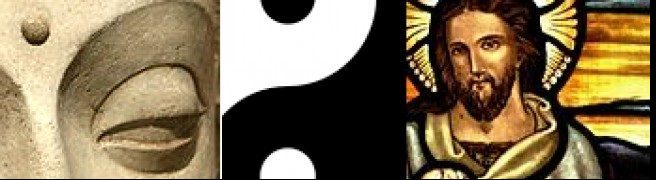
He Will Reign – Won’t He?

One of the challenges in building a brand is to ensure that prospects receive a consistent message concerning value proposition. The Church fathers and Emperor Constantine addressed this problem in the fourth century, establishing the Nicean dogma and creed that the Catholic Church and its heretical variants enforced through preaching, training and – in the breach, until recently – torture and death.

Normally, we’d talk of offended authority as “spinning in the grave.” In this case, given the last, we must be glad for Jesus’s resurrection, because otherwise the globe would have been whirling around his tomb.

The early Church fathers, confronted with the evidence of civil decay following the decline of the Roman Empire, seem to have concluded that empire was a part of God’s plan of salvation. They spent the twelve centuries following Nicea working to centralize political authority in Europe. At the end of that era, Renaissance Europe sprouted a dozen kingdoms capable of reproducing the accomplishments of Rome. Their response to Church meddling was to interfere in Papal selection, and when coming out on the losing end of that struggle, to support the rise of reforming heresies.

So what might Christ think of that?

In Scripture, I see three high points in the relationship between Humanity and God. The first is in Eden, where Adam and Eve experienced the ravishing grace of a direct relationship with God. Next is the era of Judges immediately following the entry into the Promised Land. The Hebrews as a people lived in gratitude for the Father’s gift, and when their occupancy was threatened, God found heroes to guide them through danger. That era ended with the people throwing their trust onto the human institution of monarchy. In the final act, Jesus arrives to expose the iniquity of the human institutions of his day, and proclaims that redemption is not bound by any contract or tradition, but is available to all the peoples of the Earth.

The modern Dominionist interprets this proclamation as a call to spread the institutions of Christianity across all the globe. The question is: what is the true church? Or is it simply enough that each individual should recognize Christ as lord and master in his heart?

Jesus is a little coy on this point, stating [John 10:14-16]:

I am the good shepherd; I know my sheep and my sheep know me — just as the Father knows me and I know the Father — and I lay down my life for the sheep. I have other sheep that are not of this sheep pen. I must bring them also.

In The Soul Comes First, I consider the parallels between the spiritual trajectory in Judaism (culminating with Jesus) and Buddhism. In Islam and Christ, I examine the choices made in the formulation of Islam, choices made to facilitate such developments in cultures still practicing polytheism.

These insights, supported by the evolution of the covenant recorded in the Bible, lead me to the conclusion that Unconditional Love reaching to us from Christ meets us where we are. It does not care about structures and institutions, and in fact idolatry is often evident in human attempts to sustain those forms. Rather, as Jesus says, it enters into our lives in twos that grow into threes, thereby empowering us to care for one another.

Witnessing the end of this process, John testifies of the “New Jerusalem”, that {NIV Rev. 21:22]:

I did not see a temple in the city, because the Lord God Almighty and the Lamb are its temple.

Remember that Jesus does not ask us to submit, but to learn [NIV Matt 11:29]:

Take my yoke upon you and learn from me, for I am gentle and humble in heart, and you will find rest for your souls.

And [Math 20:28]

…the Son of Man did not come to be served, but to serve, and to give his life as a ransom for many.

The temple of God is the individual human heart. His age is consummated when we allow his sensibility to enter into us. As I said recently to a priest:

Sometimes words serve no purpose, and the only thing I can do is to allow the broken heart of Christ within me to speak for itself.

It is when we offer our hearts as he did, offering them in the service of supporting the weary and burdened, that his will for us is achieved. This is a service beyond understanding, for we cannot explain all the suffering in the world. It is beyond us, having its origins billions of years ago, and woven into our living through the predatory competition that is Darwinian evolution. All that we can do, as Jesus did, is to offer ourselves in the service of healing the wounds it has created.

So is the modern fragmentation of Christianity – exposing contradictory messages that erode faith – is that fragmentation a problem? Or should it be interpreted as the process by which Christ dissolves the human institutions that stand between the seeker and Unconditional Love? If Eden was the ideal, should we not be seeking to recreate that ideal for every man and every woman? And if that is the goal, how can we doubt Christ’s word that he will gather all of his flocks – all of those traditions that declare a covenant and discipline that opens our hearts to the power of Divine Love – how can we believe that any one of them will be unreconciled to Christ? Or judge any of them as inferior to our own path?

Two Conversations

Down in Carson yesterday, I was trying to teach a young Hispanic girl how to shoot set-shots. I kept at it for a half an hour, and she just wanted to prance and play, so we didn’t get very far. That’s not true – she did get better over time, and seemed to improve in her accuracy. But after twenty minutes of encouragement and silly dancing around, she asked me:

How old are you?

Well, that didn’t seem fair, so I asked her how old she was. Then I told her I was more than five times her age. She kept on going with guesses until she learned that I was fifty-four. When I asked her why she asked, she said:

You act like you’re younger than that.

So I asked: “If I came here all serious and stuffy, would you be shooting baskets with me?”

“No.”

“But that’s what I’m here for. It doesn’t make a difference what you think about me – this is all about you. I work five days a week writing software and doing mathematics. But when I come here, it’s all about what works for you.”

My father says that if her parents find out, they’ll never let her come again.

And then this morning, to the priest who had just announced that he was leaving religious orders because his out-spoken passion for Christ had caused too much friction in the community:

As someone who has been told that his expressions of faith frighten people, my experience has been that sometimes I have to choose to say nothing, and let the broken heart of Christ within me speak for itself. Sometimes words will not do – we just have to let others feel what we feel. We have to take people into our hearts. It is as Jesus said: ‘Take my yoke upon you and learn from me. For my heart is humble, my yoke is easy, and my burden is light.’

Jon-Rolled

When I first put The Soul Comes First in front of readers, one was a young Jew working in the coffee shop at Barnes and Noble. I began summarizing the book, and got as far as Moses before he broke in to challenge, “Yeah, well, I’ve concluded that no Bronze Age religion has anything to offer us in the 21st century.”

A couple of months later, he agreed to read the book (it’s only 70 pages or so), and came up to testify:

This is the only thing I’ve read that makes sense of the Bible.

So my jaw fell open when, following an advertisement from the Freedom for Religion Foundation, Jon Stewart introduced a satirical skit on Christianity by saying “I can do this because, as a Jew, my religion is thousands of years older than yours.”

An appropriate comment, because in the entire skit, the only serious criticism of Christianity was a reference in Exodus to ownership of slaves. Argh! Christ promised to fulfill the law, which means that the old contract with God was concluded, and a new one begun. The covenant of Christ supersedes the Covenant of Moses, and it says simply:

‘Love the Lord your God with all your heart and with all your soul and with all your mind.’ This is the first and greatest commandment. And the second is like it: ‘Love your neighbor as yourself.’

As for the Freedom from Religion Foundation, the ad draws upon the authority of the Founders, many of whom drew their moral and ethical philosophy from Jesus, which includes:

Render unto Caesar those things that are Caesar’s.

I find satire to be a lot funnier it is rooted in understanding of the basic tenets of the culture. So, if the FFRF and Jon Stewart show really want to have an impact on Christian fundamentalism, they could try teaching Christianity while making fun of the way it’s presented to society. As they have succeeded so well in attacking the political hogwash served up by the elitist, libertarian right, that might actually get Christians to recognize and challenge false teaching.

As it was done, they merely come off as tediously shallow.