In Coherence

The philosopher Ludwig Wittgenstein proposed a final solution for philosophy in his twenties, and then took up teaching and gardening until he realized that people were abusing his intellectual authority. Strangely, that authority arose from his insistence that much of what philosophers wrote shouldn’t be considered philosophy, because it was concerned with matters that could not be decided. Taking a less charitable perspective, Wittgenstein set himself up as arbiter of what was and was not philosophy, and his desperate peers submitted to the force of his intellect.

I wonder whether Wittgenstein recognized the similarities to the program undertaken by Socrates in ancient Athens. Socrates, assuming that he knew nothing, went about seeking wisdom. In questioning the ethical reasoning of his peers, he exposed the inconsistency of their precepts. Having clarified the relationships between theory and practice, Socrates (as represented by Plato) then proposed his own solutions to the ethical problems of the day.

To the outside observer, the similarity between Wittgenstein and Socrates might be cause for despair. After nearly three millennia, the same fundamental problem remains: no philosophy has stood the test of its application. Actually, that’s not entirely true: philosophy spins off independent disciplines, many of which are phenomenally successful. Philosophy is left with the hard questions, questions concerning ultimate truth and meaning that are difficult to pin down in a rapidly evolving culture. Where in tribal societies the concerns of the parent are inherited by the child, the information age has decoupled the generations. Thus every generation must invent anew – and necessarily either reformulate the truths of the past, or relearn them after decrying their irrelevance.

In general, we find two threads of philosophical practice in response to this dilemma: play the role of Socrates in every generation, or seek to narrow the scope of philosophy to matters susceptible to the fashionable tools of the day. Strangely, the histories of philosophy are dominated by the latter, though the arguments become more and more arcane in every generation. Each luminary writes principally in opposition to his or her immediate predecessors, and so can often be understood only in that context. This leads to some repetition in every third of fourth generation, as the reaction against the reaction re-iterates the original thinker, although the increasingly obscure terminology may hide that fact. Thus around 1800 we find Kant speaking of phenomena (our description of events) and noumena (the events in themselves), and concluding that while we cannot guarantee that the former reflects accurately the latter, our survival as a species implies that there must be some correspondence. Of course, this is just what Socrates offered 2600 years earlier in his parable of the cave.

Socrates proposed that universal education should be offered to ensure that citizens possessed the skills to maximize the correspondence between experience and description. Following Kant, it was the psychologists and neurophysiologists that took up the problem, seeking to illuminate the physiology that links experience to thoughts. The first flowering of that effort was in the work of Sigmund Freud. As presented in Ideas: Invention from Fire to Freud, the early psychoanalysts stood on the brink of building a complete theory of human culture, but Freud drew back when confronted with the non-local spiritual experience of women that reported being molested by men at a distance. Freud’s conclusion was that he was being manipulated by his patients, and he abandoned his inquiries.

One consistent thread in philosophy is fertilization by its progeny. The insights of physics, chemistry and biology illuminate and constrain the forms of experience, and so clarify the analysis of the philosopher. The progeny, however, also narrow the scope of their study to exclude that which cannot be explained. For this reason, I tend to trust the original thinkers – the ancient Greeks, Hindus and Chinese – who reported their experience without the filter of professional respectability. I assert that Freud was hamstrung by this prejudice. As regards the matter of spirituality, I’ll defer to the ancients.

This long introduction serves to motivate what follows: I believe that the program of the early philosophers had an element that was missing in latter generations. They recognized the potential of the intellect, and sought to strengthen it. They were not concerned narrowly with truth, which seduces with its promises of certain deduction. Instead, they sought to build power in humanity as a whole – perhaps simply so they could have more interesting conversations. Be that as it may, in reading the history of philosophy, I believe that much controversy can be settled by advancing a model of intellect, and recognizing that philosophers that spoke with greatest certainty were those predisposed to focus on specific aspects of the intellect, thereby simplifying what evidently is an intractably complex problem.

That they belittled their predecessors reflected the assumption that all minds operate alike, an error that our autistic brothers and sisters are now forcing us to confront. Taking individual variation in the intellect as a given, the history of philosophical study can be mined to reveal its full richness.

This post builds on the propositions originally formulated in Ideas, Ideally. It adds pretty pictures that will hopefully make the model of intellect more apprehensible.

The Role of Intellect

Recognizing that humanity’s evolutionary advantage is in the power of our minds, I have proposed to define intellect as the faculty that synthesizes our mental states. To understand the operation of intellect, we must first characterize our mental states, and then explore the possibilities for their synthesis.

Survival is a manifestation of successful relation to the world. When beginning to enumerate mental states, we benefit by considering the structure of those relationships. As concerns the mind, I recognize four immediate categories of relation, three of which are exhibited in equal degree by most animals. Of those first three, I differentiate sensory perception of our environment from the intimate physiological response of emotions. These two are most immediately concerned with our survival – the latter as the feedback signal that regulates our interaction with the world around us. The third category consists of spiritual influences that organize collective behaviors – such as the swarming attacks of bees – that may not serve the survival of the individual.

These three categories define the intellectual dynamic of Darwinian evolution, behaviors that we classify as instinctual. Even among creatures lacking a nervous system, intellect still operates, just through tissues and organs that are either less malleable or less effective at encoding information. In an herbivore, the emotion of hunger stimulates foraging, a complex interaction of muscles to navigate the sensed physical environment to locate food. Success is rewarded by satiation, and possibly sufficient surplus of energy to trigger the emotions that drive mating. As this simple illustration suggests, the intellect manifests as behaviors that couple sensation and emotion.

AnimalBut the feedback is more widespread than the example suggests. Modern ecosystems are chemically determined by the existence of life: free oxygen, soil and the food chain are all side effects of biochemistry. The physical and chemical environment determines sensation. More subtly, the same holds true in the realm of spirit, which contains reservoirs of energy and intention that can become enmeshed in the external world, influencing the emotions of living things, and consequently their behaviors. Through that interaction, the spiritual reservoirs are themselves modified. In part, that reflects that physical commonality of spiritual interaction with metabolic activity (See That’s the Spirit). Spiritual forms can gain energy and spread influence through their interaction with matter, including biological forms. Finally, emotion drives the behavior of living creatures, determining how they modify their ecosystem. Successful individuals achieve dominance in part by attracting spiritual energies that force others to support their behavior.

Recognizing the significance of the interaction between biological and spiritual forms, I find it useful to think of life as their co-evolution. Without that coupling, geology and chemistry would hold sway over the earth without any meaningful purpose.

O, Humanity!

Multicellular organisms dominate their ecosystem by optimizing the chemical environment of cells specialized to perform specific functions. Most obvious in many cases is the differentiation between the protective dermis and the organs of digestion that produce refined foodstuff for the dermis. In the case of the higher animals, of course, the specialization and organization of cells is wondrous. The layers of skin, the placement and density of follicles and sensory bulbs of nerves: these boggle our comprehension.

The evolution of multicellular organisms reflects two requirements: distribution and coordination. The first is obviously seen in the circulatory systems that distribute gases and fluids, but it is also manifested in the skeletal system that translates muscle contractions into motion. Coordination is also implemented through the circulatory system via the release of hormones that affect the organism as a whole. The nervous system is far more refined in its targeting, using the transmission of electrical signals to coordinate the behavior of specific tissues.

While the history of cellular innovation may never be known, the miracle of thought became inevitable when nerves evolved structures that chained the transmission of electrical signals along networks of nerves. This meant that the instinctual behaviors once triggered by sensation and spirit could be induced without the original stimulus by the firing of a nerve. This is accomplished most efficiently by the clustering of nerves in nodes, the most significant being the brain. In the higher animals, the progressive reallocation of metabolic resources to the brain is evidence of the benefits of signal processing by networks of nerves.

In the early stages, the signal processing provided by the brain stem was focused primarily on individual survival and procreation. Even today, reptiles are rarely social creatures. In birds and mammals, the limbic system manages social behaviors, while the cortex supports higher forms of thought.
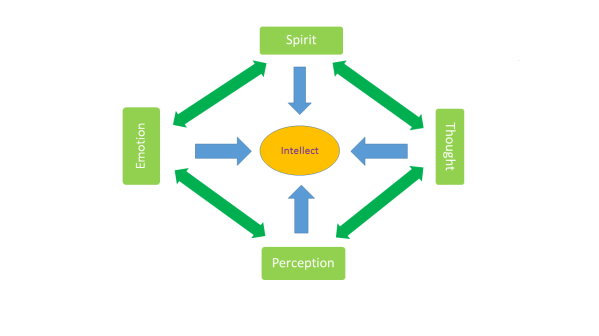
IntellectSo what is thought? In On Intellect, Jeff Hawkins of the Redwood Neuroscience Institute summarized the science that demonstrates that the cortex is a structure that categorizes experience to coordinate behavior. While initially that categorization would have been focused on the first three categories of intellectual stimulus, by the mechanism of network stimulation, eventually the internal operation of the network would have become an independent source of intellectual stimulus. Thus arose thought: the stimulation of the intellect by the brain.

Obviously thought has an ancient lineage, dating back even to insects. But full expression of its potentiality required coupling of that capacity to skills that could be used to reorganize the environment and thus control sensation. Birds and octopi manifest that to a limited extent, but primates to a degree that flowered to environmental dominance with the arrival of homo sapiens sapiens. We create tools that allow us to enhance our biology in real time, where every prior creature was allowed that opportunity – and then only imprecisely – through procreation.

While today we tend to emphasize the power of our material tools, the brain also allows a far more precise interaction with the spiritual realm. I understand that souls are composed of electrical charge decoupled from mass. Nerves channel and interpret the flow of electrical charge. As regards the emotions, nerves also affect our endocrine glands, muscles, organs and metabolism. Thus the brain provides methods for coupling thought to spirit and emotion, methods that are far more powerful than the couplings previously available to intellect.

As the influence of spirit is most evident in social activity, we should note the importance of language in facilitating the coupling of spirit to thought. While all mental states are abstractions of the underlying reality, words alone are capable of conveying our apprehension of that reality to another. Modern cultures are rooted in the conventions adopted for the association of words with experience. The ability of communities to coordinate effort to solve problems depends on the consistency and integrity of their use. Communities that honor clarity and honesty evolve social structures that may manifest as completely new forms of spirit. The ancients recognized these as “gods.”

Love of Wisdom

I have proposed to characterize Philosophy – the “love of wisdom” sought by the ancient Greeks – as study of the operation of the intellect. Here I understand intellect not narrowly as a manifestation of reason, but broadly as any process that couples the behavior of a living organism to the world around it. Intellect, in this view, mediates the interplay of the elements of reality through living creatures. Bringing together in humanity the dexterity and strength to create tools with the capacity of thought, nature manifested the potential to outgrow Darwin’s evolution through natural selection. Philosophers seek to organize that effort.

If that effort occurred in a vacuum, we might better be able to measure our progress. But it does not. Humanity is the culmination of a billion years over which life insinuated itself into the material substrate of the earth. That integration involves enormous amounts of energy, and disruption of the natural order threatens all of the higher lifeforms with extinction. The complexity of ecosystems makes it almost impossible to predict accurately the consequences of human intervention, and our facility with tools means that often we are the last creatures to feel the full force of disruption. Whether through clear-cutting of forests, the suffocation of once-fertile soils with covers of asphalt and concrete or the ubiquity of air conditioning, in fact our disruption of ecosystems often produces immediate advantage for us.

Our indulgence of those opportunities is a sign of dangerous immaturity. That immaturity is most dangerous in two scenarios. The first is when our primitive animal instincts infect our thinking, causing us to engage in contests for dominance using the most sophisticated tools that we can create. During the Cold War, the world as a whole was threatened by the nuclear arms race. While most nations appear to have recognized the insanity of direct military conflict, many nations still seek to define spheres of cultural hegemony through practices that require profligate consumption of fossil fuels. Unless reversed, that consumption will see human civilization destroyed by global warming. This second threat – the danger of inattention – manifests over many generations, and while no less deadly is far harder to address, not least because in the short term many beneficial outcomes accrue to the exploiting communities.

Under such circumstances, most parents deny children access to firearms and matches. And so it is with our spiritual predecessors. As they began to understand our potential by exploration of our minds, they have been forced to resist our head-long rush to Darwinian dominance.

If this sounds incredibly complex and ambiguous, it is. Most of the early philosophers counseled their peers to reticence. They sought to create a safe preserve for the operation of thought. Over time, that manifested through the formation of ideas that stood as bastions against disruption of human intellect by base motivations.
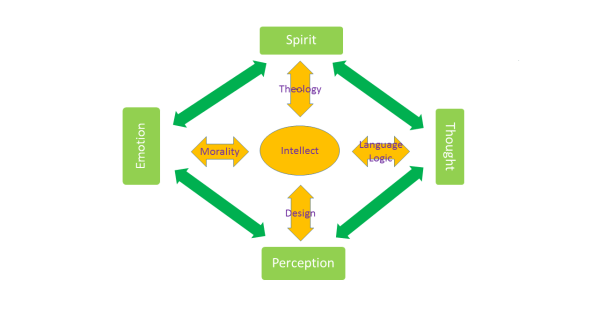
PhilosophyThe principal threads of philosophical discourse can be understood as filters through which the human intellect manages its interaction with the sources of our mental states. At the interface to the physical world, we have the discipline of design that encompasses art as well as science and engineering. Design is concerned not only with the limits of practical possibility, but with ensuring that the environment that we create accommodates our emotional needs. Ethics attempts to organize and discipline our emotional experience, building reserves of good will that facilitate collaboration. Language and logic tame the profligate domain of thought, which if left unchecked devolves into incoherence or insanity. And at the interface between intellect and spirit, we have the bastion of theology that ensures that our faith is invested with personalities that respect our potential and seek to facilitate its flowering into mature judgment.

The history of philosophy demonstrates the difficulty of expanding the scope of human intellect. In the early days of Christianity, theology was considered dominant, but today design seems to be the most powerful method for bringing reality under human control. The unbridgeable gulf between physical reality as interpreted by our senses and the abstract realm of thought has long frustrated philosophers, and Aristotle’s dominance of intellectual discourse for 2000 years reflected in large part his belief that careful observation and logic could narrow that gap. Unfortunately, the strides made by technological innovation have allowed the spread of narcissism that undermines the work done by political theorists most concerned with the balance between morality and theology (nations being gods of a sort). Perhaps recognizing the futility of imposing purpose in the world, Post-Modernism celebrates the interplay of thoughts without reference to other experience.

And so it has been in age after age: profound thinkers set off to expand the scope of human intellect by focusing narrowly on opportunities in one discipline or another, only to have their successors shout “But you forgot about this!” In making clear the complexity of the philosophical quest, I hope that I will encourage future generations to humility, and the realization that no single mind can hold all the answers. Rather, not just the richness of human experience but our very survival is dependent upon the degree to which we allow our intellect to be disciplined by compassion in our hearts.

The Philosophical State

In parting, I offer these conclusions regarding my sense of where we should focus in the next era of philosophical discourse.

Concerning design: While nature holds its secrets, the Promethean fecundity of creative intelligence allows us to explore configurations of matter that could never be attained through other means. The sublime divinity of that capability must be yoked to compassionate service to life.

Concerning language and logic: No intellectual activity is sustainable unless we seek to honestly, clearly and precisely express our experience and expectations of this reality. In debate, we must avoid egotism that prompts us to consider our perspective to be superior to the perspective of other living things.

Concerning ethics: Morality is found in any system of values that expands the domain in which love is expressed.

Concerning theology: If love is a seeking after opportunities for the object of our affection to receive affirmation, then in its selflessness unconditional love is the only incorruptible unifying principle worthy of our faith.

Blessings and honor are due any that undertake to further the project of philosophy. I pray that some benefit may be found in the thoughts that I have here offered.

Google-Plex

When my sons learned about exponents in elementary school, they came home chattering about googol – which is 10100, or ‘1’ followed by 100 zeros. This is an impressively large number: physicists estimate that the entire universe only contains enough matter to make 1093 hydrogen atoms. However, as with their nine-year old peer that invented the terminology, the next step was even more exciting: the googolplex, or ‘1’ followed by a googol of zeros. When challenged to exhibit the number, the originator adopted a more flexible definition, purportedly:

‘1’ followed by writing zeroes until you get tired

One of the most attractive aspects of science and engineering research is just such child-like “what comes next?” The tendency is to think in exponential terms, although not always in powers of ten. Moore’s Law in semiconductors held that microprocessors should double in power every 18 months, and inspired a generation of chip designers, so that now our cell phones contain more processing power than the super-computers of the ’70s. Digital storage systems have improved even faster, allowing us to indulge the narcissism of the “selfie” culture: every day we store 50 times as much data in the cloud than is required to encode the entire Library of Congress.

The problem is when what appears to be the next obvious step in physics and engineering becomes decoupled from social need. We spend billions of dollars each year launching satellites to probe the structure of the cosmos, and even further billions providing power and material to the facilities that probe the matter that surrounds us. “Super-high” skyscrapers are pushing towards a kilometer in height, led by Saudi Arabia and Dubai, who appear to be engaged in a penis-envy contest that seems tolerable mostly because it side-steps the threat of mass extinction posed by the last such contest (the nuclear arms race between the US and the USSR).

In the case of software development, the “what next” syndrome is particularly seductive. It used to be that we’d have to go to a store and buy a box to get a better operating system, word processor or tax preparation package. Now we purchase them online and download them over the internet. This means that a software developer with a “better idea” can push it out to the world almost immediately. Sometimes the rest of us wish that wasn’t so – we call those experiences “zero day exploits,” and they cost us collectively tens of billions of dollars to defend against and clean up afterwards.

But most of the time, we benefit from that capability, particularly as artificial intelligence improves. We already have medical diagnostic software that does better than most physicians at matching symptoms to diseases. Existing collision avoidance algorithms allow us to sleep behind the wheel as long as a lane change isn’t required, and self-driving cars are only a few years away from wide-spread use. Credit card transaction monitoring protects us from fraud. These all function as well as they do because the rules described in software don’t disappear when the machine turns off. While the understanding encoded in the neural pathways of a Nobel Laureate vanishes upon death, software algorithms are explicitly described in a form that can be analyzed long after the originator retires. The lineage of successors can therefore improve endlessly upon the original.

The combination of robust, long-lived memory and algorithms means that the software industry believes that it is curating the evolution of a new form of mind. Those developing that mind seek to extend its capabilities in both directions: recording everything that happens, and defining rules to control outcomes in every possible situation. Their ambition, in effect, is to create God.

Contemplating this future, I had a colleague at work effuse that he “looked forward” to Big Brother, believing that in an era in which everything was known and available online for discovery, people would think twice about doing wrong.

In response, I suggested that many religions teach us that such a being already exists, but has the wisdom to understand that confronting us with our failings is not always the most productive course. In part, that is because error is intrinsic to learning. While love binds us together in an intimacy that allows us to solve problems together that we could never solve alone, we’re still going to hurt each other in the process. Big Brother can’t decide who we should love, and neither can God: each of us is unique, and part of life’s great adventure is finding that place in which we create greatest value for the community we nurture.

Furthermore, Big Brother is still a set of algorithms under centralized control. In George Orwell’s 1984, the elite used its control of those algorithms to subjugate the world. By contrast, the mind of God is a spiritual democracy: we chose and are accepted only by reciprocal gestalts.

Finally, Big Brother can never empathize with us. It can monitor our environment and our actions, it can even monitor our physiological state. But it cannot know whether our response is appropriate to the circumstances. It cannot be that still, quiet voice in our ear when our passion threatens to run amok. Big Brother cannot help us to overcome our weakness with strength – it can only punish us when we fail.

So, you in the artificial intelligence community, if you believe that you can create a substitute for God from digital technology, you should recognize that the challenge has subtleties that go beyond omniscience and perfect judgment. It includes the opportunity to engage in loving co-creation, and so to enter into possibilities that we can’t imagine, and therefore that are guaranteed to break any system of fixed rules. Your machine, if required to serve in that role, will unavoidable manifest a “Google-plex,” short for a “Google complex.”

Disarming Incivility

Constitutional wrangling aside, as a Christian, my personal choice is to renounce violence as a means of conflict resolution. My experience is that a disciplined commitment to this choice overwhelms aggression in those that come into my personal space. This can manifest in two ways: either the aggressor realizes that I see them as a brother, causing their fear to melt away; or their aggression, finding no harbor in me, turns self-destructively inward.

I have many personal qualities that empower me to renounce fear: I am a man, tall without being imposing, and physically fit. I possess rare intellectual talents and traits of character that make me desirable as an employee. I have modest aspirations that I articulate clearly, and project good will that allows me to manifest my intentions where others might collide with bureaucratic restrictions. Last but not least, I have associations that bring patience and endurance gained through experience of the cycle of life and death that stretches over a billion years.

Recognizing the rareness of these assets, I sympathize greatly with those that crumble under the pressure of aggression. For me, the most powerful moment in the sit-in coverage was the testimony of a female representative describing the routine terror she suffered as a child when threatened by her gun-toting father. Listening to her summary of those events, I could hear the frightened girl crying out for aid.

So when someone touts their Second Amendment right to bear arms, I wonder why their protection against “infringement” must tread so heavily on the desire for others to renounce violence. I trust law enforcement, and see that our modern industrial economy provides financial levers to control governmental abuse of force that did not exist when the founders wrote the Constitution. These constraints are strengthened because mastery of military technology requires a focus that creates dependency upon civilian production of goods and services. On the other hand, I see the ready availability of weapons creating an arms race between police and criminals that tramples upon the peace of mind of the law-abiding citizen. Contradicting the claims that our freedom is secured only when a well-armed citizenry opposes the natural tyranny of governments, I believe that the greatest threat to my safety – and the safety of those I cherish – is the proliferation of arms.

On the whole, then, I am a citizen that would like to renounce his right to bear arms. I would like to be able to limit my associations to those of like mind. Why is it that Constitutional prohibitions against infringement of that right prohibit me from living that desire? Can I not form a community that requires people to leave their weapons outside our borders? But once formed, is that community not governed by laws, and does not the Second Amendment prohibit such laws?

Judgment in Self-Defense

In Matthew 7:1-2, Jesus offers:

Do not judge, or you too will be judged. For in the same way you judge others, you will be judged, and with the measure you use, it will be measured to you.

The challenge of living this guidance is that people cause us pain. That may be as small as saying an unkind word to us, or as severe as murdering one that we love. Do we not have the right to decide that those that hurt us should be placed apart? Do we not have the right to protect ourselves?

This quandary reflects an understanding of “judgment” as part of a legal process. We take the evidence of our experience and then organize our lives to avoid harm. The futility of this strategy was summarized by Martin Luther King, Jr.:

Injustice anywhere is a threat to justice everywhere.

Just because we push evil away from us doesn’t make it go away. It either shifts its focus to others, or bides its time until it has the strength to assault us again. This applies even beyond the grave: in a secular sense, punishing an offender heightens the stakes of wrong-doing, and so pushes the criminal to take ever greater risks. Spiritually, destruction of the body doesn’t destroy the spirit, which must return again and again until it finds a personality strong enough to heal it.

Jesus, as the healer of last resort for broken personalities, understood this with a terrible immediacy. He could feel the trapped goodness in the people that were judged by the Canaanite culture. Whether speaking to the adulteress or the thief on the cross, Jesus knew that they had been conditioned to the most vengeful judgment of all: the self-judgment that they were beyond redemption.

It is this spiritual consequence of judgment that I think Jesus is focusing on in this teaching. He speaks of other-judgment as like a “plank” or a “beam” in the eye of the one that judges. It is to say: “As we all sin, if you believe that your fellow sinner cannot be saved, then you also believe that you cannot be saved.”

Jesus is speaking from the knowledge that God can heal any wound in those that are willing to receive the gift. This is what he affirms again and again after healing transpires in his presence: “Your faith has healed you.”

What is most painful to me is reading the scripture of Matthew in light of the fact that Jesus did not write a gospel. He understood how the law had been manipulated by the priesthood to divide the people from God. In this case, those among us that have reason to fear direct contact with God use Jesus’ words to argue “You do not have the right to judge me.” They use the power of our minds to hold us in sway as they tear out of our hearts the love that we receive from God.

It is such that Jesus refers to when he calls those that judge “hypocrites.” One way of interpreting his inducement [Matt. 7:5]:

first take the plank out of your own eye, and then you will see clearly to remove the speck from your brother’s eye.

is that the hypocrite will discover himself to be the speck in his brother’s eye! But just below Jesus also counsels [Matt. 7:6]:

Do not give dogs what is sacred; do not throw your pearls to pigs. If you do, they may trample them under their feet, and turn and tear you to pieces.

So he clearly believes that those the love honestly must protect themselves. So how are we to do that?

First, we should not judge, because in judging those that attempt to tear apart our hearts we are affirming that they cannot go to God for what they need. They do have that power, and we need to let that responsibility rest with them.

Secondly, we should recognize that nothing that Jesus taught requires us to surrender our hearts to those that harm us. But we have a part to play there. We should not engage in argument of judgment because it diverts our attention from our heart, leaving it wide open to plunder.

Finally, then, we should love ourselves. When the plunderer comes into our hearts, we need simply to say: “No, that is mine. I will not relinquish it to you.” If we stop acting as their drip feed for God’s love, they’ll eventually conclude that they have to go to the source themselves, or allow their souls to wither and die.

This law of natural consequences is far more powerful and permanent than any punishment that we could organize.

Freedom’s Prison

There are two fibers running from our brain to the glands that regulate our fight-or-flight response: one from the ancient reptilian brain and the other from our cortex, the part of the brain that reasons. The cortical fiber is myelinated, so the signal gets to the glands first, and can over-ride the signal coming from the reptilian brain.

Our freedom is freedom from the basic physics and fundamental biology that rules the rest of the world. But too often we turn it around and use it to force the people around us into conditions of poverty, psychological duress and physical hazard that forces them to behave as animals. We maximize our freedom by denying it to others.

Jesus is lord because, confronted by the consequences of the choices made by those most free, the oppressed choose his compassion and strength as a spiritual refuge. He preserves their freedom against those less wise who use power to play at being gods. For that reason, those rescued are loyal to Jesus in eternity. Inexorably, the tyrants turn on each other, creating yet more victims for Jesus to heal and redeem, until all except the most heinous are wrapped in his love.

Celestial's avatarSoul Surrendered

Countless wars have been fought in its name. Brave soldiers have sacrificed their lives to protect it. We’ve pawned off our souls to taste it. Yet, it holds us captive. We have cut open the Earth and yanked it from her core. The blood that pours forth, we call freedom.

Can a creation exist separate from the will of its creator? Why then, do we believe that we can thrive independent from the will of our maker?

Outside of our creator’s purpose, we are but walking sandcastles. And is not dust easily swayed by the caress of the wind? Beautiful souls cloaked in flesh, so readily tempted by the elements. Fools we’ve become, dressing ourselves high and mighty in our own concrete beliefs and labeling it freedom.

The liberties that we’ve taken with our lives have served only as a deception to further bind us. We believe that we are…

View original post 380 more words

To Have Meaning

In Islam, Ali, the son-in-law of the prophet, testified that there are three kinds of faith: that rooted in fear, that motivated by the promise of reward, and the faith of service.

When I first re-engaged the Catholic Church, the priest challenged me “Do you want to die, or live forever?” While that didn’t reach me deeply, it ties together the first two inducements: fear of death and the promise of eternity.

According to Jesus’s teaching, both outcomes will be implemented by God. For this reason, the Protestants sought for signs of God’s favor in this life.

But for most now living, fear is rooted in this life – in the pain of deprivation, or the reality of physical abuse. For those that suffer, it is not powers and principalities in the afterlife that stand as rewards, but simple justice: that those that prey upon them will be cast down, and comfort will be offered.

In the faith of service, we surrender personal fear – fear for our fate in the afterlife – and devote ourselves to bringing relief to others. The question is how we can best fulfill that role, for it has many aspects. The prisoner of fear may not be capable even of living outside the walls of their cell. The experience of freedom confronts them with choices that they are unprepared to navigate. So to simply provide for their needs is not enough to liberate their souls.

The wisdom of the Buddhist path is to encourage the sufferer to realize that if they can lift their heads up to study the world around them, they can make one small change after another until freedom is realized. A friend can help them make that journey, a journey from dependence to independence.

The danger is that in the context of tyranny this effort will flare into violence – either violence against the oppressor (whose children then become victims), or violence against those seeking freedom. Once violence is engaged, the dynamics of material power rule, and the oppressed are most likely to be destroyed. We see this everywhere in the world today.

How than are the oppressed to rise above fear and into service? As Jesus says that to serve is necessary to eternal life, how are we to achieve that reward if we are denied the means to serve? Life appears to be completely meaningless, and faith misplaced for all except the privileged.

The answer to this dilemma is that in suffering we serve.

It takes both great courage and great faith to so suffer. But when Jesus proclaimed “Pick up your cross and follow me!”, this is exactly what he meant. So to any offering service, the question must be “How do we support the determination of those that suffer?”

To serve in faith is to allow love in our hearts to control our decisions in life. It is to demonstrate that to offer ourselves to the redemption of the world is a source of greater joy than any material reward. To one that suffers, heart-broken, this appears impossible. Their heart lacks the strength even to redeem themselves.

My testimony of service is this: Only God can heal that wound.

So this is the ultimate act of service: to take into our whole heart the broken heart of a brother, and allow them to meet the healing power of God within us. It is to provide an irrefutable experience that there is no wound that God will not suffer with us, and finally no wound that God cannot heal.

The difficulty to those that serve in faith is that it hurts. They may have forgotten what it was like to be broken. They live in community that protects them from harm. Their defenses are weak.

But it is not upon us to survive this experience of receiving a broken heart within us. It is upon God. Ours is only to be available in that moment when grace can be received, and allow it to flow through us. Indeed, to try redeem another of our own strength is folly: it is to surrender ourselves to their experience of life, and so to be consumed by their weakness. No, ours is only to be the material manifestation of God’s love that wakens hope that change is possible. Once God moves into the sufferer’s life, the person of faith needs to get out of the way, lest the limits of human endurance infect the redeemed with doubt.

Only God can offer certain guarantee of meaning to those that suffer. Only He can say with assurance “You have meaning to me: there is no suffering that I will not share with you, and indeed reward eternally for your service in redeeming the world!”

City on the Hill

I’ve started attending a contemplative prayer gathering. The process starts with twenty minutes of silent meditation on any devotional word that comes to mind. Then we read a passage from the Bible three times, allowing time between each recitation for it to settle, until a single word or phrase stands out from the text. After sharing our personal reflections, we close with reflections from the greater church on the passage, allowing us to project our personal focus against the longer backdrop of Christian experience.

This week’s passage was Matthew 5:13-16, the famous “You are the salt of the earth.” Most of the reflections celebrated both the salt and the light. But before the incongruous image of the city on the hill, I heard a contrast in Jesus’s assertion:

But if the salt loses its saltiness, how can it be made salty again? It is no longer good for anything, except to be thrown out and trampled underfoot.

This was the condition of the people – their kings and priests had sundered their bond with God, and the Romans arrived to trample them underfoot.

I held my tongue, though, as the gathering celebrated the qualities of salt, only after the meeting had ended calling the facilitator over to engage her in discussion. When I suggested that Jesus was offering a metaphor on the condition of his people, I felt truth cementing our connection. She did not repel it, as so many do when confronted with a contradiction of received wisdom, but bowed her head and said “Yes, that is how it was.”

So I continued, as I have never been allowed before, observing that Jesus was proclaiming that they were no longer salt, because he was making them a light to the world. He, the lamp lighter, would not hide their light, but send them forth to inspire faith in God. And she simply continued to nod, saying  “Yes, yes. Brian, you have a gift.”

We talked further, affirming each other. The things she said were so terribly confounding. I have decided to move out to Port Hueneme, seeking to find simple people with open hearts who don’t ask “What’s the price?” when they are offered a gift. It is a form of withdrawal from the world, which has given me some deep wounds recently. But I woke up this morning, and realized that nobody in my life had ever said what she said to me, an affirmation that sums up to this:

Brian, people need you. They might not realize it; they may even act frightened of you. But keep on doing what you are doing. They need to hear what you have to say.

The Struggle

These thoughts began to form this Sunday during services at the University Catholic Center down in Westwood.

May all those that surrender their light in service to dispelling the darkness be gathered by welcoming arms into the healing heart of Christ.

And from that sacred nexus that joins all open hearts, may the one lost realize the opportunity, in that place outside of time, to reach out to those that grieve for their loss – to whisper into our hearts words of comfort and encouragement in every moment that offers an opportunity to renew our strength and courage, and so to guide us toward healing.

And may we that grieve not build a wall of resentment against God, who suffers in sorrow alongside us, but remain open to the voices of those we have lost, and so discover that we are not abandoned – that our loved ones, while no longer physically present, are still with us in spirit.

Finally, may we all remember that our sorrow, if we but seize it as an opportunity to continue the work of healing begun by Christ, is but a momentary experience on a journey that leads to an eternity of love.

Sacred, Healing Heart

A sin is a sin because it leaves a wound in the spirit of our victim. That extends not only to other people, but to God himself. In both Genesis and the history following entry into the Promised Land, Yahweh cries out against the agony of his association with the people of Israel.

The Law was intended to guide the Chosen People into a path of righteousness – a way of living that kept sin from entering into our relationships. The challenge, of course, was that Israel was surrounded by people that lacked that same discipline. The relationship with God was insufficient to protect them from the sins of others.

In the books after return from exile, a common exhortation among the prophets is that the Gentiles must be allowed into the covenant with God. This flew in the face of Hebrew tradition, which passed the heritage through mothers. But it was intended to entrain a process that would eventually manifest in the spread of righteousness across the face of the earth.

And then comes Jesus to bear the sins of the world.

In common theology, this is seen as an act of retribution. In Christ Alone expresses this with a beautiful gratitude:

Till on that cross as Jesus died
The wrath of God was satisfied
For every sin on Him was laid
Here in the death of Christ I live

But this is to think with the heart of men, not with the heart of God. Jesus tells so many parables of evil-doing that is forgiven by the grace of God. In every case, those stories reveal that it is not retribution that God seeks, but reconciliation.

The truth is approached in the last two lines of the stanza, particularly when seen in the light of Jesus’s promise to those that suffer [Matt. 11:28-29]:

Come to me, all you who are weary and burdened, and I will give you rest. Take my yoke upon you and learn from me, for I am gentle and humble in heart, and you will find rest for your souls.

When offered, this was almost certainly seen as a promise to the few that heard, but on the cross it became true for all willing to receive the healing grace of the father. Jesus opened his heart to all of the sin of humanity, each of us finding a place in the tissue of his compassion. The sun shone its light into its chambers, and brought healing there.

This surrender has its dark side: Jesus, bearer of a perfect, spotless heart, allowed sinners to take up residence in it. He embraced the world in his love, knowing that to love is to give power to others. While his will washed against the tide of sin, he knew that some would use that power to hurt others – turning his power against his own heart.  Thus his declaration of its humility: he knows that his heart cannot heal us without empowering us to create suffereing.

To complete the work, then, his heart will be broken: some among those he loves will have to be cast out into the darkness. As he says about the power of loving in the parable of the talents [Matt. 13:12]:

Whoever has will be given more, and they will have an abundance. Whoever does not have, even what they have will be taken from them.

But for those that have, to “pick up your cross” is not to bear the burden of sin. It is something far more joyful and hopeful. It is to offer yourself as a tool for the healing of others. It is to allow the love that fills you  to pass through you to those that suffer with fear, filling them until they, too, fear no longer.

It may seem unfair, to be required to heal those that hurt us. Only keep in sight the outcome of his agony  carried for these millennia (again from In Christ Alone):

And as He stands in victory
Sin’s curse has lost its grip on me
For I am His and He is mine
Bought with the precious blood of Christ

Evolution of Love

I have signed up for the Zacharias Trust’s e-pulse feed, produced by the Oxford Center for Christian Apologetics. The foremost member of that community is John Lennox, who has engaged Richard Dawkins and other militant atheists in debate on whether evolution disproves the Bible.

The conflict arises from the way that Genesis describes creation as occurring in six “days.” The term is vague, and long prior to Darwin we had Christian scholars cautioning that it shouldn’t be taken literally. But without any science to help interpret the book, the tendency was to take the common translation as cause to celebrate the glory and power of the Creator.

In the New Testament, that glory and power is manifested in a different way – it is through Jesus’s parables that explain that no matter how big a mess we make of things, it doesn’t affect God. He is going to love us anyways. Even more, when we turn our will and intelligence to caring for the world we live in, great power comes to us – power that is inaccessible through any other means. Power that gave Jesus authority even over death.

I met a family whose daughter studied with Lennox, and they shared his perception that the people he debates have a deep hunger for the love that God brings. They have just convinced themselves that the evil done by men proves that God doesn’t exist. In their quest to support their conviction, they use the conflict between the translation of Genesis and the fossil record to argue that the whole of the Bible should be discarded.

The apologists use a number of techniques to try to defend their faith. One is intelligent design – the idea that we can use evolution to prove the existence of God by demonstrating the infinitesimal probability that evolution could merge single-celled organisms into something as complex as a human being. Others shut their eyes and insist that if evolution is advanced as proof against God, then evolution must be wrong. And a final group insists that we should just stop arguing about it, and prove God’s existence through the works of our love.

But what of this: what if there was no contradiction? What if God prepared the way for reconciliation between naïve faith and sophisticated scientific understanding by writing evolution into the Bible long before it was formulated by Darwin? Would that not be a magnificent demonstration of his power and love for us?

For this is what I read. Genesis records that light allowed photosynthetic organisms to escape the dark depths of the ocean. From there they migrated from salt waters below to fresh waters above. Next they learned to survive outside of water, becoming plants that spread across the face of the earth. Then sight arose, resolving the light into the sun and the moon, and supporting seasonal migration. After the extinction of the dinosaurs, the fish and birds dominated the earth until the rise of the mammals. And finally we have man, whose flexible brain liberated life from the Darwinian struggle, to the point today that we can design simple creatures ourselves.

Evolution does not contradict the Bible; rather the elaboration of Darwin’s theory has substantiated the Bible. The Bible contains the history revealed by paleontology written thousands of years before science gave us the tools to interpret the fossil record.

So Christians, take heart: there is absolutely nothing to apologize for.

And let’s just put the argument aside and get around to the business of applying our intelligence to the restoration of the planet that God provided to sustain us on our journey to understanding.