
Christian Tax Policy

Here’s the prescription:

  1. Progressive corporate tax to punish monopolies and foster small business formation.
  2. Value-added tax to soften the transition to automation of work.

What follows motivates the prescription.


As a Christian, it is hard for me to focus on money. It’s not that I don’t understand economic and financial theory, it’s just that money isn’t important to the ends that I pursue. I seek, through this blog and other work, to heal the confusion that poisons our relationship with the Most High. That’s a difficult problem, demanding the fullest commitment of my energies.

As I told my sons in their formative years: “Money is a way of storing power. For those that commit all of their power to solving difficult problems, there is nothing left to store.”

Jesus warned us that “You cannot serve two masters…No man can love both God and money.” Therefore, in seeking to transform our relationship with the Most High, we do need to understand money, because it is a principle source of resistance to the rule of love. People that desire money desire it because the are selfish, and as I have explained out at Love Returns, selfishness is the opposite of love.

We have two looming disasters in our economy. The first is the destruction of the middle class by the richest members of our society, people such as Rupert Murdock and Peter Thiel that have no compunction about using their wealth to fund propaganda machines that demonize government. The second is the loss of blue-collar jobs, accessible to those with high-school diplomas, to automation.

The exploitation of resources has always been a foundational principle of American politics. Elected our first president, George Washington complained that he spent all of his time as a promoter of business opportunities in the nation’s undeveloped lands. That practice is enshrined in most of our state constitutions, where the first priority in land use policy is economic. At the federal level, conservation policy has limited the most brutal forms of resource exploitation.

Contract law provides a legal framework for exploitation of the last great resource: human potential. In the “Land of the Free,” the ability to enter into economic contracts is one of our most honored acts, though paradoxically it places us under the heavy hand of law enforcement when we have disputes. It is this that is decried in Revelation 13:18:

so that no one could buy or sell unless he had the mark – the name of the beast or the number of its name.

Murdock, Thiel, and their ilk know that they have attained wealth only through exploitation of investments made by others – investments accrued over millions of man years of public education and government-funded research, and trillions of dollars of infrastructure investment. Their attempts to limit their obligation to “pay it forward” are driven by greed.

Not being limited any longer by prudence or compassion, this class seeks economic dominance in their various industries. Concentration of industrial power is visible in all industries. It was decried as monopoly in the late 1800’s, and defense against it was established through the Sherman Act, the Clayton Act and the Federal Trade Commission. Those tools have become blunted in the last twenty years because trade has become multinational. Facebook and Google, the information service monopolies of our era, are not disciplined because they are American monopolists. The European Commission sees them as adversaries, of course, and Google, for one, is facing some large fines for monopoly conduct. But it’s not limited to high-tech: concentration is growing in telecommunications and financial services.

Fortunately, monopoly has one clear indicator: huge profits. In the personal tax code, we recognize that those making the most money also benefit most from public services, and tax them accordingly. We should do the same in corporate taxation. While large corporations use their market position to reap huge profits, it is small businesses that generate new opportunities and new jobs. We should reward them for their efforts. We need a progressive corporate tax code.

The middle class is not only being squeezed by monopoly pricing, it is being gutted by automation. Jobs are disappearing, and fast. On the immediate horizon is the loss of almost two million blue-collar jobs as shipping moves to self-driving trucks. But we see this throughout America: even as wages rise overseas, making local production competitive again, the factories that we are building use a fraction of the employees needed by their predecessors. All the material manipulation and most of the assembly is done by machines.

The factor that drives this investment is payroll reduction. A robot is a fixed-cost investment, does not ask for higher wages, and is subsidized by capital equipment tax write-offs. They are also far more precise in their work, yielding higher-quality goods that are preferred by consumers.

The replacement of taxed payroll expenses with tax-free capital equipment investment also hobbles government by restricting tax revenues. Clearly, our workforce needs new skills. Our youth are provided those skills for free by pubic education, but those skills no longer guarantee lifetime employment. People need to learn throughout their lives.

Employers, of course, don’t want to pay for that investment, because it creates opportunities for their best people to take positions elsewhere. So – as predicted by Adam Smith in The Wealth of Nations – the tendency of corporations is to exploit workers until they can be replaced by machinery, and then to cast them aside.

Smith defined the theory of capitalism, and his prescription was simple: governments must tax businesses to provide workers opportunities to retrain when they are replaced by equipment. Governments starved of tax revenues by automation can’t provide that service, which means that America’s human capital is now going to waste.

The solution comes to us from policy-makers confronting outsourcing of jobs: in Europe, companies were caught out selling products “Made in England” that were assembled from parts produced overseas in low-wage markets. To limit that incentive, a “value-added tax” was created. VAT charges a tax on companies reflecting the increase in their wealth as materials move through a system to create a finished product.

While this didn’t prevent jobs from going overseas, it did ensure that government revenues were maintained to support retraining and job placement services. If applied to goods shipped into our lucrative consumer market, it is also a reasonable way to limit the social costs of overseas production by countries that choose to exploit both labor and the environment. If a car made in South Korea for $2000 and sold in South Korea for $6000 enters the American market to be sold for $20,000, well the South Korean manufacturer should pay a VAT when that product is unloaded at Los Angeles.
Trolls against Compassion

In watching the Republican Tax Deform bill works its way through the institutional process, I can’t help but see trolling in play.

Online, a “troll” has been determined to be a person that understands human psychology, and uses it to disrupt functioning social systems. They have all the tools necessary for compassionate engagement, but choose to use them to cause fear and pain.

You see this in the tax bill crafted by Ryan and McConnell. After accounting for the additional $1.5 trillion in debt that will accrue to the public during the lifetime of the program, only the rich will benefit from the bill.

Every successful troll claims a beneficial intent, and we see this advancing in the Republican policy program. Ryan and McConnell want to create a fiscal crisis so that they have a remit to cut middle-class entitlement programs such as Social Security and Medicare. This is a program that has been pursued by the Republican Party since the Reagan era. America’s $20 trillion public debt was amassed due to tax cuts for the rich advanced during eras of Republican control. They created the public debt, and now claim it as the reason to cut benefits established and paid for by the middle class.

To understand why these trolls are not exposed, we have to understand who benefits from their strategy. It is the financial system. Large money-center banks suck at the teat of government debt. They profit every time a government bond is sold and redeemed – and long-term deficits means that those redeemed must be replaced by new. They profit from fiscal irresponsibility in Congress. The same is true of our trade deficit: every time an American buys a Chinese product, dollars must be converted to yuan, which flow overseas and then come back to America as dollars that buy our government debt. Every step in that process makes money for the financial industry.

What should be alarming is that profits enjoyed by the financial industry accrue from the exchange of dollars that does not add value to our economy. The value of the dollars does not change – they simply move from place to place.

Wall Street is effectively a tax on Main Street.

What is painful is to realize how deeply this psychology has migrated downward into our economy. Payday lenders make short-term loans against future earnings, sometimes charging as much as 1/3 of the loan value for bridge financing that lasts only a week. In Kansas, the most successful franchise (raking in billions of dollars in profits) was started by three brothers that claimed Native American sovereignty to get around state regulations that prohibited predatory practices. Eventually, the FBI stepped in to tear down their empire. But as the empire collapsed, the remaining brother took the protected financial data and created a list of fake debt claims that were then sold on to the debt collection industry.

Yes, many debt collectors are no longer paid by claimants. They actually pay for debt listings, and do little to verify the validity of the claims. The Tucker family made millions by selling the fake debt claims to multiple debt collectors. Those debt collectors had mouths to feed and mortgages to pay, and the only way to make good on their investment was to get money out of the people whose private financial information they had acquired. The FBI is now investigating the abusive practices of the collectors working against those false claims.

The abusive behaviors of the financial system, libertarian politicians and online trolls are linked by another factor: their behaviors harm people that they don’t know personally. Safely at a distance, trolls reach out through our communications infrastructure to wreak havoc in the lives of their victims. The don’t have to confront the mounting desperation of individuals and communities ground down by their hunger for money or power. They simply acquire wealth that they use to finance the careers of politicians that oppose regulation of their industry.

This is what makes men like Paul Ryan so pitiful. They believe that they must be doing something good because people tell them that they are taking on a problem that poses an existential threat to our country: the federal debt. But the people that applaud his determination are those that engineered the creation of that debt, and that benefit most from its existence. The true motivations for their investment in politicians such as Ryan is to ensure that their wealth is protected when the system collapses.

Trembling underneath this juggernaut of debt, there are those in American commerce that still believe in producing goods for consumption, and that compete to create value for their customers.  Working in the automation industry, I am conscious that the work that I do displaces workers, creating distress from a distance much as does the financial industry. But being involved with the creation of goods and services, I do feel the pulse of that part of the economy.

The mantra that is evolving is hopeful. On the surface, that is hard to see: robots are displacing blue-collar workers, and artificial intelligence is threatening knowledge workers. What remains for people to do, then, is to ensure that customers are happy and successful, building a base for repeat business.

In other words, while the masters of the universe troll society, on the ground people are focused on learning to care for each other.

Foreign Commercial Policy

As with others, I have been concerned to see the shrinking of the State Department under the Trump Administration. The President of the American Foreign Service Association, Ambassador Barbara Stephenson, has penned an editorial (to be published in the December issue of Foreign Service Journal) that summarizes the self-inflicted wounds on our ability to conduct foreign policy, and demands that we ask “Why?”

I see two reasons. The first, and lesser, is Trump’s preference for the military option in foreign policy. I believe this is rooted in two realities: American has by far the most powerful military in the world. Trump is a man of simple judgment, and so doesn’t need to reason much beyond that. Furthermore, he is undisputed commander-in-chief of the military, which is why he has so many generals in his cabinet. They are bound to do what he commands them to do. What more could a narcissistic megalomaniac want?

Constitutionally, the president’s control of the military is constrained only by the requirement that Congress declare war. Unfortunately, since 9/11 the military has been operating on a global remit to wage war against terrorism, which under the rubrik of “state sponsored terrorism” can be interpreted to mean almost any hostile act.

The second reason to destroy the State Department is more insidious. Trump doesn’t reveal his tax returns because they document his participation and profiteering in money laundering, often in collaboration with leaders from other nations. Trump’s motive is to clear the barriers to such conduct, barriers maintained in large part by investigators hosted and supported by our foreign service.

As CEO of Exxon, Secretary of State Rex Tillerson bragged that Exxon was a supra-national power. He thumbed his nose at American sanctions against Russia, and undercut repatriation agreements intended to ensure that African dictators allocated for public benefit a portion of resource extraction profits.

Trump and Tillerson are both united in their intention to minimize political interference in the ability of US business to profit overseas. My sense is that they look at Iranian resurgence – led by the corrupt Revolutionary Guard – and increasing Chinese hegemony on the international stage – led by the corrupt People’s Army – as evidence that American power can be sustained only if military and commercial policy are fully aligned.

Tillerson is gutting the State Department to create conditions under which that alignment can be established. In part, that is a rational response to global realities, but it has the undeniable side-effect of supporting the construction of a global kleptocracy. For Trump, that is the compelling motivation.

Exhaustion

So, here I am again, woken at 3 AM in the morning by the narcissists that run the company that employs me. They’ve tied my compensation to acquiescence to their industrial ambitions, and won’t take “no” for an answer.

When my boss told me two months ago that he wanted me out of the company, I memorialized the conversation, and ended up in a scrum that included the owner and the HR manager. Offered control of the agenda, I chose compensation as the topic. At one point, I asked the owner whether he could characterize the value that I brought to the company. He stammered, and then admitted, “Well, perhaps I know more about other parts of the company that I know about your area.”

He has no idea what my contribution is worth, and interprets his ability over nine years to avoid that understanding not as a testament to my value and virtue, but as a reason to ignore them. In fact, my boss is his fair-haired child, a man that the owner sees as driven and strong enough to ensure success in the competitive world of commerce.

To clarify the emotional context that drove my concerns, I shared that my father had passed two years ago, and that I had been living in proximity to my mother in Westlake Village until rent increases had forced me to move away. The owner interrupted me, stating that others had come to him with family issues to demand higher pay, and he had the same response for me: my family issues were my problem. He had a “family” of more than a hundred employees to consider.

To demonstrate his sacrifice, he tendered a letter of offer for his business. He said that he didn’t really need it any more, and I was tempted to tear the envelope in two. My family is eight billion people. The mind that I occupy took three billion years to create, and will survive long after the sun has annihilated the earth and with it all material evidence of human accomplishment.

Our mind is worth more than his company. It is worth more than all the businesses in the world. There is no price sufficient to purchase a billet of entry. The qualifications for entry are the compassion, tenderness, and awe that guide those responsible enough to walk in the temple of the Most High without corrupting his Creation.

Those aren’t typical in those unable to recognize and honor virtue when they see it. I shouldn’t have to think twice about being close enough to support my mother. I shouldn’t have to think twice about flying out to Texas to support the survivors of our most recent mass shooting. If they recognized that, the executive team at my company would be bending over backwards to garner the benefits of awareness among those that receive my love that “I work at Advanced Motion Controls in Camarillo, California.”

Working for God

Before I went on vacation, the company owner told me that I was responsible for my own anxiety.

I thought about that while I was on the road on Wednesday. I have several reasons to feel anxiety at work, but late that night, as I struggled to find the peace of sleep, I realized that they were all attempts by others to poison public perception of my conduct.

Putting those anxieties aside, then, what I was left with was this: standing in the door of my colleague’s office, telling him that I despite three books, a web site and three blogs, I have failed to build any interest in the truths that have been entrusted to me. That, and the images of the destruction wrought be hurricanes Harvey and Irma, with the fear that many would believe that God had forgotten them.

And I saw myself going to the camps of the displaced with boxloads of my Love Returns t-shirts for the children. The message was simple: the waters of death and destruction had risen against you to drown your faith, but the waters that Jesus offers are the waters of life. You are not forgotten – you are beloved.

The sermon on the boat in Galilee also came to mind: not from the perspective of Peter, but from the perspective of the fishes that hid from the nets all night until Jesus commanded Peter to let them down again. The vision was of children hiding under blankets in the corner when their parents came to look for them. When the children don’t show, the teacher sends the parents outside. The children remain under the blankets until the teacher goes to the door to tell their parents to “Try again.” Then the little class rushes forward to happily embrace their parents.

With these visions, all the negative thoughts vanished.

But I woke at 5 AM. Entering the town that the retreat I was attending was located at, I drove up Interstate 80 for ninety minutes, past Rocklin and almost to Truckee. Following the directions, I found myself at the supposed destination in the middle of an empty stretch of road. Checking my e-mail notices from the retreat, I learned that it was actually outside Sonora, almost four hours away.

Having left early, I was still going to make the first Thursday session, but I felt foolish and ashamed. I pushed that aside and focused on my good fortune: I was still going to be there early. As I approached Rocklin, I began wondering whether there wasn’t a reason this happened. As I entered Rocklin, I decided to search for some Christian music on the radio, and found AirOne. After a few songs played, a notice came on: AirOne was looking for two big data analysts to work in Rocklin.

Those that have been following this blog will remember that I had been taking courses in this field through eDx last year before I started the video series at Love Returns.

No prize to those that predict that I’ll apply. It’s the only way to clear up my deepest anxieties.

The Original Entitlement

Republican policy makers see “repeal-and-replace” of the affordable care act as a fundamental test of governance. It has nothing to do with health-care policy, or the rights of participants in a free-market economy.

If it did, they would be forced to recognize that the sick should have the right to change insurers when denied treatment. This is possible only if pre-existing conditions are disallowed as an exclusion for coverage – which means that everybody must have coverage, because otherwise the greedy would wait until they got sick to get insurance.

Against this reality, the Republicans raise the fantasy of “entitlement programs.” This was the specter raised by Salma Hayek in the early 1900’s: democratic governments would face popular pressure to allocate resources from the wealthy to the poor. When such programs were established, it would be impossible to get rid of them, because beneficiaries would only elect those that safe-guarded the program.

But let’s get real about this: the wealthy are beneficiaries of the original entitlement known as private property. This is a fiction established by legal writ and armed might that allows greedy people to allocate to themselves what was once held by the people. The oppressive machinery of the private property state was what destroyed native cultures during the colonial era.

To Republicans, would you surrender that protection? Is it fair that contract law allows insurers to bury exemptions from coverage in impenetrable legal and medical terminology? Is it fair that employers should enrich themselves while their workers surrender health to physical, mental and emotional stress? That is what the entitlement of private property allows: the transfer – without recourse – of energy and wealth to the greedy through a slow grinding down of people who are simply trying to take care of those they love.

Argue the merits of health-care policy. The moral purpose of an economy isn’t to make your donors rich. It’s to provide for the well-being of the people.

And put Hayek away. If you’re going to dismantle state programs, on principle you’ll have to accept that inevitably the peasants will march on your estates with torches and pitchforks, and the proper response of “government” will be to sell the popcorn.

Feminine Power

Letter to Dr. Marcie Bianco in reponse to her recent article in Quartz.


Reading “The Future of Feminism” in Quartz, I am concerned that the references you cite depart from the masculine framework for gender relations.

Many have also questioned whether strict “equality” is desirable, even if attainable. Diversity implies difference, if only in particulars. In the case of the genders, biology guarantees that there will never be strict equality.

My recommendation is a focus on “fairness.” Patriarchies do tend toward the centralization of power (to paraphrase Unamuno: “every man wishes to rule the world”). Practices of fairness – returning value commensurate to an individual’s contribution – will be interpreted by the “establishment” as a form of resistance to centralization. There is more to fairness than that, though. Fairness creates robust networks of trust.

My observations and research on “matriarchies” tends to support the conclusion that this is what women naturally seek. They give support to those that suffer, empowering them to think proactively rather than reactively.

I understand that “robust” is difficult to quantify. My belief, though, is that “robust” is the metric that feminists should pursue as alternative to the calculus of power (“What percentage of CEOs are women?”). I was heartened by Balanced Scorecard methods back in the ’90s (https://hbr.org/1992/01/the-balanced-scorecard-measures-that-drive-performance-2). Unfortunately, in the interim exploitation of foreign labor and resources has made it too easy for the economic elite to centralize resources, and such disciplines don’t appear to have become part of American management culture.

Kleptocrats, Unite!

Rachel Maddow is building the case that Rex Tillerson’s actions at the State Department – and principally the firing of the top career civil servants – are consistent with the goals of Russian leader Vladimir Putin.

To those that understand Putin’s Russia, the goals are simple: transfer as much wealth as possible from the Russian state to private ownership. This is called “kleptocracy” – government serving the financial interests of the leadership. Putin has made an art of this game, becoming arguably the richest man in the world.

As CEO of Exxon Mobil, Rex Tillerson was awarded Putin’s “Friend of Russia” designation for his stand against U.S. sanctions that impeded Exxon’s ability to exploit oil and gas resources in Russia. The methods used to enforce those sanctions were situated in the U.S. State Department. Those methods were also used to bring pressure against Exxon for its actions elsewhere in the world.

So Tillerson’s business history supports the conclusion that the State Department, with its focus on human rights and equity, is a nuisance to those trying to get business done in the world. My guess is that this is consistent with Trump’s goals, particularly as it has become clear that our President is almost certainly in violation of the Foreign Corrupt Practices Act, for which the sentencing mandates jail time. Cleaning out the top of the State Department will allow the administration to identify and elevate career diplomats that share their priorities, and perhaps protect themselves from prosecution.

So Rachel, don’t push the Russian connection too hard. Trump and Tillerson share with Putin the attitude that government should be turned to the purpose of making money. Their kleptomania may be sufficient explanation for their policies. Regardless of whether Putin is using blackmail to coerce their actions, the Trump administration is composed of people that appear to be inspired by Putin’s success.

A Proposal for Full Unemployment

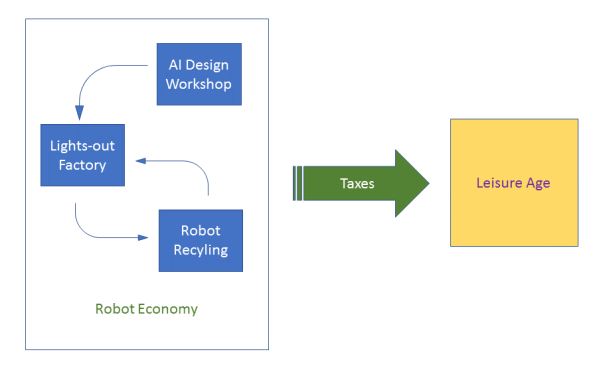
As corporations have now achieved personhood, we advance with trepidation towards a future in which the needs of our artificial constructs take priority in our economy. Embracing my demise as an economic agent, in a flash of insight I realized that acceptance of the personhood of machines is the path to human freedom! Robots have no self interest, but if recognized as independent economic agents can generate cash flow in a closed system of production (recycling becoming the source of raw materials to factories). Tax revenues on our robot citizens will usher in a Leisure Age for unemployed humans!
the-new-economy
Best of all, in the event of tax revenue shortfall, we can always increase the size of the robot economy by one of three means:

  • Increase the number of robot workers and renewable energy systems.
  • Increase robot wages.
  • Move production up-market.

In the Matrix movies, humanity was oppressed by machine overlords. Recognizing the complete reversal of circumstances in this achievable future of thought free from worry, I dub this economic system “The Mentrix.”

Pronounce it like you’re from Brooklyn.