To be Trolled, or Not to be Trolled

Trolling – posting a comment on a discussion forum for the sole purpose of creating hostility among the participants – is the most dangerous threat to the exchange of ideas on the web. The tech community is seeking to moderate the damage. Some new artificial intelligence engines profile accounts, others monitor for certain logical constructs (for example, any statements starting “You think…”).

Engadget reports that a site in Norway disallows a comment until the poster demonstrates knowledge of the main article. A script engine presents a multi-choice question generated from the article, and disallows comments until it is answered correctly.

What would be even better is if they would verify comment relevance against the original post and the previous comments in the thread. Given that a script is generating the questions, and a script is able to answer them, it seems that should be possible. Maybe that could be verified by a question posed to the poster?

Unfortunately, all of these solutions play into the hands of state-run trolls, such as the Russian “fake media” mills. By generating scripts that determine the correct answer, they can post far more efficiently than others, and thus come to dominate forum contents.

Here’s another option: build an AI engine that ranks the relevance of comments against the article and discussion, and allow readers to filter content against that ranking. That would enable those seeking serious discussion not just to be protected from trolls, but also to skip past comments that are just socializing. Offering “Good point!” is nice, but posted enough times and more substantial commentary falls off the bottom of the page.

A Proposal for Full Unemployment

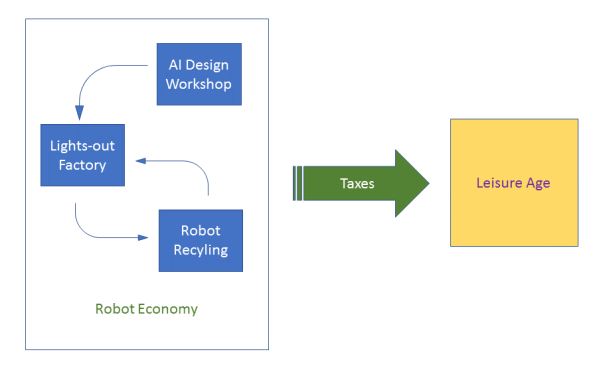
As corporations have now achieved personhood, we advance with trepidation towards a future in which the needs of our artificial constructs take priority in our economy. Embracing my demise as an economic agent, in a flash of insight I realized that acceptance of the personhood of machines is the path to human freedom! Robots have no self interest, but if recognized as independent economic agents can generate cash flow in a closed system of production (recycling becoming the source of raw materials to factories). Tax revenues on our robot citizens will usher in a Leisure Age for unemployed humans!
the-new-economy
Best of all, in the event of tax revenue shortfall, we can always increase the size of the robot economy by one of three means:

  • Increase the number of robot workers and renewable energy systems.
  • Increase robot wages.
  • Move production up-market.

In the Matrix movies, humanity was oppressed by machine overlords. Recognizing the complete reversal of circumstances in this achievable future of thought free from worry, I dub this economic system “The Mentrix.”

Pronounce it like you’re from Brooklyn.

Robin Hood Goes Digital

Kaspersky Labs, the digital security company, has reported that the technology used to attack Iran’s uranium production system (“Stuxnet”) has made its way into the banking system. The malware is hard to detect because it does not run from files – it exists only in memory, being passed from machine to machine over internal networks.

My comment is a meditation on the inevitability of this in exploitative corporate cultures.


Azethoth666 wrote:

>> Or perhaps its just taking them time to get around to everyone manually?

Considering the corporate culture of the American banking system, this seems highly likely. The post-mortem on the Wells Fargo account creation fraud was that management propagated unreasonable performance requirements, with the result that only fraudulent conduct by employees would produce the desire results. However, the executives, some of whom were ousted with huge bonuses, did not make the decision to commit fraud. They were protected from direct involvement by the decision made by employees fearing for their livelihoods.

That situation is ripe for exploitation by criminal elements, and in fact employees caught in that system would be likely to take a “Robin Hood” attitude to their compromise of corporate security.

Disassembling the Sith Lords

When I was working at Lawrence Livermore National Laboratory in 2004-5, I was housed in an uncleared “holding tank” while waiting for my security clearance to be approved. Many of my office mates were foreign guests that had come to pursue research projects as part of the Department of Energy’s effort to build an international non-proliferation community. Among them was a Bulgarian post-doc that swam aggressively through the psychic pool, claiming the talents of others as his own.

In a social gathering one evening, he found that he couldn’t gain any purchase on me, and instead attacked a close friend of mine. Understanding the ways of the world, I didn’t get upset, simply getting a good bead on him so that I could deal with him later.

That night, when I entered REM sleep I found myself having a series of dreams about the Russian mafia. It was like watching clips from movies. After being bounced through that psychic chain, I came suddenly awake while reading a sign that said “Hard Men.” I was in the presence of a man, deep in Russian, who visualized placing a gun against the top of my head. I could literally fell the pressure on my crown. Pausing to let fear take hold, he then pulled the trigger. I simply refused to accept the visualization, and felt the psychic energy flood out over the top of my head and along my skull.

He paused then, and I led him into a future possibility: “Do that again, and I’ll simply bounce the energy back on you. The visualization of harm is forming in your mind, and so you’ll be unable to prevent its affect from appearing in you. Do you want to go that way?”

He removed the gun and walked off into the psychic mist.

I was diagnosed with situational depression in the course of my divorce, and so couldn’t afford health care for myself when Kaiser identified it as a “pre-existing condition.” I regained my Kaiser enrolment as an LLNL employee, and on my calendar that next week was my first annual health exam. The doctor refused to do the physical assessment, offering only this elliptical explanation: “My father had a massive stroke last week.”

This was my first confrontation with the psychic network used by Vladimir Putin to project his will across the world. I started calling him “Mama Bear” in those encounters. While I can’t penetrate his control of Kremlin, I’ve been working the process described in my book Ma as the “Battle of Sequia.” Every time he reaches out to beat up on good people, I connect with the peace-loving birds and animals of Russia, and take another chunk of land away from him.

In the review of my book Golem, the writer avers:

[Dr.] Balke has a Ph.D in particle physics, so he understands better than most of us the true potentialities of the forces he describes in this paean to our own little piece of green, the planet Earth. Surprisingly, perhaps, for a scientist, Balke gives final and absolute credit to Yeshua, an obvious stand-in for the messianic father of all.

This is true, to a point: the community of particle physicists no longer accepts me. The understanding that Love has allowed me regarding the structure of the universe is uniquely my own. So I possess visualizations of psychic processes that no other does.

The efficacy of these visualizations gives me the confidence to respond pithily to threatening figures such as Stephen Bannon, who yesterday told the liberal press to “Shut up,” claiming that “they didn’t understand how Donald Trump became president” before referring the himself as the “Dark Lord of the Sith.” On the NY Times site (copied to my Facebook timeline) I responded:

Lolz. Dear Bannon, you’re so cute. Trump was elected because his voters wanted to throw an IED into our constitutional system. Unfortunately, IEDs are consumed in the course of manifesting the intended effect. Enjoy the ride!

There is a strong bond between Trump and Putin: I perceived it clearly when watching a clip of Ryan and Trump trying to suborn the will of Chuck Schumer. Ryan smirked like a viper in the background while Trump loomed bearishly over the victim. So Putin (“Mama Bear”) was in the wings when Bannon came to confront me last night.

Psychic parasites achieve their power by using their emotional apparatus to project fear into their victims. But that apparatus was patterned on God’s image: it thrills to the touch of love. So when Bannon came at me, I simply used my visualizations to peel away that part of his personality, telling it:

Come over here where you won’t be abused.

Republicans probably take offense at my political commentary, most directly characterized by Jesus’s edict:

You cannot love both God and money.

But I have been here before: in the aftermath of 9/11, when Dick Cheney and Karl Rove played at being Sith Lords in the psychic field of another poor little rich boy president. In that era, I was again threatened with physical and psychic violence. My response was to pull forward the image of Obi-Wan Kenobi in the Death Star:

Destroy me now and I will become far more powerful than you can possibly imagine.

They perceive the endpoint of my visualizations, and walk away. I am less powerful alive than I would be dead – principally because I am still restrained by hope.

If only Hollywood understood the potentiality of love. I’ve done my best to explain it to them, but they are in the habit of trying to turn understanding into money. It is repulsed by their greed, and slips away. So the public is left without empowering visualizations. Instead, when they gather in hope, as at the Women’s March last Saturday, love stretches out to them as a warm affirmation and comforting bond in which they gather the power and will to resist fear.

You are undone, you Sith Lords. You are undone, you bears, eagles, lions, hawks, leopards, vultures and wolves.

You just haven’t yet resigned yourselves to it.

On Politics and Altruism

The Huffington Post has picked up on the clarion call sounded by Judith Herman and others regarding their psychological profile of Donald Trump. Cynics respond that all politicians are power-seeking, and therefore possess significant personality defects. While that may be so, brains do evolve as we mature.

The brain is plastic, and evolves structures as we age that are responsible for socialization. The most evolved structure, which doesn’t appear until most are in their twenties, is responsible for the expression of altruism. Sociopathy (which I see manifested clearly in Trump’s behavior) is the tendency to treat other people as objects. It is indicative of a lack of even the most basic structures of socialization that are entrained with nursing, which delivers the most basic of rewards for collaboration. Forget psychoanalysis: scans of brain activity reveal whether people have even the basic machinery necessary for responsible leadership of others. My guess is that Trump is seriously deficient in that regard.

Louis Cozolino, who teaches at Pepperdine University, also has a practice in psychotherapy that guides adults through experiences that help them to evolve the neurological mechanisms of socialization (see The Neuroscience of Human Relationships). In other words, there are methods for treatment of these disorders, and we should try to educate the electorate to prefer politicians that engage in such counseling. Altruism is the ability to act for the good of others, and is something that everyone should prefer in political leaders.

Of course, the fullest flowering of altruism appears in our great spiritual leaders – those whose service is pursued without any external evidence of seeking for power. It is granted to them by the world they serve. One of my favorite quotes is from Tagore, the educator and poet who was Gandhi’s cultural collaborator:

Power said to the World, “You are mine.”
The World kept it prisoner on her throne.

Love said to the World “I am yours.”
The World gave it the freedom of her house.

In my post Man and Woman, I flirted with the assertion that the capacity to express altruism (characterized as “unconditional love” in that context) is what made Adam and Eve fully human. Conversely, from a psychological perspective, sociopaths are little more than lizards.

Jobs Jobbing

Steven Bannon is spinning his political agenda as “jobs, jobs, jobs.” His candidate, Donald Trump, is pushing three methods for creating jobs. The first is tax cuts for the wealthy and business, a replay of the failed “trickle down” economics first foisted upon us by Reagan. The second is to protect American jobs from foreigners by restructuring our trade relationships and deportation of illegal immigrants. Finally, we have infrastructure spending, long a Democratic priority frustrated by the Republican Party’s “no new taxes” policy that has locked the federal gas tax at $0.28 per gallon.

None of these proposals make much sense over the long term. Since Reagan, top-down stimulus policies have resulted in the largest income disparity in the nation’s history, with manufacturing jobs replaced by retail work. Overseas workers are themselves being displaced by automation, with electronics manufacturer Foxconn in China laying off 60,000 workers this year after installing robots, and illegal immigrants do the jobs that Americans won’t. Finally, infrastructure spending is not a permanent solution to unemployment – it will only make a significant dent now because the situation has been allowed to become so dire, with so many bridges, roads and dams in danger of collapse.

The future of employment was cast in a new light for me by a recent OECD study on computer use. In an assessment of users in advanced economies, the study revealed that only one-third of users could do more than fill out forms. This was also typical of most manufacturing jobs. As variability in sources of supply were reduced, it was less and less that the skills of the craftsman were required. Workers were trained to perform procedures.

Unfortunately, artificial intelligence and automation is assuming most of those tasks. Cortana will fill out our order forms for us. The Army is testing robot chefs that learn to cook watching videos on YouTube. In the near future, self-driving trucks will begin to erode the last great mainstay of blue-collar work, throwing 5 million drivers out of work.

From my experience as a fab tech in college, I know that it wasn’t the work that made such jobs enjoyable. People whose minds aren’t engaged by their work invest that energy in politics – whether innocent socialization or profiteering. During a year spent routing, sanding and soldering, my peers would disrupt each others concentration by squirting isopropyl alcohol on unsuspecting bums. And while I was building book cases using a wood working shop owned by one of the technicians, he took me out to a party run by a packer who had built a cinder block building behind his house stocked with goods that had “accidentally” fallen off of the forklift. I came away with stain and varnish.

While both examples sound abusive, they demonstrate an aspect of work that no machine will ever be able to replicate: building trust that allows us to have fun. Studies of laughter among apes shows that it serves primarily to indicate that aggressive behavior is regulated by empathy. Scratching, biting and hitting doesn’t progress, except accidentally, to actual injury.

One interpretation of our 24×7 political system is that this activity is being elevated as work in its own right. It is currently financed principally by mining out of the wealth held in the middle class commons. On the one hand, financial services companies no longer take a percentage of portfolio gains, they reap a service charge on each transaction, regardless of gain to the investor. Churning of retirement funds transfers wealth to the financial elite. That elite then finances the careers of politicians that vote for deregulation and lower taxes. The middle class, sensing incipient doom, then commits from its remaining wealth to fund the campaigns of revolutionaries such as Bernie Sanders and Donald Trump.

This impulse toward social cohesion is not always driven by desperation. Regional currency systems ensure that neighbors buy from each other, conserving wealth in a form that the money-center financiers can’t access. Sustainable multi-crop farming requires ten times as many workers as monoculture. With the spread of artificial intelligence and augmented reality, the inefficiencies and environmental degradations of family farming can be overcome, and communities rebuilt around the social cohesion that historically characterized agricultural societies.

My friend Sister Gloria celebrates her resuscitation of plants that appear to be dead in their pots. She simply applies her will to their survival. The biological capacity to heal through spiritual investment is explored in more depth in Stephen Harrod Buhner’s beautiful treatise, The Lost Language of Plants (reviewed here and here). This is the skill exercised by our nurses, and expressed as nurturing by teachers. It is a skill that our captains of finance and industry, so focused on exploiting resources to capture wealth, have been hostile to for thousands of years.

It is faith in this capacity that I believe will restore our broken political and economic systems. This capacity of intuition, that guides living things into a mutually supportive future free of fear, will be supplemented and supported by information systems that analyze information and prescribe treatments. Those decisions, however, are meaningless without the fundamental benefit of nurturance: the transmission of the spark of joy that fortifies our desire to survive.

As was the industrial age, this economic transformation will be frightening to those that cannot perceive its virtues. We are seeing such a fundamental shift. I doubt that Donald Trump and Stephen Bannon understand its nature, for they attained power by trumpeting doom. What they fail to understand is that in the new era, it is exactly those social and emotional skills that cemented the cohesion of industrial teams that will be of most value. The information age will unleash the nurturing potential that was held captive by the industrial age, ushering in an age of healing and sustainability.

Inerrancy

When I began taking flute lessons again at 50, my teacher kept on insisting that I needed to record my practice sessions. I understood why: I was substituting speed for clarity and precision. The notes came out in a blur that began and ended on the right notes, but that didn’t communicate anything in the middle.

But the thing is that I conditioned myself to that expectation of velocity, and I’ve stuck with it, slowly eliminating the extraneous motion and learning to focus the air flow. I’m beginning to sound like a flautist.

This was particularly apparent today after I came back from Dance Tribe in Santa Barbara. I felt like playing dirges, and since I don’t have any in sheet music, I just played slowly. I was pleasantly surprised by the clarity of tone.

I’ve been calling patiently to Hillary all week, and resolved to dance this morning for healing. While waiting for the doors to open, I offered Out of Eden’s Every Move I Make and the Katina’s Draw Me Close. I got part way through Sheena Wellington’s The Christ Child’s Lullaby before cutting inadvertently over to Lauren Daigle’s I Am Yours. Fifteen minutes of tears later, I realized that I could have taken another path: Shiva’s Dance of Destruction. But I held my resolve, and spent most of the first hour of the dance working my way in to the root of the pain. When it was over, I thought “You know, Hillary, your pain is a link to the things that beset us.” I walked out into the sunlight, and made them present to the Ancient of Days.

Yes, that is an intentional reference to Daniel 10.

I am hardly proud of all this trauma. Particularly because much of it originates in Christian confusion – this idea that we are “one nation under God,” which means that the Bible should be the moral law of the land.

I finally heard an interviewee on NPR explain the Evangelical premise: Christian faith requires conversion of the heart, and a belief in the inerrancy of God’s word. Politically, that departs from the ten commandments, headlined by “thou shalt not kill,” and continues through pro-life logic to a determination to see the Supreme Court recomposed to overturn Roe v. Wade. It was that determination that caused almost all white evangelicals to vote for Donald Trump.

I could tell them that they are wrong – wrong all down the line. Jesus reminds us that God “desire[s] mercy, not sacrifice.” He commands us to “render unto Caesar that which is Caesar’s.” As promised in Jeremiah, Jesus dethrones the law, eliding it to “Love God and your neighbor.”

Why does he do this? Because the Law is not God’s word. Read the covenant with Noah: “By man shall man be judged.” The whole of the Pentateuch is a lesson in natural consequences – that threatening people doesn’t lead them to do good, it just corrupts those that mete out punishment. It’s not God’s Law, it’s man’s law propagated under the authority granted by God. This is why Jesus casts the law aside.

Look even at “Thou shalt not kill.” What does that mean? Only people, or does it also include other forms of life? And what about the capital punishments of Leviticus, or the genocide of Deuteronomy? The only conclusion to be drawn from the progression is that human priorities were present in the Law from the beginning.

So why was the Law allowed to persist? Because it served the purpose of building the capacity to reason in God’s chosen people. That fragile tool allows us to overcome our animal instincts, discerning and strengthening creative behaviors.

Jesus came when enough people were prepared to recognize the lesson delivered by the law of natural consequences – the religious and political practices of his era were a terrible abuse of faith. The people’s hunger for truth and justice caused many to accept the invitation to “follow.”

So what about our world today? There are still those that need the discipline of reason, and should they chose to follow some version of the Bible’s ethical code, that’s good for them. But there are also those that envision bringing a child into this world, and dread the prospect that that child will live a life twisted by fear and want, or casually crushed by violence. They know what it’s done to their lives, and they can’t imagine that anyone would want to repeat that experience. And then we have those that wish to have a child, but want to do it under the right circumstances, when all the benefits of family and community can be at their disposal as they grow.

None of us are inerrant. Even Jesus protested “Why do you call me ‘Master’? There is only one that is good.” We all make mistakes, and those mistakes cause us pain. Love is the tool that heals us of the consequences of our mistakes. Jesus tells us to love God because it calls that healing power closer to us. Jesus tells us to love our neighbors because that allows God to see them clearly, and so to heal them most effectively.

The soul of the aborted child will find a loving family capable of providing for its security and growth. Is that not what it would desire?

Maybe, then, we should think of the “Word of God” in the way the John invoked it: the logos that was and is with God. The source of all creative power, the force that amplifies all that is good. Simply and wholly: Love. In its infinite possibilities, love overwhelms any law of human reason. It leads people through error into repentance, and thus to wisdom. It prepares them to do better next time, rather than denying them the right to try at all.

From this perspective, all the dross of human vanity and folly falls away from Scripture. It reads as Jesus characterized it: the effort of a loving “daddy” to guide his children into maturity.

We shouldn’t be in such a hurry to write perfect laws, for love undoes the strictures of government. It is an error to chain it to law, for when the Kingdom arrives, government will fall away. We will all have the benefit of the wisdom of the Holy Spirit, and so no law except the song of compassion in our hearts.

Hillary: Next Steps

The fundamental problem with Bernie Sanders’ socialist agenda is that governments do not respond to the needs of individuals. In delivering services, they must categorize people and compartmentalize society.

I think that Hillary and I agree that the suffering of the American middle class demonstrates that reality. Prior to the neoconservative takeover of the Republican Party, the middle class financed college education by paying itself 7% interest for loans against deposits that earned 6% interest. The deregulation of the Savings and Loan industry under Reagan was the beginning of a long tilt of the playing field, under the auspices of government, against the middle class in favor of the economic elite. This extended not only to the financial services industry, but also to the CEOs that run Main Street, men and women that dilute our pension plans by awarding each other enormous stock options packages.

Where Sanders sought to lead a messianic revolt against the system that threatens to throw the baby out with the bath water, Clinton proposed a more modest program of adjustment. Sanders, with his unfounded charges of corruption against both Clinton and the DNC, validated Trump’s campaign rhetoric. He has as much to do with the loss as anyone, and for him to claim the mantle of the progressive movement is hypocritical in the extreme.

So the electoral and political system is broken. We’re going to have to solve our problems ourselves. As a Christian, I see it this way: the idol of the federal government has been cast down. We can no longer seek security through claims of justice against the public purse. We must rely upon the compassion of others.

Love is the only path forward.

So where does this leave the candidate that I still honor? Well, finally able to focus her full powers on charitable work. Hillary, take the Clinton Global Initiative into Detroit and Flint and Cleveland. Side-step the broken federal system, and bind people together, face-to-face, hand-to-hand, in the glorious promise of healing that transcends geographical, political and national boundaries.

I am certain that Christ will join you there.