Walking with Grace

Reply to this post by Caralyn out at Beauty Beyond Bones:


Hey, Caralyn-

Great post. I hope that somebody takes the time to stop you on the street and share what a light you are. I know that you get that here, but sometimes that affirmation doesn’t transfer until it’s expressed in the specific context.

This came to mind: a friend told me that one day she saw Princess Diana walking from her hotel to a limo in NYC. Diana stopped and simply waved her hand slowly along the street. My friend said that she felt the grace wash over her.

We can do that. We can call God into the world and allow his love to wash over others in a way that they can feel palpably. The trick is to only let go of the angels that are guided by our love when they land on somebody that will employ them to love others. Otherwise we need to pull them back into our hearts. As they come to trust our judgment with greater and greater certainty, they gather around us more densely. This is what Jesus meant when he said “To those that have, more will be given. And to those that have not, even what they have will be taken from them.”

I realize that for women this can be a little like walking off the end of the pier. Some men will misinterpret. But you don’t have to be visible to make it happen. You can be looking out a window, riding by in a car, or passing in a train.

I hope that you don’t mind my writing a sermon. I know that you’ve experienced this. I just want others to join in the process. When the joining of our little bubbles persists, the world will be changed. People will realize that they have a choice between the pain of the world the live in and the joy that surrounds those blessed by grace (which is to be given the support of angels in loving others).

Wishing joy, grace and love upon you in all things,

Brian

Me, Myself and Christ: Awakening

During the preteen years growing up in Palos Verdes, a recurring dream was of the five of us children gathered in the front yard. My sister jumped gently into the air and floated toward the hill above the school, and the rest of us followed.

I now recognize that dream as a plea from our over-stressed mother. While she was preparing dinner, we typically rambled over the chaparral-covered hill until our father came home and yelled “Children! Dinner-time!”

A number of factors contributed to my failure to recognize this and other early experiences of authentic spirituality. The most important were two instances of trying to open up to a new friend. I had this sense of them falling into an enormous space inside of me, which was followed by the panicked telepathic plea “Help! I’m falling!” My conclusion was that I was dangerous to people, and I did my best to shut them out.

My father made an attempt to make me aware of the impact I had on people. The force with which I followed ideas to their conclusions found me often finishing peoples’ sentences for them. After one such experience, he asked me whether I was aware of how I did that. I caught a glimpse of that larger self that has taken over my life in the last fifteen years, and shrugged my shoulders “I guess.” His advised me that I could use that power to get people to do what I wanted. The immediate reply was “But that wouldn’t be fair.”

This was echoed in a distinction I made in college between being a nice person and a good person. “Nice” people solve problems for others; “good” people give them the power to solve the problems themselves. While on the one hand the distinction recognizes the disaster that befalls a dependent when they lose their provider to mortality, it also reflected my sense that people come into life with a purpose to accomplish, and the lessons learned through that process could only be internalized if their free will was preserved.

But my avoidance of spiritual experience also had a dark side. When I left home, I was beset by a deep fear of intimacy. Contributing to that was the terrible eczema that disfigured me in high school, but the fear of intimacy affected even relatively impersonal communications over the phone and e-mail. When I attempted to address this fear, the voices that came out of my subconscious insisted that the consequence of intimacy was pain and suffering.

I have recounted the breaking of my psychic barriers elsewhere, but as the first really deep joy in my adult life, it bears repeating. I was under a great deal of legal, personal and professional pressure at the time, and dangerously deprived of sleep. About three weeks before Christmas, I began waking at four in the morning with the sense that there was a rhythmic pressure all over my body. The pressure became stronger and stronger each morning, and in the second week, was accompanied with a gentle encouragement. “Let me in. Let me in.” On the final morning, the encouragement became a demand. “LET ME IN! LET ME IN!” Deciding that either I needed to confront incipient insanity or that life had some secrets that I desperately needed to know, I submitted. I felt as though a wall had collapsed around me. I had a dim vision of a woman looking over her left shoulder at me. She said:

You are a beautiful man. Do not allow yourself to be destroyed.

Much of the last fifteen years has been an elaboration of that command.

Exorcising the demon of my fear was a major part of the effort, principally through blogging in various forums. I started at Gaia, the spirituality social network, under the soubriquet “Trichronos.” I described in fair detail my spiritual experiences, thinking that I was publishing anonymously, only to discover that the URLs for the posts contained my full name. When Gaia rolled over to ning, I re-published the posts as “Imaginings” at http://www.everdeepening.org, and began blogging at Gaia under my real name. I received strong affirmations from members of that group, but a number of them were refugees from Christianity (some traumatically so), and almost all of them were retired or ministers, which meant that my thoughts in the discussion groups were lost in a blizzard of socializing. Frustrated by the spread of pseudo-science and misinformation about Christianity, I finally began blogging at WordPress where I could have greater control over the framing of the conversation.

This might seem a long and indirect process for dealing with a fairly simple problem. But the shedding of my inhibitions came with increasing closeness to that “larger self” mentioned in my recounting of that conversation with my father. Under the influence of a group of people desperately opposed to my manifestation, my father always spoke deprecatingly of my spiritual journey. So it was to him that this message was finally revealed:

I have conducted myself as I have in this life in order to give my opposition the chance to do the right thing.

Of course, that assertion can only be justifiable if they knew that an authority had come to relieve them of their confusion. In the final post under this heading, I’ll explain how that has evolved.

But first, I have to share how I finally came to Christ.

Infestation

In decrying injustice, we tend to focus on the tall nails – the people with power that misuse it. In the end, though, these people really do not amount to much, because the power accumulated in love is so much greater than the power that they can scrape together here on Earth.

Rather, it’s the “scraping together” that is so hard to overcome. It’s like a disease of a certain type. We have these gifts all around us to use in healing the wounds left in us by selfishness. These gifts include food, air, light and companionship. The disease is to consume those gifts and do nothing with them while others do the work of bringing love into the world.

Anyone that has had the flu knows what it’s like to host this kind of activity. Jesus’ teaching on the matter reflects that reality. At the end of the parable of the talents, he commands [ESV Matt. 25:30]:

…cast the worthless servant into the outer darkness. In that place there will be weeping and gnashing of teeth.

This metaphor is the prop for conservative political philosophy. Indeed, the only coherent definition of “Conservatism” holds that institutions are extremely difficult to create, and are the first thing to collapse when resources are wanting. Therefore they must be conserved at all cost against the locust-like masses.

Unfortunately , the trap that has snared so many Christian Conservatives is built right into the parable of the talents. It is the convention that money is the measure of value, and so we weigh the contributions of our companions by the wealth they have accumulated. As explained in The Soul Comes First, however, Jesus’ reference to wealth was intended to be ironical. The parable was offered to a collection of disciples that didn’t have two minahs to rub together on the road to Jerusalem. Jesus didn’t inspire them with wealth – he inspired them with courage, purpose and faith. The disciples were being cautioned to mind that investment, and seek to expand its reach.

If on the cross Jesus took sin into himself to heal its effects, how would infestation have manifested in the project of Christ? Today I see it in ministers that substitute rigid rules for compassionate and creative problem-solving. It manifests more subtly in the queen bee that organizes social pressure to protect husbands and ministers threatened by those that seek to put love before convention. But it is also in those that come to church on Sunday seeking forgiveness for the sins they commit every other day of the week.

In my own case, I’ve been struggling for some time with another manifestation of infestation – a purely spiritual manifestation. In the great struggle against selfishness, there are personalities that live by the zones in which pressure builds. They siphon away energy, creating little kingdoms without contributing to the creation of a world guided by love.

Addicts call theirs “the monkey on my back.” In my own case, it’s been described as a fairy that chops at the side of my head with an axe. It’s been a source of injury to me. I’m not certain that was its intention, but in trying to manage my influence on the community I love, it’s drawn in all kinds of sin. Inevitably, it’s become infected itself.

Down at LA Ecstatic Dance yesterday (my last dance with them, unfortunately), Ataseia got me on the massage table and tried to push it out. He was really conscious of the process, pulling its roots out of my back and arms to push it up into my left shoulder, and then through my neck and up toward the crown chakra.

The immediate benefit has been a greater sense of connection to the left side of my body. But I’m not ready to let it go yet. It’s tied to one of those kingdoms I mentioned, and now that I’ve got it up in my mind, it’s time to cast some light into that realm. They’ve had their reasons for hiding, but now it’s time to put their talents to good use. While the rulers of that realm will resist the loss of autonomy, I’ve found that most subjects will embrace enthusiastically the opportunities presented to them.

It’s not the last such problem I’ve got to deal with – there is something wound about my waist that doesn’t respond to reason.

I offer this today to stimulate similar introspection in others. Each of us has a world inside, and some of those worlds are rich enough to support independent personalities. To discipline them to loving is necessary to our own immersion in Christ.

Sexual Modesty

I’ve signed up with the Universal Life Church, and came across this post on female sexual modesty. It tends to emphasize the negative impact of religion as implemented in repressive cultures: I am aware that many religions have teachings that celebrate and heighten sexual experience, most commonly known through the discipline of the Tantra. But I also think that the post tends to see religion principally as a political activity, which misses its purpose.

My response follows:


Much of what is presented here is not limited to religion – modesty in dress and control of women’s bodies has a long cultural pedigree. This should not be surprising: perhaps the most powerful biological urge we have inherited from our Darwinian past is the procreative urge. Religion is not the source of the difficulty we have in managing it, nor is it surprising that people with principally secular motives (property inheritance, for example) often project their program into the religious sphere.

But I think that there’s also a talking past the point of the religious proscriptions. Let me offer a definition: taking religion as management of our spirituality, and spirituality as the negotiation of the boundaries between the “I” and the “we,” the proscriptions have to do with preventing our spiritual landscape from being polluted by lust.

Our society tends to facilitate that pollution in two ways: by celebrating adolescent sexual license, and by limiting our opportunities to express self-love. Intercourse is often the only time that we are allowed to really enjoy our bodies. Even in exercise, our culture has so objectified the outcomes of that effort (both in terms of our self-image and competition) that we rarely enjoy sports.

Here’s an experience: I was doing child-care at a battered woman’s shelter, and the children liked to have me push them on the swing. One night, I was pushing a seven-year-old on the swing, and began to get a distinct feeling of sexual arousal. I stopped pushing the swing and said “I would appreciate it if you would keep your energy HERE” – placing my hands on her heart – “and HERE” – putting my hands on either side of here cranium. The sexual feelings evaporated, and when I began pushing her again, she shook her head and laughed with joy.

You see, she was managing me in the same way that her mother managed her abusive father. I was mature enough to recognize that and demonstrate that a caring man encourages women to manifest other potentials.

So I tend to side with the Rabbi here: little girls should cover their bodies. I also understand why some women in orthodox religions wish to avoid revealing their bodies to lust-filled men. On the other side, I have explained to my sons how to manage unwanted attentions coming from women.

As science currently offers us no explanation or tools for managing our spirituality (except drugs, unfortunately), we need religion. I would also agree that we need religion to do better that command prohibition. But I don’t think that the spiritual aspect of the problem can be ignored. I recommend the chakra model in the vedantic traditions

In Coherence

The philosopher Ludwig Wittgenstein proposed a final solution for philosophy in his twenties, and then took up teaching and gardening until he realized that people were abusing his intellectual authority. Strangely, that authority arose from his insistence that much of what philosophers wrote shouldn’t be considered philosophy, because it was concerned with matters that could not be decided. Taking a less charitable perspective, Wittgenstein set himself up as arbiter of what was and was not philosophy, and his desperate peers submitted to the force of his intellect.

I wonder whether Wittgenstein recognized the similarities to the program undertaken by Socrates in ancient Athens. Socrates, assuming that he knew nothing, went about seeking wisdom. In questioning the ethical reasoning of his peers, he exposed the inconsistency of their precepts. Having clarified the relationships between theory and practice, Socrates (as represented by Plato) then proposed his own solutions to the ethical problems of the day.

To the outside observer, the similarity between Wittgenstein and Socrates might be cause for despair. After nearly three millennia, the same fundamental problem remains: no philosophy has stood the test of its application. Actually, that’s not entirely true: philosophy spins off independent disciplines, many of which are phenomenally successful. Philosophy is left with the hard questions, questions concerning ultimate truth and meaning that are difficult to pin down in a rapidly evolving culture. Where in tribal societies the concerns of the parent are inherited by the child, the information age has decoupled the generations. Thus every generation must invent anew – and necessarily either reformulate the truths of the past, or relearn them after decrying their irrelevance.

In general, we find two threads of philosophical practice in response to this dilemma: play the role of Socrates in every generation, or seek to narrow the scope of philosophy to matters susceptible to the fashionable tools of the day. Strangely, the histories of philosophy are dominated by the latter, though the arguments become more and more arcane in every generation. Each luminary writes principally in opposition to his or her immediate predecessors, and so can often be understood only in that context. This leads to some repetition in every third of fourth generation, as the reaction against the reaction re-iterates the original thinker, although the increasingly obscure terminology may hide that fact. Thus around 1800 we find Kant speaking of phenomena (our description of events) and noumena (the events in themselves), and concluding that while we cannot guarantee that the former reflects accurately the latter, our survival as a species implies that there must be some correspondence. Of course, this is just what Socrates offered 2600 years earlier in his parable of the cave.

Socrates proposed that universal education should be offered to ensure that citizens possessed the skills to maximize the correspondence between experience and description. Following Kant, it was the psychologists and neurophysiologists that took up the problem, seeking to illuminate the physiology that links experience to thoughts. The first flowering of that effort was in the work of Sigmund Freud. As presented in Ideas: Invention from Fire to Freud, the early psychoanalysts stood on the brink of building a complete theory of human culture, but Freud drew back when confronted with the non-local spiritual experience of women that reported being molested by men at a distance. Freud’s conclusion was that he was being manipulated by his patients, and he abandoned his inquiries.

One consistent thread in philosophy is fertilization by its progeny. The insights of physics, chemistry and biology illuminate and constrain the forms of experience, and so clarify the analysis of the philosopher. The progeny, however, also narrow the scope of their study to exclude that which cannot be explained. For this reason, I tend to trust the original thinkers – the ancient Greeks, Hindus and Chinese – who reported their experience without the filter of professional respectability. I assert that Freud was hamstrung by this prejudice. As regards the matter of spirituality, I’ll defer to the ancients.

This long introduction serves to motivate what follows: I believe that the program of the early philosophers had an element that was missing in latter generations. They recognized the potential of the intellect, and sought to strengthen it. They were not concerned narrowly with truth, which seduces with its promises of certain deduction. Instead, they sought to build power in humanity as a whole – perhaps simply so they could have more interesting conversations. Be that as it may, in reading the history of philosophy, I believe that much controversy can be settled by advancing a model of intellect, and recognizing that philosophers that spoke with greatest certainty were those predisposed to focus on specific aspects of the intellect, thereby simplifying what evidently is an intractably complex problem.

That they belittled their predecessors reflected the assumption that all minds operate alike, an error that our autistic brothers and sisters are now forcing us to confront. Taking individual variation in the intellect as a given, the history of philosophical study can be mined to reveal its full richness.

This post builds on the propositions originally formulated in Ideas, Ideally. It adds pretty pictures that will hopefully make the model of intellect more apprehensible.

The Role of Intellect

Recognizing that humanity’s evolutionary advantage is in the power of our minds, I have proposed to define intellect as the faculty that synthesizes our mental states. To understand the operation of intellect, we must first characterize our mental states, and then explore the possibilities for their synthesis.

Survival is a manifestation of successful relation to the world. When beginning to enumerate mental states, we benefit by considering the structure of those relationships. As concerns the mind, I recognize four immediate categories of relation, three of which are exhibited in equal degree by most animals. Of those first three, I differentiate sensory perception of our environment from the intimate physiological response of emotions. These two are most immediately concerned with our survival – the latter as the feedback signal that regulates our interaction with the world around us. The third category consists of spiritual influences that organize collective behaviors – such as the swarming attacks of bees – that may not serve the survival of the individual.

These three categories define the intellectual dynamic of Darwinian evolution, behaviors that we classify as instinctual. Even among creatures lacking a nervous system, intellect still operates, just through tissues and organs that are either less malleable or less effective at encoding information. In an herbivore, the emotion of hunger stimulates foraging, a complex interaction of muscles to navigate the sensed physical environment to locate food. Success is rewarded by satiation, and possibly sufficient surplus of energy to trigger the emotions that drive mating. As this simple illustration suggests, the intellect manifests as behaviors that couple sensation and emotion.

AnimalBut the feedback is more widespread than the example suggests. Modern ecosystems are chemically determined by the existence of life: free oxygen, soil and the food chain are all side effects of biochemistry. The physical and chemical environment determines sensation. More subtly, the same holds true in the realm of spirit, which contains reservoirs of energy and intention that can become enmeshed in the external world, influencing the emotions of living things, and consequently their behaviors. Through that interaction, the spiritual reservoirs are themselves modified. In part, that reflects that physical commonality of spiritual interaction with metabolic activity (See That’s the Spirit). Spiritual forms can gain energy and spread influence through their interaction with matter, including biological forms. Finally, emotion drives the behavior of living creatures, determining how they modify their ecosystem. Successful individuals achieve dominance in part by attracting spiritual energies that force others to support their behavior.

Recognizing the significance of the interaction between biological and spiritual forms, I find it useful to think of life as their co-evolution. Without that coupling, geology and chemistry would hold sway over the earth without any meaningful purpose.

O, Humanity!

Multicellular organisms dominate their ecosystem by optimizing the chemical environment of cells specialized to perform specific functions. Most obvious in many cases is the differentiation between the protective dermis and the organs of digestion that produce refined foodstuff for the dermis. In the case of the higher animals, of course, the specialization and organization of cells is wondrous. The layers of skin, the placement and density of follicles and sensory bulbs of nerves: these boggle our comprehension.

The evolution of multicellular organisms reflects two requirements: distribution and coordination. The first is obviously seen in the circulatory systems that distribute gases and fluids, but it is also manifested in the skeletal system that translates muscle contractions into motion. Coordination is also implemented through the circulatory system via the release of hormones that affect the organism as a whole. The nervous system is far more refined in its targeting, using the transmission of electrical signals to coordinate the behavior of specific tissues.

While the history of cellular innovation may never be known, the miracle of thought became inevitable when nerves evolved structures that chained the transmission of electrical signals along networks of nerves. This meant that the instinctual behaviors once triggered by sensation and spirit could be induced without the original stimulus by the firing of a nerve. This is accomplished most efficiently by the clustering of nerves in nodes, the most significant being the brain. In the higher animals, the progressive reallocation of metabolic resources to the brain is evidence of the benefits of signal processing by networks of nerves.

In the early stages, the signal processing provided by the brain stem was focused primarily on individual survival and procreation. Even today, reptiles are rarely social creatures. In birds and mammals, the limbic system manages social behaviors, while the cortex supports higher forms of thought.
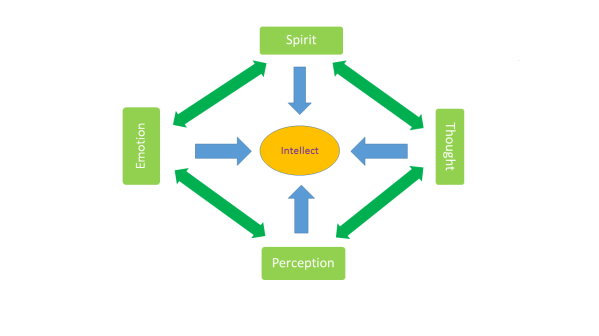
IntellectSo what is thought? In On Intellect, Jeff Hawkins of the Redwood Neuroscience Institute summarized the science that demonstrates that the cortex is a structure that categorizes experience to coordinate behavior. While initially that categorization would have been focused on the first three categories of intellectual stimulus, by the mechanism of network stimulation, eventually the internal operation of the network would have become an independent source of intellectual stimulus. Thus arose thought: the stimulation of the intellect by the brain.

Obviously thought has an ancient lineage, dating back even to insects. But full expression of its potentiality required coupling of that capacity to skills that could be used to reorganize the environment and thus control sensation. Birds and octopi manifest that to a limited extent, but primates to a degree that flowered to environmental dominance with the arrival of homo sapiens sapiens. We create tools that allow us to enhance our biology in real time, where every prior creature was allowed that opportunity – and then only imprecisely – through procreation.

While today we tend to emphasize the power of our material tools, the brain also allows a far more precise interaction with the spiritual realm. I understand that souls are composed of electrical charge decoupled from mass. Nerves channel and interpret the flow of electrical charge. As regards the emotions, nerves also affect our endocrine glands, muscles, organs and metabolism. Thus the brain provides methods for coupling thought to spirit and emotion, methods that are far more powerful than the couplings previously available to intellect.

As the influence of spirit is most evident in social activity, we should note the importance of language in facilitating the coupling of spirit to thought. While all mental states are abstractions of the underlying reality, words alone are capable of conveying our apprehension of that reality to another. Modern cultures are rooted in the conventions adopted for the association of words with experience. The ability of communities to coordinate effort to solve problems depends on the consistency and integrity of their use. Communities that honor clarity and honesty evolve social structures that may manifest as completely new forms of spirit. The ancients recognized these as “gods.”

Love of Wisdom

I have proposed to characterize Philosophy – the “love of wisdom” sought by the ancient Greeks – as study of the operation of the intellect. Here I understand intellect not narrowly as a manifestation of reason, but broadly as any process that couples the behavior of a living organism to the world around it. Intellect, in this view, mediates the interplay of the elements of reality through living creatures. Bringing together in humanity the dexterity and strength to create tools with the capacity of thought, nature manifested the potential to outgrow Darwin’s evolution through natural selection. Philosophers seek to organize that effort.

If that effort occurred in a vacuum, we might better be able to measure our progress. But it does not. Humanity is the culmination of a billion years over which life insinuated itself into the material substrate of the earth. That integration involves enormous amounts of energy, and disruption of the natural order threatens all of the higher lifeforms with extinction. The complexity of ecosystems makes it almost impossible to predict accurately the consequences of human intervention, and our facility with tools means that often we are the last creatures to feel the full force of disruption. Whether through clear-cutting of forests, the suffocation of once-fertile soils with covers of asphalt and concrete or the ubiquity of air conditioning, in fact our disruption of ecosystems often produces immediate advantage for us.

Our indulgence of those opportunities is a sign of dangerous immaturity. That immaturity is most dangerous in two scenarios. The first is when our primitive animal instincts infect our thinking, causing us to engage in contests for dominance using the most sophisticated tools that we can create. During the Cold War, the world as a whole was threatened by the nuclear arms race. While most nations appear to have recognized the insanity of direct military conflict, many nations still seek to define spheres of cultural hegemony through practices that require profligate consumption of fossil fuels. Unless reversed, that consumption will see human civilization destroyed by global warming. This second threat – the danger of inattention – manifests over many generations, and while no less deadly is far harder to address, not least because in the short term many beneficial outcomes accrue to the exploiting communities.

Under such circumstances, most parents deny children access to firearms and matches. And so it is with our spiritual predecessors. As they began to understand our potential by exploration of our minds, they have been forced to resist our head-long rush to Darwinian dominance.

If this sounds incredibly complex and ambiguous, it is. Most of the early philosophers counseled their peers to reticence. They sought to create a safe preserve for the operation of thought. Over time, that manifested through the formation of ideas that stood as bastions against disruption of human intellect by base motivations.
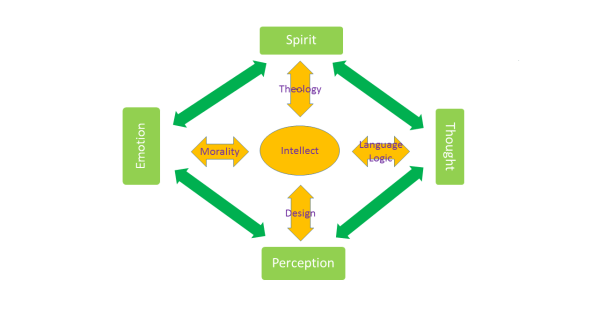
PhilosophyThe principal threads of philosophical discourse can be understood as filters through which the human intellect manages its interaction with the sources of our mental states. At the interface to the physical world, we have the discipline of design that encompasses art as well as science and engineering. Design is concerned not only with the limits of practical possibility, but with ensuring that the environment that we create accommodates our emotional needs. Ethics attempts to organize and discipline our emotional experience, building reserves of good will that facilitate collaboration. Language and logic tame the profligate domain of thought, which if left unchecked devolves into incoherence or insanity. And at the interface between intellect and spirit, we have the bastion of theology that ensures that our faith is invested with personalities that respect our potential and seek to facilitate its flowering into mature judgment.

The history of philosophy demonstrates the difficulty of expanding the scope of human intellect. In the early days of Christianity, theology was considered dominant, but today design seems to be the most powerful method for bringing reality under human control. The unbridgeable gulf between physical reality as interpreted by our senses and the abstract realm of thought has long frustrated philosophers, and Aristotle’s dominance of intellectual discourse for 2000 years reflected in large part his belief that careful observation and logic could narrow that gap. Unfortunately, the strides made by technological innovation have allowed the spread of narcissism that undermines the work done by political theorists most concerned with the balance between morality and theology (nations being gods of a sort). Perhaps recognizing the futility of imposing purpose in the world, Post-Modernism celebrates the interplay of thoughts without reference to other experience.

And so it has been in age after age: profound thinkers set off to expand the scope of human intellect by focusing narrowly on opportunities in one discipline or another, only to have their successors shout “But you forgot about this!” In making clear the complexity of the philosophical quest, I hope that I will encourage future generations to humility, and the realization that no single mind can hold all the answers. Rather, not just the richness of human experience but our very survival is dependent upon the degree to which we allow our intellect to be disciplined by compassion in our hearts.

The Philosophical State

In parting, I offer these conclusions regarding my sense of where we should focus in the next era of philosophical discourse.

Concerning design: While nature holds its secrets, the Promethean fecundity of creative intelligence allows us to explore configurations of matter that could never be attained through other means. The sublime divinity of that capability must be yoked to compassionate service to life.

Concerning language and logic: No intellectual activity is sustainable unless we seek to honestly, clearly and precisely express our experience and expectations of this reality. In debate, we must avoid egotism that prompts us to consider our perspective to be superior to the perspective of other living things.

Concerning ethics: Morality is found in any system of values that expands the domain in which love is expressed.

Concerning theology: If love is a seeking after opportunities for the object of our affection to receive affirmation, then in its selflessness unconditional love is the only incorruptible unifying principle worthy of our faith.

Blessings and honor are due any that undertake to further the project of philosophy. I pray that some benefit may be found in the thoughts that I have here offered.
Judgment in Self-Defense

In Matthew 7:1-2, Jesus offers:

Do not judge, or you too will be judged. For in the same way you judge others, you will be judged, and with the measure you use, it will be measured to you.

The challenge of living this guidance is that people cause us pain. That may be as small as saying an unkind word to us, or as severe as murdering one that we love. Do we not have the right to decide that those that hurt us should be placed apart? Do we not have the right to protect ourselves?

This quandary reflects an understanding of “judgment” as part of a legal process. We take the evidence of our experience and then organize our lives to avoid harm. The futility of this strategy was summarized by Martin Luther King, Jr.:

Injustice anywhere is a threat to justice everywhere.

Just because we push evil away from us doesn’t make it go away. It either shifts its focus to others, or bides its time until it has the strength to assault us again. This applies even beyond the grave: in a secular sense, punishing an offender heightens the stakes of wrong-doing, and so pushes the criminal to take ever greater risks. Spiritually, destruction of the body doesn’t destroy the spirit, which must return again and again until it finds a personality strong enough to heal it.

Jesus, as the healer of last resort for broken personalities, understood this with a terrible immediacy. He could feel the trapped goodness in the people that were judged by the Canaanite culture. Whether speaking to the adulteress or the thief on the cross, Jesus knew that they had been conditioned to the most vengeful judgment of all: the self-judgment that they were beyond redemption.

It is this spiritual consequence of judgment that I think Jesus is focusing on in this teaching. He speaks of other-judgment as like a “plank” or a “beam” in the eye of the one that judges. It is to say: “As we all sin, if you believe that your fellow sinner cannot be saved, then you also believe that you cannot be saved.”

Jesus is speaking from the knowledge that God can heal any wound in those that are willing to receive the gift. This is what he affirms again and again after healing transpires in his presence: “Your faith has healed you.”

What is most painful to me is reading the scripture of Matthew in light of the fact that Jesus did not write a gospel. He understood how the law had been manipulated by the priesthood to divide the people from God. In this case, those among us that have reason to fear direct contact with God use Jesus’ words to argue “You do not have the right to judge me.” They use the power of our minds to hold us in sway as they tear out of our hearts the love that we receive from God.

It is such that Jesus refers to when he calls those that judge “hypocrites.” One way of interpreting his inducement [Matt. 7:5]:

first take the plank out of your own eye, and then you will see clearly to remove the speck from your brother’s eye.

is that the hypocrite will discover himself to be the speck in his brother’s eye! But just below Jesus also counsels [Matt. 7:6]:

Do not give dogs what is sacred; do not throw your pearls to pigs. If you do, they may trample them under their feet, and turn and tear you to pieces.

So he clearly believes that those the love honestly must protect themselves. So how are we to do that?

First, we should not judge, because in judging those that attempt to tear apart our hearts we are affirming that they cannot go to God for what they need. They do have that power, and we need to let that responsibility rest with them.

Secondly, we should recognize that nothing that Jesus taught requires us to surrender our hearts to those that harm us. But we have a part to play there. We should not engage in argument of judgment because it diverts our attention from our heart, leaving it wide open to plunder.

Finally, then, we should love ourselves. When the plunderer comes into our hearts, we need simply to say: “No, that is mine. I will not relinquish it to you.” If we stop acting as their drip feed for God’s love, they’ll eventually conclude that they have to go to the source themselves, or allow their souls to wither and die.

This law of natural consequences is far more powerful and permanent than any punishment that we could organize.

The Struggle

These thoughts began to form this Sunday during services at the University Catholic Center down in Westwood.

May all those that surrender their light in service to dispelling the darkness be gathered by welcoming arms into the healing heart of Christ.

And from that sacred nexus that joins all open hearts, may the one lost realize the opportunity, in that place outside of time, to reach out to those that grieve for their loss – to whisper into our hearts words of comfort and encouragement in every moment that offers an opportunity to renew our strength and courage, and so to guide us toward healing.

And may we that grieve not build a wall of resentment against God, who suffers in sorrow alongside us, but remain open to the voices of those we have lost, and so discover that we are not abandoned – that our loved ones, while no longer physically present, are still with us in spirit.

Finally, may we all remember that our sorrow, if we but seize it as an opportunity to continue the work of healing begun by Christ, is but a momentary experience on a journey that leads to an eternity of love.

Evolving Dementia

My mother spent most of her life supporting families dealing with cancer, but now Alzheimer’s is becoming a comparable epidemic. In 2012, estimates held that nearly 5.4 million Americans had the disease in some stage. The neurological characteristics of the disease include formation of protein plaques in the cranial fluid, which start to develop as much as thirty years before the onset of dementia. In the final stages of the disease, proteins in the neurons themselves begin to tangle, killing the cells and leading inexorably to loss of muscle control and death.

My mother had recorded a Nova special on the efforts of drug companies to develop treatment for the disease. The resources dedicated to the research are impressive – the special focused on three companies running drug trials costing up to $1 billion. The treatments attempt to mobilize the immune system to harvest and break down the proteins that form plaques. Early treatments caused dangerous swelling of the brain. The current generation of treatments avoid that side-effect, but while the special heralded that breakthroughs were possible, to the scientist, the justification for that hope appears incomplete.

The researchers do not hope to reverse the progress of the disease, but hold forth the possibility that treatments may slow the formation of plaques. This hope is inspired by three-year studies that demonstrated that early-stage patients showed 30% less cognitive degradation than observed in patients that did not receive the drug. But Alzheimer’s evolves over decades, and we have no way of knowing whether long-term treatment won’t result in complications that rival the disease itself. Nor, without expensive radiographic imaging of everyone’s brain around the age of thirty, do we have any way of knowing currently who requires the treatment.

Obviously, if we understood why the plaques form in the first place, we might be able to prevent the disease entirely. Given the expense of the research, however, it is obvious that some commercial profit must be generated to keep the work alive. As with diabetes and cancer, long-term drug treatments will generate that revenue.

But can it ever lead us to a cause?

One of the criteria for canonization is proof of a miracle. In the case of Pope John Paul II, one of those demonstrations was the miraculous healing of a nun with Parkinson’s disease, another degenerative nerve condition. Scientists hold that such demonstrations are simple fraud or chance correlation with spontaneous recovery. But if we take spirituality seriously, we might expect that the development of human intellect would create stresses in our physiology that it was never designed to sustain.

As I understand our intellect, the brain is an interface to the world of ideas. In sharing ideas, we build power in them. This power is not held by any one individual, but held in what Jung called humanity’s “collective unconscious.” No other creature had ever created this kind of repository, and so we would not have inherited from our animal predecessors any mechanisms that would protect our brain from direct exposure to such energies.

Consider, then, what might happen if we taught our children that thinking occurs in the brain. Every intense intellectual exercise would intuitively manifest as an attempt to take control of ideas, to force them into the interior of our brains where we can manipulate them most directly. But each thinker that wrestles with ideas struggles against the intentions of other thinkers, creating dissonance and stress in the tissues of the brain. Might this not result in damage to that delicate organ, an organ that never evolved to deal with such strain?

In my own case, when I began to take charge of my mind back in 2002, I had to struggle against corrupt residents. The strain expressed itself physically in my brain as pressure, sensations of heat, and in the most extreme occasion, sounds of the cranial bone cracking. The events that most frightened me, however, involved a sensation of burning in the nerves along my ribs that I found similar to the symptoms of shingles in its early stages. When I realized this, I turned inwards, considering the structure of my mind, and traced the problem to an over-heated section of my brain in the back of my skull. Realizing that my mind was passing energy through tissues not designed to process it, I tried to shift the flow outwards, into the soul that blooms all around me. I felt of shifting of spiritual structures, and over the next few days, the symptoms disappeared.

My belief, therefore, is that even if we figure out how to stave off the onset of Alzheimer’s using drug therapy, our medical science, with its focus on proteins and genomes, will never touch the root cause of our evolving epidemic of dementia. Our subconscious struggle for the control of ideas will simply intensify, and manifest in other forms of disease. No, it is the idea that the brain is the mind that is at fault. Only when we begin teaching people how to manage the part of their mind that resides in the soul will we be able to prevent dementia.

Ideas, Ideally

I have been trying to reclaim (see 1 and 2) the philosophical tradition of ldealism that in the West was first articulated clearly by Plato. Idealism is one of two threads of discourse that attempt to explain the relationship between ideas and our experience of the world around us. The paradox for Plato was that the real world does not contain perfect representatives – no line is absolutely straight, and no horse manifests all the ideal characteristics of horses (fast and powerful, for example). Convinced that the world originated from a source of absolute good, Plato therefore held that the idea of a perfect line or perfect horse was the original, with the physical examples as imperfect manifestations.

To the scientific thinker, this assertion fails to satisfy because it does not specify a mechanism for the manifestation, and therefore cannot be disproved. The solution proposed by scriptural literalists is that the ideals did exist when the Holy will created the world, and were accessible for our appreciation during the inhabitation of Eden. It was through our selfishness and disobedience that the connection with the divine source was sundered. Not only human nature was corrupted in the Fall, but all of Creation.

Reacting against Plato’s idealism, Aristotle advanced the program of Empiricism. From our observation of the world around us, we intuitively recognize similarity between things. We might choose to call some things “dogs.” There is no ideal dog, but all dogs share certain characteristics. Through the mechanism of the syllogism, we can therefore transmit a great deal of understanding by simply designating the type of something. The most famous syllogism is “All men are mortal. Socrates is a man. Therefore, Socrates is mortal.” In general form, we might write “All A are B. If C is an instance of A, then C is B.”

Aristotle employed this program to a comprehensive classification of the world around him. The power of classification becomes most obvious in the physical sciences, where saying “an electron is massive and charged” allows us to apply mathematical deduction to predict its behavior. But classification is also conditional: Linnaeus, the inventor of the phylogenic scheme for categorization of living creatures, recognized only plants and animals. Modern biochemistry has demanded the addition of three new phyla, with the consequence that things once considered to be “plants” have been reclassified as “fungi,” which recognizes that all along they actually lacked some of the characteristics of “plants.”

Aristotle recognized that all ideas are abstractions, and so that when applied to a specific instance, information is lost. This should be unsettling – it means that the world is populated by exceptions to our ideas. This is consequential: If a member of a tribe asks you to care for his dog, how do you know which among the dogs is his pet ‘Akela’?

Ultimately, the pragmatic successors to Aristotle re-introduced the concept of moral good to deal with this problem. What is important is whether ideas have practical utility. This has both good and bad consequences: Darwin’s theory of natural selection was used to justify ethnic prejudice in Nazi Germany and in certain parts of America. Against that, we have housing codes that ensure that disasters do not displace entire populations, such as occurred after the 1906 earthquake in San Francisco or the great urban fires of the 19th century.

So let us now return to the larger umbrella: I hold that philosophy is the study of the operation of the intellect, which manifests as the capacity to synthesize mental states. Among the sources of mental states, I listed sensation, emotion, thoughts and spirits. Where are ideas in this categorization? They seemed to be related to thoughts, but thoughts can also be random associations without plausible manifestations, such as – Kia Soul advertising not-with-standing – “my hamster is break-dancing.”

As might be expected, the exclusion of ideas from the list of mental states is not an oversight.

I have asserted elsewhere that Idealism reflects an affinity in its adherents for soul-relation. This manifests most powerfully to the mystic as a gift of energy that suffuses moral good with joy. This is the experience that I believe informed Plato’s affiliation of ideas with “The Good.”

Where I depart from Plato is in the belief that all ideas originate from The Good, only to be expressed in corrupt form in the world around us. To me, this is the terrible deficiency of scriptural literalism. It denies us agency in moral progress in the world. In The Soul Comes First, I take this head-on, using paleontology and evolutionary biology to demonstrate that the seven days of creation and the trumpets in Revelation actually correspond to a process of uplift from primitive forms of life towards an intelligent integration that will heal the spiritual wound of selfishness.

The role offered to humanity in this process is to sort through our thoughts to identify those that empower the expression of moral good. This is “the Knowledge of Good and Evil,” and the serpent’s characterization of the Fall in Genesis is a political posture that seeks to delay the perfection of our discernment.

In re-interpreting scripture through the lens of science, I show obvious affinity for Aristotle’s empiricism. Where I depart from his formulation is in the belief that ideas are merely abstractions of experience. Thoughts are those abstractions.

In the model of physics I have offered, I understand the human mind as the interaction of soul with the empirical world through the interface of the brain. In that interaction, our thoughts are temporary modifications of our soul. An idea is a thought reinforced by multiple successful episodes that instills energy that causes the thought to bloom into the world of spirit. An important consequence of this penetration is that the thought becomes accessible to other thinkers. In other words, Plato’s Ideas do not originate from The Good, but rise into the realm of spirit most readily when they serve a moral purpose, increasing the life-time of their subscribers, and therefore gathering ever greater energy through continued application to the survival of living things.

In terms of the framework I have established, with stimulation and combination as the two types of intellectual synthesis: ideas arise from the intellect’s capacity to stimulate thoughts from sensation, and then to combine thought and spirit. Ideas do not originate from The Good, but the strength of an idea is ultimately determined by the degree to which it allows us to improve our moral discernment. When mature discernment is realized in a personality such as Jesus of Nazareth, The Good that seeks to facilitate our healing actually touches the material world, shattering all of our categorizations with consequences unimaginable to the empiricist.

I hope that in this formulation that faith and science recognize the shape of a reconciliation that can organize collaboration that will speed the development of moral discernment, fundamentally changing our relationship with reality, and liberating Life in general from our vicious cycle of angry and ineffectual claims to authority defended by reference to incompatible and ultimately meaningless standards of “truth.”

Translucence

I applied for a job out in Monrovia last week. My intuition is that an interview will not be forthcoming, but the opportunity caused me to realize that Pasadena is a center of activity that resonates well with the forces that attract my attention. Not only are JPL and CalTech premier technology centers, the latter hosts the Skeptics Society, a community of relatively free-thinking people. Just down the freeway in Claremont we have a divinity school, public policy college and Harvey Mudd. Sierra Madre hosts Reasons to Believe, a group of Christian apologists led by the Hugh Ross, who is nearing retirement. Finally, I’d be able to join the contact improve community, work out at the Bikram studio, and hike in the San Gabriel mountains.

But in my reflections on the general milieu, a specific personality came to the fore. It was a part of the experience at last year’s Skeptics Conference that I didn’t reveal at the time.

In reading intellectual history, we almost always find that liberal communities have as their nucleus a forum in which self-assured and beautiful women can meet brilliant men. That was readily apparent to me at the conference, although I found myself a little embarrassed by the age differential between the men and the ladies. Not being an anomaly in that regard, I focused on the ideas that were presented.

But as I was wandering from the conference hall to the snack table, an alabaster woman in a cerulean silk shift caught my attention. The combination was striking in itself, but as she turned away from me, the plunging back of her dress revealed a pink welt where her lower ribs had pressed against her seat. I was completely beguiled by this evidence of her physical vulnerability, and allowed myself to enjoy deeply the desire to protect her.

She froze and turned to glance at me out of the corner of her eye, lips parted gently in surprise, then took refuge with her friends. But as the conversations wound down and the attendees wandered back to the hall, I found her standing in my way, ten feet apart from a little semi-circle of her friends, and had to resist the impulse to escort her back to her seat.

I have my own evidence of vulnerability, deep scars on my face from eczema that did not clear until I was in my late twenties. My father suffered similarly in his youth, and his uncle treated him with x-rays, probably contributing to the skin cancer that left him disfigured at the end of his life. My own case evolved into deep abscesses, left untreated until my mother was approached by a counselor in high school. This left me terribly humble in the presence of women in college, exacerbated by my awareness that when I found a young lady trying to draw her boyfriend’s attention to me, I would be beset by hatred that caused the pimples to burn.

All of my life, I have caught unguarded glances from my intimates that reveal just how disfigured I appear in direct sunlight, and many people have advised me to have my skin smoothed. But I have never bothered, because I almost always found that the pity was replaced by an apologetic smile. The smile seemed to be accompanied by a recognition that it was my heart and mind that were precious to them, and that my outward appearance was only so jarring because of the contrast with what they encountered within.

The evening with the Skeptics Society ended with a performance by a Ukrainian band led by brilliant pianist. I sat in the front row on the left side where I could see his hands on the keys, and was surprised to discover that nobody else sat in the row with me. Rather, the crowd, greatly reduced from the day’s attendance, was scattered around the hall. The pianist was an instigator, though, and commanded us all to get up and dance. Michael Schermer’s wife caught sight of me cutting the rug in my socks, and came over to bump hips with me. But across the center row, I caught sight of the alabaster woman again, clapping her hands and bouncing gently on her heels.

For the last number, we were called onto the stage itself. I found myself dancing toward the piano. The performer laid himself atop the lid and played backwards on the keys while I raised my encircled hands over his heart, guiding energy into him. He finally staggered away, stopping next to his brother, the lead guitarist, pointing at me and shaking his head in wonder. As the number wound down, I turned to go, the calm center of a stunned gathering, and found the young lady offering me her admiration and desire.

I have tried to communicate this before: women are designed to bind personality to matter, and deep in their hearts there is nothing they desire more than to do that in partnership with love. But her wonder reflects a common feminine reality: men want to project their greed into them. As a society, we have conditioned them to accept that, and so as a form of protection they dis-integrate themselves. The sacred vessel of the womb is divided from their heart and mind. My deepest shame as a man originates in the sympathetic cry of my heart in the presence of women that have been so wounded. I try to put them back together again, and the response is often a desire to take me into them.

There used to be a saying about a man “moving heaven and earth” to safeguard a woman’s love. But the wounds on my face are evidence of engagement in a deep spiritual conflict. More than once, I have had visions of offering a woman the earth to tend with me. They flee in sorrow, return it upon realizing they don’t know what to do with it, or surrender it to their more acquisitive sisters. Fortunately, its preferences are clear – while it took me decades to gather it the first time, in the last instance I regained it in a few hours.

Mary Margaret invited us out to Pomona College this evening for her senior art exhibit, and I decided to make a day of it out in Pasadena at the Huntington. As I drove down the 101, I was again in the presence of the lady in blue, and found myself revisiting that scene outside the conference hall. Stepping in front of her, I stooped to whisper “You understand that your skin is suffused with the light that seeks to come into the world through you?” The wonder in her eyes allowed me to encourage her “I can unlock that for you, but you have to understand that it’s too much for your body to contain. You have to let it out into the world – into the trees, the little creatures of the air and field, the very air, the clouds and sun themselves. Do you understand?” She nodded, and I stepped behind her and placed my hand over heart.

To feel her expand in radiant fluorescence that was celebrated by all the world around her.