Paradoxes

My mind enters into all things,

But cries out for knowledge of you.

My will bends the world to love,

But cannot my heart renew.

The whispered promise of boyhood –

Silenced by consequence.

The fevered clutch of eager youth –

Aborted by elder conscience.

Every mote of you I would exalt,

And thoughts place in your service,

But your sisters’ pleas loudly ring,

And make your imagining nervous.

My inmost coil is warped by pain,

That no caress can mend.

My struggles worn upon my face:

I yield to beautiful men.

The nail I have to surrender

Would wound more than arouse,

And kisses that lips brought

The fire of truth would douse.

I would, if I were able,

Rendered upon my own table,

I cannot gather those parts

Lest they gather into your heart.

Passion broken,

Words unspoken.

Woman.

Love.

The Currency of Understanding

Sylvia Nasar’s Grand Pursuit traces the history of economic thinkers from Marx to the modern era. I say “thinkers” because Nasar present a series of historical and psychological sketches of those that generated the ideas that most profoundly influence modern public debate about the management of economies. This is not a book for those seeking to understand economics.

But for those involved in public policy debate, I would characterize Grand Pursuit as essential reading. It is one thing to talk abstractly about the relative merits of economic and fiscal policy. It is quite another to confront the historical context and moral concerns that drove the currents of economic thought. During the era that Nasar considers, Western civilization was confronted with profound existential threats. Economics was not about allocating the privileges of wealth – it was about preventing widespread loss of life through mismanagement that led to starvation and/or war.

The success of economics as a science is tied intimately to industrial entrepreneurship – to the process of incremental improvement that successively multiplies the value produced by individual effort. As Nasar documents, it was the observation of this effect that eventually gave economists the courage to believe that society could be liberated from ecological constraints.

In the agricultural era, the value of labor during planting and harvest so far overwhelmed the cost of survival that communities banded together to preserve their members. Parents taught their children almost everything that they needed to survive. Against this cohesion was mounted the vulnerability to environmental and political circumstance (drought or war could destroy the community), and lack of education that slowed innovation. Given the primitive motivations of the populace, economic thought was dominated by Malthusian precepts: any attempt to improve the lot of the lower class would result in increased birth rates, and an inexorable drop in wages to subsistence levels.

In the agricultural era, the stability of currency was paramount: sellers wanted to be certain that the currency they gained from selling grain one year could be recouped for equivalent goods in the next year. When governments abused this trust by printing money, economists concluded that money must be backed back a tangible good, such as gold. When industrialization and capitalism took root, the constraints on money supply choked the pace of investment. It took nearly half a century for economists to respond to the fact that currency was backed, not only by government-held gold reserves, but by the capital goods (machinery and buildings) that supported production, and the education and skills of the workforce.

One of the primary lessons of the history Nasar documents is that financial obligations are secondary to production, and that countries that effectively manage production (to wit: without undermining fiscal stability through inflation) almost always grow out of their obligations. Failure to recognize this opportunity entrained Europe in the terrible hardships following World War One and drove it inevitably to World War Two. (One might argue that we face this same problem today in the debtor nations of the third world.) The second prejudice to be overcome was the idea that each nation could chart independently its economic course. This should have been obvious to the colonial powers, but it was only when WW II ended that Europeans were forced to recognize that they would have to cooperate to ensure access to the resources that industrialization converted to consumer goods.

Nasar begins her survey with Marx and ends with Sen. This brackets the second great threat to the survival of Western liberalism: the proposal that planned economies were the only way to prevent economic collapse. This was not an idle question during the Great Depression. Unemployment depressed earnings, and as prices fell due to lowered demand, the value of savings increased, and the capitalist incentive to invest vanished. The Western economies were confronted with wasteful idleness of their productive capacity, and no means to stimulate demand. It was Keynes and others that encouraged governments to deficit spending and jobs programs that stimulated consumption. That eventually got economies rolling again, or at least it did in Europe – in America, FDR lost his nerve in 1937, and full economic recovery did not occur until the nation was forced to rearm under the threat of German and Japanese aggression.

The lesson of this history is that governments do not need to control all aspects of the economy. As long as leaders ensured demand sufficient to stimulate investment, individual initiative will produce the triple benefits of innovation, growth and – as falling prices outpaced population growth – increased wealth. The centrally planned economies of the East (principally Russia and China) were repudiated not by military power, but the basic laws of fiscal probity and industrial growth.

While Nasar does not articulate clearly the essential points of economic theory, that perhaps is just as well. The history makes it obvious that the greatest economists were pragmatists, not dogmatists. They were concerned principally with how things worked, not with abstract principle. They were driven by the desire to prevent, manage and recover from crises that political and economic parochialism wrought upon Western civilization.

I believe that this is why Nasar ends her survey with the economic moralism of Sen. The great thinkers of economics were successful because they cared enough to commit themselves relentlessly to study of the systems that secured the well-being of their countrymen. They confronted hardship, and felt deeply the need to overcome it. One would hope that their conclusions – that wealth can survive only when it is a tide that lifts all boats – would be appreciated better by economic and financial decision makers who have yet to have to face such crises. Else, as Santayana famously observed: “Those that cannot recall history are doomed to repeat it.”

Forgiveness of WHAT?

With the exception of Jesus’s ministry, the Bible really doesn’t quote God very much. It’s pretty obvious from Jesus’s example, however, that God doesn’t ask us to do anything that He wouldn’t do himself.

So what are we to infer from Jesus’s exhortation [Matt. 5:43-45]:

You have heard that it was said, ‘Love your neighbor and hate your enemy.’ But I tell you, love your enemies and pray for those who persecute you,that you may be children of your Father in heaven.

There’s a lot of really angry preaching against Satan in church, and after making this connection, I began to suggest that maybe we should think about Satan as the patient, not the enemy. People were pretty upset with me.

But Jesus came for the forgiveness of sin, didn’t he? We tend to think of that as our sin, but that follows a long progression. Think on what God tells Cain after his sacrifice is rejected [Gen. 4:7]:

If you do well, will not your countenance be lifted up? And if you do not do well, sin is crouching at the door; and its desire is for you, but you must master it.

Now the Hebrews eventually developed a lot of legal machinery to aid them in keeping sin away, but by Jesus’s time, it was pretty clear how that works out: the law was suborned by the monarchs and priests, and used to destroy him.

Maybe the only way to defeat sin is to declare unilateral peace, to forgive its transgression until its force has been spent against the power of the love that shines through us from God?

Into the Garden

On the weekend of my 45th birthday, I woke at 2 AM and drove from Livermore to Yosemite. The summer sight-seers were still in their beds when I parked at the Swinging Bridge. As I neared the far bank of the Merced River, I spied a circle of sunlight among the redwoods. A feeling of joy came to me, like unto an encounter with a long-lost friend. I stepped into the circle and raised my arms to the sky, and felt the whole valley singing with happiness.

I don’t know if I can ever convey what it is like to enter fully into Christ. In the official biography of Pope John Paul II, there’s a picture of him sitting on the stage in Manila, alone amidst a throng of tens of thousands. His forehead is pressed into his palm. When I saw the picture, I felt the weight of their sorrows pressing against him in that moment.

To be in Christ is to feel all the anguish of a world that suffers from our inattention. It is to shoulder the burdens shirked by those that have the power to make a difference. As Jesus says [NIV Matt. 11:28-30]:

Come to me, all you who are weary and burdened, and I will give you rest. Take my yoke upon you and learn from me, for I am gentle and humble in heart, and you will find rest for your souls. For my yoke is easy and my burden is light.

This is the paradox: those that seek power seek this same freedom – freedom from fear, freedom from weariness, freedom for sorrow. And yet they seek it in material things, when only Christ can grant them that freedom, and even then only when they accept the burdens that love lays upon them. So they are forced to choose between their desire for freedom and the love of Christ, and most choose freedom.

Fundamentally, it was this contradiction that brought Jesus to the cross.

When I thought on this last night, lying awake in the dark after Mystery had once again tried to corrupt me, I remembered that moment in Yosemite, and I thought of Gethsemane, were Jesus testified [NIV Mark 14:34]:

“My soul is overwhelmed with sorrow to the point of death,” he said to them. “Stay here and keep watch.”

Where did that sorrow come from? Well, from the Garden itself, acknowledging the man that brought words of peace and healing into its midst, celebrating the hope that maybe finally mankind would stop warring against Nature, and grieving the knowledge that the impending response was his destruction.

God, how I miss the gardens of the world – the trees and scrub, the birds, foxes and deer. I have walked the hills here in Southern California as they dry up and burn, and my heart can hardly bear it any longer. Please, God, send me someplace where the garden and I can delight again in one another.

What’s Foreign about Success?

When President Clinton’s team left office, they warned the incoming Bush Administration that some military response had to be mounted against Al Qaeda in the aftermath of the Cole bombing. The Bush security team, dominated by Cold War hawks, dismissed the warning as a Clinton albatross, and set off to renegotiate the arms treaties with Russia to allow construction of a nuclear missile shield.

The rest, of course, is history. Osama bin Laden, encouraged by U.S. flaccidity to believe that one last strike in the heart of America would cause us to curl up in a fetal position, set about planning the 9/11 attacks.

In the Middle East, we face a similar situation with Israel, still living in the memory of the Holocaust, and even after 60 years unable to build a lasting peace with its neighbors. They turn to America again and again for financial and military aid, but do not heed our requests to negotiate a lasting peace. Instead, as recent perusal of the Jerusalem Times reveals, they rewrite the history of Israel to present themselves as victims rather than armed aggressors.

I agree that the state of Israel should survive, but the conditions of that survival have to reflect the realities of the politics of the Middle East. That means, if we are going to pursue conflict against those that seek to destroy it, we must establish impeccable moral credentials. That means talking to the leaders of Israel’s enemies, and giving them the opportunity to participate in the success that comes with liberal economics. It means eroding the “American + Israel = Axis of Evil” rationale for suppressing Iranian dissent. Simply beating Iran down because Netenyahu says so is going to inflame the entire region against American involvement, bring terror back to us at home, and – given the asymmetrical practical realities in the region – ultimately result in Israel’s destruction.

So, people of Israel, you need to elect a different leader. And Republicans in Congress – you need to stop playing politics with Israeli lives.

The situation in Russia has similar characteristics. Arguably, Vladimir Putin is criminally psychotic, having recently awarded medals of honor to two members of the personal hit squad that has assassinated those attempting to document the costs to Soviet society of Putin’s psychosis (Metsov being the most recent). But the very fact that Putin caters to these men is a revelation of weakness. Where once he was heralded as the guarantor of economic stability in Russia, recent military adventurism (in Georgia as well as the Ukraine) has caused the West to unite in economic sanctions against Russia, and stimulated weaker neighbors to seek NATO membership. The oligarchy recognizes this, and so Putin is left with only one tool for managing opposition: murder.

The Soviet Union experienced such a reign of terror under Stalin, and one of the causes of Russia’s declining global influence in the ’70’s and ’80’s was the creation of a Politburo that ensured no one man would ever again wield that kind of power. Russians have experience with this kind of tyranny, and while it may take time, the oligarchy will not allow Putin to purge them as Stalin purged his foes. Putin’s adventurism is the death knell for his regime.

That President Obama defers to Germany’s Chancellor Merkel in this matter should be considered a blessing to us at home. It allows us to focus on the worsening situation in Syria and Iraq that is fanning sectarian tension and generating powerful sympathy for Iran among Iraqi Shias. That Merkel counsels against providing advanced lethal assistance to Ukraine reflects her nation’s experience in winning the Cold War. It was economic power that brought Germany back together, and it is economic power that will eventually hold sway in the Ukraine.

So, again, Senate Republicans, try to be good neighbors. Stop playing politics with the lives of our allies.

Sinning Through Love’s Eyes

As Easter approaches, celebrants all around the world will extol the virtues of God’s sacrifice on the cross. While I accept the praise, I tend to cringe at the rationale.

The rationale is also offensive to critics of Christian theology. What kind of logic is to be found in the proposition of an all-loving God that creates fallible creatures that are punished eternally for their weakness? That is cruel and arbitrary to the core.

I’d like to offer another analogy: think of evil as a cell in the body. If we performed surgery to remove that cell, how many other cells would be destroyed in the process? Is it fair that those cells should suffer and die so that the single cell can be removed?

That is the problem facing God. Yes, s/he could do the surgery and destroy evil. But in the process innocent creatures would be harmed.

In human medicine, the alternative to surgery is to condition the immune system to locate and remove the malignant cell. That can take some time, but has the advantage that it establishes a memory in the immune system. Future malignancies are dealt with far more efficiently.

Humanity is the immune system. Unfortunately, we have an auto-immune disorder. It’s not something that happened in Eden, because the serpent existed before we did. No, it’s something that precedes even the creation of this reality.

So why did Jesus choose to die on the cross?

Because experience of the disease is required for diagnosis and treatment.

Because God failed to protect us from evil, and so bears responsibility for our suffering.

Because while there is no sufficient form of atonement for our suffering, to share it, at least, might inspire us to grasp the power that is tendered for our healing.

That is the beauty of the resurrection. Not even death is beyond that power, should we chose to have faith in the love that is offered to us.

Spirituality without Religion: Hope or Hoax?

Sam Harris has amassed a fortune decrying religion. His latest best-seller, Waking Up: A Guide to Spirituality without Religion, describes a journey that I must herald as a step towards personal maturity. I won’t consider the details, because his preface was enough to let me know that he’s got a long, long way to go. Harris asserts that our minds are the only tools that we have to manage life’s challenges. That’s a sort of lobotomy, and the best response I can offer is that of Hume. Following Hobbes’s characterization that the experience of most is of:

continual fear and danger of violent death, and the life of man solitary, poor, nasty, brutish and short

Hume diagnosed that Hobbes had forgotten “the operation of his own heart.”

That may seem a small point, but a compassionate heart is the singular difference between a monstrous ego and a great personality. In its lack, the rational mind tends to the conclusion that everything that violates its logic is error, possesses no value, and thus should be destroyed.

This is the conclusion that the anti-religious have indulged in for far too long.

Now I hope that Harris will eventually confront the errors of the axioms that allow him to conclude that religion has no value. Foremost is the confusion of correlation with causation: the fact that the brain is essential to the physical manifestation of our will does not mean that our will arises from the brain. The soul does exist. When that is recognized, the heart becomes full, and logic leads us to a different set of conclusions.

For example: Harris’s book bears the picture of a face superimposed on the cloudy heavens. What happens when spirits collide in that space? How do we negotiate conflicts? Only by resort to institutional structures staffed by experienced arbiters. That is religion.

The second erroneous axiom is that the mythical aspect of scripture proves the unscientific world view of our intellectual predecessors. Far be that from the truth: those men and women were investigating aspects of reality that Harris has yet to encounter, and doing it using practices that, if one strips away the branding, are scientific in their core. That wisdom was transmitted to us from the past through – you guessed it – religion. The alternative offered us in the modern age – schools – are prey to short-term political fashion, also known as propaganda, and pit students in a competition that places knowledge above compassion.

The alternatives to religion that Harris offers, at least in his preface, are use of psychotropic substances (a.k.a. – illegal drugs) and meditation. The former is pathetic: I raised my sons with the wisdom that love is the anti-drug. Using drugs to temporarily achieve an elevated psychological state is no substitute for submitting to the discipline required to sustain loving relationships. Lacking that discipline, the craving for love, which is built deep into our hearts, leads to abuse of drugs and self-destruction. What institutional structures confront us most meaningfully with the practice of emotional discipline? Well – religions.

Meditation is where I find hope for Harris. Meditation serves to reveal the preconditioning of our minds that prevents us from accurately perceiving experience. Through it, as Deepak Chopra inveighs in The Future of God, the seeker after truth eventually confronts the reality that love exists even when no person is present, even when no drug stimulates our senses and minds, even when we do nothing. That is the nature of God – and for reasons I have outlined elsewhere, that is the only God that could ever exist. Nothing but unconditional love can bind together things that want to be apart: the Greek word religio meaning to bind anew.

When Harris encounters that presence, I am certain that he will want to find a place in which to share his joy. That would be, of course, to find religion.

My Marvel-ous World

I was a serious comic book collector while I was in college, and have been impressed with the movies that have been built around those titles. They are an introduction to the problems of growing into the powers that humanity must manage if it is to serve the purpose that the avatars of the great religions have put before us – to liberate ourselves from fear and master the skill of spiritual healing. They fall down terribly, however, in suggesting that childish mayhem will be supported by the elements of reality that empower such work, and tolerated by those that manage it.

While the Bible is of interest to me as a record of progress made in the past, it doesn’t provide much insight regarding the psychology that liberates us from fear and empowers us to perform great acts of spiritual healing. So I decided to make an attempt to describe that state of being. The first part of that exploration is the book Ma. I have now finished its sequel, Golem. The latter proposes a challenge to humanity – something that we can consider doing – as well as trying to illuminate the challenges of godhood, and the sense I have that it is a cycle.

Christian readers will be scandalized, perhaps, by my version of the second coming. More broadly, one of my readers has offered that I write great sex scenes. That was apparent in Ma, and in Golem the joyous claiming by Leelay of her right over Corin may lead some to cry “pornography”. C’est la vie. The author has his rights.

So I’ll be picking up my flute again, cleaning and dusting my apartment, and trying to figure out what to do with Golem. To this point, Ma and The Soul Comes First are commercial failures – which was pretty much as I expected. I had to give them a chance, though, and invested a lot of money in the effort. I may append Golem to Ma, which is only 50,000 words, and republish the latter. I’m sure that Trafford would like me to publish it as a separate volume. But I may also just give it away – putting it up on Good Reads and here.

As well as finishing the last 40,000 words of Golem, since November I’ve put up another 100,000 or so here. I’m going to be creating reference pages for that material. The first bookmarks the posts in my series on new directions in fundamental physics. Another will focus on Christian theology. It’s pretty heavy going, I understand. I should be able to shift to a lighter mode now that the basic message is out in the world.

Thanks to all of you that have been reading!

That’s the Spirit

We’ve been building a model of the universe with superfluid dark energy, and introducing a “cold” alternative to the Big Bang theory. The model includes a possibility for gravitational attraction between defects in the lattice. Given that there are three other forces at play in the universe (electromagnetism and the “weak” and “strong” interactions), the model is obviously incomplete.

I’m going to throw out a model here that manifests interesting and theoretically relevant behaviors. I am certain that the model is incomplete – my sense is that the dark energy lattice itself has complex structure (I refer the reader to the image on the Generative Orders proposal). But the suggestions here should be enough to stimulate innovative thinking.

So what we need to propose is a model for our defects. It’s interesting to consider the defect to be a self-repellant loop that gets pinned to a node in the dark energy lattice. Now the lattice is going to tend to corral the expansion of the loop along a particular axis. The energy driving the expansion will eventually be spent in pushing the dark energy particles apart. We can imagine thus that the loop will oscillate back and forth, as indicated below with “right” and “mid” views. We can imagine the “left” configuration by rotating the “right” configuration through half a circle.
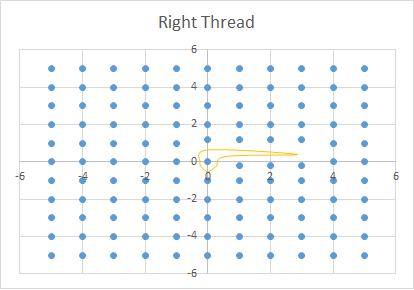
Right Thread
Mid Thread

Now let’s suppose that each point in the lattice can anchor up to two loops. How this is feasible is open to exploration. One way is for the dark energy to have structure itself. For example, it might be a little circle. Now there will be oscillation patterns that will minimize the interaction between the two threads. One possible pattern is shown below (the lattice is suppressed so that we can focus on the loop configurations).

Two-Thread Oscillations

We see that when one loop is clustered near the center, the other is extended. What is most important, however, is that when the sequence is followed clockwise, the pattern rotates clockwise. Reading in the reverse order reveals a counter-clockwise rotation. So this is a model for the top-like “spin” that was described earlier.

(NB: This is a terrible model of intrinsic angular momentum. A more fertile approach is to think about normal angular momentum, which arises when interacting particles are offset along the axis of approach. We then see that normal angular momentum is discretized in the lattice, because the offsets are discretized.

How is normal angular momentum conserved? Well, the model proposes that gravitation, electromagnetism and the strong interactions are all generated through the efforts of the lattice to minimize distortions. The specific character of each force reflects the degree to which a configuration of loops generates lattice distortion.

So angular momentum is conserved because the approach of the particles stores a particular type of distortion in the lattice that is released when they separate. Intrinsic angular momentum may be accommodated better by recognizing that the odd shape of the loop projections can be removed by offsetting the center of the oscillation by half a lattice point.)

Now the configuration with two loops should be fairly stable – it affects both directions equally, and so shouldn’t create too much disruption when moved. However, the configuration with one loop will tend to whip around when it moves, maybe even causing the lattice to be re-oriented locally. Given our discussion of mass, it would appear that asymmetric particles (one loop in our example) will have larger masses (disturb the lattice more when moving) than symmetric configurations (two loops in our example).

One way to minimize the impact of the asymmetric configuration might be to couple them together. This would localize the impact of the thrashing around at large distances, at least if the asymmetric configurations were synchronized in their oscillations. This models the strong force, which binds fractionally charged particles inside the proton and neutron.

Yes: what I’m suggesting is that the loops correspond to particle charges. In our two-dimensional model, only three charge states are allowed (with 0, 1 or 2 threads), because only two directions are available for oscillation. In our universe, we have three dimensions, and so four charge states are possible. This is precisely what we see in the particle zoo, and the asymmetric particles (with fractional charges: the up and down quarks, for example) have much higher masses than the symmetric particles (the neutrino and electron).

Adding a symmetric particle to a pairing of asymmetric particles might further stabilize the lattice. This is analogous to an electron bonding to a proton.

Now let’s tear our understanding of reality completely wide open: why should the loops be constrained to be bound to the dark energy lattice? What if they were able to form structures among themselves, structures that stored energy in the lattice by causing it to expand in their vicinity? Structures that could contain and process information? Structures that might even be able to open holes in the lattice that would allow particles to travel faster than the speed of light?

That’s the spirit, people.

I hope that you’re taking mind. Our brains are only interfaces to these structures. Our souls are the eternal part of us, bonding again and again to matter through our multiple lives, and using those opportunities to do a certain work on themselves.

Now I beg you, please read The Soul Comes First. While selfish configurations of spirit tend to dissipate the energy stored in the dark energy lattice, mutually supportive configurations have stored up an enormous amount of energy over time. They impose certain rules, and a failure to comply led to the destruction of the dinosaurs.

I believe in love, and I believe that at least a portion of humanity has enough maturity to master our baser urges. The Book of Revelation teaches that they will complete the work that was put before us in “Eden”. But I would like us to work efficiently to ensure that the predators, in their trashing about as they go down, are not allowed to do too much damage to the innocent.

Bibi, Stay Home

I wrote previously about the balance of powers problem in the federal government. As Congress continues to refuse to act on the pressing issues confronting the nation, President Obama has chosen to take executive action under existing laws to mitigate the developing crises in competitiveness (education), immigration and global climate change. The Republican-held Congress continues to complain.

While I believe that the House of Representatives under Boehner “dost protesteth too much” – after all, they have the opportunity to pass legislation – it seems more and more obvious that they pursue an agenda driven by narrow political calculation. I see the shadow of Karl Rove still lurking in the background. Rove was the campaign adviser that filtered for political impact all Cabinet decisions in W’s first term. He or his ilk appear to be doing the same for the Congress.

This began with the “poison pill” terms in the first-term budget negotiations that preserved high-income tax breaks. It continues with leaving Obama to wrestle with the nation’s intractable problems, and crying “foul” on separation of powers whenever a Republican constituent has an ox gored. And it proceeds now with a clear trespass on the President’s foreign policy remit with the invitation to Benjamin Netanyahu, Israel’s prime minister, to speak before the Congress.

Netanyahu is involved in his own political shenanigans at home. Prior to his election as prime minister, Israel was the target of frequent suicide bombing attacks. The terrorist attacks were the asymmetrical Palestinian response to ongoing Israeli settlement of the occupied territories. The stupidity of the strategy was evidenced in Netanyahu’s election in 2000, as the Israeli public eventually accepted his long-established “greater Israel” policy as the only way to restore internal security. However, years of secure living and the growing problem of domestic intimidation by Orthodox Jews is causing the Israeli public to broaden their concerns, and think fundamentally about justice. Raising the specter of Iranian attack preserves the political psychology that brought Netanyahu into office.

Israel has benefited from the action of both US presidents to serve in the 21st century. The removal of Saddam Hussein from Iraq ended a bounty program that paid $30,000 to the families of suicide bombers. US-led global sanctions against Iran have also prevented an end to Israel’s nuclear monopoly in the region. John Kerry has already made clear that the U.S. was motivated to a great extent by concerns for Israeli security, and Netanyahu’s panicked protests against diplomatic reconciliation between the US and Iran seems untrusting.

What other issues could be driving Netanyahu’s move? Obama has embarrassed him on at least one occasion in memory – letting comments regarding Netanyahu’s honesty slip out to the press during an open-mike chat with the French President. The rise of a respectable Palestinian counter-part in Mahoud Abbas has allowed the US to apply pressure against Israel to bring concessions to the negotiating table. (The lack of such concessions continues to place Abbas in danger from Palestinian extremists, making him dependent upon Israeli security, and thus undermining his authority.)

But the pro-Israel vote in America includes the historically Democratic Jews, and as we saw in 2000, that vote is enough to swing key states. So Netanyahu and Boehner have common cause in this engagement: embarrass Demcratic Foreign Policy to improve Republican chances for the 2016 presidential elections, and reinforce the ability of Israel to be the tail that wags America’s Middle Eastern policy.

Given this complicated political calculus, Netanyahu would be best advised to stay home, pursuing his agenda in coordination with the Administration’s Foreign Policy team. If this issue becomes a Republican talking point, placing the Jewish vote as a token to trade in the 2016 presidential election is going to reduce its strength over the long run. This is reflected in the decision by Democratic Representatives of Jewish heritage to boycott his speech. Once the Jewish vote is divided, there is less and less reason for any presidential candidate to cater to the concerns of Israel, while currently they get the best of both worlds: respected collaborators for Democratic presidents, and a justification for Republican hawkishness.