Looking Ahead

It’s such a beautiful experience, moving through a crowd of gentle people, and then getting hooked on life, stretching out a hand and feeling the pulse of the Amazon, caressing the Andes and then making the leap from Tierra del Fuego to Cape Hope, gently cupping the Congo and pausing before merging into the thrum of Ethiopia. Stuck there, I reached across with the other hand and felt the rainforests of Southeast Asia, roamed over the Russian tundra, and then slowly squeezing inward around the pustule that is the Middle East, soaking it with the healing energy of life and love.

And later she said, hesitantly “It seems that it’s going to get worse.”

“I’m afraid that is what I see, too.”

With the air of one surrendering innocence, she hazarded “But it’s not going to affect people like us.”

I had to look away, trying to find a formulation that did not take air out of the joy she was sharing with me. “Well, in order to bring healing, we have to make a diagnosis. That means getting close enough to feel their pain.”

It’s the last hurrah of selfishness. It knows it, and so figures there’s nothing to lose.

As Matt Maher promises in “Hold Us Together”:

It’s waiting for you knocking at your door
In the moment of truth when your heart hits the floor

And you’re on your knees

And love will hold us together
Make us a shelter to weather the storm
And I’ll be my brother’s keeper
So the whole world will know that we’re not alone

Abuse and Authority

IB writes really beautifully regarding the heartbreak that comes from the power struggle raging in our families today. When I struggled with this, I ended up with the following definitions:

Power is the ability to make reality conform to our will.

Love is a desire to see its object grow in power. The priorities are health, ability and only then happiness.

Authority is granted by a subject when the ruler’s power is validated by manifestations of love. Jesus ultimately reigns not because he destroys other claimants to power, but because those he loves learn to ignore false claims of authority.

Strength is power over the self. To offer power to someone trapped in anger or fear is self-defeating – they are not in control of themselves, and so we have no idea what the ultimate manifestation of our power will be.

This worked pretty well for my children. At one point, my elder son began to lecture me on these points, as he had forgotten that I had introduced them when he was in elementary school.

insanitybytes22's avatarSee, there's this thing called biology...

I hesitate to write this post simply because the world we live in today has a tendency to define everything as abuse, and when everything is abuse, nothing is anymore.

I spent many years working for our domestic violence sexual assault program so I know what abuse is, but at the same time I was also observing our culture’s plunge into insanity, to where the system began to see abuse everywhere, in everything. I remember someone threw a piece of banana at a spouse and it was deemed 4th degree assault. Kids started threatening to call the cops on their parents, take away my toys, that’s destruction of personal property, ground me, that’s unlawful imprisonment. What started shifting was power and who held it, and authority and who had it.

Our own kids reflected these cultural shifts too, and often hubby and I were left either outright laughing or scratching…

View original post 932 more words

Give Me Liberty, and Forgive My Threats

As I was studying Microsoft’s support for XML Paper Specification last week, for some reason I choose the Gettysburg address as lorem ipsum source material. Lincoln’s great address begins:

Four score and seven years ago our fathers brought forth on this continent, a new nation, conceived in Liberty, and dedicated to the proposition that all men are created equal.

Now we are engaged in a great civil war, testing whether that nation, or any nation so conceived and so dedicated, can long endure.

It was not the first time that the proposition had been tested. In the aftermath of the Revolutionary War, Europe brought financial pressure on the new nation by refusing to extend credit to its merchants. That class also held a great deal of the debt for the war, and sought to avoid bankruptcy by passing hard credit terms on to subsistence farmers that previously settled their debt in goods. In Massachusetts, the farmers gathered together against the state militia in 1891 in an action known as Shay’s Rebellion, eventually forcing the merchants to relent. Similarly, grain farmers in the western territories rose in the Whiskey Rebellion in an attempt to force the repeal of a tax on whiskey, which served popularly as a means of concentrating grain for transport. It was repeated in the early 1900’s, when the coal mine owners brought in armed guards on rail cars to gun down striking workers.

The central question in all of these cases was how to balance personal property rights against the obligations of the nation to foster the security and survival of its citizens. Over time, the problem of survival has expanded from immediate threat to specific individuals or populations to include sustainability of the social system as a whole. Environmental legislation, financial regulation, immunization laws and social security taxes are all part of that expanded scope.

The appeal of liberty, however, is central to us as a people. Survival is not enough if it comes at the cost of leading lives without hope of meaningful personal accomplishment, and that requires the freedom to make our lives unique. Rules and regulations constraint our latitude. They force our lives into patterned molds.

At my current place of employment, during a cash crunch, the owner complained about the expense of “government” regulations that set minimum landscaping requirements. Walking later in the parking lot, I looked up at the hills, lined with high-end housing, and thought, “Well, that’s your ‘government’ – it’s your neighbors trying to protect the value of their housing.”

There is an essential difference between those that decry government regulation that frustrates their ambitions and those that face poverty and death due to regressive policies that sustain a privileged elite.

Among that elite are families that have title to use federal lands for private commerce. They pay fees to the Bureau of Land Management that monitors their usage to ensure that the land is not damaged or misused – for example, for gold mining rather than the allowed ranching.

We have in the news today two stories of ranchers facing governmental sanctions for misuse of their land rights. In Washington, the Hammond family set a fire to clear invasive brush that was impeding their cattle grazing. The fire spread to federal land, damaging the forest. The Hammonds, known for their support of charity, were given light sentences. Unfortunately, the terms did not meet minimum sentencing guidelines, and they are voluntarily surrendering themselves to serve up to four more years. The elder Hammond “hopes” that he still has a ranch upon his release.

In Nevada, the Bundy family runs a ranch on federal land, owing more than a million dollars in unpaid land use fees. Their response to Land Management actions to settle the arrears was to claim that federal ownership of the land was unconstitutional, and to call upon a posse of extremists from across the West to help them prevent the seizure of their cattle. Faced with a gang toting military assault-style weapons, the BLM backed off.

Emboldened by their victory, the Bundy family has intervened in the Hammond case, gathering a portion of their posse to seize a tourist center on federal land in Washington State.

The Bundy clan justifies its constitutional claims on a specific interpretation of the process used by the Western states to gain statehood. In that era, much of the West’s population was concentrated in cities. The states ceded control of the wild areas to federal control. The Bundy interpretation is that the federal government coerced the transfer of land. The rational interpretation is that the states did not have means to police the wild places, often occupied by hostile natives and outlaws, and so chose to ensure that management of the land was in federal hands, and so financed by the Eastern elites that were interested in securing the continent.

In the intervening years, the civilized West entered an epoch of regulated access sustained by usage fees. The cavalry forts were replaced by tourist centers and ranger stations. Perhaps too soon: the Bundy clan and their ilk are outlaws with modern weapons. Rather than threatened patriots seeking to ensure their voices are not forgotten in the halls of power, they are failed businessmen using the threat of violence to force others to support their privilege.

They should not be forgiven, and as Lincoln said, if they are not brought to heel, the very basis of our system of government is called into doubt.

Economic Nation Building

The engineers at NASA have been warning for at least a decade that the constellation of junk orbiting the Earth is reaching critical levels. Beyond a certain point, the junk multiplies through collision with working satellites. I first became aware of this as a just-deserts illustration: a nation had launched a satellite with a loose wrench on board. When the satellite failed, they launched its replacement into the same orbit. Shortly after activation, the wrench, still in orbit, sheared through the boom that tethered the solar panel to the antenna.

NASA tracks space junk large enough to cause such incidents, and satellites commonly maneuver to stay out of their path. The job was made far harder when China, without notice to the international community, decided to demonstrate its ability to threaten global communications by blowing a satellite out of orbit. This was not done in a clever way, which would have been to destroy the satellite from higher orbit, pushing the fragments into the atmosphere. Instead, the Chinese destroyed the satellite from below, creating fully one third of our orbital space junk in a single incident.

This is only one example of a large number of similarly irrational incidents. When I stopped to chat with a Chinese co-worker one day, he was pulling his hair in exasperation. The pig farmers upstream from Shanghai had overbred, and many could not sell their stock. Rather than negotiating with their neighbors, they simply pushed the pigs into the river. Thousands of pig carcasses were floating through Shanghai to the ocean. The Three Gorges Dam, once seen as a manifestation of the efficiency of authoritarian rule, is a large open septic pit, filled with junk that is damaging the dam wall. More recently, we have the idiotic bulldozing of coral reefs in the South China Sea to create a landing strip to support Chinese claims to resource rights. The Obama Administration has chosen to thumb their nose, sailing naval vessels within the artificially created “territorial waters.”

When fighting a war to suppress authoritarian rule, we are confronted daily with death and destruction, and tend to bemoan the difficulty of nation building. The situation in China is a disaster in slow motion, but the fundamental problem is the same: where in Iraq the political preconditions for multi-party rule had not been established before Saddam’s ouster, in China the preconditions for a managed economy had not been established.

Foremost among these is a clear separation of economic, military and political spheres of influence. When Russian liberalized its economy, Western advisers recommended a distribution of state assets to the public. While the common share holder was generally defrauded of their ownership, the strategy did create a class of corporate ownership that can resist totalitarian excess. As Putin has fought to reassert totalitarian control, many of them have relocated to England, where Gazprom reportedly has headquarters in London.

No such separation exists in China. This means, for example, that when China realized that it could not divest itself of its US Treasury debt, and in fact had to continue to finance it to avoid watering down of its existing holdings, it choose to extend its global reach by repurposing consumer electronics technology received from the West for military applications.

Given our deep dependency on China for manufacturing of our electronics, it’s not clear how we are going to wriggle out of this situation. Industrial automation is one possibility – I am aware that Philips has resumed manufacturing of electric razors at a lights-out facility in the Netherlands. The maker movement pushed forward by hobbyists in America may spawn a flood of such innovations over the next generation.

More immediately, we have the Pacific Trade Pact, which allows companies to sue governments for unfair trade practices. I am hoping that this includes fair labor, industrial hygiene and environmental preservation as criteria. This removes the problem of jurisdiction faced by federal negotiators attempting to negotiate trade disputes involving multinational corporations. But the likely outcome will be to force China to reduce its cultural bias against foreign investment, with the result that labor and environmental justice will lose its focus.

And then there is the standard proposition of economic nation building: concentration of wealth drives competition for creative minds, which creates a population that lobbies for universal rights. The alternative, of course, is the creation of a privileged class that looks only to its own interests, as illustrated in The Hunger Games, or as actually existed in the European nobility that successfully suppressed capitalism through the use of royal monopolies until the monarchy in England was distracted by a long struggle over succession.

In Russia, the West is in some sense fortunate that Putin has chosen to cement his power through military aggression. We have prior experience in resisting that practice, primarily through the application of economic pressure. But China has carefully insulated itself from that pressure, while simultaneously reaping the profits from manufacturing operations relocated by cost-cutting multinationals that cannot be regulated by any single national government. Worse, the Supreme Court’s Citizens United hearing the ruled that corporate political spending is “free speech” came suspiciously close on the tail of revelations that China was funneling money into the American political process through our Chamber of Commerce. China’s trade surplus is being used to control our political decision making.

What worries me most about this situation is that the problem of nation building through military intervention is a subject of open dialog in our policy institutes. No such focus appears to exist for the theory, practice and dangers of economic nation building.

Hitler created a German boom by renouncing reparations during the Great Depression, and rode the authority granted by the German people into World War II. The rest of Europe did not recognize the threat he represented, and ultimately had no leverage over his conduct. China is creating growth by exploitation of the environment and workers, and has proceeded to military breast-beating. Do our leaders in government and industry recognize the potential threat, and what are they doing to ensure that we can reign in the Chinese ruling class?

Rush, Roger and Rove – er – Trump Come on Over!

After the loud conversation back and forth across the floor of the Barnes & Nobles Café, the extollers of Trump’s strength and the virtues of Chinese authoritarianism had settled back into their seats. Suddenly the one at the table next to me stood up and made his way across the floor. He was excited about the Asian gentlemen who had stood on a bench to take a photo of the floor layout, and then probed around under the magazine racks. “That’s just what they do – case the target, looking for places to hide bombs, then they come back spraying bullets.” Five minutes later, the store manager came by with a note written on receipt paper: “He’s our shelving maintainer.”

Shortly thereafter the gentleman’s wife arrived to guide him out of the store, offering me a pleading look.

Fear is such an easy tool to use to suck power out of people. It’s not just Donald Trump – the strategy was perfected in modern American politics by Lee Atwater and picked up by Newt Gingrich, Rush Limbaugh and Karl Rove. It’s the world-view of Roger Ailes at FOX News, a man that maintains a second entrance to the building so that the terrorists don’t know where to wait for him.

There is indeed a lot to be afraid of in the world today, but Roosevelt’s observation still holds true: “The only thing that we have to fear is fear itself.” Those that heed people like Rush Limbaugh and Donald Trump are subscribing to a mentality that divorces them from reality. It is a mentality that they propagate because it is only through that effort that the mentality survives. While there is comfort in the weight of its presence, as its adherents lose their ability to generate value in the world, the mentality must continue to spread in order to keep its power.

I confronted this for the first time back in 2002. Kevin told me that he had a dream in which he was walking to school and entered a secret tunnel that led into the White House. I asked him which backpack he was wearing, and he said “The one from Mom’s house.” I decided to go spelunking in her one night, and just bore down into the fear. I finally broke through into a psychic fog. Feeling my way through it, I discovered that it covered the entire nation. Curious, I put my ethereal hands under it and lifted it off the ground for a few seconds, then let go. It settled back down to earth.

It seemed that people found comfort in it.

Donald Trump’s popularity reflects the realization by the Republican base that their fear-generated loyalties haven’t brought them strength. Well, that’s not going to change until they choose to ally with authentic strength. It’s waiting there for them, what Christians call The Holy Spirit, that eternal repository of the wisdom of loving. It’s a mentality that finds beauty and joy in all things – particularly the weak and wounded that focus its attentions. It’s coming closer to us, and when it arrives, Ailes, Limbaugh, Rove and Trump will discover that all they have done is gather together those that need it most. It will sweep through the ranks of the fearful in an instant, because those that maintain fear have stolen the strength that once allowed pride to insist that it could go it alone.

This is what was meant by “like a thief in the night.” The mighty will trumpet their virtues, and convince the weak to tender loyalty for false promises of relief. But finally the weak will have nowhere to turn but toward love, and the mighty will realize that Christ had been there all along, waiting quietly in the background for truth to dawn in the heart.

And so what would I do, if I was on the stage with Donald Trump, when he begins spouting inane fear-mongering nonsense?

Ha, ha! Ha ha ha ha ha! Ha ha ha ha ha ha ha!

Laugh for a good thirty seconds.

Farewell, Dad

My mother, sister and brother reported telling him that it was a good “rebirthday.” He was very weak. I read him part of the scene on the Hogwart’s Tower at the end of The Half-Blood Prince. He was in pain, but the breath was too weak to form words. We tried repositioning him, offered water and medication, but could not make him comfortable.

Standing at the head of the bed, I took his head in my hands and turned my attention upwards. “Your higher self is telling you it’s time to go, Dad. Time to share all the experience and insight you’ve gained in this life with the holy mind, and try to figure out why it was so hard for people to receive it from you.”

The nurse came in around 2PM and told us that the focus was now to keep him comfortable. My mother had baked cookies and the room was filled with their sweet odor. They were talking about their hopes that he would pass soon, and I interrupted “I don’t know – I keep on visualizing him in a big brain party up in heaven. With lots of terrible puns.” My father’s head stirred, and my sister offered “I think that he heard you.”

I left to spend time with my sons, who are on break from college. My father was breathing comfortably when he passed around 8:30 last night. His spirit felt at peace when I walked back into the house.

I’m afraid that this is the best that I can do Dad:

Yes, there will be a big brain party, but no hors d’ouevres, because heaven can’t wait.

Inflorescence

I’ve begun reading Lewellyn’s Spiritual Ecology, a collection of essays by those representing the unheard voices that suffer from human exploitation of nature. The authors’ shared diagnosis is that we are rushing towards the limits of the Earth’s restorative capacities, with the prescription that we must regain the spiritual bond with nature that we once had as tribal peoples.

I have provided some reaction to this perspective in my review of The Lost Language of Plants. I believe that the history of tribal peoples is far more complex than the celebrants recall. This myopia tends to cause them to forget that Western civilizations, propagators of the twin “evils” of scientific reductionism and monotheism, also arose from tribal cultures. Whatever defects they possess arose from seeds sown in humanity’s past – which is also part of nature.

To my understanding, the important factors are testosterone and feedback. Testosterone is the hormone that stimulates aggression. It is most powerful in males, but also influences females. Aggression facilitates change, and when that change is rewarded with success, our bodies are designed to amplify the biochemical signals that generate the success. What this means is that aggressive people tend to produce more and more testosterone until something checks their behavior.

As I see it, this primitive biological drive is the root cause of the ecological crisis we face. Once we learned to fashion tools, humanity freed itself from Darwinian evolution. There was nothing to check our behavior except perhaps the Earth itself. Aggressive people then turned every tool at our disposal to gather power to themselves. That included not only machinery and oil, but also rationalization of aggression through  selective and context-free application of the wisdom passed on through our intellectual and spiritual authorities. Jesus did say, for example, “No man can serve two masters. You cannot love both God and money.” And long before Marx, Adam Smith advocated for governments to secure workers’ rights against the destructive efficiencies of capitalism.

What was perhaps different in tribal cultures is that the feedback provided by nature was immediate. Do not work at harvest, and there is no food in January. In almost every society in which those constraints were removed aggression rose. This was true in African cultures, as well as in the Aztec and Mayan cultures of Central America.

Pierre Teilhard de Chardin, paleontologist and Catholic Philosopher, published a synthesis of Christian and evolutionary ideas in 1955 titled The Phenomenon of Man. Teilhard observed that whenever a species arises with a new competitive advantage, it spreads as far as possible across the globe. In recent times, this is true not only of man – European songbirds brought with the settlers have largely displaced their smaller Native American cousins. But once the spread is complete, the parent species refines its occupation of the inherited territory through a process called inflorescence. This was visible to Darwin in the variety of the Galapagos finches, each of which had evolved from a common parent. Some had beaks adapted to crack nuts, others to fishing insects out of holes.

Teilhard observed that man was the first species to dominate the globe in its entirety. He predicted that in our inflorescence we would create a noosphere – an emanation of our thought that would allow us to manage not only the local environment entrusted to native tribes, but the planet as a whole.

It is in this process that I find hope – a hope echoed by Jeremy Rifkin in The Empathic Civilization. There is no going back. Rather than rejecting the insights of our dominant culture, we must amplify them. The subculture of testosterone will immolate itself on the altar of its own greed. The quiet, calm, thoughtful successors will marshal understanding to the service of sustainability, and bring healing and peace to the Earth.

Away, Away…

“There’s been a lot of deterioration since last night,” my mother told me.

He’s really weak. When I came through the door on Thursday, I could see the light in his face. Saturday he did not stir until I sat down next to him. We eventually rolled him over on his back. As he stared up into the lamp hanging from the ceiling, my mother asked him “Is Brian supposed to take that down yet?” There was a green piece of ruled paper curled up in the scroll work. “It didn’t make much sense,” she told me.

I thought, “Oh, but it does.”

On Christmas eve I had told him about the lineage that he was struggling with. Yesterday we felt our way toward freedom. He suffered from childhood polio, which left him with neuropathy in his legs. “Do you remember what it was like to run, before your legs became sick?”

He paused, trying to reach back. “No. I don’t.”

“Well, maybe your mother or grandmother can help.”

As I sat on the bed beside him, I rested my hand on his hip, and then caressed downward towards his lifeless feet. “Away, away the bad stuff.” It was where the domineering will had pooled. For three hours, off and on, we worked through it, sometimes holding hands. I felt the pain of the arguments and rejection he had suffered in his childhood, mostly from family but also from the peers that enjoyed bullying this genius who graduated from high school at fourteen. “I will receive that from you,” I promised him.

Indeed, I did, as the day passed into evening. He was lying on his side, looking at me hopefully, and I put my right hand on his cheek. A look of bliss came over his features, and I cemented the connection by placing my left hand on the crown of his head. The tears came as his sorrow poured into me – carrying all those lesser spirits that had been forced into him but that didn’t have a place.

“I’m so glad that you were my father.”

He, Too

I go down to the Cathedral of Our Lady of the Angels for Christmas and Easter each year. It forces the Church to confront certain realities. They manage these buildings, and so control whether and when the flock comes and goes. That tends to create some confusion regarding the nature of the shepherd, and many among them take offense when confronted with the authority of love.

So it is at the end of every age.

But while I was down in the crypt, I encountered this stained glass window in the baptismal chapel. Who knows which child, survivor of the school of tyranny, will rise to teach redemption to humanity? Who would turn away that hope?

HolyRefugees

The Holy Family seeks safety in Egypt.

Fun? What is this ‘fun’?

Greg got a great laugh out of it at the time. He called me over to the computer and said, “Hey, Dad, you should try this game.”

“What is it? Run-escape? What’s that?”

“No. RUNE-scape.”

He's just a farm(ing) boy.

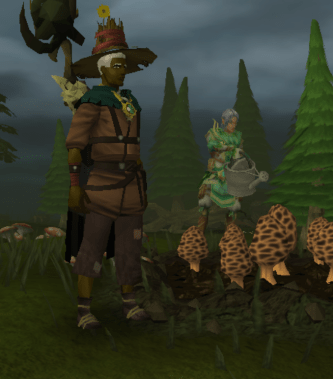
My Runescape avatar, Trichronos, watching the plotted mushrooms grow.

It started off as something for us to do together on weekends, and the chat channel let us stay in touch while they were away at their mother’s house. When I was forced to surrender my custodial rights to take a job up in Livermore in 2004, the game became a stress breaker. Runescape involves a lot of mindless, repetitive skilling activities. I would sit down with The Economist and mouse away, half the time without even looking at the screen.

My avatar, Trichronos, was once a negative image of me. Now my hair is mostly white. The original Runescape was pretty raw, with a lot of adult language, misogyny and racism. I chose the character as a reaction to the last, and have been called a ‘nigger’ more than once. And when others complain that they wish there were more female players, I always trot out my original error, “Well, it’s because girls parse the name as ‘Run! Escape!'”

On the flip side, I have observed over the years that Runescape does grow player communities consisting of disabled vets, students, the chronically unemployed and the elderly. They follow each other’s lives and often provide support in solving real-world problems.

One of the draws of a fantasy game is that you get to chose what kind of hero you want to be. Combat is a big draw to some, although the tactics and visual effects in Runescape are tame compared to those in games that focus narrowly on combat. I do enough combat to be able to do the quests, but filled up my time with skilling.

As the ecology in California began to collapse, I felt compelled to focus on the farming skill. It was my first “max” skill two years ago. Changes in the game mechanics made it easy to max out on the other skills since, but also introduced rewards for further achievements. So while I don’t have an interest in the other skills except as they factor in quest outcomes, I am trying to complete the farming achievement. It represents a bounded but not insignificant draw upon my energies: logging in for twenty minutes four times a day to harvest patches and plant new crops. I estimate somewhere between 120 and 200 days to achieve my goal.

“Trichronos” is obviously not a name I would give to a child, but has specific meaning to me. “Tri” is obviously the prefix “three,” and Chronos is the Titan of time in Greek myth. The choice references both my model of physics, in which I posit additional time dimensions, and my sense of my deep past, as in “third time is the charm.” It’s not time to explain that second one yet…