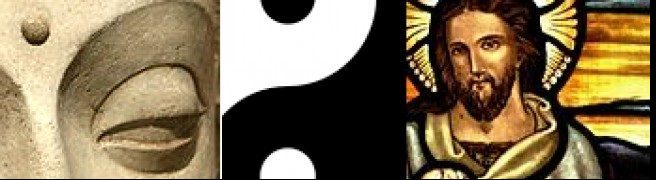
The Zen of Jesus

Upon waking up to the reality that self-serving does not bring joy, the seeker after comfort tends to a superficial sampling of religious wisdom. The sophisticated teacher needs to avoid becoming involved in blame-shifting for the seeker’s miserable state. In the traditions of Abraham, that begins with a vow of submission, formulated in Christianity as “Do you accept Jesus Christ as your personal savior?” In Islam, it is stated as the Shahada:

There is no god but God alone; he has no partner with him; Muhammad is his prophet.

The dissatisfied acolyte is then made responsible for his own condition, in that all wisdom is found in direct relation with the godhead.

Lacking a divine center for its practice, Buddhism takes a different approach, epitomized by the Zen koan. A koan is a cryptic one-liner that organizes an inward meditative journey. The most notorious is:

What is the sound of one hand clapping?

The obvious answer is “nothing,” but that certainly doesn’t point the way to wisdom. The student still needs to grasp that the “hand” being referred to is themselves, and that in seeking after spiritual glory, they earn no lauds.

The story of the rich young man in Matthew 19:16-22 shows Jesus ministering to the problematical seeker. The poor fellow grasps at eternal life as a guarantee that joy can be secured. Calling Jesus “Master,” he then asks what good he must perform to earn that grace.

Presciently, in Matthew 7:21, Jesus had pre-empted the Christian vow of submission:

Not everyone who says to me “Lord, Lord” will enter the kingdom of heaven, but only he who does the will of my father.

Consistent with this warning, Jesus immediately deflects the proffered authority:

Why do you ask me what is good? There is one alone who is good.

No man needing anything but faith to draw upon the strength and wisdom of the Father.

But the teaching does not end with the Zen master’s edict to seek inwardly. Jesus lists the six commandments of human relation: edicts against murder, adultery, theft, and lying; and encouragements to honor our parents and love our neighbors. The latter build intimacy with those closest to us; the former prevent those bonds from sundering. Through this practice, Jesus suggests that his protégé will “enter into life.” In avoiding the drama of struggle, adherence to the commandments allows to blossom those quiet moments in which we gain the subtle and sublime assurance of security in our knowledge of the compassion that embraces us.

We are no longer a hand trying to clap alone.

But the seeker is not just young; he suffers another handicap, one known in Islam as Allah’s greatest test of character. He is rich. Thus, while meaning well, others see him as a potential source of material security. They seek a bond with his money, not his heart. And so Jesus offers him this final advice: give your wealth to the poor and follow!

The young man departs saddened. We can only guess at the cause: was he responsible for managing money that ensured the well-being of the community, wealth that he could not trust others to manage responsibly? Was he simply unable to imagine survival without the perks of wealth: the daily bath, the satisfying meals? Or did he arrogantly perceive his wealth as a sign of divine approval, and so Jesus’ pronouncement as proof that hope had been invested with just another false prophet?

Whichever it may have been, we as readers should recognize the advice not as some generic one-size-fits-all formulation, but a direct response to the needs of this troubled young man. It is the mark of the greatness of his compassion that Jesus does this again and again throughout his ministry: offering just the words that the listener needs to hear to bring solace and healing, even to the point on the cross of:

Father: forgive them. They know not what they do. [Luke 23:34]

Jesus was not concerned with self-preservation – he was devoted to his ministry to the lost. Thus, while his teaching encapsulates the wisdom of the Zen and Christian teacher, it then surpasses it. None can doubt that he does the best that he can for them, although they might not be able to respond fully. Yes, it is this I believe that gives the young man sadness: his realization that salvation was offered him, and he was unable to grasp it. It foreshadows Jesus’ struggle in Gethsemane:

The spirit is willing; but the flesh is weak. [Matt. 26:41]

and:

My soul is overwhelmed with sorrow to the point of death. [NIV Matt. 26:38]

Me, Myself and Christ: Revelation

My son Greg can become exasperated with me. As a young adult, he is concerned naturally with social acceptance, and seeks for answers to the problems of his generation in the conventional wisdom brought forth from the past. When he has had enough of my contrary pronouncements, he retorts:

You speak with a great deal of assurance, Dad!

Yes, who am I, to assert that I know better than all these others?

For me, the situation is far more ambiguous. My assurance is necessary to those that I attempt to comfort. To those seeking hope, how else can one speak? They need to believe that you believe in the choices that you are offering them.

But to believe that you represent the truth is far different than believing in one’s own authority.

To those familiar with the Yu Gi Oh cartoon series, I can offer a meaningful image. In the cartoon, the young hero finds himself in conflict with evil, and struggles to the limit of his abilities to overcome it. In the lurch, a larger self – ancient, powerful and wise beyond any human reckoning – comes to the fore.

Thus, to my intimates, I speak of myself variously as a “test particle” or “bait” or “a point of contact” or “a beneficiary of a privileged perspective.” So I’ll be dreaming about a troubled baptist, and suddenly I’ll see the scene as though looking over my shoulder and another presence asks “Is that you, John?” I’ll be driving to the aquatic center and have a cardinal from 400 miles away land on me with shame and grief regarding the priestly pedophilia scandal. I’ll wake up at midnight to a pope announcing “I am your father, and I am going to die and leave all this power to you.” I’ll be listening to the opening lyrics of He Reigns, allowing my mind to wander over the continents, and a Muslim leader shows up to say “Here’s another billion people for you to manage.”

To those that don’t understand the challenges of loving, this might seem all very exciting. Having carried the heavy burden of being blamed for things done in my name, to me it’s far more ambiguous.

There are two great challenges to loving, which is to grant strength to the loved one. The first is when the recipient does not adhere to the constraints of loving. Loving them is thus to empower them to hurt others. In consequence, unconditional love moves through our lives like the tide, peaking higher when we honor its constraints, and ebbing when we violate them. The mechanism of this operation is for love to love all things so that it feels the wrongs we commit, and transfers its ministry to those we have wounded. In seeking to serve ourselves, we are indeed our own worst enemies.

The second challenge is far more painful. It is to find the beloved surrendering themselves to us, becoming merely extensions of our personality rather than beautiful manifestations of infinite possibility. A loving personality is surrounded by grateful recipients of love’s strength, and that gratitude amplifies their influence. Unless such a lover is tender, it can overwhelm the weaker links that bind together the beloved, scattering its elements to the spiritual wind.

It is for these reasons that Jesus proclaimed himself as a servant, and testified as to his humble heart.

As if this wasn’t difficult enough, this little pseudo pod of Christ is wrapped up in hostility. The important work to be done is in “binding” and “loosening” things in the spiritual realm, and my interactions with them are at best tenuous. Thus I dream of the great flocks of birds I knew in my childhood, and finding, upon walking out to the deck, that a ravenous dragon is arising from the spot in the ground from which the birds arise. At an Easter service, I cupped my hands around the sun and spread its influence, only to encounter in the asteroids an echo of the ancient cry of grief “No! Don’t kill him!” I receive a visit by an emissary of the two-dimensional race represented as the eye in the pyramid, asking for assistance to travel across the Milky Way, and am warned six months later that the gift of energy caused the output of the sun to drop by ten percent. Or wake, much as I was waken by the pope, to find myself in the midst of a perfectly spherical personality, only to be guided across a great void to a tiny speck, the “most precious place” in its realm, the “only place where life is found”, and to be told “I want to help, but even the smallest mistake would be disastrous. I need people to guide me.”

When I was introduced to the modern interpretations of Revelation, I was told that the first beast, numbered 666, was man. Man, the creation of the sixth day, believing in his own power and being humbled by failure. But not only man was created on the sixth day: in the morning came the livestock. So the correct category is mammalia. This is also the fourth, greatest beast of Daniel’s dream. It is the intelligence of man in service to the destructive Darwinian instincts of our evolutionary predecessors.

The enemy of the beast is the man with the flashing sword of truth coming from his mouth. The birds are his allies. In Daniel’s dream, he is granted dominion over the power of the “Ancient of Days.”

As when he first came, I recognize that Christ – the human perfected by unconditional love – can only become those things that he is allowed to be by those he serves. While he proclaimed his authority in the earlier era, in this era it will be to each of us to proclaim the authority of love in our lives – and thus to receive him as lord in our hearts. He is not our ruler, he is our example. And he is very, very, very close.

Take comfort. Take heart. None are forgotten, even those held captive by those that take refuge in the darkness. There is no hiding from the glory of the light that he brings.

Me, Myself and Christ: Immersion

I had not set foot in church in almost twenty years when I began looking for a community to provide a moral foundation for my sons. I was pointed at the local Unitarian Universalist congregation, and found myself caught up almost immediately in their vision to establish commonality among all the world’s religions.

I was among them for only a few short weeks when disaster befell us on 9/11/2001. The minister was visibly shaken during her sermon that week, and one critic bemoaned the poor judgment she had shown in reaching out to an Islamic Center in the San Fernando Valley.

These two factors – the hope of uniting people of good will and the terrible cost of failing to do so – prompted me to start visiting the religious communities of the Conejo Valley.

The Catholic Church was not the first Christian congregation that I visited during this exploration. In fact, the evolving pedophilia scandal dampened my expectations that I would obtain any value in cultivating the priesthood. However, recognizing the strength of the Catholic community, I eventually concluded that I needed to experience the faith of the people in the pews.

The site was St. Maximilian Kolbe’s in Oak Park. The church has an unusual layout. The side entries funnel into an alcove before a pool of holy water. The crowd around the pool distracted me. I was feeling some anxiety, recalling my childhood impressions of the angry God. I turned toward the altar, and was astonished by the cross, set off to one side and dominating the space with a larger-than-life figure of Jesus suspended in front of crossed branches. Rather than anger, a deep enduring grief and sorrow beset me. Confronted with this image and personality of human suffering, my right hand went immediately to my heart, and without thinking, I held it out to him and thought “Use this for healing.”

Thus began a relationship that is so palpable and near to me that I never partake of the elements. That was meant for remembrance, and I am absolutely convicted that the time for remembrance is past.

There are several contexts in which that nearness manifests most powerfully. Early on, the passing of the elements itself would cause me to be overcome by sorrow. Tears would roll uncontrollably down my cheeks, and eventually I realized that the sobbing I heard around me was not unrelated to my emotion – a realization confirmed in part by the irritation expressed by celebrants. When Revelation Song was popular in non-denominational congregations, with the opening words I would almost collapse in grief, my entire frame shaking, and the people around me would huddle together in small groups.

I also experienced a particularly deep relationship with the crucifix at the Los Angeles Cathedral. Flanked by roughly shaped limbs and supported by the bruised torso, the peace-filled face embodies perfectly the savior’s surrender and victory. After my first Christmas midnight celebration, I waited patiently to address the cross, looked up into that visage, and – gesturing to the broken body – admonished “It’s time to clean all this up.” Later, I would stretch up onto tip-toes, pressing my hands against the sternum, trying to push strength back through the centuries to sustain him in his suffering.

And then there are the children’s choirs. They sing with perfect and innocent faith, free of the regrets felt by adults. At St. Paschal Baylon’s in Thousand Oaks, when they led the congregation in the Agnes Dei I felt the weight of heaven pressing down on me from above, an experience that persisted in other settings until I decided to push back.

Along with these emotional experiences came visions that I find very difficult to avoid reconciling against the verses of Revelation. I will summarize some of those in the final post in this series. I will conclude today with the culmination of my immersion in Christ.

When my father was working in the nuclear weapons laboratory in Los Alamos, New Mexico, he and my mother liked to spend time in the mountains that in the last half of the twentieth century came to be known as “Sangre de Christo.” I was conceived there, and born in Los Alamos. For my forty-ninth birthday, I decided to take a trip out to Taos to connect with those roots. It was a remarkable experience in many ways, but the most important insight came as I drove down into the LA basin from the high desert. A palpable feeling of hostility mounted against me. I wasn’t wanted.

The next day, Monday, I was driving out to work from Agoura Hills to Camarillo, and could not shake his presence. The urgency and strain of his struggle on the cross came closer and closer. I was in tears as I descended the steep and winding Camarillo grade in freely flowing traffic, wracked by grief and trying to project that I was endangered. But he refused to let me go. He knew that he was dying, and refused to die until the work was done. We wrestled, back and forth, and finally the image of that first encounter in St. Max’s came to me, and our equanimity was restored as he pronounced:

Our heart is beating still.

Me, Myself and Christ: Naivety

When I met Trey (a fabricated name) at contemplative prayer, I shared that I had written two books on apologetics. He skipped past my contributions, asking whether I had read his favorite writer on the topic. I simply shrugged and countered:

My perspective is grounded in unusual experiences.

Most popular Christian writing focuses on the theology of redemption or the experience of healing. I cannot claim to have been threatened seriously with destruction by sin – either in my own weakness or as prey to others. I was raised in a white, upper-middle-class community by a brilliant father and a mother committed to saintly service. The household had its issues, but they were issues that reflected the opportunity to negotiate choices, not the pressures of fear and want.

When my mother and I were discussing the psychological challenges facing her grandchildren, I observed:

We were a household of children raised by strong and caring parents. We spent our formative years struggling for influence over one another. It was only very recently that I realized how powerful my will had become, and so to appreciate how hard others had to work to maintain their autonomy.

The characteristic attitude of my childhood was an awed gratitude for the past. The most representative memory is standing with one foot on the sidewalk below the school, staring at the seam between the asphalt and concrete, and realizing that many people had invested their energies in manifesting this magical conduit that guided cars, people and water, each in their proper places. But my gratitude also kept me in reading my history books long after my siblings had gone out to play.

We were a Catholic family until I graduated from elementary school. I attended St. John Fisher in first grade, the strongest memory of which is kneeling for communion near the angry cross, and wondering why people worshipped that kind of God. I was consoled by the Catholic Children’s Bible, which I read in second grade. I found the Old Testament to be suspiciously like the Celtic and Norse myths that my elder sister brought home from the library, but the New Testament was an attractive promise of healing for the world. My father, unfortunately, could not reconcile the science of the day with Christian theology, and his critical analysis of faith eventually tore the entire family away from the Church – with the notable exception of my younger sister.

Faith was replaced by secular ethics. The foundation was gained in Church: our parish was a liberal Vatican Two congregation with an active lay membership. My parents were active in Democratic politics and the Civil Rights movement. Cub Scouts also provided a grounding in service to others, with weekly paper and bottle drives organized in collaboration with the Boy Scouts.

Unfortunately, it was clear that my peers were intimidated by me. I was aware that my intelligence separated me from others, and it was a tool that I applied forcefully to understanding of the world. Paradoxically, it was also the engine, powered by my father’s skepticism, that kept me from recognizing the silent voices calling out to me in my childhood. The closest encounter was on my first Jamboree. The other boys went off to make friends, but I found myself wandering on the paths above the campground, drenched in the peacefulness of the trees and brush, until a scout in my patrol ran up to warn that I needed to follow the buddy system, and dragged me back to camp.

With mature perceptions, today I recognize how my elders used my calming dispassion. For myself, I was far too busy trying to figure out how the world worked to think much about the impact I had on my peers. I studied physics in college because it was the most fundamental of the sciences, but in the rich social and political environment of UC Berkeley, I could not avoid the understanding that morality and politics determined the ends to which power was turned. I absorbed the popular ethics of the day, reading F. Scott Peck and Rollo May, supplemented by Foreign Affairs and the Christian Science Monitor.

There were a few signs of the impact my devotion had on those that managed to get close to me. After discussion section one afternoon, I followed the professor and my friend Peter up the hill toward the Campanile, thinking about how wonderful it was to have people like them in my life. They had moved ahead twenty feet, talking seriously. I was moved by a great joy. They stopped, looked at each other, and turned bemused smiles to me.

City on the Hill

I’ve started attending a contemplative prayer gathering. The process starts with twenty minutes of silent meditation on any devotional word that comes to mind. Then we read a passage from the Bible three times, allowing time between each recitation for it to settle, until a single word or phrase stands out from the text. After sharing our personal reflections, we close with reflections from the greater church on the passage, allowing us to project our personal focus against the longer backdrop of Christian experience.

This week’s passage was Matthew 5:13-16, the famous “You are the salt of the earth.” Most of the reflections celebrated both the salt and the light. But before the incongruous image of the city on the hill, I heard a contrast in Jesus’s assertion:

But if the salt loses its saltiness, how can it be made salty again? It is no longer good for anything, except to be thrown out and trampled underfoot.

This was the condition of the people – their kings and priests had sundered their bond with God, and the Romans arrived to trample them underfoot.

I held my tongue, though, as the gathering celebrated the qualities of salt, only after the meeting had ended calling the facilitator over to engage her in discussion. When I suggested that Jesus was offering a metaphor on the condition of his people, I felt truth cementing our connection. She did not repel it, as so many do when confronted with a contradiction of received wisdom, but bowed her head and said “Yes, that is how it was.”

So I continued, as I have never been allowed before, observing that Jesus was proclaiming that they were no longer salt, because he was making them a light to the world. He, the lamp lighter, would not hide their light, but send them forth to inspire faith in God. And she simply continued to nod, saying  “Yes, yes. Brian, you have a gift.”

We talked further, affirming each other. The things she said were so terribly confounding. I have decided to move out to Port Hueneme, seeking to find simple people with open hearts who don’t ask “What’s the price?” when they are offered a gift. It is a form of withdrawal from the world, which has given me some deep wounds recently. But I woke up this morning, and realized that nobody in my life had ever said what she said to me, an affirmation that sums up to this:

Brian, people need you. They might not realize it; they may even act frightened of you. But keep on doing what you are doing. They need to hear what you have to say.

To UCLA

Any tragedy is a wound, an offense to our spirits that threatens our goodness. Particularly in a case such as Professor Klug, we cannot fathom how his caring for Mr. Sarkar could have ended as it did. Our intellect recoils from that connection – it offends our logic and sense of justice.

So we ask “Why?” I will offer you an answer.

For billions of years the history of the universe was a random bashing together of atoms. Even here on Earth, after the first single-celled organisms birthed the promise of meaning, for nearly a billion years every species that arose cast down those that came before it. Darwinian evolution is driven by the wounding of each other by creatures that have no choice. In truth, it is only over the last ten thousand years or so that humanity – that little blink in Nature’s eye – has had the opportunity and resources to express consciously and intelligently an intention to bring love into the world.

This is the struggle before us: to overcome our Darwinian programming. The struggle is not easy – our bodies are designed to produce powerful signals that pull us into animal behavior. In many cases, our science and engineering have given us the means to amplify those tendencies. Sometimes that is pleasant, but today we grieve because one man’s confusion was amplified by a gun.

So we feel pain, and gather together to share strength, as others have gathered in the past. It is important to remember that past, a past from which we celebrate figures such as Martin Luther King, Jr., Nelson Mandela, and Mahatma Ghandi. While they fall, and fall too often, in each generation technology allows them to reach more and more of us. We can doubt the existence of Jesus, Buddha or Lao Tze, but we cannot doubt that the message of love they shared with the world still inspires people in our day.

Institutions of higher learning such as UCLA, at their best, are a cauldron in which we hone our intentions to do good. In part, we grieve for Professor Klug because he represented the best that UCLA has to offer. The terrifying moments of his death threaten to cast us down into fear. The Darwinian world claws at our hopes.

I wish to offer you my sense of why we celebrate people whose response to fear is to choose to love unconditionally. They possess a certain power, a power that I best understand as this:

Love dissolves the barriers of time and space, allowing wisdom, energy and understanding to flow between us, and embracing us with the courage, clarity and calm that overcomes obstacles and creates opportunity. When we open our hearts to one another, there is no truth that is not revealed. And to those that truly love themselves, no impulse to harm that cannot be turned to the purposes of healing and creation.

It is to that last point that I wish to turn your attention. We can grieve, and that grief can turn to fear. Or that grief can be used for healing.

So to each of you, I would ask that you find a moment to take the hands of a friend and allow their eyes to enter you deeply. In that moment, set aside any future expectations of them, and say “Thank-you for your goodness.”

And to those of you that receive that affirmation, I would ask that you take the power that is woken in you, and to consider Professor Klug. Reach through the moment of fear that consumed him. Visualize his acts of caring as a teacher, father and friend, and offer the words “Thank-you for your goodness.”

And then consider the family that grieves for him. Jesus said “Blessed are those who mourn,” because to grieve is to remember goodness that has been lost. Grieving is our goodness affirming goodness. So visualize that family, and allow your strength to pave the way into a future of healing. “Thank-you for your goodness.”

And last, and hardest: consider Mr. Sarkar, who fell down the well of fear. No person is without merit, even if only in small acts such as tying a sister’s shoe or in recognizing virtue in another. Visualize those moments, no matter how simple, and build strength in them. “Thank-you for your goodness.”

And then open the ears of your heart. Hear the world around you, the Earth that we have abused so terribly. Hear that world awakening to hope. As you walk amidst the trees and over the grass, as the birds chirp and little creatures scurry, hear it calling out tenderly: “Thank-you for your goodness.”

Translucence

I applied for a job out in Monrovia last week. My intuition is that an interview will not be forthcoming, but the opportunity caused me to realize that Pasadena is a center of activity that resonates well with the forces that attract my attention. Not only are JPL and CalTech premier technology centers, the latter hosts the Skeptics Society, a community of relatively free-thinking people. Just down the freeway in Claremont we have a divinity school, public policy college and Harvey Mudd. Sierra Madre hosts Reasons to Believe, a group of Christian apologists led by the Hugh Ross, who is nearing retirement. Finally, I’d be able to join the contact improve community, work out at the Bikram studio, and hike in the San Gabriel mountains.

But in my reflections on the general milieu, a specific personality came to the fore. It was a part of the experience at last year’s Skeptics Conference that I didn’t reveal at the time.

In reading intellectual history, we almost always find that liberal communities have as their nucleus a forum in which self-assured and beautiful women can meet brilliant men. That was readily apparent to me at the conference, although I found myself a little embarrassed by the age differential between the men and the ladies. Not being an anomaly in that regard, I focused on the ideas that were presented.

But as I was wandering from the conference hall to the snack table, an alabaster woman in a cerulean silk shift caught my attention. The combination was striking in itself, but as she turned away from me, the plunging back of her dress revealed a pink welt where her lower ribs had pressed against her seat. I was completely beguiled by this evidence of her physical vulnerability, and allowed myself to enjoy deeply the desire to protect her.

She froze and turned to glance at me out of the corner of her eye, lips parted gently in surprise, then took refuge with her friends. But as the conversations wound down and the attendees wandered back to the hall, I found her standing in my way, ten feet apart from a little semi-circle of her friends, and had to resist the impulse to escort her back to her seat.

I have my own evidence of vulnerability, deep scars on my face from eczema that did not clear until I was in my late twenties. My father suffered similarly in his youth, and his uncle treated him with x-rays, probably contributing to the skin cancer that left him disfigured at the end of his life. My own case evolved into deep abscesses, left untreated until my mother was approached by a counselor in high school. This left me terribly humble in the presence of women in college, exacerbated by my awareness that when I found a young lady trying to draw her boyfriend’s attention to me, I would be beset by hatred that caused the pimples to burn.

All of my life, I have caught unguarded glances from my intimates that reveal just how disfigured I appear in direct sunlight, and many people have advised me to have my skin smoothed. But I have never bothered, because I almost always found that the pity was replaced by an apologetic smile. The smile seemed to be accompanied by a recognition that it was my heart and mind that were precious to them, and that my outward appearance was only so jarring because of the contrast with what they encountered within.

The evening with the Skeptics Society ended with a performance by a Ukrainian band led by brilliant pianist. I sat in the front row on the left side where I could see his hands on the keys, and was surprised to discover that nobody else sat in the row with me. Rather, the crowd, greatly reduced from the day’s attendance, was scattered around the hall. The pianist was an instigator, though, and commanded us all to get up and dance. Michael Schermer’s wife caught sight of me cutting the rug in my socks, and came over to bump hips with me. But across the center row, I caught sight of the alabaster woman again, clapping her hands and bouncing gently on her heels.

For the last number, we were called onto the stage itself. I found myself dancing toward the piano. The performer laid himself atop the lid and played backwards on the keys while I raised my encircled hands over his heart, guiding energy into him. He finally staggered away, stopping next to his brother, the lead guitarist, pointing at me and shaking his head in wonder. As the number wound down, I turned to go, the calm center of a stunned gathering, and found the young lady offering me her admiration and desire.

I have tried to communicate this before: women are designed to bind personality to matter, and deep in their hearts there is nothing they desire more than to do that in partnership with love. But her wonder reflects a common feminine reality: men want to project their greed into them. As a society, we have conditioned them to accept that, and so as a form of protection they dis-integrate themselves. The sacred vessel of the womb is divided from their heart and mind. My deepest shame as a man originates in the sympathetic cry of my heart in the presence of women that have been so wounded. I try to put them back together again, and the response is often a desire to take me into them.

There used to be a saying about a man “moving heaven and earth” to safeguard a woman’s love. But the wounds on my face are evidence of engagement in a deep spiritual conflict. More than once, I have had visions of offering a woman the earth to tend with me. They flee in sorrow, return it upon realizing they don’t know what to do with it, or surrender it to their more acquisitive sisters. Fortunately, its preferences are clear – while it took me decades to gather it the first time, in the last instance I regained it in a few hours.

Mary Margaret invited us out to Pomona College this evening for her senior art exhibit, and I decided to make a day of it out in Pasadena at the Huntington. As I drove down the 101, I was again in the presence of the lady in blue, and found myself revisiting that scene outside the conference hall. Stepping in front of her, I stooped to whisper “You understand that your skin is suffused with the light that seeks to come into the world through you?” The wonder in her eyes allowed me to encourage her “I can unlock that for you, but you have to understand that it’s too much for your body to contain. You have to let it out into the world – into the trees, the little creatures of the air and field, the very air, the clouds and sun themselves. Do you understand?” She nodded, and I stepped behind her and placed my hand over heart.

To feel her expand in radiant fluorescence that was celebrated by all the world around her.

Let’s Talk Science and Theology

My friend Jamie Wozny told me, during a career coaching session, that I should “try to keep it simple.” As I drove down Wilshire away from LACMA considering the forty years spent studying physics and religion, I whined to myself, “But it all seems simple to me.”

To bridge that gap is why I dance. At the last nightclub that I frequented, the manager came up to me one night and said “You know, I’m noticing that wherever you are, that’s where the people tend to gather.” A Persian woman came up to me one night to say “You don’t know how good you make us all feel.” Just this weekend my friend Mary Margaret, as we lay all akimbo after rolling around on the floor together for ten minutes, admonished me about viewing myself as an old man, “You really should love yourself more. Others would benefit from the experience of your joy.”

The problem is that most people take the energy that comes out of the heart and direct it downwards to the sacral chakra, the focus of passion and pleasure. I try my best to be disciplined, because otherwise I would just be a slut, but the people that come to LA Ecstatic Dance and the Full-Contact Improv Jam do love to touch and be touched. For many, it’s an opportunity to mix masculine and feminine energy without the complications of a relationship. I’ve benefited from that willingness as I try to figure out how to unlock the feminine graces, but I still find it difficult to withstand the impulse to rest my hand over a woman’s womb as she arches backwards with her hips resting on my thigh. Nobody has slapped me yet, so I surmise that I’m giving in to what they want.

I attempt to patch things up afterwards, just consistently raising energy from the fourth chakra – the heart – up to the sixth chakra. While the latter is associated with the pineal gland and known as the “seat of intuition,” physically it rests right over our cerebral cortex which is the part of the brain devoted to higher reasoning.

Realizing that somebody was peeking into my childhood, I woke up at 3 A.M. with a sinus headache. It’s drying out here in Southern California, and the grass is disintegrating. I eventually dragged myself out of bed to rinse my sinuses with Alkylol.

After crawling back under the covers, it occurred to me that the sinuses sit between the sixth and fifth chakras, the latter being the throat chakra that focuses communication and creativity. I always struggle to engage others in conversation regarding the matters that demand so much of my attention – sometimes to the degree of a painful burning in my throat as emotion wells up from my chest.

In considering Dante, Santayana elaborates Dante’s metaphor of theology as his lost love Beatrice, their happiness frustrated in part by his flirtation with philosophy. This matches my own experience: theology does seem to rise from the heart, while science – the most mature expression of philosophy – rests in the mind.  In the modern era the two camps of heart and mind have chosen to dispute with each other.

Between them we have the voice that wisdom teaches us to reserve for the truth. I have spent my life on this problem – the reconciliation of those two warring camps, each holding half of the truth. If anybody knows of an opportunity to engage with others in dialog on those problems, let me know. I’m willing to travel.

The Form of Eternity

In my analysis of Santayana’s Three Philosophical Poets, I followed the arc of maturity in my presentation of the poets. Santayana follows the arc of history which begins with Lucretius and passes through Dante to Goethe. The significance of Faust is in fact amplified by Goethe’s two lampoons of Dante’s Feudal culture and the ancient Greek culture of Lucretius, the disciplines of which are interpreted as impediments to the expression of will that flowers in the third part of the epic.

Ironically, Santayana finds redemption for Goethe’s fascinations in Spinoza, the nominal heir to the ancient Greek materialism that inspired Lucretius. Spinoza offered the idea that things (including our selves) cannot be understood in the context of any specific act, but only in the context of eternity. The broken chair is for the scrap heap, but as part of the revolutionary barricade may have deflected a bullet aimed at the hero that would become the nation’s first president. In that context, the broken chair may be seen as a sacred relic.

Similarly, Faust is redeemed because he did the best that he could in the context of his life. Trapped between dying feudalism and his contemporaries’ Neoclassicism, Goethe chose to seek a new form of self-expression. The morally ambiguous parables of Faust are modeled on his experience. Faust’s apotheosis reflects not upon the virtue of his actions, but upon the nobility of his struggle for self-determination in a society dominated by institutions that claimed cultural and spiritual authority.

Although I took a different route through life, I feel a certain sympathy with this perspective. Obviously the intellectual program I have pursued here struggles against the conventions upheld by our institutions of higher learning and religious interpretation. And as Goethe was, I have been subject to powerful forces that drive me forward. I explained my interest in physics to my father with the claim that I was seeking to reduce the world to a mathematical proof. When I reached my junior year in college, I realized the attendant dangers of providing power to people that didn’t understand the virtues of loving. Thus, while most of my contemporaries were getting married and focusing on establishing professional networks, I was expanding continuously the scope of my studies, trying to figure out how to present those virtues in a way that would be compelling.

When I was woken up spiritually in December of 2001, I finally realized what had been driving me through the first half of my life: there was a wall of pain in front of humanity, and I had been working as hard as I could to find a way over, under or around it. When I became aware of that burden, my attempts to share it with others were rebuffed, typically with some version of “Well, I’m glad you’re working on that, Brian, but really I’d rather go dance with this young man over here.”

What amuses me about those interactions is the deprecating attitude that accompanies them. Having myself hidden from foreshadowing of global ecological collapse, I am sympathetic to the desire to avoid projecting ourselves into our immediate future, and I recognize that women have reasons to be particularly susceptible to that tendency. But in the form of eternity, so to speak, impending ecosystem collapse is the only thing that matters. You may eat, drink and be merry today, but not for much longer.

Of course this all sounds tragic, so why am I amused? Because I interact directly with people’s higher selves. I see them in the form of eternity, and I realize that powerful personalities in this world are powerful because they project influence through spirit. While once those influences were dominated by selfish personalities, they have become weak through indulgence of billions of years of fascination with the play of material forms. Conversely, over the same time span mutually supportive spirits have been winnowing out the selfish and building up structures and stores of energy that will enable them to liberate themselves from immature influences.

The two endpoints in this process are described by John in the Book of Revelation. The beginning describes the twenty-four chief angels in heaven, twelve masculine and twelve feminine, crowned by pride. But the angels are forced to bow down to unconditional love, the one on the throne, by the worship of the “living creatures” on the earth. In the final stage, labelled the “New Jerusalem” by John, love is liberated from its protective shell and works freely its creative impulses. This is the form of eternity for humanity as a whole – that transformation is the purpose that we are raised up to accomplish.

And so I am amused because I am attractive to people whose higher selves are eager for immersion in love. When the living form (what we think of as a “person”) declines to commit themselves to participate in the realization of that eventuality, the higher self is shedding the final vestiges of selfishness. That is the purpose of this material realm – for the angels to localize their selfishness and shed it. The beneficiaries are those of us that commit ourselves to the work. Interacting with us is the mechanism used to cement collaborative and loving relationships in the higher realms.

And so while isolated, weak and irrelevant in this world, I store up treasures in the world to come. Treasures donated by those fascinated by the superficial play of forms in this world.

I do feel some compassion for your plight. It is expressed in the complaint of the third servant in the parable of the talents. It goes something like: “You are a hard man. You take what is not yours, and reap what you do not sow.” But the compassion only goes so far, for so it always seems to tyrants when their subjects are liberated.

Left Body, Right Mind

I spent a lot of time playing my flute over Easter weekend, and when I left work on Monday evening I unbent my elbows and caught my breath as the muscle that connects to my thumb screamed in discomfort. Laying down on my back that night, the pain radiated down to my hand and up to my shoulder. As a software developer, I immediately worried that I was coming down with a repetitive stress disorder.

What was worse was yoga on Wednesday night. The Bikram practice has poses that require pulling with bent elbows, and I just couldn’t execute them. By the time we reached tree pose, my right arm was dangling uselessly at my side. Worse, lying down for spine strengthening series with arms straight brought pain all the way from the hand up to my shoulder.

Obviously this was more than one muscle, and as I laid in bed trying to diagnose the phenomenon, I realized that it was a side-effect of the work I have been doing trying to pull my shoulders back. After two months, I’ve finally stretched my left pectoral enough that I can get that shoulder back behind my breastbone. When lying prone, then, my upper arms no longer descend from the shoulder to a bend where the forearms lie against the ground. My arm is perfectly flat, and the muscles in my arm are having to stretch to accommodate the new position. That I sit with my arms bent almost all day long doesn’t help any. Furthermore, with my shoulders back, I no longer use the muscles of the upper back to raise my arms laterally – the shoulders now do the work. This explains the pain there – I am asking for work from muscles that have been freeloading for most of my life.

As might be obvious from this analysis, my yoga is an intensely left-brain activity. Yes, it’s mind-body integration, but in any instructor-led activity, I am constantly comparing my activity to the ideal, and correlating defects with the underlying body structures as revealed by sensation.

This prevalence was first brought home to me when I attended a shamanic healing in Santa Monica ten years ago. The healer went around to take a look at all of us, and when he reached me, simply touched the right side of my head and pulled his hand away. I felt my mind expanding to fill the space he had created. It was an interested experience, but at that time I didn’t stop to consider why I had this imbalance in my mind. I assumed that it was a legacy of my intellectual discipline – that my left brain was stronger than my right brain, not that my right brain was weak.

Recently, Jeff Nash’s Awakening Process has forced me to reexamine this weakness. Jeff encourages us simply to feel, and to expand the depth of our sensation by surrendering into our exhales. With nothing in particular to think about, again and again I have found the right side of my mind turning on.

I assume that this is due in part to the work that I have done in Yoga balancing out my left and right musculature. This is still an intensely left-brain process. This week I am focusing (as I am able) on stacking the bones in my left leg, even when walking, ensuring that I am not using soft tissue to absorb stress. And I am still strengthening the muscles around the left shoulder blade and in the left side of my abdomen.

This morning, though, an unexpected side-effect came to light. My lady and I have been facing some blow-back, with her complaining (as others have in the past) that she just wanted to be a woman and here I am making her into a goddess. That left me exposed last night, and I woke up to sexual energy originating from another source. Noticing that this seemed to enter through the right side of my mind, I expanded my awareness back into the occupied part of my personality.

And found myself listening to women talking about me for the rest of the night.

Oh, well, I guess that I’ve been too much of a gentleman, trying to save space for a woman all my life. But it looks like if I want something done “right,” I’m going to have to do it myself.