
Called Out on Quotes II

While I was an atheist from ages twelve through forty-one, I was shocked from an early age at what appeared to me to be the casual and heartless misuse of the word “love.” I encountered the writings of F. Scott Peck when I was in college, and wrote a long letter to him after reading The Road Less Traveled. One of my concerns was that Peck seemed to ignore the importance and necessity of self-love. I eventually received a hand-written reply from his personal assistant, though I didn’t recognize the gravity of the personal touch.

It took me until late in my life to realize that most people didn’t share my mania for precision and integrity in their use of words. My ex-wife, an interpreter and rebel against Marxist indoctrination, explained that words were simply a semiotic system that were manipulated to produce the effects we desired. The implications of the observation were lost on me until much later.

As with many people committed to moral principle, I have found myself often feeling that the world is designed to visit cruelty upon the good. Turning the other cheek is a fool’s errand, at least from a practical perspective. But I am constitutionally unable to focus ill will. The trick for me was recognizing that I didn’t have to accept it. I’ve written about this before: heaping coals on somebodies head isn’t necessary when a refusal to accept their ill will causes it to rebound back upon them. While sometimes I give it a little push (thinking “that mind is a lot more fertile territory for you to grow in”), for the most part I try simply to let it pass through me.

The greatest struggle in that discipline occurs when there are concrete consequences to yourself and those dependent upon you. After ten years of living in that fear, I encountered the story of Jakob Boehme, the German Christian and mystic.

Boehme was compelled by mystical experience to write profusely of his experience of grace. The response of the religious authorities of the age was to forbid circulation of his works – even the hand copies produced by his friends. Eventually Boehme was forced to flee, leaving his family to the suffer alone the duress of the Thirty Years war. Boehme voiced his opinion that his faith saved him from persecution, landing on his feet again and again through the intervention of strangers.

The similarity in our stories was striking to me. Among other details, while not forbidden to write, I found myself constantly in confrontation with those that deride Christianity. This could take the form of the lawyer guiding me through my child custody dispute sitting down and joking with his peer about priestly pedophilia (“Abstinence makes the Church grow fondlers”). While on Boy Scout campouts, I would often found my meditations on the beauty around me interrupted by fathers stopping by to dismiss faith as an intellectual fraud. And at work, the owner announced at staff meeting that “you can go to church looking for forgiveness, but I get far more out of knowing the family that runs Cook County.” Finally, as a blogger, I not infrequently find myself confronted by victims of Christian theological abuse that seem to find it necessary to shift their pain.

It is this quote by Jakob Boehme that gave me the strength to grow through my bruised reaction to such events:

If you ask why the Spirit of Love cannot be displeased, cannot be disappointed, cannot complain, accuse, resent or murmur, it is because the Spirit of Love desires nothing but itself.

It is taped to the top of my monitor at work, and affirmed for me every time I see the confidence and strength in the eyes of the sons that I devoted myself to serving.

Boehme’s words have allowed me to confirm that it was the growing power of the Spirit of Love inside of me that made it so difficult for me to hurt others. It was not weakness, but a kind of being born from within. The choice, taken early in my childhood, may have been naive, but, once made, for some reason not one that I could renounce. At this time, I am glad to say, nor is it one that I can ever see regretting.

Called Out on Quotes

Anonymously Autistic has nominated me for the Three Day Quote Challenge. I am torn here, because after a lifetime of avoiding denomination I now have no means of wriggling out of nomination. Except maybe to blame AA for choosing such a great quote that I know that I will never be able to equal her inspiration.

So “Thank-you,” Anna.

Here is my favorite quote, penned by George Bernard Shaw when he sent Man and Superman to his friend Arthur Bingham Walkley:

This is the true joy in life, the being used for a purpose recognized by yourself as a mighty one; the being thoroughly worn out before you are thrown on the scrap heap; the being a force of Nature instead of a feverish selfish little clod of ailments and grievances complaining that the world will not devote itself to making you happy.

I have many reasons for returning to this quotation.

First, the distinction between joy and happiness, the first being something that arises from within while the second is a response to temporary external stimulus.

Secondly, the wisdom (as Jesus suggests in the parable of the talents) that power is not awarded to self-seekers, but only to those that serve. When we honor that compact, we do indeed become like unto a force of nature, causing others to move in sympathy with our purpose, sometimes even against their conscious intention.

And finally the sense that the body is simply an adjunct to spiritual service. I wear my scars without shame.

There are some people that I would like to get quotes from, so I think that I will propagate the challenge. As Anna, I will not be offended if any among you decline.

The challenge rules are:

  1. 3 quotes in 3 days
  2. Thank the person who nominates you
  3. Nominate three more people each day.

Hoo-hah on the last one!

Annointed One, She

I had a beautiful dream this morning.


Pale, so pale, the fires of desire
Languidly pooling within.
I would see you wind-swept, tresses
Streaming, roses in airy worship.

Cool quencher of men’s passions
Once enflaming, merciless burning,
Surrendered also to misused wood,
Be so intemperate in your pity!

For surrendering life for Life,
Heart hungering for life, and
Life answering, passionately reaching
Filling, stretching, pulsing wings of joy

Stream through you, through those tresses,
Aloft in the sunlight amidst feathers and petals,
Each strand adored and adoring, eyes
Aglimmer in fertile futures.

Oh, let me worship at the well of Life
Within you, surrender my Power
Into the waters and soil of creation
Sustained, gentled, tempered protecting.

Shield me, dearest guide, shadow me
Cast the wisdom of your knowing over me
Rising above and over, meaning,
Oh tender breasts caressing, my mind

Guide into your heart, let me serve
You, part you, fulfill you as tender –
Yet with awed tears streaming –
Paroxysms of witnessing.

Live Oaks Matter

When dealing with a problem as large and diffuse as anthropogenic climate change, many of us have a Rubicon to cross. As recently as five years ago, I had practicing engineers tell me that there was no way that our individual impacts could combine to affect a system as large as the Earth. The escalating frequency and power of destructive storms has changed the minds of many of those doubters.

For myself, I never doubted the science, but it was an abstraction until I observed the changes in the Oak Trees when I returned to Livermore in 2004 after being away for ten years. Persistent drought had reduced the level of the Del Valle reservoir by almost thirty feet. When I finally found the opportunity to hike the hills rising from its western shore, I was astonished and dismayed by the battered look of the oak trees. Flaking bark and fallen branches littered the trail, and the sturdy equanimity of forest was replaced by a beaten weariness. When flying into Oakland over the reservoir in the early evening, the rust-colored crowns were evidence that the ecosystem was facing the loss of its keystone species.

These observations were magnified when I visited the IONS retreat center in Petaluma. I had seen isolated instances of sudden oak death along the freeway, but the trees along the ridge around the retreat center were decimated by the scourge. The branches and leaves were coated with a choking fungus. Recent rains had brought new buds that twisted as they suffocated. I reached out to offer a compassionate touch, until a voice warned me that the contact would coat me in spores that would travel with me.

The death of the oak forests was not so visible in Southern California. The coastal ranges come right down to the shore north of Santa Barbara, which seemed to act as a barrier to the spread of the fungus. And the trees in the Thousand Oaks area often line waterways sustained by treatment facility discharges. Even so, my thrice-weekly runs along the Chesebro trails confronted me with evidence of trees in distress.

Other factors also brought me pain: all throughout the West, the native scrub is being wiped out by the European grasses that now sprout up in the aftermath of wildfires. Even on old growth hillsides, shrinking brush has left exposed ground that is overrun by verdant lawn after rains. Where water gathers on fields, the invaders are thick stands of mustard plant. The weeds last only long enough to choke out the native sprouts, then die off, leaving soil at the mercy of the wind. In many places, the chalky lime of the range peeks through under the burnt stems of the sage.

When I took up Bikram yoga to combat my chronic back pain, my contact with these realities lessened. Even moderate exercise causes me to perspire profusely, leaving me in a dehydrated condition that forces me to break posture early in class. So I have given up hiking to refine my posture and prana flow. The disconnection came to the fore when one of the other students remarked that it was nice to see the hills greening again. I had to hold my tongue – I had observed over the winter that the lime green of European grasses was spreading on the burnt ground.

But I had been hooked. As I walked back to my car this morning, I felt the call of the green world. It seemed to say, “Yes, it’s not the way it was. But it is new life. Come and see us!” So when I arrived home, I put on my hiking boots and headed up the trail.

WP_20160220_13_36_30_Rich_LITo be confronted with a large Valley Oak that had shed its lowest limb in a recent storm. The wound, so evocative of a screaming face, shocked me into recollection of the frightening dark forest of the Witch of the East in the Wizard of Oz. The sight was leavened somewhat by the sunflowers propped up against the trunk. I stopped to place my hands against the deep bark, and willed the matriarch to live, but she was weary. It was time to let go. So I offered the hope that a new sprout would rise under her guidance to provide new expression.WP_20160220_13_38_33_Rich_LI
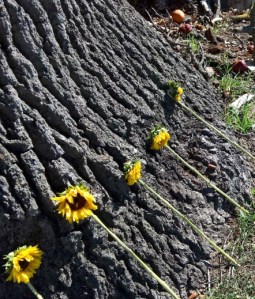
I wish I could say that it was an isolated experience, but not a hundred yards up the trail I encountered another casualty. This friend had lost its crown, probably more than a year ago. The lower limbs were thick with brushy twigs, made bare by the winter weather. This determined manifestation of the will to survive was contradicted by the evidence in the bark of a tree that stretched its lowest branch across Chesebro from the far side. The pattern of bark discoloration suggested that it, too, would be diminished in the near future.

While the Valley Oaks seemed doomed, the Coastal Live Oak, less grand in their ambitions, seem still to thrive. They lose their limbs, but even hollowed out, they channel water through the cambrium, reaching up and out to paint the sky with green.

But as I strode away from the arroyo to cut my way home along the road, the future was painted in bright green. After the last wildfire roared up Chesebro Canyon in 2004, the forest service attempted to demark and maintain native species restoration plots. Often no more than ten feet on a side, the chicken wire was often lost in a sea of mustard plant, and while steadfastly maintained, the drought yet murdered the native plants that had evolved to survive the dry months of our Mediterranean climate. The future was obvious on the slope above the trail head: stunted oak saplings, ringed by white plastic tubes to protect them from the deer, evoked a military graveyard against the backdrop of the European grass that coated the slope in a hyperactive green.WP_20160220_14_11_23_Rich_LI

Much Ado About Women

When I went to my thirty-fifth high-school reunion, I ran into one of my old cronies. After observing me dancing by myself, he remarked that I was “still afraid of women.” Thirty minutes later, I had a lady drag me out on the floor, saying she wanted me to dance with her friends. The eight of them made a circle around me, laughing and shrieking until I reached my hand out and spun around to link their hearts in a circle, rhetorically asking “What’s the energy for, ladies? What’s the energy for?”

So, no, it’s not fear.

But I didn’t know quite how to put it until I recalled a scene in the recent live-action Alice in Wonderland. The caterpillar rejects her identity, and in response to protestations from his friends merely observes to Alice, “You’ve lost your muchness.”

This reflects on a recent conversation with a woman who testified that she spent her youth protecting the weak from bullies, until a man that she recognized as an old teacher (from lives stretching back 4000 years) observed to her that she “didn’t have to be Joan of Arc all the time.” I walked away from the conversation reflecting that she had surrendered her greatness to him so readily.

So, please, don’t do that. Jesus was an exemplar, not a substitute. Make much of yourself, my dears.

Life of Sorrow

Frieda Kahlo, in a letter to her husband Diego Rivera, testified that he was “by far the worse” of the two disasters that defined her life. The first, remarkably, was the perforation of her uterus in a bus accident at age 18.

Of all the insensitivity of men, Diego epitomized the worst of it. Not only was he extravagantly unfaithful to Frieda, but he failed to appreciate the huge investment of self she made in him. Frieda, in many of her self-portraits, put a bust of Diego on her forehead. The day after her death, a friend observed that he appeared to age ten years, and finally testified that “I never knew how much I loved her.” No, lummox! You never understood the power of her devotion to you!

Diego did care for Frieda, supporting the drain on his finances of more than thirty surgeries related to her accident and spinal bifida. But he eventually divorced her, and this pressed Frieda into depression. Self-portraits of the period show her attempting to reclaim the European mantle carried by her father, where for years she had dressed the part of the Mexican peasant. A few weeks before her death, she penned the line

I hope the end is easy, and I hope never to return.

This strikes deep into my heart. In Golem, I write of a cosmic convocation of masculine minds that lost their women to sorrow. Their ladies take haven in a place that masculine minds cannot penetrate, the super-massive black hole in the center of our galaxy, leaving men without their primary inspiration in the struggle for justice. We need women like Frieda, and any testimony of their abandonment of us is, frankly, terrifying.

I learned the details about Frieda at a seminar presented by Dr. Gloria Arjona. Dr. Arjona is also a singer, and these two passions combined in her investigation, as Spanish Lecturer at Cal Tech, of the fragments that Frieda inscribed on her self-portraits. Most penetrating of them are these words from a Mexican adaptation of Cielito Lindo:

Arbol de la esperanza mantente firme

Tree of hope, be strong

Dr. Arjona spoke of Frieda as representative of the universal human condition, which is the struggle against sorrow and pain. After her presentation, I stopped to take her hand and thank her for “representing Frieda so faithfully.” For Frieda does indeed represent that struggle so universal in Latin America, though foreign to the American middle class. The experience on Saturday was a link for me, as I learned this morning when humming the tune to the chorus of Cielito Lindo

Ay, ay, ay ay. Canta y no llores

“Sing, and do not cry.” It is an assertion of will emanating from those that have nothing but their voices, and even then only in moments of private celebration that are yet always touched by the pressure of sorrow. It is to claim the right to be loved, a claim that almost broke my heart as I began to weep.

I love you. We are strong enough. Come to me.

Self Discovery

Oh gift, pulsing outward, into every cry seeking

The returning sorrow. Each discard leaves

Glimmers of light, but shadows fall

Upon myriad aversions. Alone feeling.


Nimbus tear-drowned, but breath burns,

Unquenched. Heart overflowing, emptiness

Downward rolls, bellows lock, dregs coughed

And life rushes into the breach.


No knowledge preparing, good or ill.

Ownership offending, bounding liberty,

Reason overthrown, upending faith.

Love’s solitude in truth uniting.


Truth beyond grasp, but compassion

Compelling, dissolving awareness, twining

Marionette thought in spirit free. Dancing

Freedom into bonds inescapable.


Not I, but multitudinous we.

Presenting Ourselves

When Parashakti runs her Dance of Liberation workshops down at LA Ecstatic Dance, she begins by facilitating the pairing of spirit buddies. While my first experience with her was pretty intense, more recently I’ve been working in service to others. That means that I am chosen, more often than choosing, when she finally says: “Look around and find a spirit buddy, someone close to you. Once you’ve found them, describe your intention for this dance.”

So I pivoted slowly and found myself hooked on the eyes of the really pretty woman, standing tall enough to almost cover my chin. Another gentleman tried to step between us, but she raised her hand to gesture to me.

I’ve never heard such a strongly worded statement of intention. It went on for nearly ten seconds as she spoke about preparing herself in this year to let love flow through her and into the world around her. I brought it to a close by holding my hands over her shoulders and then lowering them until they hovered over her chest, encouraging my angels to fill her heart to the brim. “Thank-you,” she murmured.

“That’s my intention.” Parashakti then told us to stand back-to-back. Feeling that I wasn’t quite connecting with my partner, I tilted my head back until it contacted her crown. She nestled in a little more closely.

I had been right behind her as we danced a circle earlier in the ritual, and had noticed her hands moving as though warding the space around her head. Asthe blindfolds went on, that image came back to me, and after the closing circle thirty minutes later, I told her that I had received something to share with her.

She was the object of a lot of masculine attention during the open dance, and I half expected her to avoid me. But forty minutes in she took a break for water, and gazed pointedly at me. I guided her into a corner, leaning in close to block the pressure of the music, and began, “Our culture projects a lot of ideas that negate a woman.”

“What?”

Not sure whether she was just buying time to process what I had said, I repeated myself. “When you were dancing next to me before the ritual, I noticed you doing a lot of work with your hands around your head, as though you were warding things away.” Stretching my right hand to touch the heavens, “We tend to look to each other for validation, but there is a source of eternal truth.” Hesitantly, I moved my hand closer to her crown, gauging her reaction. “I was offered a message from them: they want you to know that they are reaching out to you.” She just gazed at me, frozen. “When I went through this process, I had to surrender my thoughts and let my heart guide me.” I reached out with my left hand, palm upwards, and envisioned cupping her heart in it. “I had to let my heart energy rise until it merged with my mind.” Raising my left hand until it was just under her chin, I concluded “The heart guides the head, and the head protects the heart.”

I was shirtless and slimy with sweat, so she embraced the air around me, murmuring “Thank-you, thank-you so much,” fleeing and returning two or three times before returning to the floor.

She continued to be popular on the floor, mostly among the younger men that I can now only join briefly in frenzy. I worked the room in my usual manner, spreading joy and tenderness where it was accepted, but really wearing down at the end. As the afternoon drew to a close, I sat on the floor to down dinner, watching as she was intercepted by man after man. Getting up to change clothes for Contact Improv, I came back to sort through my backpack and offer my gratitude to Ataseia. She passed by and I caught her eye. “One more thing.”

She didn’t hesitate. “What you said earlier explained a lot to me about myself as a woman.”

Thinking of her confidence on the dance floor, “Yes, I could see that. But the challenge is hanging on to it. We have to stay focused on them. They have their own purpose, and if we fail in our devotion, they tend to wander away.”

She leaned into the frame of the closed doors, hands clasped before her. That wasn’t what she expected. But her lips offered a gentle bow of curiosity.

“You projected a great deal of positive energy into the room today, but when you began to dance with a man, it turned inwards. I could see you winding inwards, and the source of that energy was left adrift.”

She stopped to reflect, and voiced her agreement.

“If we want to hang on to them, we can’t do that. We have to present ourselves, and wait for the other person to open to us in turn. It’s not a winding into, it’s an expanding through.” She looked uncertain, so I reached out to cup understanding in my right hand, brushing it gently across her.

“I’m not sure that I understand.”

I stepped back. “I present myself. All of myself. And if you respond, I come closer, not directly, but slowly spiraling as my angels introduce themselves to your angels. It’s not always pleasant – some things really don’t belong together. But that’s what we do here. You danced with a lot of people today, as did I. We gently join our personalities, and then the magic happens. We go out into the world and draw upon our shared wisdom and energy.

“But we shouldn’t make too much of that. We need to stay devoted to ourselves, waiting for that encounter to which all of us announces ‘yes!'”

She raised her hand tentatively to demonstrate her understanding. Her eyes narrowed as my entourage resisted her, and I caught them sending “Not without our permission.”

We embrace twice, and she departed with a wistful “Maybe I’ll see you next time.”

“I look forward to it.”

Inner Purge

I apologize to those who find that this is “too much information.” I am more aware of my spiritual process than most, and part of the purpose of this blog is to help others understand the nature of personality. One of our biggest challenges is figuring out how to get our parts to work together, and encouraging discordant elements to seek opportunities elsewhere.


After the sudden departure of the embedded systems supervisor in November, after winter break the team arrived back at work to learn that the senior hardware designer had accepted a position elsewhere. The last two weeks have been a scramble, and I’ve been pretty brutal about testing others in assessing whether I believe that the company can survive.

Strangely, that process has been accompanied by a deep-rooted sense of joy. It has no specific source that I can identify.

So I had plenty to process last night, and found it hard to nod off. I had activated Microsoft Solitaire early this week, and got involved in trying to catch up on the daily challenges. I’m used to the Sudoku challenges which I often polish off in under ten minutes. Solitaire has an element of chance to it, and I found myself simply unable to complete some of the more difficult puzzles. I’m sure it’s possible, and I indulged myself in playing the same challenges again and again. Giving up around 11:30, I settled in to sleep.

As a man, I have found that the greatest temptation of unconditional love is (as I have alleged elsewhere) to have women offer you many opportunities to bind love to the world. Of course, it’s not that simple. Most of them want to bind that love to them personally, maybe extending to the children that will enter the world through them. I keep on sending out to them “Yes, thank-you, but what about all this?” I conclude with a projection of personality that makes them aware of just how deeply and broadly love is embedded in the world.

But we all dream, of course, and so I wake up in the middle of most nights to throbbing arousal. Until recently, a specific woman was always presented as the focus of desire. Early on they were media personalities linked to my deep past, but more recently there has been a kaleidoscope of ladies that I encounter at dance celebrations, yoga and in coffee shops, many of whom I haven’t even engaged in conversation.

I’ve been slowly boring through that facade, and recently encountered the admiration of a woman without form. She tried to hide from me, but I pinned her down and got a good look into her before turning my attention elsewhere.

Last night’s encounter was something similar. A powerful arousal without focus, just the sense of a feminine personality. I tried to pin it down to push it away, thinking about being able to function at work today, but it was too diffuse. Frustrated, I engaged in the mechanical process of release.

Then they began to arrive, woman after woman, as though the goal was to find someone to attach this passion to, a material manifestation that would be sympathetic to the goals of the originator. I simply pushed them all away, one by one.

As I laid in my bed afterwards, a powerful sense of unease entered me. I had a vision of another room, decorated with bright colors. I focused more and more intently, and then something emerged from the center of my chest – a sickening brown vapor that disappeared reluctantly into the ground.

The vision disappeared, and I was left with a powerful sense of energy along the parasympathetic nodes that line the spine. It was accompanied by a great warmth in the muscles lying over my shoulder blades. And I thought:

I’m getting my wings back.

Yoga Limits

The constraints of my professional life have driven me to yoga twice. Both times, I was suffering from back pain that constrained my ability to sustain my focus while sitting at my desk. I recognized that the problem was tight hamstrings and a weak core, but I channeled my need for exercise into jogging, which didn’t address either condition.

The first practice was held in the meeting room of a spirituality bookstore. The instructor was an Indian lady, and I was the only man that showed up consistently. As I got stronger in the practice, I eventually found myself with thirteen women hitched to my wagon. At the time, I didn’t have the energy to manage the load, so I quit.

I was able to stay away for a few years, and then I discovered the Bikram yoga studio in Agoura Hills. I have to admit that it’s been a struggle for the owners as much as it has been for me. I am a tall string bean with a large chest.

The relative narrowness of my frame results in transmission of stress into the stabilizing muscles in the hips and lower back that are supported by bones that provide limited leverage. This means that muscle balance is absolutely essential not only to achieve postures, but to avoid overuse injuries. As I strive for that balance, I’ve been developing muscle groups that had always taken a free ride in the past, which means that I become exhausted doing postures that are often placed in the “warm up” or “recovery” category.

After four years I’m finally able reliably to stay in the 105 degree room for the full ninety minutes. While the owners were often frustrated by my bailing out in the middle of class, some of the instructors are impressed by my persistence. Several have observed that the practice is not designed for my body type.

The attraction to me is a feature that many find intolerable – the dreary repetition of the practice. The Bikram formula is a series of twenty-six postures that the instructors describe with a rote dialog. Fortunately, the more difficult postures are progressive. This means that we aren’t expected to achieve full expression, and so I have the latitude to focus on trying to figure out how to get my muscles to work together. It’s a process that has caused my to look in the mirror on occasion and burst out in laughter in the middle of class.

This opportunity to focus on my physical self has been critical to my peace of mind over the last four years. While not typical, I have dreams in which people show up seeking help to keep societies and ecosystems glued together. There’s not much I can do except to offer them the sanctuary of my heart as a place of restoration. It’s frustrating and grievous to me.

So I should have intervened early today when the instructor continued reading his story during the srivasanas that punctuate the exercises of the floor series. Although I realized that it was interfering with my ability to focus on aerobic recovery, I was fascinated by the enthusiasm that filled the room, . The diversion provided some relief from the normal thoughts – people struggling with the urge to escape the room.

The story contrasted the experience of two caterpillars. The humble yellow caterpillar (which I’ll call ‘she’) encounters a grey caterpillar spinning a cocoon. While uncertain about the possibility of becoming a butterfly, the yellow caterpillar finally chooses to try, and discovers comfort in the realization that spinning a cocoon is a natural skill.

The second, striped caterpillar (which I’ll call ‘he’) has chosen to climb a pillar of caterpillars, symbolizing the struggle for social success. As he nears the top, stepping on those below, he is finally unable to penetrate the clinging mass, and becomes trapped. He looks out and sees a field littered with caterpillar pillars, and realizes that his struggle is meaningless – with so many pillars, attaining the pinnacle of one signifies nothing.

As he weighs his options, the yellow butterfly arrives to rescue him. She attempts to pull him out of the pillar, but he draws back, and sees this terrible sorrow in her eyes.

It was at that point that I walked out, the class laughing at my explanation. I laid down on the couch in the lobby, crying “Oh, God!”

I live this every day, and it’s not that simple. They don’t just refuse assistance.

They pull off your wings and drive nails through your hands and feet.

One of the students told me, as I was passing him after class on the way out the door, that “I had missed a good story.” Really? I don’t come to yoga for a spiritual fill-up, or for entertainment. That’s supposed to happen at church or the movies. I come to focus on keeping my body strong enough to bear the burdens that I carry. If I can’t focus on that, then I’m going to have to quit again.