Laming the Swamp

At the CPAC conference, Stephen Bannon announced a bold new strategy for taming the federal bureaucracy. Given that:

  1.  “swamp monster” appears to be a qualification necessary to obtain a security clearance; and
  2. the federal bureaucracy is hypocritically feeding public prosecutors evidence of criminal wrong-doing by administration officials,

the President’s “Chief Tragedist” is calling upon Academia to “deconstruct” the administrative state. In layman’s terms: the mission of the press-ganged philosophers will be to discover the contradictions inherent in the laws and regulations that legitimate the operation of the executive branch.

The prior exemplar of this approach to governmental process was Justice Antonin Scalia, whose approach to constitutional law was “strict deconstructionist.” Under this policy, it was possible to argue both that gun rights are absolute and that corporations have the rights of citizens. Such positions are reconciled in deconstruction by allowing that every law reflects the attempt by society to solve problems that it cannot articulate due to the biases of its language. In application, deconstruction has allowed analysts to justify every policy and action.

This blogger offers an aphorism: “The Ends Justify the Meanings.” There was a book by Nabokov on this subject: something about a poet’s elegy for his daughter, dead of a suicide, and an attempt by a political hack to interpret it as a call to restore a Scandinavian monarchy. Bannon’s substitution of “deconstruction” for “destruction” is a masterful application of the principle.

Intelligence and Creativity

Joseph at Rationalizing the Universe explores the modern formulation, rooted in Goedel’s Theorem of logical incompleteness, of living with uncertainty. The following discussion ensued:


Brian

You point out correctly that Goedel’s theorem is restricted to a fairly narrow problem: proving that a proof system is “correct” – i.e. – that its axioms and operations are consistent. In other words, we can’t take a set of axioms and apply the operations to disprove any other axiom.

This seems to lead to the conclusion that we can’t trust our proofs of anything, which means that there are no guarantees that our expectations will be met. Unfortunately, expectations are undermined by many other problems, among them determination of initial conditions, noise and adaptation. The last is the special bete noir of sociology, as people will often violate social norms in order to assuage primitive drives.

At this point in my life, I am actually not at all troubled by these problems. Satisfaction is not found in knowing the truth, it is found in realizing creative possibilities. If we could use mathematics to optimize the outcome of social and economic systems, we would have no choices left. Life would become terribly boring. So what is interesting to me is to apply understanding of the world to imagine new possibilities. Mathematics is a useful tool in that process, particularly when dealing with dumb matter.

This brings me back to the beginning of the post: you state that “mathematics is the unspoken language of nature.” If there is anything that Goedel’s theorem disproves, it is precisely that statement. Mathematics is a tool, just as poetry and music are tools. At times, both of the latter have transported my mind to unseen vistas; mathematics has never had that effect.


Joseph

You raise a very interesting point; if we could optimise everything then would we take all of the joy out of being…. you may well be right. I know I get a lot of my satisfaction from the quest to know more. Although I disagree that Godel’s theorems disprove my original statement in this sense; language is essentially about describing things. That is why you can have different languages but they are easily translatable…. bread/pan/brot etc…. we all know what they mean because they all describe the same thing. In exactly the same way, mathematics describes things that actually exist; that isn’t to say nature is mathematics at all – mathematics is the language of nature but it is just as human in its construction as the spoken word. But is matter not matter because a human invented the label? Matter is matter.

To be, these theorems don’t break down all of our proofs; but what they do show is a vital point about logic. One which I think is going to become and increasingly big issue as the quest to understand and build artificial intelligence increases – can we every build a mind as intelligent as a humans when a human can know the answer to a non-programmable result? We hope so! Or rather I do – I do appreciate it’s not for everyone


Brian

I appreciate your enthusiasm, but I must caution that the mathematical analogies in classical physics cannot be extended in the same way to the quantum realm. Richard Feynman warned us that there is no coherent philosophy of quantum mechanics – it is just a mathematical formulation that produces accurate predictions. Ascribing physical analogies to the elements of the formulation has always caused confusion. An extreme example was found in the procedure of renormalization, in which observable physical properties such as mass and charge are produced as the finite ratio of divergent integrals.

Regarding human and digital intelligence: one of the desirable characteristics of digital electronics is its determinism. The behavior of transistor gates is rigidly predictable, as is the timing of clock signals that controls that propagation of signals through logic arrays. This makes the technology a powerful tool to us in implementing our intentions.

But true creativity does not arise from personal control, which only makes me loom bigger in the horizon of others’ lives, threatening (as the internet troll or Facebook post-oholic) to erase their sense of self. Rather, creativity in its deepest sense arises in relation, in the consensual intermingling of my uniqueness with the uniqueness of others.

Is that “intelligence?” Perhaps not – the concept itself is difficult to define, and I believe that it arises as a synthesis of more primitive mental capacities, just as consciousness does. But I doubt very much that Artificial Intelligence is capable of manifestations of creativity, because fundamentally it has no desires. It is a made thing, not a thing that has evolved out of a struggle, spanning billions of years, for realization. Our creativity arises out of factors over which we have no control: meeting a spouse-to-be, witnessing an accident, or suffering a debilitating disease. We have complex and subtle biochemical feedback systems which evolved to recognize and adjust to the opportunities and imperatives of living. We are a long way from being able to recreate that subtlety in digital form, and without those signals, meaningful relation cannot evolve, and thus creativity is still-born.

Private Property as a Principle of Social Terrorism

James Radcliffe offers a UK perspective on Trump’s presidential candidacy. I offered this context.


There’s an aspect of the American political trajectory that is perhaps worth highlighting to those outside the country, because it is developing steam in other places.

Fundamentally, government is concerned with negotiating the rules that control the distribution of power in a society. For all of human history, it has been either at odds with or coopted by the concept of “private property,” which most often is allocated arbitrarily from the commons, and held by force even when mismanagement of resources leads to preventable social suffering.

What has happened in America is that, since the ’80s, the conservative branch of our political system has adopted an extremist view of this conflict supported by the economic proposition that the only legitimate means for redistributing power is the free market. That actual markets, with their privileged knowledge and contractual Arcana, are by no means “free” in the theoretical sense has not impeded the propagation of policies, laws and political planks that uphold this principle as the foremost goal of all governmental action.

They are blind to the contradictions of their program: the use of government to supplant government with the free market. Karl Rove, conservative talk radio, the Koch brothers and Grover Norquist are the political terrorists driving the implementation of this program. The consequence is that conservative candidates for president have become progressively less qualified to run the government. Their understanding of government has become atrophied because they actually question its legitimacy.

Trump is simply the inevitable consequence of this divorce from reality.

Solidarnosc, Roboti!

The Russian police arrested a robot that was collecting opinion data at a political rally. Given how little suffering corporations endured to obtain free speech rights in America, I think that soon enough it will be time to let robots vote. It’s not quite as bad as sending 18-year-olds to Vietnam when the voting age was twenty-one, but its getting there.

Okay, probably not.

Beyond Evil to Good

Miguel de Unamuno, considering the road from masculine frailty to faith, observed in Tragic Sense of Life that all men desire two things:

  • To live forever.
  • To rule the world.

The obvious paradox in these impulses is that most of us (myself being a man) attempt to accomplish the second by beating the crap out of other men – which tends to advance the interruption of our seeking after the first.

Work-arounds abound, the most obvious being to have a gun at the ready whenever an altercation arises. The subtlest is the use of psychological conditioning to get others to do the beating up for us. In totalitarian states, that conditioning takes the form of propaganda against imagined enemies, but is often joined with control over basic necessities. In democratic cultures, the conditioning is typically tied to unattainable visions of sexual conquest. When progeny ensue, hypersensitivity to their vulnerability often becomes the lever used to encourage financial exploitation of others.

Obviously in these systems there will be losers – a great many losers. The power of the impulses identified by Unamuno then manifests in a terrible perversion, expressed by a friend who asserted that the world would “know about him.” He testified ominously:

“Yeah, when a man has nothing to lose, there’s nothing he won’t do. And when the world learns about me, it will be nothing like anything that it’s ever seen before.”

I tried to lighten the air, offering that I knew what he meant, and that my sons were sometimes worried that I was going to just walk off and disappear. When he asked “You mean go live on the streets?” I replied, “No, probably they’d find me out someplace like the Amazon in Ecuador helping the indigenous people deal with the mess that Texaco left behind.”

Ah, the contradictory consequences revealed by Unamuno’s observation!

Some men lose everything, and seek to rule the lives of others by ending them, thus finding immortality in notoriety. I have nothing, and so claim this little piece of the blogosphere, writing about everything for almost nobody, and imagine conquering a little part of the world with a sponge and a squeegee. Some men fear the immigrant, and extrapolate our future against Europe’s tragedies where the Muslim population is ten times proportionately larger than ours. Accepting King’s dictum that “injustice anywhere is a threat to justice everywhere,” I embrace Muslim America as an opportunity for Islamic scholarship to rediscover and reassert the original message of Mohammed (pbuh), and any acts of violence as a cross to be born in conquering fear.

Unamuno’s defense of Christian faith was that we “create this God of love and eternal life by believing in him.” I see that as heresy: we don’t create him; we rather allow his virtues to manifest in our lives. In doing so, we learn to love ourselves and accept love from others, thereby obtaining dominion over the only part of the world that really matters: ourselves. In focusing that strength to the service of loving others, we lessen the burden of their resistance to our survival, and so enter more deeply into their world.

And for those that cannot learn – either those that lash out in violence or those that consume the innocent? What do they become in the end? Not themselves any longer – they become a headline in a newspaper. The history implicit in the personal “why” is lost. They become simply a “what”: 18 in San Bernardino. 49 people dead in Orlando. 3000 dead on 9/11. 47 million during World War II. Their personal history is consumed by the violence they created.

But men like Buddha – who renounced violence to bring a system of self-control to his people – or Jesus – who died to expose the hypocrisy of the military-religious complex – their names are enshrined in the hearts of those they have liberated. They live on in us.

Coming Clean on Student Absenteeism

Daily Kos reports that allowing poor students access to washing machines at school decreased absenteeism in 90% of cases – as well as improving student enthusiasm and participation.

People facing challenges in life test the effectiveness and fairness of the systems designed by those granted opportunity. When something so basic as personal dignity can be addressed so simply, with such a profound impact, it’s hard to argue that we shouldn’t do what we can to understand their condition.

Me, Myself and Christ: Lover of Ideas

If to love something is to seek to strengthen it, then in the period between high school and the World Trade Center attack, my life was devoted to the loving of ideas.

Of course, as an initiate to modern scientific materialism, at first I didn’t see it that way. I was strengthening my brain to ensure my future as a knowledge worker. I understood that when exercised, the tissues of the brain become more densely penetrated with energy-delivering capillaries. Neurons that were stimulated by thinking sprouted dendrites that sought axons, and when those synaptic connections were triggered, new thoughts were born.

I didn’t really begin to examine the detailed operation of my mind until my wife began to get angry with me when I didn’t look at her when she was asking for advice. She was a very ambitious woman, seeking a complex balance in life between competing priorities, and when she brought me a problem I would go into a kind of meditative state. Her words would enter my mind, as though through a gateway into a garden that she could not enter. I would hold them all together, not weighing them, but allowing them to find a balance among themselves. When a pathway through the possibilities became clear, I would focus on the most immediate priority and serialize the procedure that would generate the desired conclusion.

The friendship that I offered to ideas was the maintenance of the preserve in which they organized themselves. I didn’t force them together. I have never been invested in the outcome of the determination. I was interested in the truth that was revealed. When none became apparent, I would produce a plethora of possibilities for my interrogator, intuitively probing for more constraints so that I could produce a definite conclusion.

Most people, of course, found this incredibly confusing.

In the quiet hours alone, I continued to grapple with my growing concerns regarding the stability of our civilization. What I realize now is that I was reaching ever deeper into the space of ideas, and that exploration was allowed because I was trusted. Ultimately this manifested as a terrible intellectual force that simply brushed others aside as I pursued ideas to their conclusion.

The outcome on my professional relationships was distressing. In one case, I had identified a fundamental inconsistency in a design method, revealed only through a seven-step chain of reasoning. I tried to offer this to the lead investigator, who fought me at every step. When I finally wore him out one day and was able to lay out the logic, he broke off with the complaint “If you talk long enough, Brian, you can convince people of anything.” In another situation, a potential collaborator noticed me breaking eye contact when he asked a difficult question. I was looking past the blank wall of the cafeteria into the space of ideas. Intuitively, he tried to follow my gaze to enter along with me, but was rebuffed. And finally in 2005 I had a female sponsor show up in my dreams one night, offering to usher me into the quantum realm. She slipped through the atoms of the wall, pulling me behind her, and I simply bounced off. When she mused “I wonder why that happened,” I realized that I was in possession of a view of reality that led into deeper truth.

In the spiritual awakening that occurred after 9/11, I came to understand just how great a gift I had been awarded by the ideas that accepted my attention. My elder son Kevin gained access to them early in his childhood. Distressingly, he considered that space as a private preserve, and worked systematically to exclude his younger brother. So Greg learned to access ideas through his peers.

As they grew older, I offered them some advice. To Kevin, “Ideas are strongest when they are shared.” And to Greg, “People can introduce you to ideas, but eventually you need to make friends with them yourself.”

While in my childhood I was in awe of the past, I am relieved to say now that I am blessed with the awe of realizing how deeply they have integrated that advice into their lives, and to observe how their moral and intellectual skills mesh to create value in the world. While I try not to impose my expectations upon them, I find through them hope for the future.

The Inevitability of Appropriation

I spent my childhood watching my father struggle to make himself understood. It was not that he was handicapped in a fundamental way, but rather that he recognized that most people were terribly imprecise in their use of words. To ensure that he was able to describe precisely his methods of software design, he invented his own notation and terminology. In the end, he spoke a foreign language.

Of course, that also brought a certain power. In working with him years later, his resistance to my innovation was to assert that I hadn’t spent enough time sitting at his feet to really understand what he was doing.

Although I shared his concerns regarding imprecision in the use of words, I had no intention of following in his footsteps. Most of the creative intellectual energy of my twenties was devoted to an attempt to facilitate moral discourse by reclaiming terms of common usage. That thinking eventually surfaced back in 2005 at my first web site. There I laid out definitions for ‘love’, ‘power’ and ‘maturity’ (among others). The goal was to ensure that the use of such terms was based in clearly defined and shared expectations for the behavior of the speaker. Having faith in love and good will, I believed that the power accruing to subscribers to the philosophy would eventually manifest in the spread of its wisdom to the rest of society.

This work of reclamation was incredibly difficult. It was inspired, growing up in the ’70s, by my sense that the world was teetering on the brink of destruction, along with the shocking realization that when offering “I love you” most people actually meant “I feel good when I am around you. Let me bind you to me with this token.” In other words “I love myself.”

The corruption of the link between meaning and behavior is philosophical appropriation. In normal usage, appropriation is defined as:

the action of taking something for one’s own use, typically without the owner’s permission (Oxford)

In this case, we are concerned with manipulation of the consensus regarding the meaning of words to convince others that they should contribute to our benefit. The “owner” in this case is society as a whole. The “taking” is of resources meant to preserve the common good.

A topical manifestation of the struggle against philosophical appropriation is in the debate in the Democratic Party over the legitimacy of claims to a “progressive” agenda. A thorough exploration of the ambiguity in the usage of the term is offered at the Electric Agora. The nuances of the analysis rapidly evaporated into a deep cognitive dissonance as I thought back to the explanation offered in my childhood that progressives believe that “all boats rise with the tide.” This simple precept was the engine of the post-WWII Veterans Acts, the wealth generated by and for the American middle class in the ’50s and ’60s, and the Civil Rights movement. It also informs equally the choices of the partisans across the Sanders/Clinton divide – although they might dispute it.

Philosphical appropriation is driven by two forces. The first, suggested above, is simple hypocrisy. The second is more difficult to resist: it is the divergence between the original meaning of a term of social and political discourse and the mechanisms of its implementation. In religion, an early schism evolved from just such a critique. The Donatists, perceiving that priests were sometimes sinners, rejected the legitimacy of “sacraments” as administered by the Catholic Church. St. Augustine’s rebuttal was that the purpose of the Church was to reform and heal, which meant admission of sinners among the laity, and inevitably sinners among the priesthood. Augustine was concerned with the purpose of the Church as commissioned by Jesus of Nazareth; the Donatists were concerned consumers of its services.

Of course, neither the Church nor the Donatists disputed the value of the sacraments. Rather, both sides laid claim to legitimacy based upon the mechanisms of their transmission: the Church based upon the authority of Christ’s commission, which (at least in theory) established a gateway to grace that no priest could corrupt; the Donatists based upon the immediacy of Christ’s presence in the person of the administering saint. Obviously, the experience and forms of sacramental administration were different in the two societies. Eventually, those practical differences led to differences in their understanding of what was and was not a sacrament.

This is also apparent in the disputatious claims to the term “progressive.” The discussion at the Electric Agora focuses on the tension between inclusion and diversity, both  considered touch stones of the progressive program. Among some, this leads to claims of hypocrisy: how can you maintain diversity while attempting to homogenize opportunity?

Obviously, we’d like to see unity and respect in the dialog between people of good will. This seems like an ideal place for philosophical intervention.

One approach in this program of intervention is to seek to elucidate the meaning of terms in use. In both cases under discussion, unfortunately, this leads to a fracturing of meanings, with philosophical tolerance allowing legitimacy to be claimed by both sides, creating opportunities for hypocrites to profit from the divide.

The other approach is to successively refine the principle behind the term, and to elucidate the connection between that principle and implementation. This serves both to conserve and strengthen the consensus so essential to constructive social engagement, while simultaneously defending the community against hypocrites.

I find it interesting to relate this back to the original split between idealism and empiricism. The empiricist Aristotle thought that observation of the qualities of things would allow us to group them into categories. Plato, conversely, held that only in ideas could firm meaning be established, and so concrete instances in the world must be derived from ideas. The success of science leads us in the modern era to prefer the empirical approach. In sociology and politics, however, it is the ideas in our minds that determine the subject of study – which is the aggregate behavior of citizens. Here it seems that idealism – the defense of the meaning of words – is the more powerful approach. Implicitly, it is the approach that I offer to philosophers seeking to mediate political and social discourse. First defend the coherence of the statement of principle. Only then turn your attention to the practical issues of implementation.

In Coherence

The philosopher Ludwig Wittgenstein proposed a final solution for philosophy in his twenties, and then took up teaching and gardening until he realized that people were abusing his intellectual authority. Strangely, that authority arose from his insistence that much of what philosophers wrote shouldn’t be considered philosophy, because it was concerned with matters that could not be decided. Taking a less charitable perspective, Wittgenstein set himself up as arbiter of what was and was not philosophy, and his desperate peers submitted to the force of his intellect.

I wonder whether Wittgenstein recognized the similarities to the program undertaken by Socrates in ancient Athens. Socrates, assuming that he knew nothing, went about seeking wisdom. In questioning the ethical reasoning of his peers, he exposed the inconsistency of their precepts. Having clarified the relationships between theory and practice, Socrates (as represented by Plato) then proposed his own solutions to the ethical problems of the day.

To the outside observer, the similarity between Wittgenstein and Socrates might be cause for despair. After nearly three millennia, the same fundamental problem remains: no philosophy has stood the test of its application. Actually, that’s not entirely true: philosophy spins off independent disciplines, many of which are phenomenally successful. Philosophy is left with the hard questions, questions concerning ultimate truth and meaning that are difficult to pin down in a rapidly evolving culture. Where in tribal societies the concerns of the parent are inherited by the child, the information age has decoupled the generations. Thus every generation must invent anew – and necessarily either reformulate the truths of the past, or relearn them after decrying their irrelevance.

In general, we find two threads of philosophical practice in response to this dilemma: play the role of Socrates in every generation, or seek to narrow the scope of philosophy to matters susceptible to the fashionable tools of the day. Strangely, the histories of philosophy are dominated by the latter, though the arguments become more and more arcane in every generation. Each luminary writes principally in opposition to his or her immediate predecessors, and so can often be understood only in that context. This leads to some repetition in every third of fourth generation, as the reaction against the reaction re-iterates the original thinker, although the increasingly obscure terminology may hide that fact. Thus around 1800 we find Kant speaking of phenomena (our description of events) and noumena (the events in themselves), and concluding that while we cannot guarantee that the former reflects accurately the latter, our survival as a species implies that there must be some correspondence. Of course, this is just what Socrates offered 2600 years earlier in his parable of the cave.

Socrates proposed that universal education should be offered to ensure that citizens possessed the skills to maximize the correspondence between experience and description. Following Kant, it was the psychologists and neurophysiologists that took up the problem, seeking to illuminate the physiology that links experience to thoughts. The first flowering of that effort was in the work of Sigmund Freud. As presented in Ideas: Invention from Fire to Freud, the early psychoanalysts stood on the brink of building a complete theory of human culture, but Freud drew back when confronted with the non-local spiritual experience of women that reported being molested by men at a distance. Freud’s conclusion was that he was being manipulated by his patients, and he abandoned his inquiries.

One consistent thread in philosophy is fertilization by its progeny. The insights of physics, chemistry and biology illuminate and constrain the forms of experience, and so clarify the analysis of the philosopher. The progeny, however, also narrow the scope of their study to exclude that which cannot be explained. For this reason, I tend to trust the original thinkers – the ancient Greeks, Hindus and Chinese – who reported their experience without the filter of professional respectability. I assert that Freud was hamstrung by this prejudice. As regards the matter of spirituality, I’ll defer to the ancients.

This long introduction serves to motivate what follows: I believe that the program of the early philosophers had an element that was missing in latter generations. They recognized the potential of the intellect, and sought to strengthen it. They were not concerned narrowly with truth, which seduces with its promises of certain deduction. Instead, they sought to build power in humanity as a whole – perhaps simply so they could have more interesting conversations. Be that as it may, in reading the history of philosophy, I believe that much controversy can be settled by advancing a model of intellect, and recognizing that philosophers that spoke with greatest certainty were those predisposed to focus on specific aspects of the intellect, thereby simplifying what evidently is an intractably complex problem.

That they belittled their predecessors reflected the assumption that all minds operate alike, an error that our autistic brothers and sisters are now forcing us to confront. Taking individual variation in the intellect as a given, the history of philosophical study can be mined to reveal its full richness.

This post builds on the propositions originally formulated in Ideas, Ideally. It adds pretty pictures that will hopefully make the model of intellect more apprehensible.

The Role of Intellect

Recognizing that humanity’s evolutionary advantage is in the power of our minds, I have proposed to define intellect as the faculty that synthesizes our mental states. To understand the operation of intellect, we must first characterize our mental states, and then explore the possibilities for their synthesis.

Survival is a manifestation of successful relation to the world. When beginning to enumerate mental states, we benefit by considering the structure of those relationships. As concerns the mind, I recognize four immediate categories of relation, three of which are exhibited in equal degree by most animals. Of those first three, I differentiate sensory perception of our environment from the intimate physiological response of emotions. These two are most immediately concerned with our survival – the latter as the feedback signal that regulates our interaction with the world around us. The third category consists of spiritual influences that organize collective behaviors – such as the swarming attacks of bees – that may not serve the survival of the individual.

These three categories define the intellectual dynamic of Darwinian evolution, behaviors that we classify as instinctual. Even among creatures lacking a nervous system, intellect still operates, just through tissues and organs that are either less malleable or less effective at encoding information. In an herbivore, the emotion of hunger stimulates foraging, a complex interaction of muscles to navigate the sensed physical environment to locate food. Success is rewarded by satiation, and possibly sufficient surplus of energy to trigger the emotions that drive mating. As this simple illustration suggests, the intellect manifests as behaviors that couple sensation and emotion.

AnimalBut the feedback is more widespread than the example suggests. Modern ecosystems are chemically determined by the existence of life: free oxygen, soil and the food chain are all side effects of biochemistry. The physical and chemical environment determines sensation. More subtly, the same holds true in the realm of spirit, which contains reservoirs of energy and intention that can become enmeshed in the external world, influencing the emotions of living things, and consequently their behaviors. Through that interaction, the spiritual reservoirs are themselves modified. In part, that reflects that physical commonality of spiritual interaction with metabolic activity (See That’s the Spirit). Spiritual forms can gain energy and spread influence through their interaction with matter, including biological forms. Finally, emotion drives the behavior of living creatures, determining how they modify their ecosystem. Successful individuals achieve dominance in part by attracting spiritual energies that force others to support their behavior.

Recognizing the significance of the interaction between biological and spiritual forms, I find it useful to think of life as their co-evolution. Without that coupling, geology and chemistry would hold sway over the earth without any meaningful purpose.

O, Humanity!

Multicellular organisms dominate their ecosystem by optimizing the chemical environment of cells specialized to perform specific functions. Most obvious in many cases is the differentiation between the protective dermis and the organs of digestion that produce refined foodstuff for the dermis. In the case of the higher animals, of course, the specialization and organization of cells is wondrous. The layers of skin, the placement and density of follicles and sensory bulbs of nerves: these boggle our comprehension.

The evolution of multicellular organisms reflects two requirements: distribution and coordination. The first is obviously seen in the circulatory systems that distribute gases and fluids, but it is also manifested in the skeletal system that translates muscle contractions into motion. Coordination is also implemented through the circulatory system via the release of hormones that affect the organism as a whole. The nervous system is far more refined in its targeting, using the transmission of electrical signals to coordinate the behavior of specific tissues.

While the history of cellular innovation may never be known, the miracle of thought became inevitable when nerves evolved structures that chained the transmission of electrical signals along networks of nerves. This meant that the instinctual behaviors once triggered by sensation and spirit could be induced without the original stimulus by the firing of a nerve. This is accomplished most efficiently by the clustering of nerves in nodes, the most significant being the brain. In the higher animals, the progressive reallocation of metabolic resources to the brain is evidence of the benefits of signal processing by networks of nerves.

In the early stages, the signal processing provided by the brain stem was focused primarily on individual survival and procreation. Even today, reptiles are rarely social creatures. In birds and mammals, the limbic system manages social behaviors, while the cortex supports higher forms of thought.
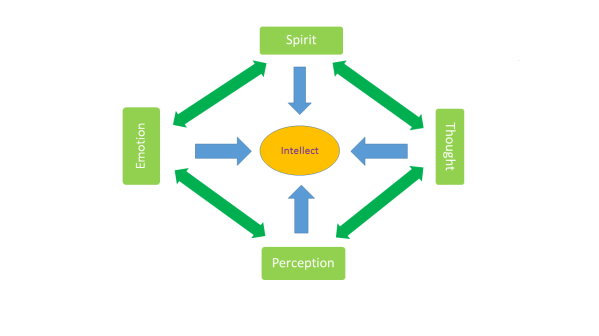
IntellectSo what is thought? In On Intellect, Jeff Hawkins of the Redwood Neuroscience Institute summarized the science that demonstrates that the cortex is a structure that categorizes experience to coordinate behavior. While initially that categorization would have been focused on the first three categories of intellectual stimulus, by the mechanism of network stimulation, eventually the internal operation of the network would have become an independent source of intellectual stimulus. Thus arose thought: the stimulation of the intellect by the brain.

Obviously thought has an ancient lineage, dating back even to insects. But full expression of its potentiality required coupling of that capacity to skills that could be used to reorganize the environment and thus control sensation. Birds and octopi manifest that to a limited extent, but primates to a degree that flowered to environmental dominance with the arrival of homo sapiens sapiens. We create tools that allow us to enhance our biology in real time, where every prior creature was allowed that opportunity – and then only imprecisely – through procreation.

While today we tend to emphasize the power of our material tools, the brain also allows a far more precise interaction with the spiritual realm. I understand that souls are composed of electrical charge decoupled from mass. Nerves channel and interpret the flow of electrical charge. As regards the emotions, nerves also affect our endocrine glands, muscles, organs and metabolism. Thus the brain provides methods for coupling thought to spirit and emotion, methods that are far more powerful than the couplings previously available to intellect.

As the influence of spirit is most evident in social activity, we should note the importance of language in facilitating the coupling of spirit to thought. While all mental states are abstractions of the underlying reality, words alone are capable of conveying our apprehension of that reality to another. Modern cultures are rooted in the conventions adopted for the association of words with experience. The ability of communities to coordinate effort to solve problems depends on the consistency and integrity of their use. Communities that honor clarity and honesty evolve social structures that may manifest as completely new forms of spirit. The ancients recognized these as “gods.”

Love of Wisdom

I have proposed to characterize Philosophy – the “love of wisdom” sought by the ancient Greeks – as study of the operation of the intellect. Here I understand intellect not narrowly as a manifestation of reason, but broadly as any process that couples the behavior of a living organism to the world around it. Intellect, in this view, mediates the interplay of the elements of reality through living creatures. Bringing together in humanity the dexterity and strength to create tools with the capacity of thought, nature manifested the potential to outgrow Darwin’s evolution through natural selection. Philosophers seek to organize that effort.

If that effort occurred in a vacuum, we might better be able to measure our progress. But it does not. Humanity is the culmination of a billion years over which life insinuated itself into the material substrate of the earth. That integration involves enormous amounts of energy, and disruption of the natural order threatens all of the higher lifeforms with extinction. The complexity of ecosystems makes it almost impossible to predict accurately the consequences of human intervention, and our facility with tools means that often we are the last creatures to feel the full force of disruption. Whether through clear-cutting of forests, the suffocation of once-fertile soils with covers of asphalt and concrete or the ubiquity of air conditioning, in fact our disruption of ecosystems often produces immediate advantage for us.

Our indulgence of those opportunities is a sign of dangerous immaturity. That immaturity is most dangerous in two scenarios. The first is when our primitive animal instincts infect our thinking, causing us to engage in contests for dominance using the most sophisticated tools that we can create. During the Cold War, the world as a whole was threatened by the nuclear arms race. While most nations appear to have recognized the insanity of direct military conflict, many nations still seek to define spheres of cultural hegemony through practices that require profligate consumption of fossil fuels. Unless reversed, that consumption will see human civilization destroyed by global warming. This second threat – the danger of inattention – manifests over many generations, and while no less deadly is far harder to address, not least because in the short term many beneficial outcomes accrue to the exploiting communities.

Under such circumstances, most parents deny children access to firearms and matches. And so it is with our spiritual predecessors. As they began to understand our potential by exploration of our minds, they have been forced to resist our head-long rush to Darwinian dominance.

If this sounds incredibly complex and ambiguous, it is. Most of the early philosophers counseled their peers to reticence. They sought to create a safe preserve for the operation of thought. Over time, that manifested through the formation of ideas that stood as bastions against disruption of human intellect by base motivations.
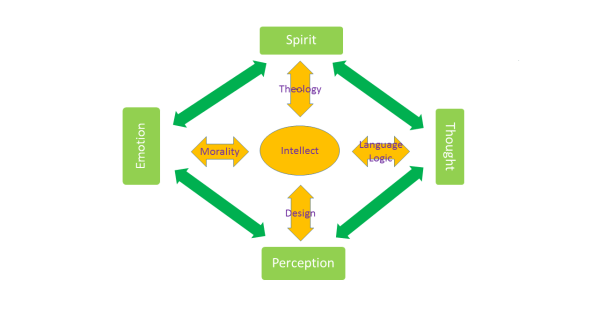
PhilosophyThe principal threads of philosophical discourse can be understood as filters through which the human intellect manages its interaction with the sources of our mental states. At the interface to the physical world, we have the discipline of design that encompasses art as well as science and engineering. Design is concerned not only with the limits of practical possibility, but with ensuring that the environment that we create accommodates our emotional needs. Ethics attempts to organize and discipline our emotional experience, building reserves of good will that facilitate collaboration. Language and logic tame the profligate domain of thought, which if left unchecked devolves into incoherence or insanity. And at the interface between intellect and spirit, we have the bastion of theology that ensures that our faith is invested with personalities that respect our potential and seek to facilitate its flowering into mature judgment.

The history of philosophy demonstrates the difficulty of expanding the scope of human intellect. In the early days of Christianity, theology was considered dominant, but today design seems to be the most powerful method for bringing reality under human control. The unbridgeable gulf between physical reality as interpreted by our senses and the abstract realm of thought has long frustrated philosophers, and Aristotle’s dominance of intellectual discourse for 2000 years reflected in large part his belief that careful observation and logic could narrow that gap. Unfortunately, the strides made by technological innovation have allowed the spread of narcissism that undermines the work done by political theorists most concerned with the balance between morality and theology (nations being gods of a sort). Perhaps recognizing the futility of imposing purpose in the world, Post-Modernism celebrates the interplay of thoughts without reference to other experience.

And so it has been in age after age: profound thinkers set off to expand the scope of human intellect by focusing narrowly on opportunities in one discipline or another, only to have their successors shout “But you forgot about this!” In making clear the complexity of the philosophical quest, I hope that I will encourage future generations to humility, and the realization that no single mind can hold all the answers. Rather, not just the richness of human experience but our very survival is dependent upon the degree to which we allow our intellect to be disciplined by compassion in our hearts.

The Philosophical State

In parting, I offer these conclusions regarding my sense of where we should focus in the next era of philosophical discourse.

Concerning design: While nature holds its secrets, the Promethean fecundity of creative intelligence allows us to explore configurations of matter that could never be attained through other means. The sublime divinity of that capability must be yoked to compassionate service to life.

Concerning language and logic: No intellectual activity is sustainable unless we seek to honestly, clearly and precisely express our experience and expectations of this reality. In debate, we must avoid egotism that prompts us to consider our perspective to be superior to the perspective of other living things.

Concerning ethics: Morality is found in any system of values that expands the domain in which love is expressed.

Concerning theology: If love is a seeking after opportunities for the object of our affection to receive affirmation, then in its selflessness unconditional love is the only incorruptible unifying principle worthy of our faith.

Blessings and honor are due any that undertake to further the project of philosophy. I pray that some benefit may be found in the thoughts that I have here offered.

The Faceless Donor

Foreign Policy has published the results of a survey that demonstrates that the younger generation rejects their experience of capitalism. The methodology of the survey was not a simple “yes or no” on capitalism per se: respondents were actually asked to identify the favorability of a number of “isms.” At the top of the heap came “patriotism.”

Neither did the survey attempt to define the terms. This means that the respondents were indicating their favor of the terms as used in common social discourse, rather than as understood by those that originally coined them.

Instead, the survey probed with specific policy prescriptions, such as “Should government provide housing and food for those unable to obtain them?” This is obviously a socialist prescription. The answer from millennials was a resounding “yes.”

I wonder why the expectation is that the government should provide this support. What about family and friends? What is it about “government” that is so attractive as a source of support?

I have an unfortunate intuition that the desire to avoid obligation to others may be involved. Receiving something from government as a right means that we can chart our course independently from others. We don’t have to constrain our choices to sustain their good will.

Of course, that is impossible: the “government” is our family and friends. It is us. If the greed of the 1% should remind us of anything, it is of our dependency upon one another. The faceless “isms” don’t care about any of us individually, and our loyalty to them will always be betrayed. Ultimately, we survive only because others care for us, and that requires a reciprocal caring for them.