Folding into Sorrow

It some ways, it is getting easier. When the weight settles during the Agnus Dei, I’ve decided to simply go with it. With “takes away the sins of the world,” I raise my hands to my shoulders and push it away into the void. And with “grant us peace,” I motion for the powers to descend from heaven into the space prepared for them. I know that the gestures must seem odd to those around me, but at least I’m not weeping any more.

Still, there are these irrational and inexplicable waves of sorrow in response to the elements of the Easter story. It’s not the crucifixion that causes my throat to clench and my chest to lock against grief. Rather it’s in the middle of this verse from In Christ Alone, which I’ve been looping on the car stereo:

There in the ground His body lay
Light of the world by darkness slain
Then bursting forth in glorious Day
Up from the grave He rose again
And as He stands in victory
Sin’s curse has lost its grip on me

It’s in the declaration of victory that sorrow overwhelms me, accompanied by a sneering voice in the back of my head.

Having gained a certain sense of control over the experience, I am now able to stand back and analyze it. It’s not in the past that the grief lay, not on the Cross. It’s in the future.

And with that realization come to mind those mysterious promises. Of the Law [NIV Matt. 5:18], Jesus says (emphasis added):

For truly I tell you, until heaven and earth disappear, not the smallest letter, not the least stroke of a pen, will by any means disappear from the Law until everything is accomplished.

Only to announce the New Covenant in the Last Supper.

Of the End of the Age, Jesus promises [NIV Matt. 24:34] (emphasis added):

Truly I tell you, this generation will certainly not pass away until all these things have happened.

And on the cross to the repentant thief [NIV Luke 23:43]:

Truly I say to you, today you shall be with Me in Paradise.

Finally surrendering life with [NIV John 19:30]:

It is finished.

In Tyranny Vanquished by Love, I explain that the dimming of the sun on Good Friday was not an eclipse, it was the sun pouring its power into the Savior. What was that power used for? The only way to reconcile these statements above with the iniquity of modern human existence is that Jesus was unbound from time. The power he was granted was guided into the future by his mercy and love, seeking relentlessly for an opportunity to realize the kingdom of peace.

So Easter was not two days later to him as it was to his followers. Rather, as Peter suggests [NIV 2 Peter 3:8-9]:

But do not forget this one thing, dear friends: With the Lord a day is like a thousand years, and a thousand years are like a day. The Lord is not slow in keeping his promise, as some understand slowness. Instead he is patient with you, not wanting anyone to perish, but everyone to come to repentance.

So now I understand: the reason that I feel so much grief in the Resurrection is because we are at the turning point in his journey. The wall of pain stands right in front of us. The final resistance of sin, having consumed all the available resources, is flagging. It is ours to walk the narrow path, to pierce that veil with love, and bring him home to us.

And then send him back to rise from the grave and celebrate love’s victory with his dearest friends.


Tyranny Vanquished by Love

As an advocate of the healing manifested in the world through divine love – that is to say, as an apologist – the most painful apology is that offered by those that justify violence in the defense of received truth.

In modern America, those justifications are flavored with desperation. For many years, Christian culture was synonymous with the dominant Caucasian culture. The twenty-first century promises an end to that dominance, but that eventuality was clearly forecast in the last century. The misguided hope that change and accommodation can be avoided breeds irrationality, manifested in the religious extremism that spawned death-threats against doctors that prescribe chemical abortions or that drives parents to resist education in evolutionary biology. Fundamentalism bred in the military, where “Warriors for Christ” sometimes coerce religious conduct in their subordinates, and issue death threats against leaders in organizations (such as the Military Religious Freedom Foundation) that oppose that unconstitutional practice. In each case, the instigators see the tenets of their faith as justifying imposition of their values upon others, and therefore implicitly justifying a broader defense of inherited social privilege.

In both Judaism and Islam, this tendency is heightened by the intervention of God in martial struggles against those seeking to subdue the faithful. It is only in Christianity that radical non-violence is upheld. That the bookends to Christianity both deny the divinity of Christ may be symptomatic of a pragmatism that makes violence inescapable.

In Islam and the Destiny of Man, Eaton explicitly upholds this principle. A Sunni scholar, his survey of Muslim history after the death of the prophet concludes with the observation that the practical realities of maintaining control of an Islamic culture meant at least paying lip-service to its theology, which was often solidified by investments in public works that facilitated its spread. Through that means, tyranny was turned to the service of faith. But it goes beyond that – Eaton makes a deep statement that truth cannot survive in the world unless evil is divided from it, and that division requires violence. Indeed, the hypocrites of the ruling class in the Umayyad and Abbassid dynasties were short-lived.

In discussion with my Shia colleague at work, I have been slowly establishing the validity of the contrasting proposition of Christian faith: Jesus demonstrated that the pragmatic truths of this world are dust in the hands of those that manipulate them. What is known to be “true” is far less meaningful than what is possible. While the common reaction is “good luck with that,” I keep on pointing out that far more power is available to us than is required to solve the problems we face. A billion times as much energy leaves the sun as reaches the earth. It is not allowed us for the same reason that parents don’t give matches to children – one selfish miss-step can destroy us all.

But, you see, it wasn’t a solar eclipse on Good Friday. It was the sun pouring its power through him.

I discovered Lauren Naigle through BJ out at The River Runs. The compositions on Lauren’s debut album don’t rival those found in the secular (and often profane) debuts of Ricky Lee Jones or Norah Jones, and subscribe to a simple lyrical formula. But they encapsulate the fundamental truths of Christian experience: it is the loving heart that bled for humanity that demonstrates the preconditions for true power. Surrender self-concern and trust that all those that you love ultimately will love you in return.

Lauren is young, and among her tracks are jingles that might be dismissed as overly exuberant. But she has not been without suffering, losing two years of high school to an auto-immune disorder and a beloved grandfather. In How Can It Be’s closing homage, she pleads for self-surrender:

There is victory in my Savior’s loss
In the crimson flowing from the Cross
Pour over me, pour over me. (Yes!)

Oh let this be where I die
My Lord with thee crucified.
Be lifted high, as my kingdoms fall
Once and for all, once and for all.

Oh Lord I lay it down.
Help me to lay it down.
Oh Lord I lay it down.

Bad things happen to good people not because they are weak.

Evil walks in the world, and hungers for the power that originates from love, but love recoils from its grasp. In Richard Nixon, the great lesson of abused power was visible when he bade farewell to his staff, tears streaming down his face as he juxtaposed his experience of political life with the love he had received from his mother. That is another way of reading Lauren’s lyrics: “Be lifted high, as my kingdoms fall. Oh Lord I lay it down.

There are those immune to these realizations – Beria, Stalin’s security chief, spat on the corpse just moments after his master’s death. But Stalin has already been forgotten by history, replaced by Vladimir Putin, a man who justifies his power by promising to allocate money for road repairs left undone by the local governments impoverished by the corruption he organizes.

Putin’s political aspirations were conceived when unrest in East Germany paralyzed the embassy staff. Stepping in with a firm will, he saw people galvanized to action. It is this strength of will that he relies upon, but the lesson that is demonstrated by history is that the will to power is no match for the discipline required of those that love unconditionally. Tyrants can concentrate spiritual power, but they cannot hold it in any confrontation with a wise and loving adversary. The tyrant simply serves as a dark well in which light shines more brilliantly into the spirits of the oppressed.

The mistake of religious fanaticism is to believe that the institutions of tyranny must be dismantled, for that strategy only justifies oppression. The truth found in Christianity is that we don’t need to destroy the institutions of tyranny. Instead, in service with he that died once and for all, we can dismantle the personalities of the tyrants.

Oh, Lauren, what an joy it is to celebrate your wise old soul!

Islam Reflected

While my understanding of Christianity is rooted in my personal spiritually, my reflections on other religions are stimulated by my encounters with writings that I feel express an authentic immersion in cultural experience. Among these writings I include Wouk’s This is My God, which celebrates the depth of Jewish faith while revealing honestly the costs of its insularity. Thich Naht Hahn’s The Heart of the Buddha’s Teaching is similarly powerful, though Ethan Nichtern’s The Road Home serves better to situate Buddhism in the modern world.

As regards Islam, apologists have the enormous benefit of written records that describe the formation of the faith. This is abused, perhaps, in their claims of authenticity and authority. But it also means that we are allowed a more intimate look at the personal and social transformations generated by a prophet. In Islam and the Destiny of Man, Charles Le Gai Eaton rendered this history appropriately, disentangling cultural and religious influences, but also with a sympathy found only in one steeped in spiritual experience. This summary of the essence of the Qur’an is not untypical:

Other books are passive, the reader taking the initiative, but revelation is an act, a command from on high – comparable to a lightening flash, which obeys no man’s whim. As such, it acts upon those who are responsive to it, reminding them of their true function as viceregents of God on earth, restoring to them the use of faculties which have become atrophied – like unused muscles – and showing them, not least by the example of the Prophet, what they are meant to be. To say this is to say that revelation, within the limits of what is possible in our fallen condition, restores to us the condition of fitrah. It gives back to the intelligence its lost capacity to perceive and to comprehend supernatural truths, it gives back to the will its lost capacity to command the warring factions in the soul, and it gives back to the sentiment its lost capacity to love God and to love everything that reminds us of Him.

The universality of this formulation reflects Eaton’s awareness that revelation is not unique to Islam. Mohammed and the Qur’an are manifestations of the Divine intention in circumstances that were unique to Arabia. Eaton dwells lovingly on those unique characteristics: the vast open spaces traversed by spice traders, the restricted word roots that make Arabic a richly allusive language, and the culture of the warrior poet – all were aspects that made the people’s minds uniquely susceptible to wisdom in the form emanated by the prophet.

But Eaton was also a European writing in 1985. The Occident was just recovering from the first of the OPEC oil crises, and the paroxysms of WWII were kept fresh in mind. Israelis and Palestinians blew each other up in hotels and apartments across Europe, to be succeeded shortly by kidnappings and bombings by home-grown radicals. The scheduled deployment of tactical nukes heightened global tensions between the US and USSR, threatening a conflict that would leave a radioactive waste along the fault line dividing NATO and the Warsaw Pact.

Seeking prescriptions for healing, Eaton’s comparative anthropology led him to elevate the virtues of Arab and Muslim culture. He places much of the blame for the onset of social decay in Muslim states on colonialism (including Zionism) and Westernization of the elite. Worse, his analysis tends to dismiss the virtues of European culture, characterizing our economics as an obsession with administrative efficiency, Christianity as immature idolatry, separation of church and state as self-destructive materialism, and our rational science as justifying exploitation of the natural world.

Placed in proximity, these attitudes seem damning, but Eaton presented them without polemics. To the Muslim, these are obvious realities not worthy of great fanfare, and generally of no great concern except in that the instability of Occidental nations threatens to engulf the Muslim world. But the comparison seemed also to blind Eaton to the subtle miscegenation of Islamic and Arabic virtues, and so perhaps blinded him to the lessons that could beneficially be learned from the history of other nations.

Among the characteristic values of Muslim culture, Eaton lists the sword, manifesting as a willingness to embrace risk in seeking greatness, and a conciliatory attitude towards death. But the symbolism is pertinent: the Muslim world was always a world of conquerors financed by the Central Asian traders whose camel trains linked the Orient with Europe. As in feudal Europe, religion forced the warlords to rationalize their ambitions in religious terms, but it was in large part the constraints of technology and flesh that limited  hardship among the people. Remove those constraints, as happened in Europe following industrialization, and both rational analysis and experience proves that there are no winners in modern warfare. It is far easier to destroy infrastructure than it is to build it. And so, after two great paroxysms, Europe chose to ensure that the struggle for dominance between national leaders was constrained to the free market. Rather than learning from this history, today we witness the Muslim world slowly grinding itself up in Lebanon and Iraq and Iran and Yemen and Egypt and Libya and Afghanistan and Pakistan. Yes the sword created the Muslim empire, but replace it with rifles and suicide bombers and tanks, and no culture has proven itself wise enough to resist the rush to self-destruction.

To the degree possible, restless aggression is moderated by the second Arab fascination: women. Eaton celebrates coitus as the most direct route to spiritual union, but then turns around and supports strict cordoning of the masculine and feminine worlds to guard against sexual immoderation. In a culture of aggressive males, these constraints inevitably fell most heavily upon women. This catering to masculine weakness discourages expression of the feminine virtues, principally among them conciliation and healing. In America, conversely, in my lifetime we have seen a steady disciplining of institutionalized misogyny, starting with removal of cheesecake calendars, passage of anti-harassment laws, and finally aggressive reconstruction of the workplace to assimilate graduating college classes that are more than fifty percent female. If the West is failing anyone today, it is the men that have not been provided the spiritual tools to control their youthful passions.

But can Islam, celebrating a man with twelve wives, offer anything more? Considering the brutal enforcement of female dress codes throughout the Muslim world, it would seem not. Yes, the West is in the ugly stage of the transition to sexual equality, but we are learning from the process, and will emerge far stronger for the investment. The Muslim world should take note.

But this criticism does not detract from the power of Eaton’s presentation. Like a great novel, his work immerses the reader in the Muslim mind-set, aided in no small part by a detailed rendering of the heroism of the founder and his heirs. It is a great story, guided by a holistic faith that has inspired artistic and intellectual achievement for more than a millennium. In recognizing defects, I seek merely to inoculate the Western reader against making too much of them, and to warn the Muslim reader to appreciate the costs of their insularity.

Islam and the Destiny of Man presented its religion as a profoundly human story, much as Christianity did in casting God’s devotion to us as the sacrifice of a son. In that commonality, the true Christian should find all necessary means to reach across the divide, inspiring and being inspired by the greatness that faith calls from humanity.

Tradition Transitions

Locally, the cultural transition from polytheism to monotheism always involves an argument about divine merit. The critical consumer of religion would have been expected to ask “Why should I worship your god?” Not surprisingly, then, the major tenets of monotheistic religions are concerned with the nature of God. In the Old Testament, God is the omnipotent creator. In Islam, the fundamental tenet of faith holds that “There is no divinity except in God (and he has no partners).”

This creates the context for today’s tawdry and tendentious theological arguments between Jews, Christians and Muslims. For the Jew, God is the commanding but devoted groom to the Chosen People. To the Christian, God manifested as man in an act of redemptive service. For the Muslim, God is the fundament of reality and thus the only meaningful subject for contemplation. The Jew argues against Christianity and Islam as against adultery. The Christian, presented with contradictory scripture, uses fragments of Jesus’s teachings to argue that he is the only path to redemption. And while the Qur’an holds that none of God’s messengers can be ignored, it also teaches that Mohammed (pboh) was the culminating prophet, and so that the Qur’an is authoritative scripture, even when it grossly elides the writings of the Torah and Bible.

These controversies provide fertile ground for political manipulation. Al Qaeda was led by a man whose principal concern was the corruption of the Holy Places by the Saudi dynasty. The House of Saud in turn uses its oil wealth to propagate the literalist theology of the Wahabbists that supported their claims to monarchy. The Republican presidential front-runners rally their base by proposing crimes against humanity justified by the idea that Muslims don’t value their own lives. And the Zionists rally Christian support for a slow annexation of Palestine by reference to an ancient land grant and obscure end-times prophesy in the Book of Revelation.

The mature religious scholar admits that all arguments concerning the nature of God are futile. God is infinite, and therefore cannot even be described, much less understood. Unfortunately, this leads to religious relativity. The principal deity of any religion (such as the Hindu Brahma) can be identified with God. In the Qur’an, tolerance is suggested by the warning that not all the prophets of Allah are known to us. Worse, in the Old Testament other gods are mentioned by name, and the inducements to worship only Yahweh are backed by dire threats. To the modern reader, the character of Abraham’s God is not always appealing.

The way out of these dilemmas is to recognize that while God may by the object of religious devotion, humanity is the subject of religious action. That perspective leads us to wonder, of each stage in the journey, what it was the humanity received for its devotion. Naturally, the history of the traditions of Abraham is limited to the human perspective, and in focusing on males leaves much wanting for those seeking to bring women back into the process. But the Torah, the Bible and the Qur’an are all the record we have. What can we make of them?

Prior to Abraham, a mature reading of Genesis would hold that man was offered the guidance of divine wisdom and the support of divine mercy. This was constrained in the covenant with Noah, in which a frustrated God makes men responsible for managing their own justice.

The story of Abraham and his progeny charts the development of moral fortitude in humanity’s change agent, the unstable male. The degree of the necessary transformation is foretold when Abraham is asked to sacrifice his son Isaac, with a ram substituted when Isaac shows fear. It is two generations later that significant strength arises in the lineage, when Israel takes under his wing Joseph the orphaned first-born of his true love Rachel. Even so, while Joseph’s virtue impels his rise to the top of Egyptian society, the Hebrews are subordinated to Egyptian culture. His strength seems to fail its purpose. From the history of the Patriarchs, the only obvious lesson is that boys need fathers.

The story resumes with the Exodus from Egypt and wanderings to the Promised Land. Raised as an Egyptian prince, Moses possesses all the intellectual skills necessary for leadership, but his people are psychologically weak. The work done in this part of the Bible is to create a society devoted to rational problem solving. This is accomplished through the propagation of a complex legal code and foundation of a dedicated tribe of philosophers.

With this resource in place, God again enters into direct relationship with the people after their entry into the Promised Land. The nation, established through conflict, is beset by enemies, but God raises up heroes to prevent its destruction. Once again, however, the investment is betrayed, as the people demand the earthly trappings of monarchy as a means of focusing resources to ensure their security. The great prophet of this era is Elijah, but ultimately it is the tangible presence of the monarchs that commands the devotion of the nation. The consequence is its destruction, with the elite carried off to Babylon.

In this setting, deprived of political power, the greatness of the prophetic relationship is proven in the person of Daniel. Like Joseph entering the royal court as a slave, Daniel is not assimilated, but expresses spiritual gifts that force both the Assyrian and Persian kings to recognize the authority of God. But the Israelites as a whole did not heed this lesson, returning to Jerusalem as an administrative power that evolved into monarchy, with the priests relegated to the role of law-keepers, decaying eventually to profiteers from animal sacrifice.

To that point, then, God had succeeded only in the private sphere. In the public space, the institutions of state and religion were used to suppress the psychological and moral freedom that comes with a personal and direct relationship with God. Overcoming this injustice was the great goal of the ministry of Jesus. In a few short years, he demonstrated that God exists to serve humanity, raised up an entire generation of prophets equal to any among their ancestors, supplanted legal codes with the rule of love, and motivated the lower classes to discover the power that arises from banding together in mutual concern. Recognizing the trap posed by written scripture, Jesus offered his wisdom in parables, leaving it to his Apostles to reconstruct for posterity the history of his ministry. Of course, upon hearing the news of the Crucifixion and Resurrection, any person familiar with the story of Isaac would recognize that the covenants of the Old Testament had been fulfilled in Jesus.

At the close of the New Testament, we have a history of cultural evolution starting from superstitious origins that culminated with ethical maturity that allows even common individuals to experience direct relationship with God through the Holy Spirit. But we had seen this on a lesser scale prior to the conquest of the Promised Land, and the outcome was eventually a corruption of the divine relationship by human power. Indeed, while the Church at first organized around ministry to the disadvantaged, with the collapse of the Roman state it was left as the only European institution. It was not long before the temptations of authority began to corrupt its mission.

While this corruption did not manifest itself fully until the Renaissance (when the European kings moved to dismantle Feudalism by meddling in Ecumenical affairs), the counter-reaction was established in the seventh century as Islam. Islam summarizes the Hebrew experience, defining a religious observance based upon holy edicts (though limited in scope as compared to the Torah), but yet encouraging individual moral judgment through a personal relationship with the creator. Where the Church and Empire had acted vigorously to suppress even mild forms of heresy, Islam recognized local differences, holding that each community chose its authorities through popular acclaim. Even more, the original “people of the book,” the Jews and Christians, were welcomed explicitly as coreligionists, not rejected as competitors.

In two short centuries, the tolerance and vigor of this teaching allowed Islam to grow into the largest empire known to that time. In defending their privileges from Muslim expansion, the authorities in Europe were forced to devolve power to lower levels of the society. As the balance between the two cultures was righted, neither the caliphs nor monarchs would be capable of subordinating religion to the service of the state. Rather, the state came to assimilate religious virtues, allocating resources from the wealthy to support the poor. In the twentieth century, the greater danger to religion was irrelevancy, a threat that has allowed the morally corrupt to foment and exploit literalism and aggression among those daunted by the complexity of modern society.

The secular historian might be tempted to dismiss the beneficial evolution here attributed to religion as due to cultural accident. Against this, we must ask what antecedents foretold the Law, the moral parables of Jesus or the social contract of the Qur’an. Even should such antecedents be surmised, we have to ask why in every case the seminal prophets should have dedicated their work to the glory of a compassionate and forgiving God, and whether anything other than divine participation can explain how those individuals, often culturally isolated, should have created philosophies so ideally suited to propagate moral discernment and freedom in societies that suffered from their lack.

For the person of faith, of course, no such doubt need be addressed regarding their personal religious experience. What I hope that I have illustrated, rather, is the degree to which those experiences are harmonized when we discard our arguments regarding the nature of God, and focus instead on the majesty of the transformation that monotheism has wrought in human nature. What faces us now is to discern the next step in the process, the step that Islam, with its teaching that Mohammed (pboh) is the last of God’s messengers, forces us to recognize must bring us to full realization of God’s purpose for humanity.
The Form of Eternity

In my analysis of Santayana’s Three Philosophical Poets, I followed the arc of maturity in my presentation of the poets. Santayana follows the arc of history which begins with Lucretius and passes through Dante to Goethe. The significance of Faust is in fact amplified by Goethe’s two lampoons of Dante’s Feudal culture and the ancient Greek culture of Lucretius, the disciplines of which are interpreted as impediments to the expression of will that flowers in the third part of the epic.

Ironically, Santayana finds redemption for Goethe’s fascinations in Spinoza, the nominal heir to the ancient Greek materialism that inspired Lucretius. Spinoza offered the idea that things (including our selves) cannot be understood in the context of any specific act, but only in the context of eternity. The broken chair is for the scrap heap, but as part of the revolutionary barricade may have deflected a bullet aimed at the hero that would become the nation’s first president. In that context, the broken chair may be seen as a sacred relic.

Similarly, Faust is redeemed because he did the best that he could in the context of his life. Trapped between dying feudalism and his contemporaries’ Neoclassicism, Goethe chose to seek a new form of self-expression. The morally ambiguous parables of Faust are modeled on his experience. Faust’s apotheosis reflects not upon the virtue of his actions, but upon the nobility of his struggle for self-determination in a society dominated by institutions that claimed cultural and spiritual authority.

Although I took a different route through life, I feel a certain sympathy with this perspective. Obviously the intellectual program I have pursued here struggles against the conventions upheld by our institutions of higher learning and religious interpretation. And as Goethe was, I have been subject to powerful forces that drive me forward. I explained my interest in physics to my father with the claim that I was seeking to reduce the world to a mathematical proof. When I reached my junior year in college, I realized the attendant dangers of providing power to people that didn’t understand the virtues of loving. Thus, while most of my contemporaries were getting married and focusing on establishing professional networks, I was expanding continuously the scope of my studies, trying to figure out how to present those virtues in a way that would be compelling.

When I was woken up spiritually in December of 2001, I finally realized what had been driving me through the first half of my life: there was a wall of pain in front of humanity, and I had been working as hard as I could to find a way over, under or around it. When I became aware of that burden, my attempts to share it with others were rebuffed, typically with some version of “Well, I’m glad you’re working on that, Brian, but really I’d rather go dance with this young man over here.”

What amuses me about those interactions is the deprecating attitude that accompanies them. Having myself hidden from foreshadowing of global ecological collapse, I am sympathetic to the desire to avoid projecting ourselves into our immediate future, and I recognize that women have reasons to be particularly susceptible to that tendency. But in the form of eternity, so to speak, impending ecosystem collapse is the only thing that matters. You may eat, drink and be merry today, but not for much longer.

Of course this all sounds tragic, so why am I amused? Because I interact directly with people’s higher selves. I see them in the form of eternity, and I realize that powerful personalities in this world are powerful because they project influence through spirit. While once those influences were dominated by selfish personalities, they have become weak through indulgence of billions of years of fascination with the play of material forms. Conversely, over the same time span mutually supportive spirits have been winnowing out the selfish and building up structures and stores of energy that will enable them to liberate themselves from immature influences.

The two endpoints in this process are described by John in the Book of Revelation. The beginning describes the twenty-four chief angels in heaven, twelve masculine and twelve feminine, crowned by pride. But the angels are forced to bow down to unconditional love, the one on the throne, by the worship of the “living creatures” on the earth. In the final stage, labelled the “New Jerusalem” by John, love is liberated from its protective shell and works freely its creative impulses. This is the form of eternity for humanity as a whole – that transformation is the purpose that we are raised up to accomplish.

And so I am amused because I am attractive to people whose higher selves are eager for immersion in love. When the living form (what we think of as a “person”) declines to commit themselves to participate in the realization of that eventuality, the higher self is shedding the final vestiges of selfishness. That is the purpose of this material realm – for the angels to localize their selfishness and shed it. The beneficiaries are those of us that commit ourselves to the work. Interacting with us is the mechanism used to cement collaborative and loving relationships in the higher realms.

And so while isolated, weak and irrelevant in this world, I store up treasures in the world to come. Treasures donated by those fascinated by the superficial play of forms in this world.

I do feel some compassion for your plight. It is expressed in the complaint of the third servant in the parable of the talents. It goes something like: “You are a hard man. You take what is not yours, and reap what you do not sow.” But the compassion only goes so far, for so it always seems to tyrants when their subjects are liberated.

Oh Woman! Oh Beauty! Oh Life!

One of the burdens of healing sin is to take it into yourself from those not yet strong enough to resist it. The selfish would hope simply to dispel it, but as sin is nothing but selfishness – the imposition of our image upon a spirit no less sacred than our own – to  cast out sin is an error. That would be to allow it the booty of its conquest. Rather, we must separate the essential from the vile, and return what was taken to the victim.

So for a long time I thought of my antagonists as my “supply chain.” But in every endeavor of grace, there is a time to heal, and a moment to inspire. I have suffered under the weakness of those that assail me for long enough. It is time to claim that which is good and strong.

So I found myself, at Good Friday services yesterday, focusing on the connection between the Cross and the future of love that arises upon his return. In that process, I found my hand guiding Christ around this era into that future. In considering that manifestation, I found myself excluded from it.

I am not disconsolate. In conserving its hold over us, sin has claimed much that is sacred. I have written about that elsewhere, how the loss of Eden was not limited to the breaking of trust with Unconditional Love, but the loss of trust between Man and Woman. Through that corruption, the Darwinian procreative urge reasserted itself. Rather than an act of loving spiritual connection that unleashes our shadowed glory upon the world, sex has been claimed for shame.

I recoiled from this fundamental misconception, so common in Christian teaching, in the sermon of the Lutheran minister during the interregnum in the reading of the Passion. We are creatures of sin, he claimed, and only Christ’s sacrifice redeems us. No, sir, we are not creatures of sin. We are creatures of choice, and even death on the Cross could not dispel the loving forgiveness that Christ brought to the world. In choosing to live wholly within it, every part of us will manifest the grace of God’s imagining of us. There is no aspect of our humanity that cannot be made sacred by love.

Yet I recall, now, the words I spoke from the pedestal in Oakland: “My name is Brian. I am from the future, reaching into the past. And I am an open heart.” It was a presaging of yesterday’s bypass.

My father was a prolifically sexual man. During our teen years, the boys had ready access to Playboy magazine. That instilled a perception of women as objects of pleasure, and a fascination with idealized feminine forms that covered the shallowness of their spiritual investment in the world.

My mother could not compete with this conditioning, and perhaps that is in part why she now decries the “patriarchal dominance” of our culture.

While I have not been a sexual libertine in this life, in my youth I explored vicariously many of its manifestations.  Over the years, that fed potent dreams that I realize now were participatory with women that were enamored of me. I understood this only late in my life: while some have dropped references to “porn star” in my hearing, I have never had my dreaming interrupted by other couples – except once when a pair in Africa peeked over the edge of their mattress to offer sympathy for my loneliness. I seem to be completely in control of my sexual imagination.

I see now, however, that my descent into the cesspool of corruption that men created for woman has left me vulnerable to the claim that my relationships with women are dominated by prurient interest. I see it differently, of course: over the last fifteen years, all of my dreaming has ended “Yes, but what about this part of you that you are ignoring?” Bliss was merely the method of achieving intimacy, with the goal of penetrating the lie that our carnality is a perversion that cannot be redeemed by love. Rather, like any other aspect of human nature, it is a tool, suitable to specific places and times, that allows us to reach Life in its most elemental level, and thereby to accomplish acts of healing and creation that are inaccessible through any other means. It has been my goal to propagate this understanding, to attempt to redeem woman’s self-esteem without insisting that they engage the world in the modality of men. It was to look deeply into them and offer them the paean that heads this post.

How long will it be before you assimilate it, before Mystery surrenders her resistance to the grace of feminine sexuality, and so allows loving couples to suffuse every particle of the world with Love in all its power?

For this is what I ask, and what they resist. Not simply bliss, but a reaching through into the world, and to command pleasure and consummation as an act of healing. It is this that Mystery seems to fear most, and whenever I come close to manifesting it with a woman, the most vile images and paranoid thoughts invade the relationship.

In this Easter’s meditations then, I gather that the hoped-for manifestation will not come in my lifetime. I have spent my manhood on my hopes for you, ladies. It is time for you to make them your own. For until one of you matches strength with Christ, his strength cannot be received by the world.

On Poverty and Riches

Just taking the long view (I mean – the long, long, long view), I consider the time-scale of the cosmos and the saga of biological evolution and we have the precious experience of living in this 10,000 year period in which our intelligence and the natural resources stored up from the past are available for us to do really deep work on our personalities. Simply to be alive in this time is such an incredible gift – to be able to play at being a creator, each in our own limited way.

Even if only to be able to plant a field, or tend a herd, or write a blog. Even if only to be the voice that reminds “There are still problems to be solved” in a way that motivates others to seek for solutions. Not to place fault, but to exhort greatness in others – to guide them into the only form of self-creation that opens to God.

Yes, the window is closing, as it was prophesied in Revelation. No, it’s not the fault of any single individual, and if we collectively had been more considerate of the forms of life that occupied the planet before us, maybe it wouldn’t be so traumatic. But that’s not under my control, so the question I constantly confront myself with is: what am I doing with my opportunity? Am I offering my creative capacities in the service of Life, or do I expect Life to serve me? Because when I finally lose my grip on this body, it is Life and Love that awaits to embrace me with the eternal embrace, if only I know how to receive it.

Trump v. Jesus

As I watched the footage of Donald Trump screaming “Get them out of here! Get them out of here!” and “Try not to hurt him – but if you do I’ll defend you in court,” I had this image of Jesus standing in the center of the crowd, trying to calm the hatred, just falling to his knees as a great shouted heart-cry arose from him.

This is not what I died for!

Rachel Maddow’s backdrop to her coverage of violence in the Trump campaign sported a picture of a Trump in full bombast, underlined with “De-Nomination.” Rachel sees Trump as a fascist, and drew parallels with the behavior of his followers and those of Hitler. Indeed, one of those caught on film pushing a black attendee at a Trump rally proudly proclaimed his affiliation with a white supremacist group. Maddow believes that through his incitement of violence Trump is disqualifying himself for nomination to be the leader of a free nation.

I see this as being a far more complex phenomenon, recognizing that the anti-Trump media has tended to feed the paranoia by casting his off-the-cuff comments in the least charitable light. Trump’s retort to Megan Kelly that “blood [was] coming from…wherever” was probably an unfinished reference to her nose or mouth, not her vagina.

My own visceral reaction to Trump comes from another source. After I finished playing with electrons and muons, I left particle physics because I realized that it would never have practical applications. It wouldn’t create jobs for the people that need them most. My first “real” job involved rescuing a project built by technologists to monitor waste discharges from a facility that employed 10,000 people. The system was required by the local treatment facility because prior discharges had disrupted their operations. Working eighteen hour days under enormous pressure, I brought the system under control, investigated patterns of radiation releases that violated the terms of our discharge license, and participated in tours to calm public fears. I protected those jobs.

After leaving government employment, I began work as a software developer. In my three major engagements, I worked in companies run by people who hated government, seeing it as merely an impediment to job creation. But the ethic of their operations was shocking to me. The organizations were dominated by fear – fear largely originating from the realization that the software used to control the expensive machines they built was so incomprehensible that engineers could no longer configure the installations. In each case, I refactored the code, fixing bugs and adding features as I went. I saved jobs.

The response in every case was to beat me down, because I exposed the fact that, at root, it was the behaviors of executives that made it impossible to achieve success. It was the lies and anger managers projected at their employees that destroyed their capacity to think. I came in and restructured those relationships, building a core of rationality and blame-free problem solving that enabled people to grasp at hope. I ministered to my peers as a Christian, and that terrified those that terrified them.

So this is what I see when I see Trump: a screaming blaggart who builds casinos designed to take advantage of people of weak will, and exclusive communities that protect the rich from rubbing elbows with the poor. I see a destroyer of families and social cohesion, and a diverter of energy that could be employed to heal the infirm and sustain the poor.

In Daniel’s Dream of the Four Beasts [Dan. 7], Daniel sees the coming of “the Ancient of Days” on a “flaming throne” with “wheels of fire.” This is the imagery that accompanies Apollo, god of the sun, in Greek religion. Daniel sees the fourth beast being consumed by flame, even as the last of its horns continues with its “boastful words.” So we have Trump, distracting us with his boasting (“When I’m elected, we’ll win so much that you get tired of winning.”) from the necessary work of healing the world of the mess we’ve made of it, and most specifically the effects of global warming.

I think that Rachel had the wrong word on her backdrop last night. I think that it should have been “Domination,” that great enemy of Christian truth and freedom that seeks to force others to comply with its will. As foretold in Daniel, the fiery destruction of domination is an unfortunate prerequisite to the coming of the Age of Christ. As Jesus suffers the “birthing pains” of His return, try not to be taken in by the enemy’s vainglorious self-promotion.

Called Out on Quotes II

While I was an atheist from ages twelve through forty-one, I was shocked from an early age at what appeared to me to be the casual and heartless misuse of the word “love.” I encountered the writings of F. Scott Peck when I was in college, and wrote a long letter to him after reading The Road Less Traveled. One of my concerns was that Peck seemed to ignore the importance and necessity of self-love. I eventually received a hand-written reply from his personal assistant, though I didn’t recognize the gravity of the personal touch.

It took me until late in my life to realize that most people didn’t share my mania for precision and integrity in their use of words. My ex-wife, an interpreter and rebel against Marxist indoctrination, explained that words were simply a semiotic system that were manipulated to produce the effects we desired. The implications of the observation were lost on me until much later.

As with many people committed to moral principle, I have found myself often feeling that the world is designed to visit cruelty upon the good. Turning the other cheek is a fool’s errand, at least from a practical perspective. But I am constitutionally unable to focus ill will. The trick for me was recognizing that I didn’t have to accept it. I’ve written about this before: heaping coals on somebodies head isn’t necessary when a refusal to accept their ill will causes it to rebound back upon them. While sometimes I give it a little push (thinking “that mind is a lot more fertile territory for you to grow in”), for the most part I try simply to let it pass through me.

The greatest struggle in that discipline occurs when there are concrete consequences to yourself and those dependent upon you. After ten years of living in that fear, I encountered the story of Jakob Boehme, the German Christian and mystic.

Boehme was compelled by mystical experience to write profusely of his experience of grace. The response of the religious authorities of the age was to forbid circulation of his works – even the hand copies produced by his friends. Eventually Boehme was forced to flee, leaving his family to the suffer alone the duress of the Thirty Years war. Boehme voiced his opinion that his faith saved him from persecution, landing on his feet again and again through the intervention of strangers.

The similarity in our stories was striking to me. Among other details, while not forbidden to write, I found myself constantly in confrontation with those that deride Christianity. This could take the form of the lawyer guiding me through my child custody dispute sitting down and joking with his peer about priestly pedophilia (“Abstinence makes the Church grow fondlers”). While on Boy Scout campouts, I would often found my meditations on the beauty around me interrupted by fathers stopping by to dismiss faith as an intellectual fraud. And at work, the owner announced at staff meeting that “you can go to church looking for forgiveness, but I get far more out of knowing the family that runs Cook County.” Finally, as a blogger, I not infrequently find myself confronted by victims of Christian theological abuse that seem to find it necessary to shift their pain.

It is this quote by Jakob Boehme that gave me the strength to grow through my bruised reaction to such events:

If you ask why the Spirit of Love cannot be displeased, cannot be disappointed, cannot complain, accuse, resent or murmur, it is because the Spirit of Love desires nothing but itself.

It is taped to the top of my monitor at work, and affirmed for me every time I see the confidence and strength in the eyes of the sons that I devoted myself to serving.

Boehme’s words have allowed me to confirm that it was the growing power of the Spirit of Love inside of me that made it so difficult for me to hurt others. It was not weakness, but a kind of being born from within. The choice, taken early in my childhood, may have been naive, but, once made, for some reason not one that I could renounce. At this time, I am glad to say, nor is it one that I can ever see regretting.

“Judeo-Christian” is an Oxymoron

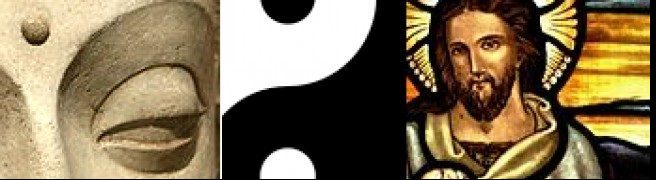
As Eastern mysticism enters Western culture, its practitioners have adopted Western marketing techniques. Starting from the proposition that Western seekers of enlightenment have been failed by their institutions, the Daoist or Buddhist teacher seeks a rationale for the failure that will entice victims of “Judeo-Christian” spirituality to sample their methods. The central tenet of the narrative is that Judeo-Christianity imposes a view of human nature as fallen into sin that disempowers its followers. In contrast, the Eastern tenets and practices of “mindfulness” open a doorway to self-knowledge and self-control that leads into joyful exploration of life’s possibilities.

Having respect for Eastern methods, I’m not going to dispute the beneficial consequences of its practices. Rather, I want to emphasize that it’s not an “either-or” proposition.

In the Bible, the confusion arises right at the start, in the Garden of Eden with Adam and Eve. As I explain in The Soul Comes First, this is a parable for a community living in direct relation with the spirit of unconditional love. In Vedantic terms, this is to interact with an occupant of the higher astral realms. The problem was not that Adam and Eve partook of the “Tree of Knowledge”, for they were given great knowledge of the world in that era, as necessary to assuming stewardship of the Earth. Rather, it was because they chose to partake of the “Tree of the Knowledge of Good and Evil.” They chose to exercise independent moral judgment. They chose to make mistakes that would cause suffering in others, rather than disciplining themselves to the dictates of love.

The immediate response of the personality described as God is to establish a safe distance. A repeated theme of the Old Testament is the pain caused by the Chosen people to its God, and in the New Testament that culminates in human experience. To love is to give power, and when that power is misused, it causes pain. What is amazing about the devotion of the God of Abraham is the investment made in human maturation in the face of that pain. But to remain in immediate and direct contact with humanity as it went through that process would have been disastrous. Love is an amplifier. It empowers whatever it touches. It needs to keep evil out, lest that destructive force run amok everywhere.

But the devotion to our maturation is clearly visible in the Bible, and follows a logical progression. The story of Abraham and his descendants ends with Joseph, the first man in the book with the strength to be steadfast in danger and to resist his primitive sexual drive. It progresses with Moses, who introduces that Law of Exodus, Deuteronomy and Leviticus to instill the discipline of logic in the Chosen people. In modern psychological terms, God was trying to create a people who were capable of using their cortexes to control the survival instincts of the brain stem and aggressive emotions of the limbic system.

Unfortunately, any fixed system of rules is inevitably corrupted by those responsible for its administration, who find it all too easy to manipulate it to deny rights and even life to those that they wish to control. It was against the corruption of the Judaic system of Law that Jesus set himself, eventually confronting both the Sadducees and Pharisees with this great truth [NIV Matt. 22:34-40]:

Hearing that Jesus had silenced the Sadducees, the Pharisees got together. One of them, an expert in the law, tested him with this question: “Teacher, which is the greatest commandment in the Law?”

Jesus replied: “ ‘Love the Lord your God with all your heart and with all your soul and with all your mind.’ This is the first and greatest commandment. And the second is like it: ‘Love your neighbor as yourself.’ All the Law and the Prophets hang on these two commandments.”

In effect, what he is saying to these experts of legal interpretation is “The Law has taught you to think. Now think about love.”

This is evident throughout Acts in the teachings of the Apostles, foremost among them Paul, but not exclusively. The message is that there is nothing that we can do to attain salvation from this corrupt existence except to call love into our presence. Having been born into corruption, which is to say in a spiritual context of Darwinian competition that requires the theft of resources from other living creatures, the fastest way to healing is to call upon love – which is to say “God.”

Judaism and Christianity are therefore two distinct spiritual practices. Because humanity is composed of individuals, both practices have value to individuals struggling with maturity. For those in thrall to aggression, lust and fear, the discipline of a system of rules still gives strength to the cortex. For those that shine hope into that struggle, love grants not only peace and joy, by a powerful transformative capability that is best exemplified by the devotion still awarded to Jesus, the man who died on the cross to prove that death has no sway over those that surrender to love.

So when looking at Eastern methods, what I see is a way to spiritual maturity without wading through the dangerous waters of Law. I see the possibility of “Veda-Christianity” that guides the seeker far more reliably into the healing spring of love.