God’s Plan: A Love Story

slide1

Translation: Combining science and the Bible, we know that it took a billion years before any living creature was capable of loving the entire world (the Garden of Eden). Unfortunately, animal behaviors are strong. The most powerful animals dominate through fear and anger, which cause the brain to degrade, so today the world is ruled by angry vegetables. When they’ve finished making a mess, the rest of humanity will join with the angels and other living creatures to cover the world with love.

Happy Valentine’s Day!

All About Us

I’ve decided to attend services at the Unitarian Society of Santa Barbara. The first service convenes at 9:15, which dovetails nicely with the Dance Tribe celebration at 11.

In the context of Trump’s immigration ban, last week’s service was serendipitous. A local couple shared pictures taken last year on the island of Lesbos, the point of access to the EU for those fleeing conflict throughout the Middle East and Central Asia. The refugees were drawn by Angela Merkel’s pledge of sanctuary to cross from Turkey over the five-mile channel on rubber rafts. Rafts made unstable by choppy seas and shoulder-to-shoulder passengers. As water was taken on, personal goods were often tossed overboard.

The refugees arrived on rocky shores against a steep cliff. Happy but exhausted, they were forced to climb up to a receiving zone, because laws prohibit private transport of illegal immigrants. The presenters ignored this risk, ferrying young and elderly alike in their car. Seeing the stress on the faces of parents, they also brought in paper and markers, inviting the children onto blankets where many of them documented the crossing – not excluding, in one little boy’s picture, those lost in the waters.

Reverend Julia Hamilton favors the spiritual image of the “cloud of witnesses,” and in this case, the cloud was hung around the sanctuary: photographs of children with their pictures. I struggled to maintain my composure, feeling their exhaustion and confusion beating through time, and echoed in places around the world. We rode through it, and in the receiving line afterwards, I simply asked “May I?”, before joining the hands of the husband and wife in mine, bending forward to allow my cloud to affirm theirs. When I offered “Thank-you for your compassion,” the woman echoed “Thank you!”

Today’s service was more typical: a reflection on personal spiritual growth. After inveighing against identification of our selves with our struggles, Rev. Hamilton continued with a parable on the traps of dogma and creed. Visiting with another master, the Zen poet Basho quoted sage after sage, until his host interrupted to ask: “Basho, you are clearly a master of Zen teachings. But could you offer me one thought of your own – one authentic expression of self?” Basho’s embarrassment deepened minute by minute as nothing came to mind. Finally, he looked outside and felt welling up in him:

The old pond.
A frog jumps in.
Splash!

His host clapped in delight.

Rev. Hamilton explained the parable as signifying the importance of being where we were – we are not our struggles, but nor our we are achievements. We are who we are in the moment.

As she illustrated the point, I found myself wondering when she was going to remark on the emptiness of a journey made alone. But it never came. That is the challenge of Unitarian Universalism, full of iconoclasts synthesizing the views of many traditions, each achieving a unique spiritual practice. In the best case, the seeker stands on the shoulders of avatars from every culture; in the saddest case, the seeker ends up like Basho – empty of personal understanding. It was this contrast that Rev. Hamilton developed: the spiritual journey is a journey to self-knowledge.

I really didn’t catch the last ten minutes of the service, my mind spinning as I grasped at methods for expressing the flowering of my own journey from sterile self-knowledge. For some reason, they crystallized in haiku form, bringing surprise and delight to her eyes when I intoned:

Through loving,
God finds meaning:
Us.

Reproductive Rights (Again)

In response to this post at The Federalist.

The commentator writes as though no other jurisprudence exists on this matter. If you want to sway the debate, you need to admit and address the arguments made by those that have sought to preserve reproductive rights for women. Many of them are not spiritually unsophisticated: their desire is to create lives that embody love.

And the details of the partial birth abortion are a canard. This is not typical of abortions, which are now most often chemical procedures (the “morning after” pill). Partial birth abortions are incredibly tragic, and politicizing a situation in which either the mother and/or child will die is immoral. A choice has to be made, and it should be made by the parents and their medical practitioners without bringing the police into the situation.

And I would be cautious about the “life at conception” position. Most conceptions end in natural abortions. If there have been 10 billion people alive on earth, God is responsible for aborting at least 10 billion babies. Obviously there is something more subtle going on in the process, some purpose that God has in filtering those that arrive alive in the world.

My perspective is that, being on the path of the knowledge of good and evil, part of our challenge is learning to not be animals in the way that we create progeny. We need to apply reasoned judgment to the problem. That is the gift that God gave humanity above all other creatures, and decrying the use of judgment by others is not morally tenable.

Rise of the Womanarchy

I hate negative memes. They offend and alienate needlessly. These, then, were the off moments for me during the Woman’s March in Portland: the signs proclaiming “Down with the Patriarchy.”

Really, girls? You expect that your sign is going to have any psychological effect on men that are rewarded by woman that sex them up to go out and rape and pillage on their behalf? Especially when the female instigators get to lurk in the background as MYSTERY, tossing aside men with broken spirits while blaming the victors for the carnage?

Hopefully my readers recognize the Biblical reference. There are two “beasts” in the Book of Revelation. They are nearly identical, differing only in that the first bears the number “666” while the second is colored red and ridden by a woman with MYSTERY blazoned on her brow.

“666” refers to the sixth day of creation that gave rise to the mammals. Not yet fully in control of their primitive urges, they swept across the globe, rising to ecological dominance in every realm except the air. It was only in man that the capacity of rationality rose to a level that would sustain the expression of Unconditional Love. The first beast was almost cast aside by the metal tools created by men, but it survived by entering into our religious experience with the spiritual aid of the serpent – the ghostly residue of the dinosaurs.

The red beast represents sexual control as the strategy for dominance developed by female mammals. In its primitive essence, the most effective literary rendering is the long introduction to Jack London’s White Fang. I read it out of curiosity when it was assigned to my son in middle school, finding it a little odd until I had to bring in a forgotten assignment and saw the sexier eighth grade girls flaunting their tits and asses on the lawn while the drooling boys jockeyed for position.

In Revelation, MYSTERY is destroyed when the red beast turns on her. I believe that bondage is broken when the mammalian females come to realize that MYSTERY does not care for their offspring – that the dominant females of homo sapiens will countenance the destruction of the global climate so long as they can use fossil fuels to maintain their personal comfort.

Trapped in his patriarchic mindset, unfortunately, John was unable to perceive the feminine virtues at work (the common theme in Revelation is that woman corrupt men through fornication). From the masculine side of the process, I am aware that love prevails only when the oppressed believe that they have a choice. This is the liberating power of the resurrection: not even death is a barrier to those that surrender fully to love. With that fear eliminated, masculine violence loses its power as a strategy for social dominance.

So what other choice do women have?

Jesus heralded the transformation of the patriarchy under the guidance of Unconditional Love: the rise of Manarchy, with the capitalization carrying the indications of Genesis. I have been seeking in this life to support a female partnership, a Womanarchy willing to subdue sexuality in the service of Unconditional Love. It is to perceive the womb as the sacred crucible in which spirit is joined to matter, thus the mechanism that can be used to call angels to guide that which is good through the era of duress that Gaia is to suffer.

I see the rising spirit of resistance against death in the hard-hitting political analysis offered in the teen girl magazines, and the strength of the criticism brought by Rachel Maddow and other female commentators. But criticism is not enough: if the joint power of the Patriarchy and Matriarchy is to be broken, woman must turn their powers to the service of Love.

Walk in the woods. Go to the zoo. See what is beautiful and good and offer your inmost self to its service. Give the red beast an alternative. Use your wombs to guide it into Unconditional Love. MYSTERY will not be destroyed, she’ll just become irrelevant.

Spirits, Undampened

I spent two hours on Saturday standing shoulder-to-shoulder in the rain with the crowd gathered in downtown Portland for the Women’s March protesting the policies of the new Administration. For a long time, we believed that we were stranded with no place to go. When my sweater began soaking under the Gore-Tex jacket, I made my way back to the Morrison Street bridge, arriving there just as the crowd began to break free. I’m not Oregon-tough: many of the marchers were bare-headed in the drizzle.

I could try to explain the work I facilitated in that setting, and again this morning during services at Portland’s First Unitarian Universalist Church. But I keep on coming back to two moments: the little girl poking the puddles with her protest sign, prompting me to say:

No matter who is president, there’s still going to be rain puddles! And aren’t they just the best!

The other is that last reading at Sister Gloria’s contemplative prayer gathering. It was the wedding at Cana, which ends with the observation:

…and his disciples began to believe in him.

[John 2:11]

In elaborating my choice of this phrase, I explained the paradox that Jesus’s entire ministry was devoted to one purpose: that people would come to believe in themselves.

Today’s sermon assumed that we were in for a long, dark struggle – a struggle that will force us to think in immediate terms and conserve our strength. The Reverend minister revealed that he found himself praying much more in this season. I was also surprised that the musical selections explicitly evoked God, something that I thought was disappearing from Unitarian Universalist worship. And so I had the compulsion to offer him this wisdom in the hall outside the sanctuary:

The divine purpose for humanity is that we bind love to the world. This era is the last hurrah of selfishness. They are divorcing themselves from reality, and in this time, truth spoken in love will have enormous power. They are the most potent tools for dispelling fear.

Thank-you for being here for your community.

This is not a time for thinking small or harboring resources. This is the moment to stretch to our limits and grasp victory. It is time to believe that you were designed through loving to channel great power to each other.

Namaste.

A Gentler Atheism

When planning my trip to Portland, I envisioned walking in snowy woods. The view of the city from the plane did not disappoint – it was covered in a pristine white blanket. It was only when riding downtown on the MAX that I learned what a disaster this was for the residents. Portland rarely sees snow, and the city has been practically shut down for the last ten days.

I did get my walk in the woods out at Breitenbush, in between sessions of the Wild Grace workshop facilitated by Paula Byrne. The experience was refreshing, although challenging. I found myself revealing far more about my journey than I had intended. After my walk in the woods on Monday morning, however, I closed my eyes to offer my gratitude before breakfast, and when I opened them the two new friends at the table said “Thank-you for that.” I found acceptance among them.

Today was my first day driving over the ice and snow. The Dollar lot was kind enough to put me in an Impreza. I don’t know what would have happened without the 4-wheel drive. I was going to go down to the OMSI, but I needed a silk swab for my flute. I ended up bouncing around NW Portland, picking up some books at Powell’s to fill in the mornings and afternoons until heading out for the dance events that drew me here. And well that I did: the rain started this afternoon, turning the roads into an icy slushy mess, and prompting cancellation of tonight’s full-contact improv event.

I picked all my selections at Powell’s from the nature shelves. I’ve been paying far too much attention to the problems people have created for themselves, and feel a strong need to see the natural world through the eyes of people that cherish it. So I find myself with books on bees and nesting.

But I started with Frans de Waal’s The Bonobo and the Atheist. The author is a primate behavioral scientist, focusing on chimpanzees and bonobos (most similar among all the apes to our primate ancestors). Without dwelling on it, de Waal makes clear his preference for the matriarchy of the bonobos, whose casual sexuality supplants fear as social glue. But in both societies, primates evidence empathy, compassion and a sense of fairness that are often upheld by philosophers as markers of “moral” conduct. de Waal extends this attribution, through brief vignettes, to other species in the mammalian order.

Laced throughout the book are reflections on the work of the Dutch artist Hieronymus Bosch, famous for his apocalyptic visions. Motivated perhaps by recent works that characterized Bosch as a deviant, de Waal reinterprets the artist as a humanist, noting that there is no representation of God in Bosch’s paradise. The artwork serves as an interesting device in the narrative: de Waal references it in drawing parallels between bonobo and human behavior.

As a work of moral philosophy, the book is weak. de Waal asserts that the cooperative socialization of apes proves that morality is innate, rather than learned. But this is the morality of the tribe that suppressed intellectual innovation for so much of human history. That is not always a bad thing: nerve gas and atom bombs are tools that we probably should do without. But it is the human capacity to innovate that creates social disparity that eventually sunders tribal bonds. I remark that the Greek root – religio – means “to bind again.”

Ignoring this problem, de Waal asserts that religion exists only to claim authority over our moral energies. This is accomplished by generalizing and abstracting the moral impulse. Without demonstrating deep religious insight, de Waal suggests that any such system of moral reasoning divorces us from the physiological and emotional roots of our natural morality. Paradoxically, he observes that natural morality applies only to individuals familiar to us, which leads to gross abuse of the rights of the “other” = whether of different cultures or different species. The book closes with an appeal to broaden our moral attachments – in effect, to repeat the sins of religion by generalizing and abstracting our morality.

Unlike his more intemperate peers (such as Christopher Hitchens), de Waal does concede the benefits that religion confers upon the believer, among them longer life, social amity and a sense of meaning. He believes, furthermore, that as our moral impulse is rooted in emotional experience, any attempt to reason people away from faith is misguided. Religion is to be tolerated.

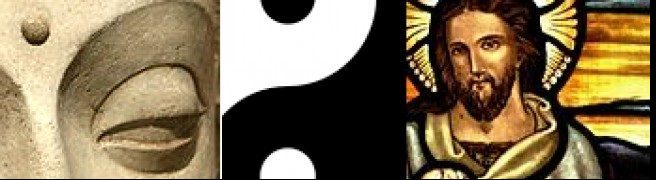
At this point, of course, de Waal has joined the camp from which I am now seeking to disentangle myself. Every human culture brought forth the concept of the soul from its tribal past. It is the most obvious mechanism for explaining the sympathy felt between intimates when one is hurt (mirror neurons having been proven to be a fiction). Taking the existence of the soul as a given, religion is then best interpreted as an institutionalized orientation toward spirituality, and the ground staked out by the atheist (de Waal among them) subsides in the tidal surge of love that originates from the divine source.
A House Crucified

Following the public outcry over its decision to gut the independent House ethics panel, Republicans backed down. When asked to explain why the public was so angry regarding their action, one member complained that the panel’s consideration of anonymous claims was unjust. In fact, he went so far as to say:

Even Jesus had the opportunity to face his accusers.

So let’s think about this: here’s a politician, a member of the most powerful legislative body in the history of the world, claiming parity with a man who decried hypocrisy among the political and religious authorities of his day. Here’s a candidate for public office, comfortable in his position in the world due to systematic efforts to suppress the votes of those that most need the support of society, claiming parity with a spiritual leader who picked his inner circle from among the most common of men – those despised and down-trodden. Here’s a Republican, one among those whose abuse of investigative authority smeared the public perception of a devoted public servant, leading to the transfer of our highest elected office into the hands of a man whose primary consideration in political affairs appears to be personal economic advantage, claiming parity with a martyr who was rail-roaded on trumped-up charges, lashed and crucified before his friends and family.

Oh, hypocrite! Oh, Satan! Get behind me!

“Man” and “Woman”

The driving motivation for the writing of The Soul Comes First was a reading of the Book of Revelation as just what John said it was: a visit to the Holy Mind in which the angels revealed their relationship to and experience of Christ. The difficulty of the writing is that the insights are like the M.C. Escher drawing of hands drawing each other. Genesis makes sense only if you’ve read Revelation, which makes sense only if you’ve read Acts, which depends upon the Gospels, the chain continuing to a dependency on Genesis.

We have to grok it all at once. I’m afraid that I didn’t succeed very well with that problem.

But the insights continue to trickle in.

Genesis 2:7 says [NIV]:

Then the LORD God formed a man from the dust of the ground and breathed into his nostrils the breath of life, and the man became a living being.

This has been interpreted literally as meaning that Adam was the first instance of the species homo sapiens sapiens. There are those that take a different tack: that Adam and Eve were the sole human survivors of a geological catastrophe such as a major volcanic eruption. But the continuity of the archaeological record undermines all of these interpretations.

Revelation 4 starts where Genesis starts [NIV Gen 1:2]:

Now the earth was formless and empty, darkness was over the surface of the deep, and the Spirit of God was hovering over the waters.

This is the scene that John encounters: the “Spirit of God” being the corporate body of the angels united under the guidance of Unconditional Love. In John’s vision, there are twenty-four of the former – described as “elders” – gathered around the “one on the throne.” We should understand the latter to be Unconditional Love, which is warded by fearsome beasts that prevent the approach of the elders.

So this is the initial state of Heaven before the investiture of God in the Earth. What comes next in Revelation is the sequence of that investiture: a scroll with seven seals is opened, and selfishness is given dominion over the Earth. Then from among the twelve princes of heaven, twelve thousand are sent from each down to Earth. These are the masculine angels that generate change; the feminine angels are held in reserve until a measure of safety is created.

Paleontology tells us that it took approximately a billion years before that safety was attained. Finally, in homo sapiens sapiens, God recognized a species with the potential to express love.

Genesis 2 starts with God’s reflection on that process. The species “man” was created from the dust of the ground, rising up only through an enormous commitment of intention and attention to the manifestation of the potential for life to receive love. If done too early, the gift would have been wasted: it would have been corrupted by selfishness. So love was held in reserve when the 144,000 were sent down from heaven, and remained aloof for a billion years.

God having spawned homo sapiens sapiens as an animal with the potential to elaborate love, Unconditional Love then breathed itself into one such animal, Adam, making him Man. Love was joined to biology, making it possible for us to escape the brutal practices of natural selection as described by Darwin. Recognizing that Adam should not be alone, Unconditional Love then sought for a mate to share the stewardship of spreading love throughout the world. Thus was one female animal imbued with love, creating Eve – the first Woman.

This is what we celebrate when we call them “First Man” and “First Woman” – not the material superfluity of their physical forms, but the transformation that comes with becoming imbued with Unconditional Love.

How did this make Adam a “living being”? Because one of the forms of selfishness is death. Through the link with Unconditional Love, Adam was freed from that captivity. He acted with fearless generosity. It was in seeking to become God’s equal that our thralldom to selfishness was reimposed.

In reflecting on all the evil we have committed since, I have called it “the great working out through the flesh of our dependency on sin.” Each generation becomes a little stronger, and with Jesus to light our way as an exemplar, eventually love will have its way with us.

Magnificent, She

In the Garden, God warns Adam [NIV Gen. 2:17]

[Y]ou must not eat from the tree of the knowledge of good and evil, for when you eat from it you will certainly die.

After the serpent seduces Eve, God comes into the garden and asks [NIV Gen. 3:9]:

“Where are you?”

What heartbreak there is in these words, that the stewards of its creation should hide from Love!

Why do we hide? Is it because we perceive the dependency of flesh upon sin, and so feel shame? Is it because, if we were to fully understand, we would see the burden that God meant for us to shoulder in healing the world of sin? Is it because, knowing of evil, we are infected with thoughts that, when empowered by love, grow into weeds that choke our souls?

These are the reasons that I experience.

And given that we must hide, how do we hide? What is the mechanism of our shelter? Genesis says that Adam and Eve hid “among the trees of the garden,” but that is only figurative. No, the only means to hide from love is, as God foretold, to take refuge in death.

In healing Peter’s betrayal, the resurrected Christ asks him three times “Do you love me?” [John 21:15] This is the grace of God: to redeem with mercy, to celebrate the strength that comes with the lessons learned from mistakes made in frailty.

And so, as it was Eve that submitted first to Death, it is to WOMAN that Gabriel speaks. To a virgin, betrothed to be married, the angel announces that the child of God will come through her into the world, preceding the tidings with these words [NIV Luke 1:30]:

Do not be afraid, Mary.

For what did the Law say about a conception that Joseph, her husband to be, could interpret only as a sign of infidelity?

Death.

And yet, pierced to the core with the promises made for the salvation of her people, Mary offers herself, body and soul [Luke 1:38]:

Here am I.

O woman, O grace, O life restored! Oh, magnificent surrender to Love!

You were indeed the Christmas Eve.

The Season of Peace

Among the seven forms of selfishness released upon the Earth when the seals were broken in heaven [Rev. 6], the prince of death is that mystical presence that divides us from those that we love and feasts on our sorrow.

In this season, we celebrate a man who submitted to death, yet still loving those that abused him [Luke 23:34]. Through his devotion, Jesus suffused death with love. He converted that impenetrable barrier into a shield that keeps warring spirits apart until they find the strength to forgive one another [Matt. 1:21 and Luke 24:47].

For those of us that in this season celebrate Christmas, this is the source of its meaning and joy.