How Christ Tranforms Evil

In “Christ is Risen”, Matt Maher encapsulates the message offered by so many celebrants at Easter:

Christ is risen from the dead,
Trampling over death by death!
Come awake! Come awake!
Come and rise up from the grave!

Oh, death, where is your sting?
Oh, Hell, where is your victory?

It is a message of conquest.

But those that have survived a near-death experience tell us that as they drifted into the light, they saw all their loved ones reaching out to call them forward, and behind them shone the loving embrace of Christ.

Jesus did not conquer death: he entered into our greatest fear and transformed it into a conduit through which love is brought to us.

Understanding that conflict justifies evil, I have been negotiating with sin for the last fifteen years, offering the exhortation that love will not destroy it, but bring it into greatness. In that process, I have been assaulted psychologically, night and day, by people that exercise sin to gain power over others. The struggle has been exhausting.

This morning, I find myself in a different place. I turned the problem around: rather than resisting them, I envisioned the light of Christ shining through me, then through them and onto those that they oppress. The closer they press against me, the closer they come to the light, and the more brightly it shines from them.

Maher begins his song with this exhortation:

Let no one caught in sin remain
Inside the lie of inward shame.
We fix our eyes upon the cross
And run to him who showed great love.

Those that rely upon sin for power run in the other direction, of course, and build their castles to wall out the light of Christ. Death is their final tool – the means by which they weed out those that insist upon loving. Every Christian that keeps his eyes upon the cross defeats that strategy: they make death the means by which Christ enters into the darkness, bypassing all the walls of the citadel.

How does Christ protect his faithful? Because even thinking about bringing harm to a true servant of Christ calls him closer. Those that would sin against the faithful must flee their ramparts into the wilderness.

At the beginning of his ministry, Jesus offered this counsel:

“You have heard that it was said, ‘Eye for eye, and tooth for tooth.’ But I tell you, do not resist an evil person. If anyone slaps you on the right cheek, turn to them the other cheek also.
[NIV Matt. 5:38-39]

And for those strong enough, even more:

“You have heard that it was said, ‘Love your neighbor and hate your enemy.’ But I tell you, love your enemies and pray for those who persecute you, that you may be children of heaven.
[NIV Matt. 5:43-45]

What I see now is: it is the miracle of the cross that guarantees the efficacy of this conduct! Death was not vanquished, it is the very tool by which we redeem one another!

Dawn of the Soul

Midi Berry’s newly published Nights of the Road examines the mystical power of feminine devotion. The nominal protagonist of the tale is Sarah, a British refugee from bad relationship mojo, taking up a life as a psychotherapist in Los Angeles. The power driving her spiritual awakening, however, arises from the 17th century, where her ancestor Frances Coke earns the regard of those surrounding the Stewart court as its excesses succumb to Parliamentary discipline.

When I was a child, my father declaimed modern music by observing that it was the discipline of classical forms that allowed composers to create pieces that challenged listeners without alienating them. This seems a suitable metaphor for the structure of Midi’s work.

In both time streams, Berry injects the theme of a woman committed to a natural love with a devoted partner, but challenged in her course by the passionate attentions of an unstable and possessive creative genius. In the Stewart Court, Frances is frustrated in her love by an arranged marriage, albeit to a man who – as long as the forms of the relationship are honored – kindly accepts her devotion to another. In modern Los Angeles, Sarah escapes a political marriage through emigration, and falls captive to the reborn creative genius whose attentions were frustrated by social strictures in the Stewart Court.

The novel evolves through a series of tetes-a-tetes between the romantic interests. Sarah employs the language of modern psychology as a shield against strong emotions, eventually drawing her two competitors – both previously members of a band called Nights of the Road (whence the title, in part) – into collaborative reconciliation. As for Frances, I found myself thinking that her attitudes were entirely too modern, but then realized that so were the attitudes of Beethoven and Brahms. Frances makes a decision early on in the book to believe in herself, and thus speaks her mind honestly throughout, and so perhaps reveals wisdom of the feminine heart that has been long suppressed.

I found myself at times wishing that Berry would bring us into some of the historical experiences discussed by Frances and her lover Robert. However, the emphasis of the book is on transformation of relationships, and there is a lot of valuable relationship modeling in the story line.

The most significant flaw in the story – and this is nit-picking – may be the lack of forecasting of Frances’s mystical ascension as her death nears. For those familiar with such events, this is foreshadowed by the affirmation by a noble protector that Frances’s beauty, compassion and devotion have brought her unsuspected admiration from the royal entourage. Unfortunately, for some the connection may be lost, and so her wandering down the psychic road as she nears death (whence again the title) may seem a little jarring, if not deus ex machina.

But the book’s final chapter is golden. Antony, the creative genius of Nights of the Road, manipulates masterfully Sarah’s emotions, and precious are the lyrics sung as reflections upon her impact on the men that love her.

Berry’s heart-felt tribute to reconciliation and redemption casts light on the challenges of being a muse, and presents wisdom that readers will usefully apply when seeking to understand and deepen their relationships. As the Brits would say: “Give it a go!”

You-Say-I-Am

In the last week of his life on Earth, Jesus brought his verbal sparring match to Jerusalem, where was gathered the authorities of his age. Welcomed enthusiastically by crowds expecting him to transform their political and religious reality, Jesus instead proclaims the kingdom of heaven and his impending destruction.

Sensing weakness, the temple priests swoop in for the kill. Perhaps advised by spies that Jesus had been proclaimed the Son of God, and certainly with the evidence of his tirade in the temple, they summon him to pose the question directly: Is he the Messiah, the “King of the Jews?” However, if they thought that Jesus was on the ropes intellectually, they were mistaken. For in answer to their questions, and the questions of Pilate and Herod, he simply answers “You say I am.”

The Gospels give us no punctuation for this statement, and so it is generally read passively, without emotion. But we cannot imagine Jesus without emotion in this moment, not given the throes of passion just evidenced in the Garden of Gethsemane. There must have been something there, besides simple resignation.

So what would the emotion have been? That of the man pleading “Father, take this cup away from me!” – a petulant “You say I am.” That is to observe “Would you face the consequences of that admission? Then why do you expect me to say it?”

No, Jesus was a man of greater heart than that. Perhaps, then, it was “You say I am!” The proof of the statement was in their actions, this desperate attempt to preempt the rallying of the people to him after his non-violent provocations against their authority. If they did nothing, he would indeed become king, a king brought to authority by God, rather than by human methods.

Or was it a prophetic proclamation? As David had proclaimed his suffering twenty generations before, was Jesus merely observing to Pilate, “You say I am!” The ultimate authority of Rome, the Emperor himself, will one day proclaim Christ the Lord!

But there is another thread, the thread that starts with Israel being told “I am that I am”, and continuing with the challenge to Peter “Who do you say I am?” It is the prompting of God through the ages that beseeches us to trust our hearts – to hear the still, quiet voice that Samuel counseled the Israelites to rely upon over the institutions of men. It is a voice of hope, still hoping against hope that the pain and suffering could be avoided. Not just the endurance of the cross, but all the religious wars, the starving children, the women demonized and abused for sexual gratification, and the wasted words of political dispute when only compassion can light the road to justice.

It is the hope of rejoining human institutions to the divine purpose.

It is to encourage:

You! Say I am!

Are we prepared to do that now? Not just if he came down in glory – but if he came as he did before, a man with all the frailties of flesh. Would he be recognized? And if not, why would he return?

Only to die again?

Into the Garden

On the weekend of my 45th birthday, I woke at 2 AM and drove from Livermore to Yosemite. The summer sight-seers were still in their beds when I parked at the Swinging Bridge. As I neared the far bank of the Merced River, I spied a circle of sunlight among the redwoods. A feeling of joy came to me, like unto an encounter with a long-lost friend. I stepped into the circle and raised my arms to the sky, and felt the whole valley singing with happiness.

I don’t know if I can ever convey what it is like to enter fully into Christ. In the official biography of Pope John Paul II, there’s a picture of him sitting on the stage in Manila, alone amidst a throng of tens of thousands. His forehead is pressed into his palm. When I saw the picture, I felt the weight of their sorrows pressing against him in that moment.

To be in Christ is to feel all the anguish of a world that suffers from our inattention. It is to shoulder the burdens shirked by those that have the power to make a difference. As Jesus says [NIV Matt. 11:28-30]:

Come to me, all you who are weary and burdened, and I will give you rest. Take my yoke upon you and learn from me, for I am gentle and humble in heart, and you will find rest for your souls. For my yoke is easy and my burden is light.

This is the paradox: those that seek power seek this same freedom – freedom from fear, freedom from weariness, freedom for sorrow. And yet they seek it in material things, when only Christ can grant them that freedom, and even then only when they accept the burdens that love lays upon them. So they are forced to choose between their desire for freedom and the love of Christ, and most choose freedom.

Fundamentally, it was this contradiction that brought Jesus to the cross.

When I thought on this last night, lying awake in the dark after Mystery had once again tried to corrupt me, I remembered that moment in Yosemite, and I thought of Gethsemane, were Jesus testified [NIV Mark 14:34]:

“My soul is overwhelmed with sorrow to the point of death,” he said to them. “Stay here and keep watch.”

Where did that sorrow come from? Well, from the Garden itself, acknowledging the man that brought words of peace and healing into its midst, celebrating the hope that maybe finally mankind would stop warring against Nature, and grieving the knowledge that the impending response was his destruction.

God, how I miss the gardens of the world – the trees and scrub, the birds, foxes and deer. I have walked the hills here in Southern California as they dry up and burn, and my heart can hardly bear it any longer. Please, God, send me someplace where the garden and I can delight again in one another.

Spirituality without Religion: Hope or Hoax?

Sam Harris has amassed a fortune decrying religion. His latest best-seller, Waking Up: A Guide to Spirituality without Religion, describes a journey that I must herald as a step towards personal maturity. I won’t consider the details, because his preface was enough to let me know that he’s got a long, long way to go. Harris asserts that our minds are the only tools that we have to manage life’s challenges. That’s a sort of lobotomy, and the best response I can offer is that of Hume. Following Hobbes’s characterization that the experience of most is of:

continual fear and danger of violent death, and the life of man solitary, poor, nasty, brutish and short

Hume diagnosed that Hobbes had forgotten “the operation of his own heart.”

That may seem a small point, but a compassionate heart is the singular difference between a monstrous ego and a great personality. In its lack, the rational mind tends to the conclusion that everything that violates its logic is error, possesses no value, and thus should be destroyed.

This is the conclusion that the anti-religious have indulged in for far too long.

Now I hope that Harris will eventually confront the errors of the axioms that allow him to conclude that religion has no value. Foremost is the confusion of correlation with causation: the fact that the brain is essential to the physical manifestation of our will does not mean that our will arises from the brain. The soul does exist. When that is recognized, the heart becomes full, and logic leads us to a different set of conclusions.

For example: Harris’s book bears the picture of a face superimposed on the cloudy heavens. What happens when spirits collide in that space? How do we negotiate conflicts? Only by resort to institutional structures staffed by experienced arbiters. That is religion.

The second erroneous axiom is that the mythical aspect of scripture proves the unscientific world view of our intellectual predecessors. Far be that from the truth: those men and women were investigating aspects of reality that Harris has yet to encounter, and doing it using practices that, if one strips away the branding, are scientific in their core. That wisdom was transmitted to us from the past through – you guessed it – religion. The alternative offered us in the modern age – schools – are prey to short-term political fashion, also known as propaganda, and pit students in a competition that places knowledge above compassion.

The alternatives to religion that Harris offers, at least in his preface, are use of psychotropic substances (a.k.a. – illegal drugs) and meditation. The former is pathetic: I raised my sons with the wisdom that love is the anti-drug. Using drugs to temporarily achieve an elevated psychological state is no substitute for submitting to the discipline required to sustain loving relationships. Lacking that discipline, the craving for love, which is built deep into our hearts, leads to abuse of drugs and self-destruction. What institutional structures confront us most meaningfully with the practice of emotional discipline? Well – religions.

Meditation is where I find hope for Harris. Meditation serves to reveal the preconditioning of our minds that prevents us from accurately perceiving experience. Through it, as Deepak Chopra inveighs in The Future of God, the seeker after truth eventually confronts the reality that love exists even when no person is present, even when no drug stimulates our senses and minds, even when we do nothing. That is the nature of God – and for reasons I have outlined elsewhere, that is the only God that could ever exist. Nothing but unconditional love can bind together things that want to be apart: the Greek word religio meaning to bind anew.

When Harris encounters that presence, I am certain that he will want to find a place in which to share his joy. That would be, of course, to find religion.

That’s the Spirit

We’ve been building a model of the universe with superfluid dark energy, and introducing a “cold” alternative to the Big Bang theory. The model includes a possibility for gravitational attraction between defects in the lattice. Given that there are three other forces at play in the universe (electromagnetism and the “weak” and “strong” interactions), the model is obviously incomplete.

I’m going to throw out a model here that manifests interesting and theoretically relevant behaviors. I am certain that the model is incomplete – my sense is that the dark energy lattice itself has complex structure (I refer the reader to the image on the Generative Orders proposal). But the suggestions here should be enough to stimulate innovative thinking.

So what we need to propose is a model for our defects. It’s interesting to consider the defect to be a self-repellant loop that gets pinned to a node in the dark energy lattice. Now the lattice is going to tend to corral the expansion of the loop along a particular axis. The energy driving the expansion will eventually be spent in pushing the dark energy particles apart. We can imagine thus that the loop will oscillate back and forth, as indicated below with “right” and “mid” views. We can imagine the “left” configuration by rotating the “right” configuration through half a circle.

Right Thread
Mid Thread

Now let’s suppose that each point in the lattice can anchor up to two loops. How this is feasible is open to exploration. One way is for the dark energy to have structure itself. For example, it might be a little circle. Now there will be oscillation patterns that will minimize the interaction between the two threads. One possible pattern is shown below (the lattice is suppressed so that we can focus on the loop configurations).

Two-Thread Oscillations

We see that when one loop is clustered near the center, the other is extended. What is most important, however, is that when the sequence is followed clockwise, the pattern rotates clockwise. Reading in the reverse order reveals a counter-clockwise rotation. So this is a model for the top-like “spin” that was described earlier.

(NB: This is a terrible model of intrinsic angular momentum. A more fertile approach is to think about normal angular momentum, which arises when interacting particles are offset along the axis of approach. We then see that normal angular momentum is discretized in the lattice, because the offsets are discretized.

How is normal angular momentum conserved? Well, the model proposes that gravitation, electromagnetism and the strong interactions are all generated through the efforts of the lattice to minimize distortions. The specific character of each force reflects the degree to which a configuration of loops generates lattice distortion.

So angular momentum is conserved because the approach of the particles stores a particular type of distortion in the lattice that is released when they separate. Intrinsic angular momentum may be accommodated better by recognizing that the odd shape of the loop projections can be removed by offsetting the center of the oscillation by half a lattice point.)

Now the configuration with two loops should be fairly stable – it affects both directions equally, and so shouldn’t create too much disruption when moved. However, the configuration with one loop will tend to whip around when it moves, maybe even causing the lattice to be re-oriented locally. Given our discussion of mass, it would appear that asymmetric particles (one loop in our example) will have larger masses (disturb the lattice more when moving) than symmetric configurations (two loops in our example).

One way to minimize the impact of the asymmetric configuration might be to couple them together. This would localize the impact of the thrashing around at large distances, at least if the asymmetric configurations were synchronized in their oscillations. This models the strong force, which binds fractionally charged particles inside the proton and neutron.

Yes: what I’m suggesting is that the loops correspond to particle charges. In our two-dimensional model, only three charge states are allowed (with 0, 1 or 2 threads), because only two directions are available for oscillation. In our universe, we have three dimensions, and so four charge states are possible. This is precisely what we see in the particle zoo, and the asymmetric particles (with fractional charges: the up and down quarks, for example) have much higher masses than the symmetric particles (the neutrino and electron).

Adding a symmetric particle to a pairing of asymmetric particles might further stabilize the lattice. This is analogous to an electron bonding to a proton.

Now let’s tear our understanding of reality completely wide open: why should the loops be constrained to be bound to the dark energy lattice? What if they were able to form structures among themselves, structures that stored energy in the lattice by causing it to expand in their vicinity? Structures that could contain and process information? Structures that might even be able to open holes in the lattice that would allow particles to travel faster than the speed of light?

That’s the spirit, people.

I hope that you’re taking mind. Our brains are only interfaces to these structures. Our souls are the eternal part of us, bonding again and again to matter through our multiple lives, and using those opportunities to do a certain work on themselves.

Now I beg you, please read The Soul Comes First. While selfish configurations of spirit tend to dissipate the energy stored in the dark energy lattice, mutually supportive configurations have stored up an enormous amount of energy over time. They impose certain rules, and a failure to comply led to the destruction of the dinosaurs.

I believe in love, and I believe that at least a portion of humanity has enough maturity to master our baser urges. The Book of Revelation teaches that they will complete the work that was put before us in “Eden”. But I would like us to work efficiently to ensure that the predators, in their trashing about as they go down, are not allowed to do too much damage to the innocent.

Shedding Light on Light Mysteries

In the last post, I identified correspondences between superfluid motion and the phenomenon that are described by the equations of quantum mechanics and special relativity. The discussion leads to the assumption that light is a disturbance in a cold – and therefore highly ordered (“crystal-like”) – sea of dark energy.

The illustration in that post showed a perfect lattice, but given what we know about the universe, we’d expect the dark energy lattice to be a little less regular. For example, we know from the Michelson-Morley experiment that dark energy is entrained with massive objects, which tend to be round. There’s an old adage about “pounding a round peg into a square hole” (or was it the other way around) that fits here: the distortion created by the spherical Earth requires accommodation from the rectangular lattice, which will introduce defects.

And then we have the early history of the universe: unless the universe was unfolded from a single location, dark energy will organize itself locally, just as we see in crystals formed in solution. Here’s a picture of insulin crystals:

Insulin crystals grown in solution
Now obviously as these crystals grow to fill in the volume, there’s going to be some places where they don’t fit together nicely, which is going to leave defects in the final mass. So it would happen with the dark energy lattice.

What would we expect to happen when light encounters such a defect? Well, a reasonable analogy is what happens when a water wave encounters a rock. While most of the wave will continue around the rock, ripples will be cast off all around.

Do we see evidence of this in our study of the universe? Well, yes we do. First of all is the cosmic microwave background. But there’s more than than. Recent studies reveal that there is too much light coming from the empty space between galaxies (see Galaxies Aren’t Bright Enough). Astronomers originally assumed that the light had to come from early sources (back around the “Big Bang”, which I think is hokum), but that early light should should be “stretched”, and therefore redder than it is. So the light must be coming from modern sources. Without any other proof, astronomers suppose that there must be many stars between galaxies.

In the lattice model, the cosmic microwave background and extra light between galaxies actually go together: if light is scattered by dark energy, it will lose a little bit of its energy (perhaps into microwaves) and change its direction. Therefore, some of the light coming from a distant galaxy will appear to have originated from empty space, and space will seem to be filled with microwaves.

Finally, the loss of energy from scattering in the lattice explains why light emitted from distant galaxies appears redder than light from nearer galaxies. In current theory, this is explained as due to the relativistic Doppler effect (similar to what we experience when a car passes us with its horn blaring, the pitch drops after the car passes us). But with the discovery of Dark Energy, other mechanisms may exist to explain this effect.

I will admit that the last two paragraphs are a “have you cake and eat it too” situation. If light from distant galaxies loses energy to scattering, it would be diffused as it passes, which would make the galaxies indistinct. But remember that the volume around galaxies is expected to have many more defects in the lattice than the intergalactic medium, which would cause stronger scattering in their vicinity. And when defects exist, radiation may also be emitted when the lattice reorganizes itself to close the defect. The point is that there is a whole set of new phenomena to consider when explaining astrophysical observations.

All this without needing to suppose a Big Bang at all.

Way Beyond Teflon

In imagining a universe filled with an invisible substance, it is natural to use air as an analogy. We then run immediately into trouble with Newton’s first law of motion, which is also an assumption in Einstein’s theories:

Every object in a state of uniform motion tends to remain in that state unless acted upon by an external force.

We know that air actively slows the movement of objects passing through it. Why aren’t moving objects slowed as they pass through Dark Energy?

One way around the problem is to assert that Dark Energy is a wall-flower: it doesn’t interact with anything else. That’s a prevalent assumption, and it causes me to remember the early history of thermodynamics. In building a theory of heat, early investigators, noticing that heat moved from place to place without changing the substance it occupied, conceived of caloric, an invisible field that permeated the spaces between atoms. That didn’t have much explanatory power, and was rapidly replaced by theories that explained heat as disordered motion of atoms.

Astrophysicists tell us that the universe is a pretty cold place – only a few degrees centigrade away from the coldest temperatures possible. Study of systems at these temperatures have revealed some amazing behaviors. For purposes of our discussion, liquid helium is an interesting example because it exhibits superfluidity, which allows objects to move through it without resistance. But superconductivity – materials that pass electricity without resistance – is another consequence of the basic principles that determine the behavior of really cold systems. Both liquid helium and superconductivity, by the way, are extremely important technologies in building facilities such as CERN.

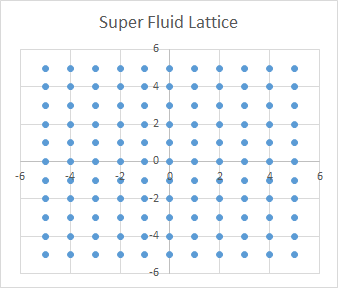
Liquid helium is particularly simple because it bonds only very weakly, which is why it is liquid at temperatures that cause almost every other element to freeze. For illustration, I’m going to show a model system that shows atoms in a square two-dimensional lattice. The details may not apply to liquid helium, but I have reason to believe that they might to dark energy.

Imagine that we have a tank filled with liquid helium. At very cold temperatures, the atoms stack uniformly in the tank.
Super Fluid Lattice
Such arrangements are said to have high order. They are typical of crystalline materials, including many solids. One of the upshots is that it’s difficult to move a single atom without moving the entire collection. That’s because gravity presses the volume into a compact mass, which means that that atoms are compacted slightly, and therefore repelling each other. So moving one helium atom causes the atom it’s moving towards to move away. The cold here is important: if the lattice were vibrating somewhat, there would be little gaps that could absorb some of the distortion, and so the parts of the lattice could change independently. It’s the lack of such vibrations that forces the lattice as a whole to respond to changes.

Now let’s imagine that we place an impurity into the lattice.
Impurity in Super Fluid
This time a slight distortion of the arrangement will occur. The atoms nearest the impurity will indeed shift their positions slightly. Since the atoms at the walls of the container can’t move, they will tend to remain in place. So the distortion will be localized. What’s interesting to consider is what might happen if two defects are created. Will the disturbance to the lattice be minimized if the defects are brought together, or if the lattice acts to separate them? The astute student of physics will see that this thought leads to a model for gravity.

Now let’s propose that somehow our impurity begins to move.
Slow Impurity
How will the lattice react? Well, again, the atoms at the walls can’t move. The impurity will push against the atom in front of it, and leave a gap behind it. So long as the speed of the impurity is much less than the speed of the sound in the lattice, it is only the nearest atoms that will be disturbed. Obviously, the solution to restoring the order of the lattice is for the forward atoms to migrate to the sides as the impurity passes, displacing the atoms already on the side so that they fill the gap left by the passing impurity. When they reach the back, the atoms will come to rest by giving their energy back to the impurity. This is the essence of superfluidity: the impurity loses energy to the lattice only temporarily.

What is interesting to note is that in quantum mechanics, when calculating collisions between two charged particles, we have to assume that the particles are constantly emitting and re-absorbing photons. This is analogous to the situation in the superfluid: the impurity is constantly losing energy and then regaining it.

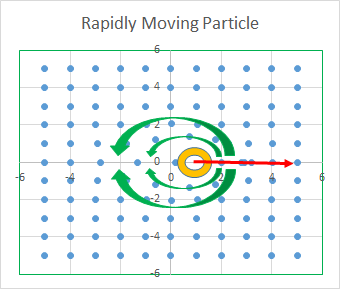
Finally, let’s consider an impurity moving closer to the speed of sound in the lattice. In this case, the distortions affect more than the nearest atoms, and the circulation becomes more widespread.
Fast Impurity
It’s important to note that energy is stored in the circulatory motion of the helium atoms. They are moving, just as the impurity is moving – but in the opposite direction, of course. The closer to the speed of sound, the more energy is stored in the circulation. This means that it becomes harder and harder to make the impurity move faster as it moves more and more nearly at the speed of sound.

In Special Relativity, Einstein showed that particles become harder and harder to accelerate as they come closer and closer to the speed of light. The relationship is (m0 is the mass of the particle at rest):

m = m0/(1-v2/c2)1/2

Again, we see some strong correspondence between superfluidity and the behavior of particles in both special relativity and quantum mechanics. The big difference is that, while Richard Feynman famously stated that quantum mechanics was merely a mathematical procedure without any explanation, when applying the superfluid analogy to dark energy, it seems that at least some previously mysterious quantum and relativistic phenomena are simple to understand.

For more on models of particle mass, see That’s the Spirit.

A Massive Mystery

Quantum Mechanics describes particles as vibrations in time and space. The intensity of the vibration in time (i.e. – when it is) reflects the particle’s energy; the intensity of the vibration in space (i.e. – where it is) reflects its momentum.

In large-scale reality, such as baseballs and buildings, those vibrations are way too small to influence the results of experiments. In studying these “classical” systems, physicists discovered certain mathematical laws that govern the relationship between momentum (p) and energy (E). Believing that these rules should still be manifested in the quantum realm, they were used as guidelines in building theories of vibration.

In Special Relativity, that relationship is (m is the mass of the particle):

m2 = E2 – p2

In the case of electromagnetic waves, we have m = 0. Using a fairly simple mathematical analogy, the equation above becomes a wave equation for the electromagnetic potential, A. An electric field (that drives electricity down a wire) arises from the gradient of the potential; a magnetic field (that causes the electricity to want to turn) arises from the twisting of the potential.

The contribution of P.A.M. Dirac was to find a mathematical analogy that would describe the massive particles that interact with the electromagnetic potential. When the meaning of the symbols is understood, that equation is not hard to write down, but explaining the symbols is the subject of advanced courses in physics. So here I’ll focus on describing the nature of the equation. Let’s pick an electron for this discussion. The electron is a wave, and so is represented by a distribution ψ.

Physically, the electron is like a little top: it behaves as though it is spinning. When it is moving, it is convenient to describe the spin with respect to the motion. If we point our right thumb in the direction of motion, a “right-handed” electron spins in the direction of our fingers; a “left-handed” electron spins in the opposite direction. To accommodate this, the distribution ψ has four components: one each for right- and left-handed motion propagating forward in time, and two more for propagation backwards in time.

Dirac’s equation describes the self-interaction of the particle as it moves freely through space (without interacting with anything else). Now from the last post, we know that nothing moves freely through space, because space is filled with Dark Energy. But when Dirac wrote his equation, Einstein’s axiom that space was empty still ruled the day, so it was thought of as “self-interaction”. That self-interaction causes the components of the electron to mix according to m, E and p. When the self-interaction is applied twice, we get Einstein’s equation, relating the squares of those terms.

So what does the mass term do? Well, it causes right-hand and left-hand components to mix. But here’s the funny thing: imagine watching the electron move in a mirror. If you hold up your hands in a mirror the thumbs pointed to the right, you’ll notice that the reflection of the right hand looks like your left hand. This “mirror inversion” operation causes right and left to switch. In physics, this is known as “parity inversion”. The problem in the Dirac equation is that when this is applied mathematically to the interaction, the effect of the mass term changes sign. That means that physics is different in the mirror world than it is in the normal world. Since there is no fundamental reason to prefer left and right in a universe built on empty space, the theorists were upset by this conclusion, which they call “parity violation”.

Should they have been? For the universe indeed manifests handedness. This is seen in the orientation of the magnetic field created by a moving charged particle, and also in the interactions that cause fusion in the stars and radioactive decay of uranium and other heavy elements.

But in purely mathematical terms, parity violation is a little ugly. So how did the theorists make it go away? Well, by making the mass change sign in the mirror world. It wasn’t really that simple: they invented another field, called the Higgs field (named after its inventor), and arbitrarily decided that it would change sign under parity inversion. Why would it do this? Well, there’s really no explanation – it’s just an arbitrary decision that Higgs made in order to prevent the problem in the Dirac equation. The mass was taken away and replaced with the Higgs density and a random number (a below) that characterized its interaction with the electron: m ψ was replaced with a H ψ.

Now here’s a second problem: if space was empty, why would the Higgs be expected to have a non-zero strength so that it could create mass for the electron? To make this happen, the theory holds that empty space would like to create the Higgs field out of nothingness. This creation process was described by a “vacuum” potential with says that when the Higgs density is zero, some energy is available to generate a density, until a limit is reached, and then increasing the density consumes energy. So space has a preferred density for the Higgs field. Why should this happen? No reason, except to get rid of the problem in the Dirac equation.

And what about the other spinning particles? Along with the electron, we have the muon, tau, up, down, strange, charm, bottom, top and three neutrinos, all with their own masses. Does each particle have its own Higgs field? Or do they each have their own random number? Well, having one field spewing out of nothingness is bad enough, so the theory holds that each particle has its own random number. But that begs the question: where do the random numbers come from?

So now you understand the concept of the Higgs, and its theoretical motivations.

Through its self-interaction, the Higgs also has a mass. In the initial theory, the Higgs field was pretty “squishy”. What does this mean? Well, Einstein’s equation says that mass and energy are interchangeable. Light is pure energy, and we see that light can be converted into particle and anti-particle pairs. Those pairs can be recombined to create pure energy again in the form of a photon. Conversely, to get high-energy photons, we can smash together particles and anti-particles with equal and opposite momentum, so that all of their momentum is also converted to pure energy (this is the essential goal of all particle colliders, such as those at CERN). If the energy is just right, the photons can then convert to massive particles that aren’t moving anywhere, which makes their decay easier to detect. So saying that the Higgs was “squishy” meant that the colliding pairs wouldn’t have to have a specific energy to create a Higgs particle at rest.

Of course, there’s a lot of other stuff going on when high-energy particles collide. So a squishy Higgs is hard to detect at high energies: it gets lost in the noise of other kinds of collisions. When I was in graduate school, a lot of theses were written on computer simulations that said that the “standard” Higgs would be almost impossible to detect if its mass was in the energy range probed by CERN.

So it was with great surprise that I read the reports that the Higgs discovered at CERN had a really sharp energy distribution. My first impression, in fact, was that what CERN had found was another particle like the electron. How can they tell the difference? Well, by looking at the branching rations. All the higher-mass particles decay, and the Higgs should decay into the different particle types based upon their masses (which describe the strength of the interaction between the Higgs field and the particles). The signal detected at CERN was a decay into two photons (which is also allowed in the theory). I am assuming that the researchers at CERN will continue to study the Higgs signal until the branching ratios to other particles are known.

But I have my concerns. You see, after Peter Higgs was awarded the Nobel Prize, his predecessor on the podium, Carlo Rubia (leader of the collaboration that reported the top particle discovery) was in front of a funding panel claiming that the Higgs seemed to be a bizarre object – it wasn’t a standard Higgs at all, and the funding nations should come up with money to build another even more powerful machine to study its properties. Imagine the concern of the Nobel committee: was it a Higgs or not? Well, there was first a retraction of Rubia’s claim, but then a recent paper that came out saying that the discovery was not a Higgs, but a “techni-Higgs”.

One of the characteristics of the scientific process is that the human tendency to lie our way to power is managed by the ability of other scientists to expose fraud by checking the facts. Nobody can check the facts at CERN: it is the only facility of its kind in the world. It is staffed by people whose primary interest is not in the physics, but in building and running huge machines. That’s a really dangerous combination, as the world discovered in cleaning up the mess left by Ivan Boesky and his world-wide community of financial supporters.


The God Particle

When I did my undergraduate studies in physics at UC Berkeley, the textbooks (always a generation behind) celebrated the accomplishments of great particle physicists of the ‘50s and ‘60s. The author lists on the papers, typically eight people, offered a picture of personal and meaningful participation in revealing the mysteries of the universe.

When I stood one step down on the stage at Wheeler Hall, giving my thesis adviser a height assist when passing the Ph.D. sash over my head, the realities of research in the field of particle physics had completely changed. While I had worked on an eight-person experiment, the theorists had dismissed the results even before they were published. Many of my peers worked as members of geographically dispersed teams, either national or international in scope. The design and commissioning of apparatus had become major engineering projects requiring a decade or more to complete. Some of them never sat shift to acquire data, but published a thesis based upon computer simulations of what their data would look like when (or in some cases, sadly, if) their experiment was run. They were forgotten cogs in collaborations involving hundreds of scientists.

The sociological side-effects of these changes could be disconcerting. The lead scientist on my post-doctoral research project acquired most of his wealth trading property in the vicinity of Fermilab, sited in bucolic countryside that sprouted suburbs to house the staff of engineers and technicians that kept the facility running. Where once a region could host a cutting-edge experimental facility, eventually the sponsors became states, then nations. The site selection process for the Superconducting Super Collider, the follow-on to Fermilab, was a political circus, eventually falling in favor of Texas during the first Bush administration. The project was cancelled in a budget-cutting exercise during the Clinton Administration. This left CERN, the European competitor to Fermilab, as the only facility in active development in the world, with thousands of researchers dependent upon its survival.

Obviously managing the experimental program at such a facility requires an acute political ear – not just to manage the out-sized egos of the researchers themselves, but in packaging a pitch for politicians approving billion-dollar line-items in their budgets. I watched with trepidation as every year a low-statistics survey was done at the limits of the machine’s operating range, with the expected anomalies in the data held out as evidence that there was “something right around the corner” to be uncovered if the machine was allowed to continue to operate. This happened year-after-year, and that can have bad consequences: the frustration of the funding community creates pressure that causes things like the Challenger disaster to happen.

When I left the field in 1995 (yes, 1995! And it’s still relevant!), two specific problems were held out as motivations for continued funding. First, the equations used to calculate reaction probabilities developed a serious anomaly at the energies targeted by the next set of improvements: the values were greater than unity. Since an experiment can have only one outcome, this was held out as proof that something new would be discovered. The other problem was the existence of the Higgs boson, known popularly as the god particle.

There are many explanations for that soubriquet: “God Particle”. Some attribute it to Stephen Weinberg, a theorist whose frustration with the difficulty of proving or disproving its existence led him to call it “that god-damned particle.” I had a personal view, which was that every time theoretical physics ran into a difficulty, it seemed to be resolved by introducing another Higgs-like particle. But the cynic might also be forgiven if he claimed that the Higgs had become a magic mantra that induced compliance in mystified politicians, and spirited money out of public coffers – pretty much as atheists like to claim religions do.

So what is the Higgs particle?