
Valuable post at The Conversation on the internal resistance that trauma victims face in taking the first step towards healing: talking to someone about their experience.
Home » Science (Page 6)
Category Archives: Science
Healing the Legacy of “Black Gold”
I was aware of the exploitation of the indigenous peoples of Ecuador by Texaco, and must admit to not being terribly surprised that similar offenses have occurred throughout the world. Reparations and restoration may be impossible, given the vast extent of the degradation. They will certainly bankrupt the industry – Ecuador alone represents a $27 billion liability to Chevron, which bought Texaco back in 2001.
The two European oil giants, Shell and BP, have both made forays into renewables. This piece from Platform London describes their uncomfortable attempts to muster the conviction to do what is right for the future.
In America we addressed the issue of culpability for environmental degradation with the Clean Air and Water Acts. Parts of the legal framework were moderately unfair: “joint and severable” liability meant that if a small-potatoes polluter dumped something into a landfill, non-polluters had to pay to clean up the mess. Even when a polluter was able to pay, the chemical and oil industries have evolved a sophisticated array of legal practices to avoid financial liability, ranging from divestment of operations responsible for managing polluted sites all the way to bankruptcy.
As it became clear that the original Acts were not going to generate assets sufficient to undo decades of exploitation of workers and ecosystems, Congress responded with a broad tax on the industry. This recognizes that the benefits of exploitation accrued to the society as a whole, motivating local, state and federal elected officials to turn a blind eye to the effects of pollution. The Superfund Act recognized that society as a whole needed to take responsibility for the problem, and contribute through taxation to remedies.
I’m not certain whether those at Platform London and elsewhere recognize that we need to move beyond attempts to hold Big Oil responsible for its servicing of our addiction to fossil fuels. All of us, as citizens of an energy rich economy, need to do our part to contribute to a solution. That means a global pact to finance restoration and restitution.
Given the Brexit vote, it appears obvious that we lack the institutional means to negotiate that kind of commitment. What the activists might consider is that Big Oil itself may be a powerful and motivated partner in creating the conditions under which that negotiation can take place.
The Big Bang Collapses
Yet again.
One of the challenges confronting astrophysicists is figuring out how galaxies form. The problem arises in kind of a round-about way.
The space the fills our universe is remarkably uniform. That’s surprising, because it formed from an extremely violent context. We would expect it to be warped, in the mode of Einstein’s general relativity, causing light to “bend” as it traveled the great distances between galaxies. In addition, until a couple of years ago it was believed that the universe was coasting to a stop. In other words, the mass of the universe appeared to be just enough to keep the galaxies from flying apart forever, but not so much that they would turn around and collide together in a “big crunch.”
These two questions were reconciled with Alan Guth’s “inflationary universe” hypothesis. This holds that the universe was created with an invisible, uniform background energy that dissipated very early, creating most of the matter that we see around us.
One consequence of this model is that matter should be distributed uniformly in the universe. This is a problem for galaxy formation, because if matter is distributed uniformly, there’s no reason for it to start clumping together. There have to be little pockets of higher density for galaxies to form. When only normal matter is included in the simulations of the early universe, galaxies form way to slowly, and don’t exhibit the large-scale structures that we observe in the deep sky surveys.
Worse, when we look around the universe, we can’t actually see enough visible matter to account for the gravitational braking that slows down the rushing apart of the galaxies.
One way of solving these conundrums is “dark matter.” The proposed properties of dark matter are that it does not emit light (it’s dark) and that it has a different kind of mass that causes it to clump together to seed the formation of galaxies.
Today we have a negative result from an experiment designed to detect dark matter. This won’t deter the theorists for long – they’ll just come up with new forms of dark matter that are invisible to the detector (this is an old trick, which caught out my thesis adviser back in the ’80s). But it does seem to make Occam’s razor cut more in the direction of the generative orders proposal for the formation of the early universe. That model doesn’t need inflation or dark matter or a multiverse to work. It anticipates just the universe that we see around us.
*sigh* Just saying.
In Coherence
The philosopher Ludwig Wittgenstein proposed a final solution for philosophy in his twenties, and then took up teaching and gardening until he realized that people were abusing his intellectual authority. Strangely, that authority arose from his insistence that much of what philosophers wrote shouldn’t be considered philosophy, because it was concerned with matters that could not be decided. Taking a less charitable perspective, Wittgenstein set himself up as arbiter of what was and was not philosophy, and his desperate peers submitted to the force of his intellect.
I wonder whether Wittgenstein recognized the similarities to the program undertaken by Socrates in ancient Athens. Socrates, assuming that he knew nothing, went about seeking wisdom. In questioning the ethical reasoning of his peers, he exposed the inconsistency of their precepts. Having clarified the relationships between theory and practice, Socrates (as represented by Plato) then proposed his own solutions to the ethical problems of the day.
To the outside observer, the similarity between Wittgenstein and Socrates might be cause for despair. After nearly three millennia, the same fundamental problem remains: no philosophy has stood the test of its application. Actually, that’s not entirely true: philosophy spins off independent disciplines, many of which are phenomenally successful. Philosophy is left with the hard questions, questions concerning ultimate truth and meaning that are difficult to pin down in a rapidly evolving culture. Where in tribal societies the concerns of the parent are inherited by the child, the information age has decoupled the generations. Thus every generation must invent anew – and necessarily either reformulate the truths of the past, or relearn them after decrying their irrelevance.
In general, we find two threads of philosophical practice in response to this dilemma: play the role of Socrates in every generation, or seek to narrow the scope of philosophy to matters susceptible to the fashionable tools of the day. Strangely, the histories of philosophy are dominated by the latter, though the arguments become more and more arcane in every generation. Each luminary writes principally in opposition to his or her immediate predecessors, and so can often be understood only in that context. This leads to some repetition in every third of fourth generation, as the reaction against the reaction re-iterates the original thinker, although the increasingly obscure terminology may hide that fact. Thus around 1800 we find Kant speaking of phenomena (our description of events) and noumena (the events in themselves), and concluding that while we cannot guarantee that the former reflects accurately the latter, our survival as a species implies that there must be some correspondence. Of course, this is just what Socrates offered 2600 years earlier in his parable of the cave.
Socrates proposed that universal education should be offered to ensure that citizens possessed the skills to maximize the correspondence between experience and description. Following Kant, it was the psychologists and neurophysiologists that took up the problem, seeking to illuminate the physiology that links experience to thoughts. The first flowering of that effort was in the work of Sigmund Freud. As presented in Ideas: Invention from Fire to Freud, the early psychoanalysts stood on the brink of building a complete theory of human culture, but Freud drew back when confronted with the non-local spiritual experience of women that reported being molested by men at a distance. Freud’s conclusion was that he was being manipulated by his patients, and he abandoned his inquiries.
One consistent thread in philosophy is fertilization by its progeny. The insights of physics, chemistry and biology illuminate and constrain the forms of experience, and so clarify the analysis of the philosopher. The progeny, however, also narrow the scope of their study to exclude that which cannot be explained. For this reason, I tend to trust the original thinkers – the ancient Greeks, Hindus and Chinese – who reported their experience without the filter of professional respectability. I assert that Freud was hamstrung by this prejudice. As regards the matter of spirituality, I’ll defer to the ancients.
This long introduction serves to motivate what follows: I believe that the program of the early philosophers had an element that was missing in latter generations. They recognized the potential of the intellect, and sought to strengthen it. They were not concerned narrowly with truth, which seduces with its promises of certain deduction. Instead, they sought to build power in humanity as a whole – perhaps simply so they could have more interesting conversations. Be that as it may, in reading the history of philosophy, I believe that much controversy can be settled by advancing a model of intellect, and recognizing that philosophers that spoke with greatest certainty were those predisposed to focus on specific aspects of the intellect, thereby simplifying what evidently is an intractably complex problem.
That they belittled their predecessors reflected the assumption that all minds operate alike, an error that our autistic brothers and sisters are now forcing us to confront. Taking individual variation in the intellect as a given, the history of philosophical study can be mined to reveal its full richness.
This post builds on the propositions originally formulated in Ideas, Ideally. It adds pretty pictures that will hopefully make the model of intellect more apprehensible.
The Role of Intellect
Recognizing that humanity’s evolutionary advantage is in the power of our minds, I have proposed to define intellect as the faculty that synthesizes our mental states. To understand the operation of intellect, we must first characterize our mental states, and then explore the possibilities for their synthesis.
Survival is a manifestation of successful relation to the world. When beginning to enumerate mental states, we benefit by considering the structure of those relationships. As concerns the mind, I recognize four immediate categories of relation, three of which are exhibited in equal degree by most animals. Of those first three, I differentiate sensory perception of our environment from the intimate physiological response of emotions. These two are most immediately concerned with our survival – the latter as the feedback signal that regulates our interaction with the world around us. The third category consists of spiritual influences that organize collective behaviors – such as the swarming attacks of bees – that may not serve the survival of the individual.
These three categories define the intellectual dynamic of Darwinian evolution, behaviors that we classify as instinctual. Even among creatures lacking a nervous system, intellect still operates, just through tissues and organs that are either less malleable or less effective at encoding information. In an herbivore, the emotion of hunger stimulates foraging, a complex interaction of muscles to navigate the sensed physical environment to locate food. Success is rewarded by satiation, and possibly sufficient surplus of energy to trigger the emotions that drive mating. As this simple illustration suggests, the intellect manifests as behaviors that couple sensation and emotion.
 But the feedback is more widespread than the example suggests. Modern ecosystems are chemically determined by the existence of life: free oxygen, soil and the food chain are all side effects of biochemistry. The physical and chemical environment determines sensation. More subtly, the same holds true in the realm of spirit, which contains reservoirs of energy and intention that can become enmeshed in the external world, influencing the emotions of living things, and consequently their behaviors. Through that interaction, the spiritual reservoirs are themselves modified. In part, that reflects that physical commonality of spiritual interaction with metabolic activity (See That’s the Spirit). Spiritual forms can gain energy and spread influence through their interaction with matter, including biological forms. Finally, emotion drives the behavior of living creatures, determining how they modify their ecosystem. Successful individuals achieve dominance in part by attracting spiritual energies that force others to support their behavior.
Recognizing the significance of the interaction between biological and spiritual forms, I find it useful to think of life as their co-evolution. Without that coupling, geology and chemistry would hold sway over the earth without any meaningful purpose.
O, Humanity!
Multicellular organisms dominate their ecosystem by optimizing the chemical environment of cells specialized to perform specific functions. Most obvious in many cases is the differentiation between the protective dermis and the organs of digestion that produce refined foodstuff for the dermis. In the case of the higher animals, of course, the specialization and organization of cells is wondrous. The layers of skin, the placement and density of follicles and sensory bulbs of nerves: these boggle our comprehension.
The evolution of multicellular organisms reflects two requirements: distribution and coordination. The first is obviously seen in the circulatory systems that distribute gases and fluids, but it is also manifested in the skeletal system that translates muscle contractions into motion. Coordination is also implemented through the circulatory system via the release of hormones that affect the organism as a whole. The nervous system is far more refined in its targeting, using the transmission of electrical signals to coordinate the behavior of specific tissues.
While the history of cellular innovation may never be known, the miracle of thought became inevitable when nerves evolved structures that chained the transmission of electrical signals along networks of nerves. This meant that the instinctual behaviors once triggered by sensation and spirit could be induced without the original stimulus by the firing of a nerve. This is accomplished most efficiently by the clustering of nerves in nodes, the most significant being the brain. In the higher animals, the progressive reallocation of metabolic resources to the brain is evidence of the benefits of signal processing by networks of nerves.
In the early stages, the signal processing provided by the brain stem was focused primarily on individual survival and procreation. Even today, reptiles are rarely social creatures. In birds and mammals, the limbic system manages social behaviors, while the cortex supports higher forms of thought.
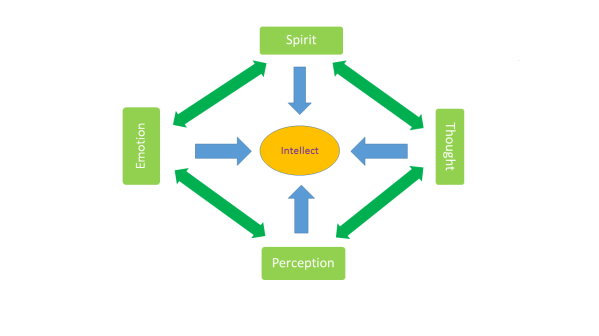 So what is thought? In On Intellect, Jeff Hawkins of the Redwood Neuroscience Institute summarized the science that demonstrates that the cortex is a structure that categorizes experience to coordinate behavior. While initially that categorization would have been focused on the first three categories of intellectual stimulus, by the mechanism of network stimulation, eventually the internal operation of the network would have become an independent source of intellectual stimulus. Thus arose thought: the stimulation of the intellect by the brain.
Obviously thought has an ancient lineage, dating back even to insects. But full expression of its potentiality required coupling of that capacity to skills that could be used to reorganize the environment and thus control sensation. Birds and octopi manifest that to a limited extent, but primates to a degree that flowered to environmental dominance with the arrival of homo sapiens sapiens. We create tools that allow us to enhance our biology in real time, where every prior creature was allowed that opportunity – and then only imprecisely – through procreation.
While today we tend to emphasize the power of our material tools, the brain also allows a far more precise interaction with the spiritual realm. I understand that souls are composed of electrical charge decoupled from mass. Nerves channel and interpret the flow of electrical charge. As regards the emotions, nerves also affect our endocrine glands, muscles, organs and metabolism. Thus the brain provides methods for coupling thought to spirit and emotion, methods that are far more powerful than the couplings previously available to intellect.
As the influence of spirit is most evident in social activity, we should note the importance of language in facilitating the coupling of spirit to thought. While all mental states are abstractions of the underlying reality, words alone are capable of conveying our apprehension of that reality to another. Modern cultures are rooted in the conventions adopted for the association of words with experience. The ability of communities to coordinate effort to solve problems depends on the consistency and integrity of their use. Communities that honor clarity and honesty evolve social structures that may manifest as completely new forms of spirit. The ancients recognized these as “gods.”
Love of Wisdom
I have proposed to characterize Philosophy – the “love of wisdom” sought by the ancient Greeks – as study of the operation of the intellect. Here I understand intellect not narrowly as a manifestation of reason, but broadly as any process that couples the behavior of a living organism to the world around it. Intellect, in this view, mediates the interplay of the elements of reality through living creatures. Bringing together in humanity the dexterity and strength to create tools with the capacity of thought, nature manifested the potential to outgrow Darwin’s evolution through natural selection. Philosophers seek to organize that effort.
If that effort occurred in a vacuum, we might better be able to measure our progress. But it does not. Humanity is the culmination of a billion years over which life insinuated itself into the material substrate of the earth. That integration involves enormous amounts of energy, and disruption of the natural order threatens all of the higher lifeforms with extinction. The complexity of ecosystems makes it almost impossible to predict accurately the consequences of human intervention, and our facility with tools means that often we are the last creatures to feel the full force of disruption. Whether through clear-cutting of forests, the suffocation of once-fertile soils with covers of asphalt and concrete or the ubiquity of air conditioning, in fact our disruption of ecosystems often produces immediate advantage for us.
Our indulgence of those opportunities is a sign of dangerous immaturity. That immaturity is most dangerous in two scenarios. The first is when our primitive animal instincts infect our thinking, causing us to engage in contests for dominance using the most sophisticated tools that we can create. During the Cold War, the world as a whole was threatened by the nuclear arms race. While most nations appear to have recognized the insanity of direct military conflict, many nations still seek to define spheres of cultural hegemony through practices that require profligate consumption of fossil fuels. Unless reversed, that consumption will see human civilization destroyed by global warming. This second threat – the danger of inattention – manifests over many generations, and while no less deadly is far harder to address, not least because in the short term many beneficial outcomes accrue to the exploiting communities.
Under such circumstances, most parents deny children access to firearms and matches. And so it is with our spiritual predecessors. As they began to understand our potential by exploration of our minds, they have been forced to resist our head-long rush to Darwinian dominance.
If this sounds incredibly complex and ambiguous, it is. Most of the early philosophers counseled their peers to reticence. They sought to create a safe preserve for the operation of thought. Over time, that manifested through the formation of ideas that stood as bastions against disruption of human intellect by base motivations.
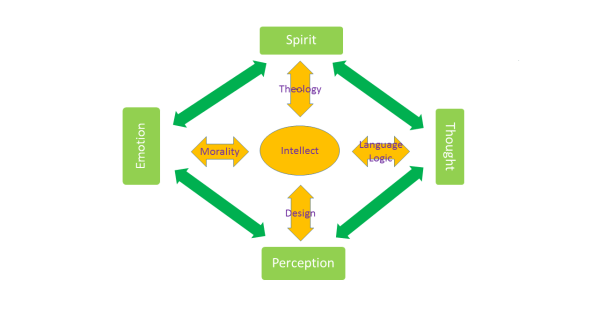 The principal threads of philosophical discourse can be understood as filters through which the human intellect manages its interaction with the sources of our mental states. At the interface to the physical world, we have the discipline of design that encompasses art as well as science and engineering. Design is concerned not only with the limits of practical possibility, but with ensuring that the environment that we create accommodates our emotional needs. Ethics attempts to organize and discipline our emotional experience, building reserves of good will that facilitate collaboration. Language and logic tame the profligate domain of thought, which if left unchecked devolves into incoherence or insanity. And at the interface between intellect and spirit, we have the bastion of theology that ensures that our faith is invested with personalities that respect our potential and seek to facilitate its flowering into mature judgment.
The history of philosophy demonstrates the difficulty of expanding the scope of human intellect. In the early days of Christianity, theology was considered dominant, but today design seems to be the most powerful method for bringing reality under human control. The unbridgeable gulf between physical reality as interpreted by our senses and the abstract realm of thought has long frustrated philosophers, and Aristotle’s dominance of intellectual discourse for 2000 years reflected in large part his belief that careful observation and logic could narrow that gap. Unfortunately, the strides made by technological innovation have allowed the spread of narcissism that undermines the work done by political theorists most concerned with the balance between morality and theology (nations being gods of a sort). Perhaps recognizing the futility of imposing purpose in the world, Post-Modernism celebrates the interplay of thoughts without reference to other experience.
And so it has been in age after age: profound thinkers set off to expand the scope of human intellect by focusing narrowly on opportunities in one discipline or another, only to have their successors shout “But you forgot about this!” In making clear the complexity of the philosophical quest, I hope that I will encourage future generations to humility, and the realization that no single mind can hold all the answers. Rather, not just the richness of human experience but our very survival is dependent upon the degree to which we allow our intellect to be disciplined by compassion in our hearts.
The Philosophical State
In parting, I offer these conclusions regarding my sense of where we should focus in the next era of philosophical discourse.
Concerning design: While nature holds its secrets, the Promethean fecundity of creative intelligence allows us to explore configurations of matter that could never be attained through other means. The sublime divinity of that capability must be yoked to compassionate service to life.
Concerning language and logic: No intellectual activity is sustainable unless we seek to honestly, clearly and precisely express our experience and expectations of this reality. In debate, we must avoid egotism that prompts us to consider our perspective to be superior to the perspective of other living things.
Concerning ethics: Morality is found in any system of values that expands the domain in which love is expressed.
Concerning theology: If love is a seeking after opportunities for the object of our affection to receive affirmation, then in its selflessness unconditional love is the only incorruptible unifying principle worthy of our faith.
Blessings and honor are due any that undertake to further the project of philosophy. I pray that some benefit may be found in the thoughts that I have here offered.
Nucleons in a Bunch
The world of the very small is impossible to observe in complete detail. In the everyday world, once the billiard ball is struck, we can predict the final configuration on the pool table. This is because the method we use to observe the initial positions and motion of the balls – vision – doesn’t change appreciably those positions and motions. In the microscopic world described by quantum mechanics, however, Heisenberg’s uncertainty principle tells us that we can’t measure with arbitrary accuracy both position and velocity.
A similar principle affects the theory of quantum mechanical rotations. In principle, a rotating body has a total angular momentum (its propensity to keep spinning) and an orientation of the angular momentum in space. Since we have three spatial directions in our reality, there are three components of angular momentum. However, quantum mechanical theory tells us that we can know the total angular momentum, but any attempt to measure one of its components will disrupt the values of the other two components.
This leads to some confusion in interpreting the theory, even among physicists. The leader of my Ph.D. thesis project, hearing that I was doing well in my advanced coursework on quantum mechanics, expressed his confusion regarding the underlying physics of the system we were studying (muons in a magnetic field). I explained to him that the other two components still existed and influenced the time-evolution of the muon, but at the end only a single component could be measured.
This was a man that intimidated his collaborators with his brilliance and drive, and no one had ever clarified for him the basics of the quantum theory of angular momentum. This is not uncommon – often the words used to describe quantum processes are not reflective of the underlying mathematics of the theory. This allows lots of room for physicists to overplay the significance of their measurements.
Today we have a report from an experimental study that confirms that some quantum objects are not symmetric. This is not surprising, in some sense. The system, the nucleus of the barium atom, is a swirling stew of 56 protons and 88 neutrons. What the study reveals is that some number of these particles can clump together in a particularly ordered fashion. Once they achieve that configuration, the remaining protons and neutrons can’t push their way into the structure, and end up hanging like a barnacle on the outside.
Here’s a way of visualizing this: let’s say that we have twelve of those little magnetic balls. We can organize eleven of them into a nice little tetrahedron. But the twelfth ball is going to be stuck on the outside of the tetrahedron like a barnacle. It is going to ruin the regularity (what physicists call symmetry) of the assembly.
Why is this loss of symmetry exciting? Well, it seems to be a pretty natural consequence of self-organizing aggregates. But it’s also related to some principles used to guide the development of quantum mechanical theories. Remember, we can’t see this world very clearly, and touching its inhabitants disrupts their behavior. So to guide the development of theory, physicists have come up with abstract mathematical principles. Three important ones are charge (C), parity (P) and time (T) inversions. These state, respectively, that the equations that describe the quantum world should not change if:
- particles are replaced with anti-particles
- the particles are observed in a mirror, and
- the universe is run backwards.
In actuality, it’s hard to create theories that violate all of these principles simultaneously (what is called CPT violation). However, the weak force that controls radioactivity is known to violate parity (P), though invariance is restored under CP.
So what is the significance of the asymmetry of Barium-144? The authors claim that it is parity violation in the strong and electromagnetic forces. The claim is based upon the observation that when looked at in the mirror, the barium atom will have its bump on the opposite side.
But that is not what parity violation means! The mirror-image barium nucleus is still allowed under the equations that describe its structure. In fact, it can also be obtained simple by walking around to observe it from the other side. That is certainly allowed in the theory.
We can contrast this with parity violation in neutrinos. Neutrinos, which only participate in the weak interactions, always have their angular momentum aligned against their direction of motion. They are “left-handed.” Observed in a mirror, however, that orientation changes: the direction of motion is reversed, but not the angular momentum. Thus the neutrino becomes “right-handed,” which is not known in nature, and so the equations of the weak interaction are violated by parity inversion. However, by adding charge inversion, the violation is removed: anti-neutrinos are indeed right-handed.
So in this case I’m afraid that got those making so much of the Barium-144 asymmetry have gotten their “nucleons in a bunch” for no good reason.
In general, the obscurity of quantum phenomena are not even well understood by physicists themselves. When they trumpet a great discovery, then, you should always ask yourself whether the practical implications of their work merit continued support by the public.
Unless, of course, you think of science as a cultural investment, like art or politics.
Freedom’s Prison
There are two fibers running from our brain to the glands that regulate our fight-or-flight response: one from the ancient reptilian brain and the other from our cortex, the part of the brain that reasons. The cortical fiber is myelinated, so the signal gets to the glands first, and can over-ride the signal coming from the reptilian brain.
Our freedom is freedom from the basic physics and fundamental biology that rules the rest of the world. But too often we turn it around and use it to force the people around us into conditions of poverty, psychological duress and physical hazard that forces them to behave as animals. We maximize our freedom by denying it to others.
Jesus is lord because, confronted by the consequences of the choices made by those most free, the oppressed choose his compassion and strength as a spiritual refuge. He preserves their freedom against those less wise who use power to play at being gods. For that reason, those rescued are loyal to Jesus in eternity. Inexorably, the tyrants turn on each other, creating yet more victims for Jesus to heal and redeem, until all except the most heinous are wrapped in his love.

Countless wars have been fought in its name. Brave soldiers have sacrificed their lives to protect it. We’ve pawned off our souls to taste it. Yet, it holds us captive. We have cut open the Earth and yanked it from her core. The blood that pours forth, we call freedom.
Can a creation exist separate from the will of its creator? Why then, do we believe that we can thrive independent from the will of our maker?
Outside of our creator’s purpose, we are but walking sandcastles. And is not dust easily swayed by the caress of the wind? Beautiful souls cloaked in flesh, so readily tempted by the elements. Fools we’ve become, dressing ourselves high and mighty in our own concrete beliefs and labeling it freedom.
The liberties that we’ve taken with our lives have served only as a deception to further bind us. We believe that we are…
View original post 380 more words
Trimmed to Size
I am in the third stage of down-sizing my living space, preparatory to relocation from a 1200 square-foot apartment with attached garage to a 700 square-foot space. Considering the expense of a storage unit, I have steeled myself to discard or donate everything except the bedroom set and my tech tools. I began the final purge and boxing up for the move last night, and stuff that had survived the first two cuts is now either piled up in the garage pending a trip down to Good Will, or sitting in the dumpster.
Strangely, the two collections represent very different aspects of my life.
The primary impetus for down-sizing is that my sons are off to college. I’ve held back their child-hood memorabilia, most of it stored under my bed, which is were it will be again after the move. The rest of me as a father is destined for Good Will, including the power tools that I used in fixing up the house their mother now lives in, the racks that stored their backpacking gear, and the last of the storage bins that held their craft supplies.
In the dumpster lies the record of my intellectual life, starting with the journals I wrote in college that marked the beginning of my attempts to understand the power of love and why it was so hard to transmit it. Also from that era are the remnants of the comic book collection that I accumulated up to the date of my marriage at thirty-five. More significant are the last of the evidence of my investment in Diagrammatic Programming, the systems analysis technology developed by my father who passed away just before New Years.
The furniture and appliances are no loss. But these things hurt somehow.
From the comic collection I did hold back my run of The Puma Blues. It’s been sitting on a wire rack for three months, but made it to my bed last night. My elbow began aching around 9:30, so I decided to turn in. Instead, I ended up propped up by my pillows, trying to decipher the faded scratches of the hand-lettered dialog, while a voice in the back of my head keep on observing “This was the only thing in your comic collection worth keeping.”
Puma Blues, which ran only 24 issues, charts the experience of Gavin, a young man confronted on all sides with the futility of the struggle against death. It was created by two Canadians with deep environmental sensitivities. The artwork lovingly captures the natural world, with a moodiness that sometimes makes it difficult to discern the minutiae of artificial existence.
Set at the turn of the millennia, the ecological context of Gavin’s life is terrifying: global warming, acidification, ozone depletion and nuclear terrorism have brought the natural world to the point of collapse. Strangely, in seeking refuge from hopelessness, Gavin finds himself posted at a nature preserve, monitoring the pH of a lake that is being limed to allow the fish to survive, and thus to support the rest of the ecosystem. But with too much free time on his hands, Gavin is brought to confront a more direct experience of mortality, in the form of videos made by his deceased father that consider darkly the larger question of humanity’s relationship to eternity.
The storyline offers two promises for healing, promises that I regret were barely formulated before the series was dropped. The first is the assertion by Gavin’s father that “rebellion is the beginning of faith.” In the backdrop of Gavin’s life, the rebellion is evident in his rootless refusal to engage society, and it is indeed that rebellion that allows him the opportunity to engage his father’s voice. But from my writings here, it might be gleaned that I believe that the whole of religious experience is a rebellion against our Darwinian programming. In both cases, rebellion manifests as a pig-headed refusal to participate in systems that create death.
This parallel will be offensive to lovers of nature, but I stand by it: while it is fashionable to believe that humanity has disrupted a natural balance, that is only true on the human time-scale. Looking at ecology even on the time-frame of tens of thousands of years, and we see a constant rising and falling of species and ecosystems. There is no stability, and the instability brought by death was the agency of our evolution.
Gavin resists faith, however, even though the second promise for healing is nothing less than an absolute miracle. Symbolically, it reflects the hope of life itself, a hope that it will find some way to outgrow the disasters that humanity is visiting upon it. Along with his environmental monitoring duties, Gavin is occasionally ordered to seek out and “transmute” aerial manta rays. Physiologically, there is no concession in the artwork to biological necessity. The rays sport gills, and flutter their wings gracefully as though under water. But they fly through the air none-the-less. Obviously, the only explanation for their survival is access to some other form of energy, a form that is not channeled by the normal metabolic means.
This is the promise that I offered my sons all through their childhood. While I try not to show it, it hurts now to hear them enthuse about terraforming Mars (to which I think: “Really – invest all that energy so we can move there and screw it up?”) or spread nanoscale sensors all over the Earth (“Disrupting the digestion of the insects and worms just as our plastic refuse does that of the birds and fish?”). I do understand, of course: they must survive in a culture that abases itself before its technological avatars, because they offer the promise of complete control of the world through the use of digital technology.
But the problem, as I see it, is in seeking control.
Here’s an experience: I was working at a climate change modelling institute in 2004, back when the fossil fuel industry really began to push back against the scientific community. The ozone layer was a serious concern: the CFCs used for foam production and refrigeration catalyzed the breakdown of ozone, thereby allowing cancer-causing ultraviolet radiation through the atmosphere. While replacements had been found, the chlorine atoms at fault would remain in the atmosphere for decades.
As a physicist, I was mulling one day over the thought that neutrinos from the sun could catalyze electron emission from a neutron in the chlorine nucleus, transforming it into argon, which is chemically inert. Thinking more and more deeply about this, I visualized the neutrino field being emited from the sun, and then honed my attention on the thin shell of the atmosphere. I felt other minds joining mine, and then a frission of energy.
A few weeks later, one of the climate modelers came by after church to say: “We were pretty worried about the ozone layer, but it seems like it wasn’t such a big problem after all.”
And so I find myself a little disjointed today, juxtaposing my promise of hope against the paranoia of Gavin’s father, whose faith manifests as belief in UFOs and the hope that some higher species is standing in the wings to engineer our salvation. Neither my sons nor the authors of Puma Blues seemed ready to proclaim that we are the intervention. We are the tool by which God conquers Darwinian violence.
We just need our rebellion against death to mature into a surrender to love.
To UCLA
Any tragedy is a wound, an offense to our spirits that threatens our goodness. Particularly in a case such as Professor Klug, we cannot fathom how his caring for Mr. Sarkar could have ended as it did. Our intellect recoils from that connection – it offends our logic and sense of justice.
So we ask “Why?” I will offer you an answer.
For billions of years the history of the universe was a random bashing together of atoms. Even here on Earth, after the first single-celled organisms birthed the promise of meaning, for nearly a billion years every species that arose cast down those that came before it. Darwinian evolution is driven by the wounding of each other by creatures that have no choice. In truth, it is only over the last ten thousand years or so that humanity – that little blink in Nature’s eye – has had the opportunity and resources to express consciously and intelligently an intention to bring love into the world.
This is the struggle before us: to overcome our Darwinian programming. The struggle is not easy – our bodies are designed to produce powerful signals that pull us into animal behavior. In many cases, our science and engineering have given us the means to amplify those tendencies. Sometimes that is pleasant, but today we grieve because one man’s confusion was amplified by a gun.
So we feel pain, and gather together to share strength, as others have gathered in the past. It is important to remember that past, a past from which we celebrate figures such as Martin Luther King, Jr., Nelson Mandela, and Mahatma Ghandi. While they fall, and fall too often, in each generation technology allows them to reach more and more of us. We can doubt the existence of Jesus, Buddha or Lao Tze, but we cannot doubt that the message of love they shared with the world still inspires people in our day.
Institutions of higher learning such as UCLA, at their best, are a cauldron in which we hone our intentions to do good. In part, we grieve for Professor Klug because he represented the best that UCLA has to offer. The terrifying moments of his death threaten to cast us down into fear. The Darwinian world claws at our hopes.
I wish to offer you my sense of why we celebrate people whose response to fear is to choose to love unconditionally. They possess a certain power, a power that I best understand as this:
Love dissolves the barriers of time and space, allowing wisdom, energy and understanding to flow between us, and embracing us with the courage, clarity and calm that overcomes obstacles and creates opportunity. When we open our hearts to one another, there is no truth that is not revealed. And to those that truly love themselves, no impulse to harm that cannot be turned to the purposes of healing and creation.
It is to that last point that I wish to turn your attention. We can grieve, and that grief can turn to fear. Or that grief can be used for healing.
So to each of you, I would ask that you find a moment to take the hands of a friend and allow their eyes to enter you deeply. In that moment, set aside any future expectations of them, and say “Thank-you for your goodness.”
And to those of you that receive that affirmation, I would ask that you take the power that is woken in you, and to consider Professor Klug. Reach through the moment of fear that consumed him. Visualize his acts of caring as a teacher, father and friend, and offer the words “Thank-you for your goodness.”
And then consider the family that grieves for him. Jesus said “Blessed are those who mourn,” because to grieve is to remember goodness that has been lost. Grieving is our goodness affirming goodness. So visualize that family, and allow your strength to pave the way into a future of healing. “Thank-you for your goodness.”
And last, and hardest: consider Mr. Sarkar, who fell down the well of fear. No person is without merit, even if only in small acts such as tying a sister’s shoe or in recognizing virtue in another. Visualize those moments, no matter how simple, and build strength in them. “Thank-you for your goodness.”
And then open the ears of your heart. Hear the world around you, the Earth that we have abused so terribly. Hear that world awakening to hope. As you walk amidst the trees and over the grass, as the birds chirp and little creatures scurry, hear it calling out tenderly: “Thank-you for your goodness.”
Evolving Dementia
My mother spent most of her life supporting families dealing with cancer, but now Alzheimer’s is becoming a comparable epidemic. In 2012, estimates held that nearly 5.4 million Americans had the disease in some stage. The neurological characteristics of the disease include formation of protein plaques in the cranial fluid, which start to develop as much as thirty years before the onset of dementia. In the final stages of the disease, proteins in the neurons themselves begin to tangle, killing the cells and leading inexorably to loss of muscle control and death.
My mother had recorded a Nova special on the efforts of drug companies to develop treatment for the disease. The resources dedicated to the research are impressive – the special focused on three companies running drug trials costing up to $1 billion. The treatments attempt to mobilize the immune system to harvest and break down the proteins that form plaques. Early treatments caused dangerous swelling of the brain. The current generation of treatments avoid that side-effect, but while the special heralded that breakthroughs were possible, to the scientist, the justification for that hope appears incomplete.
The researchers do not hope to reverse the progress of the disease, but hold forth the possibility that treatments may slow the formation of plaques. This hope is inspired by three-year studies that demonstrated that early-stage patients showed 30% less cognitive degradation than observed in patients that did not receive the drug. But Alzheimer’s evolves over decades, and we have no way of knowing whether long-term treatment won’t result in complications that rival the disease itself. Nor, without expensive radiographic imaging of everyone’s brain around the age of thirty, do we have any way of knowing currently who requires the treatment.
Obviously, if we understood why the plaques form in the first place, we might be able to prevent the disease entirely. Given the expense of the research, however, it is obvious that some commercial profit must be generated to keep the work alive. As with diabetes and cancer, long-term drug treatments will generate that revenue.
But can it ever lead us to a cause?
One of the criteria for canonization is proof of a miracle. In the case of Pope John Paul II, one of those demonstrations was the miraculous healing of a nun with Parkinson’s disease, another degenerative nerve condition. Scientists hold that such demonstrations are simple fraud or chance correlation with spontaneous recovery. But if we take spirituality seriously, we might expect that the development of human intellect would create stresses in our physiology that it was never designed to sustain.
As I understand our intellect, the brain is an interface to the world of ideas. In sharing ideas, we build power in them. This power is not held by any one individual, but held in what Jung called humanity’s “collective unconscious.” No other creature had ever created this kind of repository, and so we would not have inherited from our animal predecessors any mechanisms that would protect our brain from direct exposure to such energies.
Consider, then, what might happen if we taught our children that thinking occurs in the brain. Every intense intellectual exercise would intuitively manifest as an attempt to take control of ideas, to force them into the interior of our brains where we can manipulate them most directly. But each thinker that wrestles with ideas struggles against the intentions of other thinkers, creating dissonance and stress in the tissues of the brain. Might this not result in damage to that delicate organ, an organ that never evolved to deal with such strain?
In my own case, when I began to take charge of my mind back in 2002, I had to struggle against corrupt residents. The strain expressed itself physically in my brain as pressure, sensations of heat, and in the most extreme occasion, sounds of the cranial bone cracking. The events that most frightened me, however, involved a sensation of burning in the nerves along my ribs that I found similar to the symptoms of shingles in its early stages. When I realized this, I turned inwards, considering the structure of my mind, and traced the problem to an over-heated section of my brain in the back of my skull. Realizing that my mind was passing energy through tissues not designed to process it, I tried to shift the flow outwards, into the soul that blooms all around me. I felt of shifting of spiritual structures, and over the next few days, the symptoms disappeared.
My belief, therefore, is that even if we figure out how to stave off the onset of Alzheimer’s using drug therapy, our medical science, with its focus on proteins and genomes, will never touch the root cause of our evolving epidemic of dementia. Our subconscious struggle for the control of ideas will simply intensify, and manifest in other forms of disease. No, it is the idea that the brain is the mind that is at fault. Only when we begin teaching people how to manage the part of their mind that resides in the soul will we be able to prevent dementia.
Super Massive Black Holes
New study indicates that super massive black holes did not form through slow accretion from normal black holes, but rather early in the evolution of the universe in some unknown, cataclysmic process.
This contradicts the “Big Bang” theory, but is expected in a physics of Generative Orders (see points 7 and 8 of the “Reference Model”).
 everdeepening