
Arguing Toward the Middle

As a benefit of my attendance at the Skeptic’s conference last may, I have been receiving copies of their flagship magazine. The magazine has begun to entertain the views of theists that work in the sciences. The dialog is generally pretty counterproductive, with the participants often talking past each other. Motivated by the debate between Dave Matson and Douglas Navarick (Debating the “God” Construct) in Vol. 20 No. 4, I address the issues of abiogenesis (the origin of cellular life) and the distinction between “supernatural” phenomena and those such as spirituality that lack an explanation.

You’ll find another response to Navarick’s original article here.


Dave:

As a scientist who believes that the soul is a part of the physical construction of this reality, I am dismayed by the tone of your response to Douglas Navarick.

“Supernatural” is a tendentious term

The scientist loves to ask “Why?”, and comes up with theories that propose explanatory relationships. In propagating those abstractions, an elite cognoscenti is created. As this elite solidifies its political power, funding of scientific research tends to crowd out radical ideas (I refer you to Kuhn’s The Structure of Scientific Revolutions).

So the researchers at CERN focus on the discovery of the “Higgs boson” (which looks nothing like the Higgs boson I studied in graduate school), despite the fact that the Higgs mechanism actually doesn’t explain particle masses – you still need to generate the coupling constants that determine the mass of each individual particle. The “Higgs boson”, however, has been built up as an accomplishment worthy of pursuit, and so is trumpeted as a Nobel-worthy achievement even though – with the exception of charge – no property of the simplest composites (the mesons and nucleons) can be calculated from the standard model of the fundamental forces – even given the measured properties of the quarks. Thus we have a situation in which the obvious failures of current theory are ignored to the purpose of sustaining funding for large-scale research programs with many stakeholders outside of the sciences.

Following Kuhn, I would argue that fundamental physics is ripe for a revolution. The issues as I see them are outlined here. Conceptually, it would seem that if one posited structure inside the current collection of “fundamental” particles, it actually wouldn’t be too hard to make room for the soul. I also have a far simpler picture of this reality, without the unobservable (and highly unstable) Planck-scale plasma and alternate universes. (The multiverse theory, BTW, being obviously another version of your magical hare-brained Easter Bunny.)

So rather than “supernatural”, I would prefer a term that suggested “beyond the things that scientists can yet explain.” “Spirituality” may fit. I would hope that you would admit that scientists, with their emphasis on material experience, may self-select from among those that are spiritually insensitive. As one not so insensitive, often marveling at the healing power of love, I find that “hare-brained Easter Bunny” provides no explanatory leverage. There is something to life beyond what particle physics can yet explain. I’d like to have a rational dialog on the topic.

Of course, if I am right, everyone will be confronted with the need to rethink the record of scripture that has been brought forward from many cultures. Clawing back the sarcasm is going to take a great deal of courage, I recognize, but no less than surrendering the comfort of dogmatism on the other side.

Abiogenesis

This really isn’t that hard a problem. Assume that the oceans contain distributed pools of heavy hydrocarbons in contact with various sources of heat and minerals on the ocean floor. The hydrocarbon pools will develop a skin of polarized molecules (maybe even phospholipids, as phosphor is not rare). Other fundamental components of life (nucleic acids, amino acids, etc.) may also be sourced from the complex chemistry of the pool, which could support (as we know) selective exchange of materials with the water. Agitation of the pool (through earthquakes, overflow, or venting) will result in formation of protocells. These events will  produce innumerable trials, liberated into sub-sea currents. Eventually among those trials will be cells that can scavenge materials for growth from the environment. Voila! Life.

Pools lying on different mineral strata will form protocells with different morphologies. Those with compatible membranes could merge, producing further biochemical trials. Which is what we actually know happened – cells are composed of organelles that were protocells in their own right before being absorbed.

BTW – there’s an IMAX on life around thermal vents in which the pilots of the deep sea vehicle actually interact with such a hydrocarbon pool.

Regards,

Brian Balke
Reconciling Scripture and Evolution

Posted in a discussion of our symbiotic relationship with mites, this summarizes my position succinctly:

The biologists that rely upon strictly biochemical processes of evolution will never be able to calculate rates, because the forcing conditions have been lost in prehistory. I found it interesting to ask “why does every civilization develop the concept of a soul”, and eventually concluded that Darwin was half right: life is the co-evolution of spirit with biological form. The addition of spirit influences the choices made by living creatures, and so changes the rates.

Given this, I went back to Genesis and interpreted it as an incarnation (“The SPIRIT of God hovered over the waters” – and then became God for the rest of the book), with the “days” of creation reflecting the evolution of senses and forms that enabled Spirit to populate and explore the material conditions of its survival (photosensitivity, accommodation of hypotonic “waters above”, accommodation of arid conditions on the “land”, accommodation of seasons with sight (resolving specific sources of light), intelligent species in the waters and air, and mammals on earth (along with man)).

Couple this with the trumpets in the Book of Revelation, which pretty clearly parallel the extinction episodes identified by paleontology – including injection of the era of giant insects – and it looks like science and scripture actually support each other.

The only point of significant disagreement is spirit itself. Given my knowledge of the weaknesses of modern theories of cosmology and particle physics, I found myself considering the possibility of structure inside of the recognized “fundamental” particles. It became apparent to me that it wouldn’t be too difficult to bring spiritual experience into particle physics. To my surprise and delight, I became convinced that this reality is constructed so that love inexorably becomes the most powerful spiritual force.

From the Earth to the Sun and Back Again

One of the hazards of engaging in epistemological debate is that they almost always become religious. We look back through the haze of history, trying to understand the practices by which knowledge is revealed to us, hoping to glean insights that help us heal divisive intellectual conflicts in the present.

Currently, these discussions become religious because our era suffers from an extreme bifurcation in our pursuit of knowledge. In no other era of human history have the two great pursuits of understanding – religion and science – been perceived as diametrically opposed. The linear causality of Einstein stands in contradiction of the gift of prophesy, and the power and predictability of dumb matter seduces us into believing that we can achieve all of our desires right here on Earth. Conversely, science denies us the comfort of meaning, to the extent that some denounce the search for meaning, or go even further to propose that this reality is evidence of a malefic creator.

Given this modern myopia, in looking back at the great episodes of resistance to truth, we tend to focus on the conflict between science and religion. Consider, for example, the succession from geocentric models of the solar system to the heliocentric models. The oppression of Brahe and Galileo is characterized as resistance by a religious elite threatened by the destruction of a Platonic universe whose geometrical perfection (circles moving within circles) was advanced as proof of the existence of the Christian God.

In fact, the history was rather more subtle, and its consideration brings a great deal of insight into the intellectual resistance to the program of this blog, declared on the title bar: “Unifying Science and Spirituality.”

The Greeks advanced both the geocentric and heliocentric models. If the ancients had been capable of building the instruments used by Galileo, they would certainly have settled on the latter. They resolved on the former for entirely practical reasons: they were concerned with using the positions of the stars to calculate the calendar date and the position of objects on the Earth’s surface. Culturally, their needs were absolutely geocentric. To solve this problem, they correlated geographical position with stellar observations and the progression of the seasons. Next, they sought methods for compacting this large body of data in a form that could be used by voyagers. The technology most adaptable to that purpose was the mathematics of circular revolution. Not only was the mathematics of circular revolution relatively simple, it was easy to translate to mechanical form as instruments containing rotating dials.

The “geocentric” model of the heavens was not in essence a philosophical proposition, but a proposition of practical technology. The principle motivation for upending the model was that over the centuries, the circular approximations began to fail. Designs specified in the first century produced the wrong answers in the eleventh century. A more reliable model was necessary, and the application of the new mathematics of elliptical analysis revealed that the heliocentric model fit the data more reliably than did the geocentric model of circular revolution.

As for the resistance of the Church, Galileo insisted on publishing an insulting parody of the Pope with his observations. He made his science a political issue. This was not an idle matter: the Church used the feudal compact to constrain the rapaciousness of those with a monopoly on the instruments of war. Those scientists were well accepted that chose to engage with the Church with the aim of minimizing the social disruption that always comes with new knowledge.

In my own intellectual adventures here on this blog, I find myself confronted by those that tout modern cosmology as proof that the universe is a machine unfolding without purpose from its initial conditions. The foremost intellectual challenge to that conclusion has been “fine tuning” – the delicate balance of the fundamental constants of nature (specifically the relative strengths of the four forces) that must be preserved if life is to survive. The solution to this conundrum has been the “multiverse” variant of the Big Bang theory (the name itself is a mischaracterization). The multiverse proposition holds that universes exist with and without life – we just happen to occupy one in which life is possible.

The random generation of universes in the Big Bang, however, results from the proposition that we can explain all of nature by using two branches of mathematics: group theory and Fourier analysis. Both of these methods are relatively susceptible to hand calculation. What is little understood by the public is that the theorists trumpet their successes and ignore their failures. The application of current theory to study of the hydrogen nucleus is summarized here, and the results are incredibly ugly.

Why is the theory not abandoned? For the same reason that the geocentric theory was not abandoned: physicists and astronomers have used the current theory to justify the construction of multi-billion dollar observatories. As the Church did, they oppose any idea that might destabilize the social order that pays their salaries.

What is scandalous is that the interstellar navel-gazing saps money from problems here on Earth that desperately call for the full commitment of our best and brightest minds. The scientists need to get the heads out of the stars and back onto the Earth.

Understanding, Hope

The ferocity of the wildfires raging in Northern California was given a human face last Monday morning when one of the staff at AMC shared that two members of her family had lost their homes and everything they owned when their town was devoured by the flames. As I write today, the fires have destroyed 1400 homes.

To some, it is human crisis that makes global climate change palpable to them. For me, once a wanderer of the trails above the Conejo Valley, the cries of nature have weighed on my heart for far longer. The day that I first encountered the great Muslim love poem, Yusef and Zuleika, these words caused me to weep as I looked out over the hills:

To my wounded heart this soft balm to lay,
For not beyond this can I wish or pray.
The streams of thy love will new life bestow,
On the dry, thirsty field where its sweet waters flow.

After services at St. Kolbe’s today, I was moved to stand on the floor where the gaze of Christ fell. I was struck suddenly that the last thing that he beheld was the earth under the cross. The earth that held in place the instrument of his destruction, but also that had carried him on his wandering, that had brought forth food for him to eat, and provided all the tools of weather and life that had responded to his authority as he tried to teach his people to heal the world.

We could have avoided this destruction. Not just the destruction of families, cities and nations, but the loss of species and the poisoning of water and earth that will delay their recovery. Both to the reasoning mind and the intuitive heart, these consequences have long been apprehensible. Now, faced with the undeniable evidence of doom, we still hesitate to act, for we think first of what is close to us. Our families, our homes, and our land: they all suffer, and so we take from elsewhere to preserve them. We take from those with no voice: the poor, the uneducated, and the natural world.

But what else are we to do?

I write here because I understand things that others do not, and so I perceive solutions that are beyond their grasp. It may seem small-minded to decry the folly of Elon Musk and his peers, desperately trying to disperse the human species so that it can survive all the threats of the natural world: black holes, solar instability, and human greed. But I do so with sympathy for them, for they cannot see how much power is available to us if only we understand it.

On the New Physics page I offer a model of physics that holds these truths: space is not empty. It is filled with a medium in which light propagates, the medium that physicists once called the “aluminiferous ether”, and now call “dark energy.” That medium is wrought through with threads that appear most obviously to us as electric charge when bound to the medium, but that may also float in the medium. The floating threads interact, merge and evolve to form what we know as “souls.” The souls merge with matter to “live” as plants, animals and people. In that form, they are capable of warping the fabric of space. In most cases, that warping occurs through the use of their physical manifestation – in humans, we commonly use our legs, hands, and mouths.

Through our actions, we join other things in the service of our will. That can be a temporary affair, such as when we throw a light switch or press the accelerator pedal. We are often seduced by the temporary thrill of such expressions, a thrill made accessible through the efforts of engineers to remove souls from the world around us, ensuring that it responds only to our will.

But any great lover knows the permanence of the bonds that arise when we ask permission before enjoying a gift, and attempt to reciprocate in kind. In those exchanges, we make persistent spiritual arrangements – persistent precisely because the participating souls do not seek to escape them.

So this is how we save the world: we surrender our self-concerns. We open our hearts in compassion to the suffering of the world. We marshal the displaced souls of the natural world and join them together to warp the fabric of space to create a lens that bends light away from the earth. And we reward them every day with the expression of our gratitude for their service.

Are we enough to do this, by ourselves? Perhaps, and perhaps not. But we should consider this: there is a billion times as much energy leaving the sun than comes to us on Earth. The source of that energy is not unintelligent. It is, in fact, the “Ancient of Days” described in Daniel’s Dream of the Four Beasts. It would help us if it could, but we are so terribly small, and one mistake would destroy us all. It needs us to guide it.

I had a friend challenge me once that with faith we should be able to move mountains. My response was: “Yes, if every living thing on the mountain and the land around it agreed that the mountain should move, the mountain would move.” But if any voice claimed privilege over that power, the result would be chaos. It is for this reason that I decry the ugliness of the Republican debates. If we are going to save all of the world, the power of such voices will still be among us. The destructive effects of their expression cannot be risked. They must learn self-control.

I was late getting to church this morning. As I organized my thoughts to write this post, I sat down to the reading from Acts. I wept as these words were read [James 4:2-3]:

You lust and do not have, so you commit murder. You are envious and cannot obtain, so you fight and quarrel. You ask and do not receive, because you ask with wrong motives, so that you may spend it on your pleasures.

Oh, humanity! Why must the world suffer so?

Love Works Posted

Just a note that I’ve uploaded the rest of Love Works. Click on the page link on the banner. The post explains the delay.

The document was originally created in OpenOffice, and the images acquired a grey background in the port to Word. At some point I’ll fire up my old laptop and break it apart in OpenOffice. If there’s an immediate need, let me know and I’ll push it up on the priority list.

Beyond Good and Evil Round II: A Response to John Zande

John:

The proposition of good and evil is not a functional moral dichotomy – there is simply too much conditionality in moral analysis. I think that there are really only two principles that inform a meaningful moral dialog. The first is power – the capacity to make reality conform to our will. The second is love – an irrational desire to create power in the object of our affection. Moral analysis focuses on “who are you loving with your exercise of power?” The ultimate moral condemnation is “only yourself.”

I do not deny that the world is full of pain, but that is an inheritance from our Darwinian past, which is a process free of morality. In Genesis, when the Bible heralds the Fall as the entry of sin into the world, it is to recognize a separation from that past into a future of rational moral analysis. “Adam and Eve” are a metaphor for the human struggle with shame, guilt, forgiveness and redemption (all in the context of human society – God doesn’t need to deal with these issues).

The question is whether there is a force that lifts us up from brutal biological competition toward rational moral discourse. The Christian proposition is that Jesus came and died to demonstrate that there is nothing that can alienate us from God’s love or qualify us for preferential treatment in his eyes. This was demonstrated even in the face of murder at the hands of the culture that he came most immediately to love. His victory was to create a foothold for divine love in the world, and that foothold has broadened enormously over time.

So my response to your position is: yes, things are still bad, but they are far better than they were. It is only by looking at the trends that one can form a judgment concerning the efficacy of love. I experience its power day-by-day in a world that you seem to not to experience.

You have a great deal of intellectual energy, which you seem to focus toward the purpose of creating pain in others. My experience is that such people often are “doing as was done unto them”, looking for someone strong enough to show them how to heal. I can only offer Hume’s response to Hobbes (the latter whom you echo, btw). Hobbes averred that life for most was a “war of all against all” and “nasty, brutish and short.” Hume’s response was: “Mr. Hobbes has forgotten the operation of his own heart.”

If you want a person committed to the proposition of loving to read your book, you should start by offering a testimony regarding the things that you do love. That’s a point of contact that might allow them to engage your view of the world.

As it is, those of us that love have improved enormously the condition of life on this Earth. We’re at a turning point in that process, having nearly exhausted the resources that were laid up in the past. Under those circumstances, it will ultimately be those that learn to work together that survive.

Brian

Zande’s response to this was an assertion that he was trying to clarify the true nature of the reality we inhabit. My response was:

John:

Thank you for your considered response. I find myself, however, still seeking a declaration of the allegiance of your love.

Truth is indeed terribly important. Those that divorce themselves from truth ultimately abandon power (the ability to make reality conform to our will). For those that love, the truth of suffering is an essential goad to action. But the truth is only what it is. The goal of any active intelligence is to create new truth. It is through creative action that I find greatest meaning in life, and my ability to create is largely contingent (in the “no man is an island” sense) on the good will of others. That means offering them good will in return.

From a Christian perspective: yes, in its foundational state, this creation was indeed a reflection of Lucifer’s character. But I see the action of Divine Love in the mechanisms that are provided to heal his insanity. It is the simple existence of that possibility that I celebrate.

Good luck on your journey!

Brian

Mr. Zande’s response was to ask me to remove my religion from his blog – which I found odd because the only religious statement was actually an affirmation of Mr. Zande’s thesis.

My Background in Particle Physics

I earned my B.A. in Physics from UC Berkeley in 1982. That spring, I was asked by the undergraduate adviser where I had been accepted for graduate studies. I told him that Princeton had rejected me, and that Harvard expected me to find $10,000 a year. Face paling, he excused himself to go talk to the department head. When he came back, he said, “Here’s an application for graduate school at Berkeley. Fill this out. I’ll walk it down to the admissions office. If you don’t get accepted, don’t worry: you won’t have to pay the application fee.”

So I did my graduate work at UC Berkeley as well, receiving a Ph.D. in particle physics in 1987. There were two significant things about this era. First, it was when the fundamental ideas of particle physics and cosmology (the study of the early universe) were assembled.

Particle physics had been pursuing the use of group theory as a framework for unifying our understanding of the four forces (electromagnetic, weak, strong and gravitational). The theory had some really ugly problems. It did not account for particle masses, it produced infinities in its calculations that had to be “renormalized” away, and it had no satisfying explanation for the mathematical structure of the four forces. With the exception of the first, these problems were resolved by bringing gravity into the framework (through a Grand Unified Theory that was finally refined as superstring theory).

With regards to cosmology, the Big Bang had become dogma back in the 30s when Hubble discovered the red shift. The only available explanation for the result was the relativistic Doppler shift. The problem was that the universe was far too smooth to have been created in an explosion involving normal matter. The contribution of Alan Guth was a model of the early universe with ten spatial dimensions heated to the Planck scale, followed by an “inflation” driven by a Higgs-like particle with extremely large mass. Normal three-space and matter would only appear after the universe had cooled enormously, and light would slow down tremendously in the process. However, it turned out that there were tens of millions of possible configurations of the laws of physics in that cooling. Again, there was no way of explaining the mathematical structure of the four forces. This was addressed by assuming that our universe was only one of an infinite number of universes spawned from the original super-heated Plank plasma.

The second significant aspect of this era was the rise of Big Science in these fields. I was lucky to work on a team of eight, and turned my Ph.D. around in five years. Most of my peers worked on far larger projects, anywhere from one hundred to (at the end) a thousand researchers. The projects involved hundreds of millions or billions of dollars. Because the work had absolutely no practical utility, the arguments for funding became more and more abstract (often invoking science as a fundamental moral imperative), and then became simply political. To illustrate: the organizational success of the particle physics community, in alliance with the Department of Energy, was scandalous to the material science community, whose funding was drained to support the construction of large and larger particle colliders. The rebuttal came in the form of a proposed designer for a linear collider to study particle zoology at the Plank scale (10^40 electron volts, as opposed the the 10^15 electron volts at CERN). The sarcastic concept drawing showed a linear collider superimposed on the galaxy.

I was offered a job at BellCore (the telephone systems research lab) after graduating, but decided to give Particle Physics one more chance by joining a neutrino mass project at Lawrence Livermore National Laboratory. The woman that taught me particle theory, Mary Gaillard, was despondent. I had the feeling that she felt that I was joining the evil empire. Indeed, the nuclear weapons facilities were a vortex that absorbed a lot of talented particle physicists (I guess that DoD was worried that we’d go off and invent something even more destructive than the hydrogen bomb). So the ten years that I spent there were amidst a vital community of theorists, and I was able to keep abreast of developments in particle physics and cosmology.

I chose my position at LLNL because I knew that if particle physics didn’t appeal to me, I would be able to change careers. I did so after three years, entering Environmental Science. Unfortunately, I became married in 1994 to a trauma victim of the Soviet secret police. That trauma made it impossible for my peers to sustain their relationships with me. I was encouraged to leave the Laboratory for industry.

When I made a decision to restructure my personal life in 2000, I went through a period of enormous volatility in my career. My peers at LLNL (some of who had intervened in my personal life with disastrous effect) decided to throw me a lifeline, and I was back there in 2004 and 2005. The latter was the centenary of Einstein’s “anno mirabilus”, when he published his papers on the photoelectric effect, Brownian motion, and special relativity. The speaking schedule that year was dominated by cosmologists and particle theorists. I was able, in that venue, to come up to date on current developments in the field. What I came away with was confirmation that nothing had changed, and that theorists were simply adding parameters in order to match data that they couldn’t explain, often with unsatisfactory results. It was so dire that the NSF head of fundamental physics declared that the field needed “revolutionary” ideas.

I had begun to assemble the thoughts presented here in 2000 (see the “New Physics” tab), and offered them to some of my peers. It was then that I ran into political restrictions. I was told “wait ten years,” which was the foreseeable duration of the CERN research program. Well, that ten years is up.

I did receive some recognition while I was there. During a budget cutting exercise, funding of the National Ignition Facility was threatened. I ate lunch frequently at the NIF cafeteria, and one day found myself looking at the promotional poster on the wall, wondering how to make the program work. As I sat there, I had the sense of having a conversation with researchers from a number of disciplines. When I published that analysis (several months later), the budget discussions were resolved with an increase to support new research directions, and I was invited by the Associate Director’s office for a program participant’s tour of the facility. It was the only concrete evidence I received of the political contributions I had made to the laboratory in the eighteen months that I was able to remain there.

When Physics Breaks Down

Firmly convinced – as I am – that modern theories of physics are fundamentally flawed, I tend to cringe when reading articles such as “How Do Gluons Bind Matter?” (Ent, Ulrich and Venugopalan, Scientific American, May 2015, p.42ff). The authors consider the observable properties of the proton (one half of the hydrogen atom, the other being the electron), maintaining that theorists using the Standard Model of particle physics have been unable to explain:

  • The proton mass (only 2% of which is due to the Higgs mechanism)
  • Why it doesn’t fall apart
  • Why it doesn’t leak
  • Why it doesn’t have more stuff inside
  • Why it seems to rotate so much

This list could actually be summarized as follows:

The only thing the Standard Model explains about the proton is its charge.

Note that this is after more than 30 years of theoretical effort, including construction of special-purpose supercomputers. The failure is explained away by the mathematical complexity of the underlying model, quantum chromodynamics. As I see it, however, the conclusions are pretty pathetic. It’s not enough to say “it’s hard and we’ll keep on trying.” At some point, an honest person has to say, “Well, I guess that we need to consider other alternatives.”

I’m going to try to explain why I think the failure is so great using a simple analogy.

Imagine that you have a swimming pool with two boards in it. If you push one board up and down in the water, waves will travel to the other board and cause it to move as well. Think of the boards as particles and the waves as the fields that cause the interactions of fundamental physics.

What happens as the boards get smaller and smaller? Well, there will still be an interaction between them. What we will see, however, is that the waves get to be more tightly packed (their peaks will be closer together). Eventually, though, we reach a limit: when the boards are the same size as the spaces between the water molecules, they become like bats knocking around baseballs. We can no longer describe the interaction between the boards using the model of waves – we have to think of the structure of the water itself to get the right answers.

Einstein actually won his Nobel Prize, in part, for changing his mode of thinking about the interaction between small impurities and water. Microscopic studies of the motion of the impurities showed that they were not swept along smoothly, but seemed to bounce around, as though they were being struck by rapidly moving balls – the water molecules, in fact.

Modern particle theory assumes that the fundamental particles have no discernable structure, and that space is an empty vacuum that does not disrupt the motion of the waves created by the particles. What I have proposed here (see the “New Phyics” page on the banner) is that the vacuum is not empty – it is full of something, much as a swimming pool is full of water. The failure of modern theories to explain the properties of the proton suggest, just as in the case of Brownian motion, that the substance that fills space creates structures comparable in size to that of the proton.

My heartburn comes because the authors of the article propose that the right way to resolve the difficulty in understanding the proton is to build machines that explore the proton at very small scales. This is like trying to study the tensile strength of Kleenex by probing it with a pin rather than a pencil. Tissue paper has lots of little holes, and will pose little resistance to a pin, but significant resistance to a pencil.

There is already plenty of evidence that the Standard Model is wrong. I believe that the machine proposed by the authors will do little to cast light on the situation, while costing the taxpayer a great deal of money.

That’s the Spirit

We’ve been building a model of the universe with superfluid dark energy, and introducing a “cold” alternative to the Big Bang theory. The model includes a possibility for gravitational attraction between defects in the lattice. Given that there are three other forces at play in the universe (electromagnetism and the “weak” and “strong” interactions), the model is obviously incomplete.

I’m going to throw out a model here that manifests interesting and theoretically relevant behaviors. I am certain that the model is incomplete – my sense is that the dark energy lattice itself has complex structure (I refer the reader to the image on the Generative Orders proposal). But the suggestions here should be enough to stimulate innovative thinking.

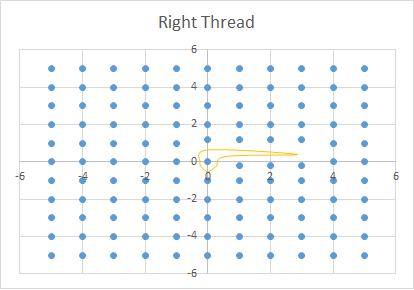
So what we need to propose is a model for our defects. It’s interesting to consider the defect to be a self-repellant loop that gets pinned to a node in the dark energy lattice. Now the lattice is going to tend to corral the expansion of the loop along a particular axis. The energy driving the expansion will eventually be spent in pushing the dark energy particles apart. We can imagine thus that the loop will oscillate back and forth, as indicated below with “right” and “mid” views. We can imagine the “left” configuration by rotating the “right” configuration through half a circle.

Right Thread
Mid Thread

Now let’s suppose that each point in the lattice can anchor up to two loops. How this is feasible is open to exploration. One way is for the dark energy to have structure itself. For example, it might be a little circle. Now there will be oscillation patterns that will minimize the interaction between the two threads. One possible pattern is shown below (the lattice is suppressed so that we can focus on the loop configurations).

Two-Thread Oscillations

We see that when one loop is clustered near the center, the other is extended. What is most important, however, is that when the sequence is followed clockwise, the pattern rotates clockwise. Reading in the reverse order reveals a counter-clockwise rotation. So this is a model for the top-like “spin” that was described earlier.

(NB: This is a terrible model of intrinsic angular momentum. A more fertile approach is to think about normal angular momentum, which arises when interacting particles are offset along the axis of approach. We then see that normal angular momentum is discretized in the lattice, because the offsets are discretized.

How is normal angular momentum conserved? Well, the model proposes that gravitation, electromagnetism and the strong interactions are all generated through the efforts of the lattice to minimize distortions. The specific character of each force reflects the degree to which a configuration of loops generates lattice distortion.

So angular momentum is conserved because the approach of the particles stores a particular type of distortion in the lattice that is released when they separate. Intrinsic angular momentum may be accommodated better by recognizing that the odd shape of the loop projections can be removed by offsetting the center of the oscillation by half a lattice point.)

Now the configuration with two loops should be fairly stable – it affects both directions equally, and so shouldn’t create too much disruption when moved. However, the configuration with one loop will tend to whip around when it moves, maybe even causing the lattice to be re-oriented locally. Given our discussion of mass, it would appear that asymmetric particles (one loop in our example) will have larger masses (disturb the lattice more when moving) than symmetric configurations (two loops in our example).

One way to minimize the impact of the asymmetric configuration might be to couple them together. This would localize the impact of the thrashing around at large distances, at least if the asymmetric configurations were synchronized in their oscillations. This models the strong force, which binds fractionally charged particles inside the proton and neutron.

Yes: what I’m suggesting is that the loops correspond to particle charges. In our two-dimensional model, only three charge states are allowed (with 0, 1 or 2 threads), because only two directions are available for oscillation. In our universe, we have three dimensions, and so four charge states are possible. This is precisely what we see in the particle zoo, and the asymmetric particles (with fractional charges: the up and down quarks, for example) have much higher masses than the symmetric particles (the neutrino and electron).

Adding a symmetric particle to a pairing of asymmetric particles might further stabilize the lattice. This is analogous to an electron bonding to a proton.

Now let’s tear our understanding of reality completely wide open: why should the loops be constrained to be bound to the dark energy lattice? What if they were able to form structures among themselves, structures that stored energy in the lattice by causing it to expand in their vicinity? Structures that could contain and process information? Structures that might even be able to open holes in the lattice that would allow particles to travel faster than the speed of light?

That’s the spirit, people.

I hope that you’re taking mind. Our brains are only interfaces to these structures. Our souls are the eternal part of us, bonding again and again to matter through our multiple lives, and using those opportunities to do a certain work on themselves.

Now I beg you, please read The Soul Comes First. While selfish configurations of spirit tend to dissipate the energy stored in the dark energy lattice, mutually supportive configurations have stored up an enormous amount of energy over time. They impose certain rules, and a failure to comply led to the destruction of the dinosaurs.

I believe in love, and I believe that at least a portion of humanity has enough maturity to master our baser urges. The Book of Revelation teaches that they will complete the work that was put before us in “Eden”. But I would like us to work efficiently to ensure that the predators, in their trashing about as they go down, are not allowed to do too much damage to the innocent.

Shedding Light on Light Mysteries

In the last post, I identified correspondences between superfluid motion and the phenomenon that are described by the equations of quantum mechanics and special relativity. The discussion leads to the assumption that light is a disturbance in a cold – and therefore highly ordered (“crystal-like”) – sea of dark energy.

The illustration in that post showed a perfect lattice, but given what we know about the universe, we’d expect the dark energy lattice to be a little less regular. For example, we know from the Michelson-Morley experiment that dark energy is entrained with massive objects, which tend to be round. There’s an old adage about “pounding a round peg into a square hole” (or was it the other way around) that fits here: the distortion created by the spherical Earth requires accommodation from the rectangular lattice, which will introduce defects.

And then we have the early history of the universe: unless the universe was unfolded from a single location, dark energy will organize itself locally, just as we see in crystals formed in solution. Here’s a picture of insulin crystals:

Insulin crystals grown in solution
Now obviously as these crystals grow to fill in the volume, there’s going to be some places where they don’t fit together nicely, which is going to leave defects in the final mass. So it would happen with the dark energy lattice.

What would we expect to happen when light encounters such a defect? Well, a reasonable analogy is what happens when a water wave encounters a rock. While most of the wave will continue around the rock, ripples will be cast off all around.

Do we see evidence of this in our study of the universe? Well, yes we do. First of all is the cosmic microwave background. But there’s more than than. Recent studies reveal that there is too much light coming from the empty space between galaxies (see Galaxies Aren’t Bright Enough). Astronomers originally assumed that the light had to come from early sources (back around the “Big Bang”, which I think is hokum), but that early light should should be “stretched”, and therefore redder than it is. So the light must be coming from modern sources. Without any other proof, astronomers suppose that there must be many stars between galaxies.

In the lattice model, the cosmic microwave background and extra light between galaxies actually go together: if light is scattered by dark energy, it will lose a little bit of its energy (perhaps into microwaves) and change its direction. Therefore, some of the light coming from a distant galaxy will appear to have originated from empty space, and space will seem to be filled with microwaves.

Finally, the loss of energy from scattering in the lattice explains why light emitted from distant galaxies appears redder than light from nearer galaxies. In current theory, this is explained as due to the relativistic Doppler effect (similar to what we experience when a car passes us with its horn blaring, the pitch drops after the car passes us). But with the discovery of Dark Energy, other mechanisms may exist to explain this effect.

I will admit that the last two paragraphs are a “have you cake and eat it too” situation. If light from distant galaxies loses energy to scattering, it would be diffused as it passes, which would make the galaxies indistinct. But remember that the volume around galaxies is expected to have many more defects in the lattice than the intergalactic medium, which would cause stronger scattering in their vicinity. And when defects exist, radiation may also be emitted when the lattice reorganizes itself to close the defect. The point is that there is a whole set of new phenomena to consider when explaining astrophysical observations.

All this without needing to suppose a Big Bang at all.