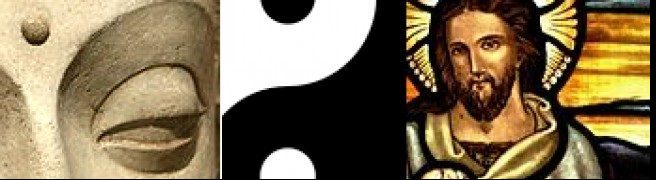
Miguel de Unamuno, considering the road from masculine frailty to faith, observed in Tragic Sense of Life that all men desire two things:
- To live forever.
- To rule the world.
The obvious paradox in these impulses is that most of us (myself being a man) attempt to accomplish the second by beating the crap out of other men – which tends to advance the interruption of our seeking after the first.
Work-arounds abound, the most obvious being to have a gun at the ready whenever an altercation arises. The subtlest is the use of psychological conditioning to get others to do the beating up for us. In totalitarian states, that conditioning takes the form of propaganda against imagined enemies, but is often joined with control over basic necessities. In democratic cultures, the conditioning is typically tied to unattainable visions of sexual conquest. When progeny ensue, hypersensitivity to their vulnerability often becomes the lever used to encourage financial exploitation of others.
Obviously in these systems there will be losers – a great many losers. The power of the impulses identified by Unamuno then manifests in a terrible perversion, expressed by a friend who asserted that the world would “know about him.” He testified ominously:
“Yeah, when a man has nothing to lose, there’s nothing he won’t do. And when the world learns about me, it will be nothing like anything that it’s ever seen before.”
I tried to lighten the air, offering that I knew what he meant, and that my sons were sometimes worried that I was going to just walk off and disappear. When he asked “You mean go live on the streets?” I replied, “No, probably they’d find me out someplace like the Amazon in Ecuador helping the indigenous people deal with the mess that Texaco left behind.”
Ah, the contradictory consequences revealed by Unamuno’s observation!
Some men lose everything, and seek to rule the lives of others by ending them, thus finding immortality in notoriety. I have nothing, and so claim this little piece of the blogosphere, writing about everything for almost nobody, and imagine conquering a little part of the world with a sponge and a squeegee. Some men fear the immigrant, and extrapolate our future against Europe’s tragedies where the Muslim population is ten times proportionately larger than ours. Accepting King’s dictum that “injustice anywhere is a threat to justice everywhere,” I embrace Muslim America as an opportunity for Islamic scholarship to rediscover and reassert the original message of Mohammed (pbuh), and any acts of violence as a cross to be born in conquering fear.
Unamuno’s defense of Christian faith was that we “create this God of love and eternal life by believing in him.” I see that as heresy: we don’t create him; we rather allow his virtues to manifest in our lives. In doing so, we learn to love ourselves and accept love from others, thereby obtaining dominion over the only part of the world that really matters: ourselves. In focusing that strength to the service of loving others, we lessen the burden of their resistance to our survival, and so enter more deeply into their world.
And for those that cannot learn – either those that lash out in violence or those that consume the innocent? What do they become in the end? Not themselves any longer – they become a headline in a newspaper. The history implicit in the personal “why” is lost. They become simply a “what”: 18 in San Bernardino. 49 people dead in Orlando. 3000 dead on 9/11. 47 million during World War II. Their personal history is consumed by the violence they created.
But men like Buddha – who renounced violence to bring a system of self-control to his people – or Jesus – who died to expose the hypocrisy of the military-religious complex – their names are enshrined in the hearts of those they have liberated. They live on in us.

 everdeepening
Here is the conundrum: If the “fantasy God” made a perfect world in which everything unfolded according to his will, then there would be nothing to love, because his will would be all. Since love requires an object to exist, the creation of such a universe would be a form of self-annihilation.
So we are granted the option to not heed the will of God – we are allowed our own free will. Unfortunately, many of us chose to play at being gods ourselves, and it is in imposing our will upon others that sin occurs.
The Christian proposition is that if we learn to submit ourselves in service to one another, we obtain access to enormous amounts of power. I won’t bother you with how that manifests in the New Testament – you’d simply assert that science disproves the possibility of the events that transpired. But to the person of faith, the healing accomplished by Jesus and the Apostles indicate that many ills that we suffer are not of God’s will. In fact, if we surrendered ourselves to the dictates of love as Jesus did, those ills would be unable to obtain purchase upon us.
So Rocket is right: we are misguided to refuse (or worse, misuse) the gift of love and then decry the consequences of its absence. And it is hypocrisy for Fry to say “God, you didn’t intervene to save the children!” when God created Fry and gave him wealth to so intervene. We were made in God’s image, which can be interpreted as “we are his intervention.”
And, given the huge amount of charitable work and giving provided by people of faith, to challenge faith is also counter-productive. The faithful understand that the world is imperfect. We simply choose to keep on giving, in part because we feel our hope sustained by the endless love that arises in our hearts.