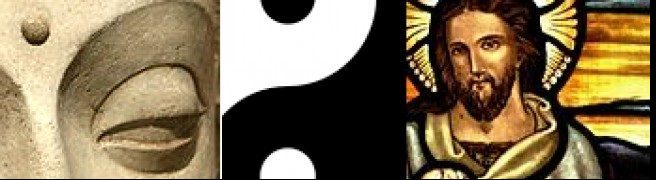
Christianity and Paganism

In response to this post in Gods and Radicals.


It is misguided to found any argument about the future of a spiritual tradition upon the success of political figures in corrupting Christianity.

All gods wish for their followers to worship only them, because it is through the acts of their followers that they are invested in the world. That investment long predates humanity – there were Neanderthal gods, and before them gods of mice and gods of dinosaurs. The problem facing humanity was to create a human god in the context of billions of years of predecessors. That is the project of monotheism – to create a god that manifests and supports the expression of humanity’s unique talents.

Now perhaps the essence of humanity’s talent is political organization, but I see it differently. Looking at our evolutionary success, I would argue that humanity is a manifestation of intelligence. For the original adherents (not those indoctrinated in service to the priests, which is a problem in any tradition), the attractive proposition of Christianity was that the divinity served humanity. Christianity is the original humanism – it is to assert that the human god should be a god of love, and serve all equally, without regard to station or industrial skill.

Obviously this is a reasonable proposition, and the power of the Church in the Roman world came not because of the allegiances that joined the interests of emperors and priests. Rather, it was because in the Roman context of utilitarian worship, the Church followed Christ’s edict of charity. The Church, though oppressed, took care of the orphans and widows, the sick and poor, and organized their gratitude to the service of others. When the Empire collapsed, the Church assumed control because they were the administrative and organizational backbone of Roman society.

I see paganism as a political act on the spiritual plane. Humanity, having succeeded in propagating the tyranny of utilitarianism through the application of intelligence, is confronting the fact that it is destroying the fundament of its own existence. It needs to think about all of those forgotten gods. It needs to infect them with rational understanding, and engage them in expression of mutual support. In other words, Humanity needs to join in loving the world, rather than just itself.

This is a difficult pivot. Our religions are still infected by expressions of our physical vulnerability: as an illustration, the vulnerability of a child whose cave is invaded by the saber-tooth cat while father and mother are away. Many people still live in circumstances of vulnerability, although the predators are no longer other species, but rather politically powerful people.

Jesus preached that the meek will inherit the earth. As a reaction against abusive political structures, I see paganism as furthering that goal.

Welcoming the Light of Love

Stephen Harrod Buhner closes The Lost Language of Plants just as I would have hoped. After recounting a healing session with a young lady, the book closes with four autobiographic sketches, each by a herbologist recounting immersion in biophilia. Left behind are the recriminations and the tone of moral superiority that marred the preceding chapters. Each of the writers focuses on the opportunity before us now – an opportunity to call into being relationships built around affirmations of love shared with the world around us.

As the book progressed, lunging between the yin and yang of natural and industrial chemistry, I found myself remembering my experiences of being stalked by predators. One was at a Webelos overnighter, of all things, at Camp Whitsett in the Southern Sierras. A Native American elder inducted a number of the senior scouts in a fire ceremony. As the ceremony progressed, I had a strong sense of the bear in the man, and felt the fire of predation building in the camp as the boys settled in to sleep. Rather than hiding from it, I let it enter into my heart, sent my will into the forest to demonstrate that no bears were present, and then breathed peace into the space I had cleared. The fear resided, and the camp settled into slumber. Several years later, I was driving home from work on Friday night, knowing that my youngest son had been sent to the Sierras on a camping trip, and felt the bear again in his presence. I sent the warning “Wake up, Gregory! Get Mr. Povah!” When he returned that Sunday, I learned that on Saturday morning, he had woken early, and heard a noise as Mr. Povah’s son Braden was dragged away from the camp by a black bear. The onrush of shouting campers scared the bear off, and Braden survived with only a bruised ankle.

Given his immersion in the natural world, I doubt that Buhner has not had similar experiences. But perhaps not – he has been chosen by the world of chlorophyll, the deep, patient source of renewal. That touches the animal realm through the herbivores, an intimate co-creative process that Buhner documents in loving detail. But the animal kingdom has another dimension as well: in Love Works, I enumerate the rites of blood – sex, maternity, the hunt and sacrifice. Each of these has its unique pathologies, and the fragility of animal existence means that those pressures are often driven into fear and rage.

In Dune, the great science-fiction author Frank Herbert advances the Bene Gesserit Litany against Fear:

I must not fear. Fear is the mind-killer. Fear is the little-death that brings total obliteration. I will face my fear. I will permit it to pass over me and through me. And when it has gone past I will turn the inner eye to see its path. Where the fear has gone there will be nothing. Only I will remain.

It was this discipline that I exercised in Camp Whitsett. It is the discipline of the rational mind, a discipline that safeguards our ability to perceive clearly and so to exercise our intelligence when facing circumstances that our natural talents could never hope to overcome. It is to perceive the forces in play with the aim of negotiating a win-win outcome when the predator’s zero-sum mentality holds sway.

As I finished the life sketches that close The Lost Language of Plants, I was filled with the desire to find these people and join forces with them. A great barrier arose, followed by a vision and memory. Buhner shares the plant kingdom’s experience of light, that great source of love that originates from the sun and desires to merge with us through them. But when discussing with my sister the ecological disasters that will confront our children, I told her,

This is how we heal the world: by teaching the plants not simply to receive passively the light, but to reach up to the sun and guide its power to rebuild the devastated forests and savannahs.

This may seem like a little thing, but to accomplish it we have to convince them to surrender the conventions of the chemistry that Buhner celebrates so tenderly. It is to recognize that it is not the plant that is important, but the spiritual transformation that gives courage to the fearful through its physical manifestations.

Buhner touches on this metaphorically in describing his healing work. He testifies that he meets people that are missing parts, and is guided by visions of plants that can fill those voids. It is in establishing those relationships that healing arrives, through an expansion of spirit that occurs when our hollowness is filled.

I spent the rest of the day struggling with the grief that filled me then.

It has two parts. The first is that the plant is only an intermediary – it is a reservoir in which love gathers, but it is not the source itself. It was the source that disciplined me, forcing me stand apart until people realize that all intermediaries are imperfect. Secondly: in that place apart we are beset by those that would ravage the gardens that Buhner and his peers create. We plant the seeds of knowledge, and watch as they are corrupted by the predators. We heal the wounded, and set them again into the world, hoping that each time the light of love reaches more deeply into them.

It is hard to be told that our path has led us into evil. I wish that Buhner could see that scientific reductionism is a means of removing the primitive triggers of predation from the world. Yes, it has gone too far, but it has also created the field in which he and his friends plant their garden.

Lest we wish to repeat the experience of Eden, we must leave recrimination behind. I take solace that in his closing Buhner celebrates the light of love that will ultimately unite us all.

Revelation Abuse

I spend a lot of time managing fear and anger – not my own, but the fear and anger that people project into me. One of the principal reasons for writing The Soul Comes First was to deal with the Book of Revelation, which contains murky and frightening imagery that allows psychopaths to manipulate victims by linking fear to the promise of redemption that emanates from the Cross.

An example of the consequences of such manipulation is organized criminality in the  guise of religion, where “leaders” of inspirational movements demand that their “flock” emulate the early church, surrendering their worldly assets for management by the “community.” You can be assured that those at the top live in luxury, while the “flock” scrapes by in poverty.

So, while I would love for people to read the book, let me summarize the main points regarding Revelation. The most important is that John’s experience of the angelic realm should be interpreted as the experience of someone following links on Wikipedia. The flow of events is not strictly linear, and John tends to emphasize events on Earth that are sometimes tangential.

  • The seals were opened billions of years ago. The six symbols seen by John are not manifestations of God’s glory, but manifestations of selfishness: domination, infestation, opportunism, death, vengeance and fury. They are released onto the Earth so that their captives can work themselves free through the process of living.
  • The 144,000 were spirits gathered (billions of years ago) not from the tribes of Israel themselves but from the angels that became the patrons of the tribes of Israel. The are sent down to Earth to facilitate the liberation of the captives.
  • The trumpets correspond powerfully with the facts that paleontology has revealed regarding the great extinction episodes over the last billion years.
  • The Age of Man does not begin until the angel stands with one foot on the shore and one in the sea.
  • The beast with the number ‘666’ represents the spiritual collective that arose on the sixth day of creation, which is not Man, but the mammals.
  • The bowls represent the consequences of our exploitation of the resources that we were told to harvest. Those consequences are coming to full force right now in the modern age.

One of the great and marvelous consequences of the love that emanates from God is that it empowers us to grasp the truth, and moreover to move with confidence and determination to respond to the demands it makes upon our compassion.

Please share this with anyone that you know to have been trapped in fear through manipulation of the teachings of the Book of Revelation.

Discovering Love in a Secular World

My public authorship was initiated after rereading the Bible from the perspective of the angels. This has led me into deep philosophical and theological waters – “ever deepening”, naturally.

Having made a conscious decision to attempt to ground myself in human experience, I found myself at a spirituality book store in Santa Monica. That day, I found two books calling to me: Sera Beak’s Red, Hot and Holy, the subject of several blog posts at the end of last month. While that itself became pretty cosmic, Sera’s honest celebration of sex has helped me to ground myself physically.

The second book was Spickard and Cragg’s A Global History of Christians. I must admit to feeling a little let down by the book. The subtitle reads “How Everyday Believers Experienced Their World.” From that, I was expecting something along the lines of Tolstoy’s experience. Having become disillusioned with sophisticated Russian society, Tolstoy retired to his country estate, where he awakened to faith not through the erudite ministry of the priests, but in seeing how the peasants drew upon Christian teaching to build relationships grounded in decency.

Two hundred pages in, however, it is pretty obvious that the book’s title should have been A Global History of Churches. The book focuses on the dissemination and transformation of institutions and dogmas. In the sense that Christianity was the foundation of Europe’s social contract from 500 to 1900 or so, the title may be forgiven. The way that people saw themselves in relation to their neighbors and government was largely determined by their Church. But the book does not actually delve into the details of their lives to reveal how Christians differed from non-Christians in their behaviors, nor how their behavior was influenced by the evolution of Church teaching.

The book does chart the role of theology in the formation of ideas of the self, mostly through the reflections of theologians concerned with the problem of sin. This leaves a huge psychological gap. I found myself, when considering the appeal of Christianity as an adult, to be profoundly moved by the idea of a God that did not demand sacrifice from worshippers, but rather remembrance for the sacrifice of a brother made in honor of a loving Father. How did this idea impact those living under the rule of Roman patriarchal impunity? I have this strong prejudice that Jesus’s example should have caused many to question and seek to improve unfulfilling relationships, and was hoping to discover answers to this and related questions in the historical survey.

The focus on redemption leads to a different set of questions, with a somewhat narcissistic tone. How do I achieve salvation? What causes me to sin? The common (anthropocentric) reading of the Garden of Eden is ultimately revealed as a caricature of human nature. We were not created in grace to fall into sin. We represent an evolutionary waypoint in a long and difficult process. Perhaps secularism – rejecting the baggage of institutional dogma – was required as a precondition for illumination of that process. Even if not necessary, we are yet today as Christians operating in a world that is preconditioned by the challenges of secularity – the idea that humanity can (or must at least try to) manage itself without recourse to God.

I must admit to being grateful for the historical background that makes apparent the extent of this dilemma. Stripping away the Biblical idea that we are defined by the necessity to achieve redemption from a fallen state, what does it mean to be human? The authors present four modern answers to this problem: Darwin, who held that we are the product of natural competitive forces experienced by all living creatures; Marx, who recognized that culture has created an entirely artificial competitive environment that is propagated not through genetics but social indoctrination; Freud, who identified the enormous challenge of raising our indoctrination from the depths of our subconscious into the light of rational analysis; and the existential philosophers led by Sartre, who championed the goal and practices of self-realization. In its full expression, then, secularism adopts the posture that to be human is to struggle for self-identity against the resistance of other wills.

The Christian response to these thinkers is characterized with reference to three theologians. Tillich elaborated an accommodation of secular thought, in heralding Jesus as the exemplar of self realization. Barth elaborates rejection in asserting that the secular project is doomed because we cannot overcome the bias of our imperfect and fallen perceptions – we require the aid of an eternal, all-loving God. Finally, Niebuhr saw secularism as a prism which could be used to refine our understanding of Biblical metaphors that reveal the strength found in a relationship with the Divine Presence.

All of these men were impressively learned Christian scholars, but as I considered their theology, a single image completely demolished their relevance: the image of a mother nursing a child. I can see where the difficulty arises: Jesus commands “Love the Lord your God with all your heart and with all your soul and with all your mind,” with the prequel somehow elided: “As God seeks to love you…” Thus the image of the bond between the nursing mother and child. A bond of complete trust: unconditional donation of the mother’s self, and from the infant unguarded gratitude for the gift of sustenance.

And so it all seems terribly simple to me: the agency of love in our lives is to give us strength. Who in their right mind would ever choose to reject it? Jesus made it clear, not least in the parable of the prodigal son, that no sin is beyond redemption – all we have to do is turn to God for acceptance and receive gratefully the cloak of his authority.

Of course, the commandment continues “Love your neighbor as yourself.” As loving God allows us to receive God’s love, so we should share the love of God with others. In fact, to sin is to deny love to others. The only measure of the degree to which we have received God’s love, then, is the witness of those that we are given to love. When love has worked its way through us, its power flows through us without resistance to serve others. In love, we both facilitate and stand in guard of each other’s perfection.

As I see it, then, the proposition of Christianity in a secular world is: try to be yourself, and then see what happens when you chose instead the mutuality of love. The power that awaits you there is beyond mere human comprehension.

T-Shirt Heaven

I prepared an experiment last week by creating some t-shirts that tried to explain what is going on with the energy that surrounds me. It was pretty much an act of desperation. I accepted long ago that when you send love out into the world, you surrender control over what is done with it.

In the specific context of the dance celebrations that I enjoy so much, what happens is that people channel it into sex. I’ve gotten to be much better, over the years, at controlling the reflection of that corrupted energy, but it’s been pretty exhausting. The political consequences are also disruptive to my life. A lot of men are visibly angry when I come into a club and start dancing by myself while the women stare in wonder at me. My son shared with me once that his female friends described it as “like discovering fire.” I kept on hoping that the men would be inspired by the beauty that wells up in a woman when she encounters a man that doesn’t want to dump poison into her, but in most cases the male reaction is rather to try and beat me down.

I thought that I was going to have to postpone the first trial this Sunday. I’ve been shifting energy in my yoga practice. It started three weeks ago when I held balancing stick posture beyond my normal point of collapse, and I felt energy emanating from my root Chaka and flushing up along my obliques, the wave cresting just under my ribs where the nerves erupted in burning. I knew that I had displaced something, and it manifested more recently in vertigo focused on the right side of my head. It was different from the normal cochlear vertigo (stimulated by a trapped air bubble), and finally shifted to the top of my head, directly over my foremen. I was a little panicked by that change, and was relieved when one of the ladies in class reassured me that “It’s just trying to work its way out.”

But with my obliques fully active, I’ve been building strength in them, which has led to stiffness in the area. That culminated on Saturday when I strained my right side during standing head-to-knee posture.

I wasn’t sure that I could actually dance – I could barely get in and out of the car on Sunday morning – but I went down to Culver City anyways. When an acquaintance asked me how I was doing, I explained my situation, and he jumped right in, rubbing, pulling, and massaging the right side of my back from hip to shoulder. I didn’t realize how much blockage I was dealing with, and when he was done, I was far looser that when he started.

So I went in to change and came out with my t-shirt on. He approached me almost immediately, sharing that he was an engineer and offering where he had heard similar thoughts. It was the first meaningful conversation that I have had in that community.

But what was most amazing was that people didn’t struggle against the energy that I organize when I dance. This was most evident in a young Filipina. She caught my attention, and we kind of skirted each other for a while. When I left the center of the room to rest against the stage, she took up the space I had vacated and began waving her arms gracefully in the energy there. Surprised, I pointed my finger to push energy into her heart, stilled the sexual response that came back, and then connected her cerebral cortex to the community of thoughts that was celebrating her courage.

When I had done this in the past, one among a group of men always approaches the woman to steal the gift from her. This happened next, and this lady just ignored him, staying focused on her dance. Finally, she turned to me, building a ball of energy in the air with her right hand, and pushed it back my way.

There was more – much more – and some of it wandered down the familiar pathways to sex. But as I laid Sunday evening on the couch trying to relax my abused muscles, I felt this great glow of energy enter my heart through the channel of the world. I’ve just kept on sending this message out: “Don’t focus on me. I don’t need more of it. Look rather into the world, and liberate people into the healing of it. It’s from there that the energy is magnified.”

Trying to Make It Simple

I’ve been struggling with misinterpretations of the energy I project, so I designed and ordered this t-shirt this morning.

T-Shirt FrontT-Shirt Back

The text on the back says:

Love’s infinite possibilities
Are beyond our control.
But let it pass through us
To the people and places we love
And it returns to us multiplied
Every single day.

To those that have faced disappointment in love: there is no discipline more difficult than to let it pass through us, rather than trying to force it to go where it does not find a home.

What is Evil?

This is a response to this post by Insanity Bytes on “There’s this Thing Called Biology”:


IB:

This is a terribly complex problem, but fundamentally, I see it this way: love (which is God) enters into all things, because everything desires the power that it offers (the essence of loving is to offer power). But that power comes with constraints – love will abandon us if we hurt others. So love turns everything to its purpose, which is loving. To preserve their identity, the things that love embraces will do terrible things to push it away.

You began your post with a meditation on dysfunctionality in relationships. Often, that is what I see going on: people struggling for control against the dictates of love.

Jesus taught on many occasions about this struggle: the parable of the talents, the exhortation to “die to yourselves.” He understood how difficult it was, confronting the surrender to Death in Gethsemane and pleading “take this cup away from me.” The reason it is hard is because the world is full of the pain of our attempts to assert ourselves over the needs of others. Rather than the graceful patience of accepting that “this is not my moment, but my moment will come”, we lash out in fear, seeking to make every moment our moment. Paradoxically, we only augment our suffering, because in that lashing out we drive love from us.

Jesus was confronted with the obligation to shoulder that burden, surrendering everything else to it. I don’t know if you’ve seen “The Green Mile”, but the jailed healer in the movie pleads in the end for death. He says that walking around in the world is like living with broken pieces of glass in your mind.

You allude to Christ as the solution to evil, but he is the “Prince of Peace” for a reason. Death separates our souls – we mourn the loss of those that loved us, and often celebrate the end of those that hurt us. But Death consumes us, stealing from us the memory of our lives. Jesus changed all that. He suffused Death with love, and so now has the power to say: “These two enemies need to be separated for the sake of peace.” So I don’t think that he sees anything as evil. He sees sickness that as a surgeon he has the power to heal.

Pope Francis, in reaction to his predecessors characterization of homosexuality as a sin, said “Who am I to judge?” As humans, we might recognize the existence of evil in the world – the presence of personalities so committed to themselves that they will never accept the dictates of love. But it is not our place to pass judgment on them. Jesus redeemed death when no other believed that it was possible. Until we enter fully into his mind, we should be cautious about casting people into the abyss, seeking instead to educate and heal.

I recognize your participation in that in your work. Thank-you.

Freedom from Government through the Governance of Love

In explaining the necessity of God in Tragic Sense of Life, the Jesuit philosopher Miguel de Unamuno asserts that it arises when every man, naturally desiring to control the world, confronts the inevitability of death. As the latter treads on our heels, even the most powerful are pressed to the conclusion that the only way to live forever is to embrace a God that loves us enough to grant us life.

Atheists are inclined by this logic to conclude that faith is a delusion. Marx certainly saw it that way, declaring that “religion is the opium of the masses.” But the underlying pressure is evidenced in the pronouncements of some technologists, among them the man I described yesterday who saw our digital sensors, networks and software as empowering us to build God. Others are more humble. At the ACM fiftieth anniversary symposium in 1997, Nathan Myhrvold, then chief architect at Microsoft, envisioned (somewhat playfully) a future in which we could escape death by creating digital simulations of our brains. The video skit included Bill Gates rubbing his chin as he thoughtfully considered the reduction in Microsoft’s benefits budget.

But if delusion is pathetic, oftentimes in the powerful avoidance is grotesque. We have Vladimir Putin, assassin of Russian patriots, proclaiming that Jesus will find no fault with him on Judgment Day. Or the effrontery of Donald Trump who, protected by his army of lawyers, knows that so long as he asserts righteousness, no one has the means to contradict his claims of competency and benevolence. Thus he continues to assert – in contradiction of the actual birth certificate – that his lawyers have compelling evidence to reveal regarding President Obama’s citizenship. Both of these men suffer from the same affliction, the tendency of our bodies to respond to successful acts of aggression by manufacturing more and more testosterone, the chemical driver for aggression. This is a positive feedback loop that was broken only by death in the cases of Hitler, Franco, Mao, Stalin, Kim Yung Un and so many other tyrants. In the prelude, millions of people were sacrificed on the altars of their psychological invincibility.

This dynamic is writ small in the lives of many businesses, congregations and families. People addicted to the rush of adrenaline and the power of testosterone manufacture experiences that stimulate their production. This is why it is said “absolute power corrupts absolutely.” The desire for power arises from the biological thrill of success, and to continue to receive that thrill, the addict must continue to risk his power in ever greater contests. In the heat of passion, the suffering visited upon others is ignored.

There are three antidotes to this dynamic. The first is popular rebellion. Paradoxically, this is the very force that pushed Putin and Trump to prominence. At a stump speech yesterday, Trump opened the floor to questions, and the first person to the microphone began to rant hatefully about President Obama and an imagined domestic Muslim threat. Trump did not defuse the situation, instead responding “We need to hear this question!” But often rebellion is merely another manifestation of the drive to power. Unless tempered, it rages out of control, as happened in the Jacobian tyranny following the French Revolution.

The second antidote is reason. Reason builds discipline that forces us to reconcile our actions with their consequences, thereby disciplining our aggression with objective evidence of failure. The tension between reason and will is not just moral, however: heightened levels of adrenaline actually degrade the higher thinking centers of the brain. This creates a terribly contradictory dynamic, perhaps manifesting itself in the fact that most academics do their greatest work in their youth. While testosterone serves the reasoning mind in creating the thirst to conquer and claim ideas, as the successful mind expands, so do levels of testosterone and adrenaline, which destroys the power of reason. In that context, the methods used to sustain power are not as brutal as those used by the social tyrant, but have their own unique form of cruelty, and leave lasting scars on the psyche. Isaac Newton, cheated of credit for a scientific insight by his predecessor as head of the Royal Academy of Sciences, had the satisfaction of burning the man’s portrait. Most victims of intellectual tyranny are consigned to obscurity.

It is natural for supporters to gather around the social or intellectual tyrant during his rise to power. Claiming benevolent intention is a great way of rallying support from the oppressed. Unfortunately, this dictum holds: A man will change his beliefs before he will change his behavior. When that behavior is organized around aggression, enemies must be created when there are none left at hand. All tyrants eventually turn on their lieutenants, often using hallucinatory rhetoric to justify their actions.

A peer once offered to me that all the greatest scientists were lovers of humanity. This brings us to the third antidote: love. This arrives upon us through many pathways. It can be through sex and maternity. It can be when an infant first grasps our forefinger. It can be through service to those in want. In those moments a bond is established, a linkage that makes palpable the suffering we visit upon others. That can be rationalized in material terms: tears on a beloved face or cries of shame are evidence of our failure. That breaks the vicious cycle of success and aggression.

But there is another aspect that goes beyond negative feedback. Aggression stimulates the loins and the mind, but barely touches the heart. Exchanging love with someone just feels good. It opens us up to a world of experience that can be touched in no other way. Ultimately, its rewards are far greater because no one that loves themselves objects to being loved. They do not turn on their friends for satisfaction, because their friends offer them satisfaction every day.

Democracy attempts to combat the urge to power by institutionalizing rebellion. In America, the two Presidents that were awarded most authority were George Washington, who gracefully surrendered power after two terms of service following universal acclamation by the Electoral College, and FDR, who literally worked himself to death through four terms in office. Both those men were governed by a sense of duty and love for their country, a commitment affirmed by the popular voice that is expressed in elections. At the end of the 20th century, those that seek the freedom to act always as they please (the ultimate manifestation of power) responded to electoral constraint by attacking our faith in government. Driven by testosterone and thus unable to govern themselves, they have invested huge amounts of money creating personalities such as Newt Gingrich, Rush Limbaugh and Bill O’Reilly. As visible in the Oklahoma City bombing and the events surrounding the Republican nominating process, the end result has been to stimulate the resort to violence by others.

Thus we have the wisdom of Jesus: “Render unto Caesar those things that are Caesar’s.” We have the promise of Jeremiah: “For I will write my law on their hearts, and no man will be told ‘Come learn about my God’, because all will know me.” And we have Christ’s summation of the Jewish experience with law (the rule of reason) and governmental control: Love God and your neighbor.

It is through self-regulation that we discover truth and peace[NIV Matt. 7:13-14]:

Enter through the narrow gate. For wide is the gate and broad is the road that leads to destruction, and many enter through it. But small is the gate and narrow the road that leads to life, and only a few find it.

But what other government would we choose, except the governance of our hearts? And to what other authority would be choose to submit, other than the authority of compassion in another? Why do we delude ourselves that there is any other way?

Love Doesn’t Do Anything

It undoes things.

It washes away dirt and fear to reveal the world as it hopes to be.


When I was working as a Post-Doc, my friend Laurent Terray discovered Yoshi’s bar down in Oakland. Yoshi’s was an intimate club that drew jazz headliners such as Dizzy Gillespie.

Laurent dragged me down one night to hear a trio play – guitar, keyboard and percussion. I found myself drawn to the back wall where I could see all three pairs of hands at once. The music entered a timeless realm, the air resonated with beauty.

During intermission, I was chatting with Laurent when the guitarist came up and laid his instrument on the chair in front of me. I didn’t know what to make of it. Finally a young man came up and, looking a little scandalized, took the guitar and walked off with it.

I just didn’t understand, then, how much people crave to be looked upon with kindness. It heightens every experience.

Be good to each other. It allows light into the world.

The Trust Mind

Hundreds of years before the life of Jesus of Nazareth, the mystics of Greek Hellenismos understood Humanity’s spiritual development as a growth into engagement with certain fundamental natural forces. Aphrodite, for example, was represented as a beautiful woman, but as a god mediated between humanity and the force of attraction, which manifests as much in gravitation as it does in sensual desire. Following the era of the Titans and Olympians, the aim of the mystics was to usher in the age of Dionysius, allowing men to interact directly with the principles. In other words, for us to become gods.

When this truth was first revealed to me, the speaker admitted that in the modern era, we view Dionysius, the “party god”, as an unlikely avatar. We view alcohol as a vice, but the Greeks saw it as a tool. When we are drunk, we “lose our inhibitions.” That may manifest itself in a tendency to orgy, but at a deep spiritual level reflects the loosening of the protective barriers around our souls. We surrender ourselves to trust, and so relate more freely and deeply than we would otherwise. (See this post by Irwin Osbourne for more on this experience.)

The power of this relation can be abused. Megalomania is one pathology. In “Ray”, the film biography of Ray Charles, one scene reconstructs a set in which a horn player stands up to take an impromptu solo in the middle of a number. The man was dismissed, not because he violated the integrity of the rendition, but because Ray recognized intuitively that the man was on heroin. Accused of hypocrisy, Charles’s retort was that he had to be the only one. A second pathology is dependency. In graduate school, a friend shared his experience of a teacher who drank incessantly, and actually could do chemistry well only in that state. It took me a while to figure out how to suggest that maybe the teacher wasn’t doing the thinking at all – that the alcohol enabled him to inject himself into a community of minds that tolerated his needs.

There are other methods to achieve this integration. A young woman can be almost suicidal in her disposition to trust the men that she desires, and when that is manifested in sexual license, she may serve as the pool in which men join. Junger’s book “War” documents the characteristics of men that survive constant threat only by surrendering themselves to trust in each other.

There is enormous power in such melding, but the methods listed above cannot be sustained by our physiology. The licentious woman becomes corrupted by masculine demons, and loses her beauty. Substance abuse drives our metabolism into pathways that destroy our health. And war is a process that no one escapes without harm, even if it is hidden deep in the soul behind a stoic mask.

It is for this reason that everdeepening.org opens with this statement:

Love dissolves the barriers of time and space, allowing wisdom, energy and understanding to flow between us, and embracing us with the courage, clarity and calm that overcomes obstacles and creates opportunities. When we open our hearts to one another, there is no truth that is not revealed, and to those that love themselves, no impulse to harm that cannot be turned to the purposes of healing and creation.

As a Christian, I see the ultimate human manifestation of this truth in the march of Jesus of Nazareth to the cross. And behind that sacrifice, I must see the yearnings of a perfect and unconditional love that invests itself in the realization of that truth in our lives.

But when picking up the Bible, it doesn’t take long to reach contradictory evidence. Taking Eden as a metaphor for a relationship of trust between the source of love and humanity, that trust is corrupted by the serpent, which appeals fundamentally to human selfishness. In God, we were gods, but Eve is encouraged [NIV Gen. 3:5] to “be like God, knowing good an evil.” For this breach of trust, Adam and Eve are dismissed from the garden, and punishments are heaped upon them.

What was so heinous about their crime? Was it worse than the slaying of Abel, for which Cain was allowed a lifetime of repentance? And what is so important about us that God would give Jesus as a sacrifice to the goal of our redemption?

To understand this, we have to understand the nature of thought. We have succumbed in the modern age to scientific materialism, and so hold that thought occurs in the brain. I know this not to be true: I relate frequently to thinking beings that have no bodies and no brains, and so must recognize that my brain is merely an interface to my soul. To facilitate the expression of will through my body, the operation of the brain must correlate completely with the thinking done by my spirit.

Thus I interpret “In the image of God he created them” [NIV Gen. 1:27] in this way: our bodies are a tool through which we manifest the will of our souls and – given the quote above – they operate most effectively when used to express love.

The problem is that every interface is a two-way street. While through our commitment to creative expression, we can bring truth and beauty into the world, the opposite can occur. In the experience of pain and suffering, we project thoughts back into God. In the expression of greed and lust, we corrupt the purity of love. This is articulated many times in the Bible: consider Noah, Exodus and Ezekiel. Rather than being remote and impervious, God suffers from our wrong-doing. The flood is thus a desperate move to rid himself of the irritation, as is the destruction of the Holy City through the witness of Ezekiel. While horrifying to us as humans, we might imagine that so must the bacterium feel when confronting the operation of the immune system.

The error of the Law is to interpret these actions as a judgment, as an evidence of sin. They are not. The effect is to destroy the material manifestations of the success of selfishness, revealing its sterility. They are actions taken to frustrate selfish personalities that attempt to prevent love from liberating and healing their abused captives.

This is “The Knowledge of Good and Evil” that brings death into the world. Lacking appreciation of the virtues of love, we chose not to trust in love. We demanded understanding. But understanding is gained only through experience, and experience requires expression of both good and evil. We are educating ourselves.

In the end, Christ gathers those that chose good into the fold of the perfect love that originates from the divine source. We join our shared memory and wisdom into a single holy mind, and heal the world of the disease of selfishness. Thus I do not interpret the Crucifixion as atonement for our sins. Rather, I believe it should be seen as a surrender to trust in love, a struggle waged most fiercely in the Garden of Gethsemane, and redeemed by the proof of the power of love in the Resurrection. Rather than an indictment of our frailty, it is meant to be an exhortation to manifest our own forms of greatness.

Trust in yourselves. Trust in love. Welcome yourselves into the Holy Spirit, the mind formed when that trust is perfected in us.