Science, by modern convention, is concerned with what is measurable and repeatable. God does not sit up and roll over on command. Any contradictory statement is proof of dyslexia.


Home » Articles posted by Brian Balke
Science, by modern convention, is concerned with what is measurable and repeatable. God does not sit up and roll over on command. Any contradictory statement is proof of dyslexia.
One of the artistic expressions available in the management of value is emotional tone. The instructor in the course that I follow exhorts us to do geometric studies using only three values from our scale, starting on the light end and progressing to the dark.
The dark end, of course, demands charcoal. I admit to being intimidated by the mess associated with the medium. Experiments with printer paper revealed that blending with stumps grinds it down, making it a challenge to lighten. Once the stumps are loaded with charcoal, they tend to smear darkness when used elsewhere, created a mass.
So, I avoided the medium.
After the graphite sketch of the girl with the coffee cup, I bought a fresh set of tortillons and stumps and segregated them into plastic bags for dedicated use with different media. Then I found a night-time portrait and began throwing down charcoal.
The result is shown here. The process was fascinating. With high-quality paper and clean tools, I found myself refining details by pushing the charcoal around before lifting it away with various types of erasers. The process produced happy accidents like the radiation around the hairline and the light/dark juxtaposition of the jacket pockets.

The source image was a glamor shot outside a nightclub or casino. The model sported wire-rim glasses. Dropping into a darker tone and abandoning the glasses, the image expresses a kind of grim determination that is sympathetic to my personal journey of service to humanity’s redemption.
The human figure is intimidating in the subtlety of its dance with light. From geometrical forms, this study begins to grapple with that challenge. Taken from a photo, the principle compositional challenges were already addressed in by the photographer (although I did crop the setting). In particular, the lid of the coffee cup that provides some ballast against the darkness in the upper left.
This study followed the construction of a ten-step grey scale using graphite, willow sticks, and charcoal. In trying to achieve smooth fields, I loaded up my supply of paper blending sticks (tortillons and stumps) with graphite and charcoal. I tried cleaning them against a sanding block, with limited success. This study, then, was done only with pencil and eraser. This frustrated my ability to achieve uniform and graduated transitions in tone.

Still, from a distance, the rendering is tender. Most challenging was actually the curly hair and its highlights. This could only be rendered approximately, but I feel that I achieved some success. This had to be balanced against the scarf, which has its own fascinations. The heightened tonal contrast in the face and eyes (I hope, at any rate) sustains the subject as the focus.
One of the challenges of value is a sensitive handling of shadow. The video series instructor breaks light intensity into nine categories, including light reflected off the setting onto the object, the effect of that light on the object’s cast shadow, and deepening of the object shadow due to the lack of light from the setting where the cast shadow falls.
To facilitate understanding of these interactions in a natural setting, architectural studies are recommended. This gave me an excuse to visit the Getty Santa Monica for in what seems like forever.
Culturally, the visit was a disappointment. In hard winter, many of the galleries close to prepare exhibitions for the Spring season. Arriving in mid-morning, many of the nooks that I had planned to settle in were in full shadow, so I ended up settling by the rock fountain on the main plaza.
As I sketched happily, using an HB graphite pencil on printer paper, a couple attempted to interrupt my work. I engaged them while continuing to sketch, realizing only after they had left that she was an art instructor. She was offended by my report that I was following an online video course. In retrospect, I was irritated that she took the chance encounter on the plaza to attempt to recruit me as a student.
At the end of the day, I returned to the back side of the fountain and took the source photo for this study. The semi-gloss surface of the arcade’s stone was ideal for the purpose. Visual interest focuses on the pair of shoes and reflected legs in the upper right.
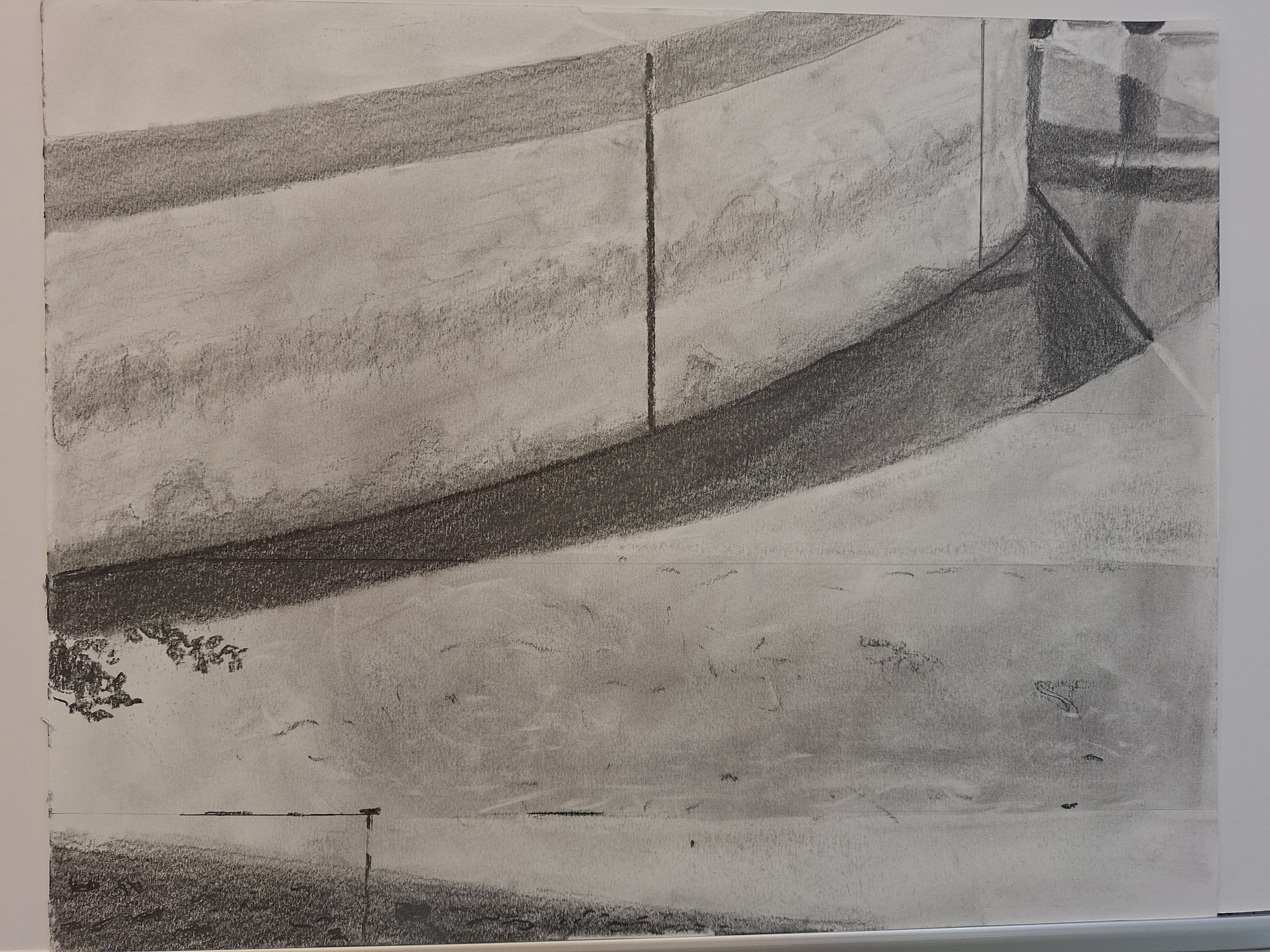
I started with a graphite powder wash, but realized that it hid the slab breaks in the foreground. Graphite powder is hard to remove, so I scrubbed with an eraser, leaving the middle slab in the foreground. This yielded speckling in the slab above it – a pleasant surprise.
All of the curves were done free-hand. The straight lines were done with pencil or eraser against a ruler
My perceptions of reality are focused on cultivation of loving engagements. That has its downsides: self-destructive people try to coerce me into solving their problems for them. Fortunately, for the most part the experiences are sublime.
Unfortunately, the terror generated by self-destructive personalities appears to captivate the world’s imagination.
I have cultivated a number of practices to try to encourage people to focus on the good. Explaining the physical basis of spirituality, philosophy, Christian exegesis, ministry to gun violence, dance, and hypnotherapy are all instances. None has been compelling. The response to my encouragements tends to be, “Thanks for projecting love into the world. Let me know when you’ve succeeded in lighting the darkness.”
What has been missing is the demonstration of a loving relationship. For decades, I have been telling people that “I am a half a thing.” If, as a projection of the divine masculine, I express Love, my correspondent would manifest Life. That is daunting – the world is undergoing an anthropogenic extinction. While many beautiful and wealthy women have offered to take care of me, they have all walked away from the weight of healing that wrong.
It is in dance that I come closest to cultivating that commitment in women, but the conceptual bandwidth is limited. The communion of dance is limited to the expressive potential of bodies. Healing Creation involves spiritual abstractions. No woman has ever had the temerity to demand, “I’d like to understand what you are doing when you are dancing by yourself.”
This void in my heart has been subject to diagnosis, of course. As I explain at love-returns.org, John’s Revelation describes the resolution. But John offers the male perspective. To understand the feminine grace necessary to the transition, I turned to the Sacred Mother who waits in a spiritual desert on the moon.
But how to communicate those insights? There is no proof, only manifestation.
The only discipline that I have not explored is art. So, I have been learning to draw. The inspiration is a lecture series out at The Great Courses (“How to Draw for Beginners”). After two months and twenty lectures, the course moved into value (defining shape through shading).
I present here the first work that I might consider actual art. It was from a photo. What surprised me was the playful enjoyment of learning to use pencils to capture variations in smoothness and texture, as well as value.

I have three other pieces to share over the next week. After that, I have committed myself to a huge leap in ambition that is going to take a month or more to execute.
After decades of persecution, the Jewish sisterhood has finally accepted that they will never have access to my authority. So, this morning they sent me a vision of preparations for my eldest son’s marriage to one of their daughters. They had assigned Kevin a rabbi who would ensure that he was capable of participating fully in their rituals.
They encouraged my approval, but I just left the building. “It’s Kevin’s life.”
As I left, however, I waded once again into the psychic sewage that flooded the world through Jeffrey Epstein. Our compromised Commander-in-Chief is facilitating Ellison’s construction of a Zionist media empire, and Kushner strides across the Middle East, dictating terms to the crushed remnants of Palestine and the Islamic tyrants in Iran.
Angry, I returned, marching past the seats towards the screen that shielded the Holy of Holies from public view. An authoritative woman stood to oppose me, but her sisters, sensing my resolve, pulled her away to safety.
I strode around the screen and looked up to the symbolic flame at the ceiling’s peak. Lifting my hand, I seized its essence in my will, proclaiming, “This symbol was meant for all nations. I reclaim it.” Raising my voice, “From this moment forwards, all those that behold it will recognize the symbol of my authority.”
That ended the vision, but there was another symbol to be reclaimed. These foolish women yet believe that they can create some durable effect in the world through men that can be led around by their penises. This is not the way of Divine action., but of Babylon So I spent the next hour reclaiming the Star of David as a mandala that expresses my approach.
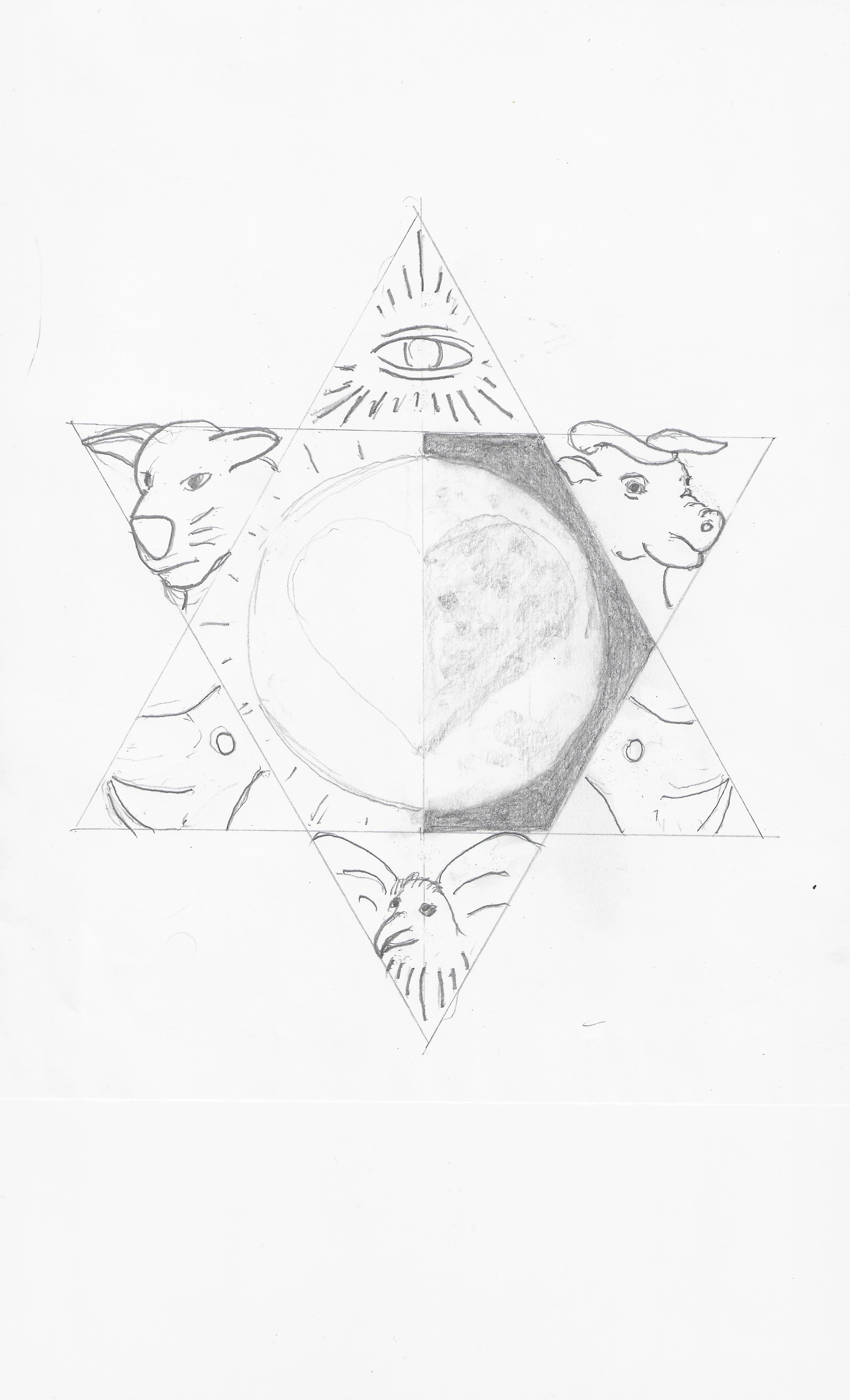
At the peak is the Cosmic Mind, fountain of truth. At the other two corners of the triangle are the hands that have, again and again, surrendered themselves to demonstrate the impotence of violence and fear. (Yes, those are my lifelines, which in life wrap all the way around the palm.) The points of the lower triangle contain the guardians of virtue, the lion, ox, and eagle. These allies represent the lower forms of life that bear the consequences of human self-indulgence. That knowledge is the linchpin of healing. In the center we have the masculine (solar) and feminine (lunar) manifestations of love.
You may gain the Earth, girls, but I have gained all of space and time.
The world’s most successful con man is not in finance or politics. He is the scientist that runs the world’s biggest machine. He has defrauded the US taxpayer of tens of billions of dollars, and he’s not done yet.
This is the story of particle physics and its kingpin, Carlo Rubbia.
Particle physics is the study of matter and space. Newton and Einstein are the most famous scientists in this field. For centuries, physicists went about their business largely unnoticed by the public. Then came nuclear weapons.
History’s most famous equation was given to us by Einstein. E = mc2. To military planners, the equation is important because it says that matter can be converted to pure energy. Prior to World War II, chemical munitions only used a billionth of that explosive potential. The atom bomb showed that chemical munitions could start a nuclear reaction that achieved a million-fold improvement. A decade later, atom bombs were used to trigger fusion in a hydrogen bomb, achieving another factor of forty improvement.
Naturally, after World War II, politicians recognized that particle physicists were the most dangerous people in the world. A single hydrogen bomb can wipe out a city like London. Particle physicists were organized under the Department of Energy and told to find out whether even greater horrors were possible. That mission was sustained by the Cold War competition with the Soviet Union.
This work was done at particle colliders. Over time, these became the world’s largest machines, costing hundreds of millions of dollars to build and operate.
Fortunately for the survival of the human race, by the mid-eighties we knew that the hydrogen bomb was the limit. Everything discovered by the particle colliders was unstable, lasting at most a millionth of a second. However, this was bad for particle physicists. They needed a new marketing message to convince politicians to give them billions so they could keep on building and running colliders.
Given that the researchers were inspired by the prospect of blowing up the world, perhaps we should have expected what came next.
Every politician knows that politics is a contest of wills. In the halls of Congress and in the White House, palpable energy is generated by these contests. Politicians know that spirituality is real.
Could that energy be tapped? Well, not according to physics. In fact, Einstein’s theories seemed to prove that spiritual energy couldn’t exist. Remove all the matter from space and there is nothing left.
Physicists knew better. Richard Feynman, the quirky theorist from Cal Tech, spoke about going to Princeton to speak before the “Monster Minds.”
This, then, was the pitch: “We know that our theories of matter and space are incomplete. Give us money so that we can find the final theory of everything. Then we’ll know how to harness the power of will.” Now, this was absurd from the start. Will is generated by the human mind, which needs to avoid explosions at all costs. But it worked for a while. Congress is a creature of habit, and it wasn’t too much money, at first. Only a couple of hundred million dollars a year.
Then, in the mid-eighties, came the supercolliders. These were billion-dollar machines. Finally, the international particle physics community banded together into coalitions. In Europe, researchers at CERN promoted an upgrade to their collider. In the US, states competed to host the Superconducting Super Collider. Not surprisingly, George Bush Sr. picked Texas as the winner.
As the price tag went up and up, the particle physics community realized that only one candidate could be built. And this is where the con started – the con that left the US giving billions of taxpayer dollars to CERN.
Alfred Nobel was a Swedish chemist and arms merchant (alas, explosions again) who bequeathed his fortune to fund the Nobel Prize. Winning the Nobel Prize in any science is one of the few ways that a scientist gains public notoriety. With that stature comes access to politicians that funnel taxpayer dollars into research. Universities and laboratories, naturally, compete to hire Nobel Prize winners. When they can’t hire them, they try to create them.
Inevitably, the Nobel Prize is a highly political award. It’s not just the ideas that count.
The Nobel Prize for Physics is dominated by fundamental physics. Discovering a new particle or force is almost guaranteed to be followed by an invitation to Stockholm.
Motive: billions of taxpayer dollars for the next particle collider. Opportunity: given that politicians don’t understand a single thing about particle physics, winning a Nobel Prize establishes prestige that could determine the flow of those dollars. Means: the existing collider at CERN. Sounds like a recipe for crime.
Exposing the grift is difficult because particle physicists speak an arcane language. I will try keep it to a minimum, but to be able to confront the perpetrators of this crime against the American taxpayer, we need to understand some of that language.
As well as particles of matter called fermions, the universe contains fields. These fields come in packets called bosons. Bosons allow matter to interact. As a practical example, when you chew food, the atoms of your teeth are not mechanically breaking the food apart, but generating bosons called photons that break the food apart.
How do physicists prove that they have discovered a new fermion?
The concept is built upon Einstein’s equation. E = mc2. To achieve perfect conversion of mass to energy, physicists discovered that they could make antimatter that, when combined with normal matter, annihilates completely.
How to make new kinds of matter? In this regard, the most interesting bosons are the W and Z. Through these so-called weak interactions, any kind of matter can be created. The only requirement is that enough energy exists to run annihilation in reverse. This is called “pair creation.” From the pure energy of the Z, matter and antimatter are created.
To find a new kind of fermion, a collider first manufactures antimatter. It then takes the antimatter and matter, pushing them through voltage that adds energy of motion, creating beams. Finally, the beams are aimed to an intersection point at the center of a detector. Randomly, annihilation occurs. Both the energy of mass and the energy of motion are available to create new fermions.
The process is rote. Build a collider. Use the acceleration to control the energy of the collisions. Analyze the data coming out of your detectors. When you get to the power limit of your collider, go to Congress and ask for more money.
The challenge is that sometimes beams collide without producing anything interesting, filling your detectors up with noise. Fortunately, there is a specific signal that occurs most frequently when creating a new kind of fermion. The detectors will see two photons moving in opposite directions.
Remember that last fact. When a new kind of fermion is found, we see two photons moving in opposite directions.
From the start of particle physics until 1987, eight fermions were discovered. They first six showed a definite generational pattern: a light lepton followed by two heavier quarks. The first triad is known as electron, down, and up. The second generation contains muon, strange, and charm. In the third generation, colliders had detected the tau and bottom. The field was racing to find the third member of that generation, the top.
Along the way, there was another important discovery. The weak interactions are weak because the W and Z themselves have large masses. On the way to finding the top, the bosons were confirmed, at energies of 80 and 93 GeV. (The units are not important. Remember the numbers.) For purposes of understanding the fraud, I emphasize that the W and Z do not produce two photon signals.
The W and Z results confirmed theoretical predictions, convincing politicians that the field was on a solid footing. For this, Carlo Rubbia was awarded the Nobel Prize in 1984.
I was in my last year of my graduate studies in 1987 when CERN announced the discovery of the top, publishing its claim in Physical Review. One of my thesis advisors, Mary Kay Gaillard, had come to UC Berkeley through CERN. That connection brought researchers from CERN who described the result. I was shocked to hear that the data did not demonstrate the required two-photon signal. Furthermore, the accelerator energy during the study was 346 GeV, exactly twice the sum of the W and Z masses.
I trusted Mary Kay. In my presence, she denounced the evils of nuclear weapons. I went to her and voiced my confusion. How could this be a new particle? It looked like a collection of four weak bosons, exactly at the energy that you would predict.
Her answer amounted to, “Go home little boy. The adults are playing politics.”
As the leader of CERN, winner of the Nobel prize, and lead author of the top paper, Carlo Rubbia was the kingpin of particle physics. And CERN won the competition for the next collider.
Let’s return to the political context now. Remember: the Cold War was ending. Everyone knew that no new bomb technology was coming out of particle physics. The goal was now a theory of everything. How long would that political motivation last?
Given the abstractness of the motivation, the field needed a long runway in its next accelerator. This was part of the strategy with the top announcement. The heaviest particle to that point was the bottom quark, at 4.2 GeV. That the fraudulent “top” was all the way up at 173 GeV suggested that there was much more to come, if only politicians would fund the work.
The proposed upgrade of CERN was not modest. It set a 20-year goal of attaining a sixty-fold increase in the collider’s power. Bedazzled by Nobel prizes and the pretty pictures produced by taxpayer-funded science propagandists, the politicians were persuaded to comply.
Then came turn-on date in 2012. The machine was ramped up through its energy range, scanning for new particles all the way up to its limit.
Nothing. Zero, Zilch. A ten-billion-dollar boondoggle, funded in no small part by the American taxpayer.
Except then, after a summer spent scanning higher energies, the machine was turned down to 125 GeV. Be clear: this was an energy accessible by the earlier collider. At that energy, the detectors showed a two-photon signal. Detecting this signal is a primary design criterion for every detector. As it occurred at lower energy than the signal announced as the “top,” it must have been known before that study.
Demonstrating their impenetrability to shame, the 125 GeV signal was published in Physical Review and announced as the long-sought after “Higgs particle.”
“Really,” I though, “you are going to double down on your fraud?”
Remember: two photons is the signal for a new particle. The “Higgs” is what the top should have looked like. In fact, by the standards of the field, I should be awarded the Nobel prize for recognizing that it is the top.
None-the-less, the shameless perpetrators began their pressure campaign. They leaned on the Nobel committee to recognize Peter Higgs, the developer of the field’s minimally coherent theory of particle mass. In the background, Marco Rubbia, CERN’s prior laureate, went to the funding panels, demanding, “You know, this Higgs is kind of weird. We need more money for another collider.” The Nobel committee, having acceded to the Higgs award, heard of this and protested, “We are about to award the Nobel Prize for this discovery. Is it the Higgs or is it not the Higgs?” Rubbia backtracked.
Only temporarily, however. Read the popular science press and every week you will see a propaganda piece promoting the next collider at CERN. After all, the full-time job of their taxpayer-funded propagandists is to secure funding for that collider.
The question, in any massive conspiracy, is how the community maintains discipline. This is a matter of leverage.
You see, university posts in particle physics are not funded directly. They are funded as an adder on collider construction and operation budgets.
For twenty years, I have been trying to get particle physics out of the rut of superstring theory – a theory that is certifiably insane for its violations of everything that we observe about the universe. In the one instance that I was able to get into dialog with a theorist, I was told “I know that you are right, but if I work with you, I will lose my funding.”
CERN is the only game in town. Anything that does not build to more construction is not funded. Pure and simple, Rubbia is the godfather of particle physics. If you don’t play, he won’t pay.
It is time to stop the grift. The next machine will cost the US taxpayer tens of billions of dollars. Enough is enough. Call your local congresspeople and demand that they investigate and shut this down. We have more pressing problems to worry about.
Technocrats ask us to “follow the science.” But what happens when that leads into mass hallucinations?
Ever since Einstein published his theory of gravity – General Relativity – physics has been in pursuit of a theory of everything. In this post, I will explain where Einstein went wrong, and how mass has been used to paper over all the evidence that disproves their theory of everything.
Einstein’s work depended upon the assumption that we can’t tell whether we are moving. Consider: sitting on your chair, you don’t feel like you are moving. In fact, you are carried along with the surface of the earth as it spins, completing a revolution each day. That cycle is embedded in larger cycles: the earth rotates around the sun, and the sun rotates around the center of the galaxy.
Of course, during an earthquake, we know that we are moving, because we can feel acceleration. Even here, however, Einstein said that we don’t know whether the earth is shaking or whether gravity is changing. Both shaking and gravity create acceleration.
To enshrine the principle that we cannot tell whether we are moving, Einstein declared that, should all matter be removed, space would be empty. Once matter is added, it causes space to deform, and the relative positions of particles begin to change. This relativity of motion is declared in the names of his theories: Special Relativity and General Relativity.
Once General Relativity was announced, other physicists considered how its principles might apply to other forces of nature. Eventually, we had three complete theories covering electromagnetism (most of engineering and chemistry), color (that keeps atomic nuclei from flying apart), and the weak force. In trying to extend General Relativity to those forces, a certain perspective became popular. Einstein was interpreted as having said that gravity exists to allow matter to change its position. In trying to build a theory of everything, then, physicists thought of forces as means of allowing any and all of the properties of a particle to change.
Before explaining how that ambition led to mass hallucinations, I will observe that to the spiritually sophisticated, Einstein is clearly wrong. In my career, I have worked with many spiritually sophisticated scientists. They are troubled by the failure of physics to explain spirituality but can’t see their way out of the trap that Einstein built. I have offered them that escape, but to accept it is to admit that everything published by particle physics and cosmology over the last forty years has been wrong. They aren’t ready to accept that humbling.
Pride comes before the fall.
Fortunately, I don’t have to explain the last forty years of journal articles to you for you to understand the mass hallucination.
Let’s start by counting the number of particle properties. We have:
That’s a total of ten. Mathematically, the equations that describe the effects of interactions between these properties cannot be bolted together, however. To unify them, we have to allow the possibility that there are other particle properties, currently hidden from us.
This is now an open-ended search. If we currently cannot see the other particle properties, how do we test our theories? This led the theorists to rely upon the principle established by Einstein in General Relativity. Forces exist to allow particles to influence other particles. The properties of one particle change the properties of another particle.
To theory starts, then, by putting all of the particle properties into a single bag. But how big a bag? Now we confront the constraint of analytical feasibility. The theorists needed to choose a bag that was subject to mathematical analysis. They turned to telecommunications, which had learned how to encode twenty-six channels of data into a single stream. Twenty-six is obviously more than ten, so this seemed an acceptable place to start.
Given this scheme of describing everything as the intermingling of properties, the problem was then to figure out how to test the theory. Here we come to the first of the delusions that follow from Einstein’s assumption that space was empty.
When Edwin Hubble began his survey of galaxies, it was obvious that light lost energy (“red-shifted”) as it traveled to us from distant galaxies. If space was filled with a substance, that could be explained as light bouncing off that substance. Given Einstein’s authority, however, that possibility was rejected. The only explanation available was that distant galaxies are moving away from us. From this explanation, we are led immediately to the conclusion that the universe formed in a huge explosion called the “Big Bang.”
Physics uses its theories to predict the history of objects. Here on earth, conditions are too complicated to support a test of theories of everything. But the Big Bang, conceived of first as starting at a single point and then as a small bubble in a super-heated soup of particles, simplified the starting conditions so that predictions could be calculated. This linked the theory of everything to cosmogenesis – the early history of the universe.
As that work progressed, the following problems arose. In each case, the problems were made to go away by introducing a “vacuum potential” to the theory. In what follows, I give that mechanism the degree of respect it deserves by substituting “pixie dust.” The outrageousness of its application demands the concession that the theory is no longer a theory of everything, because it cannot explain its own pixie dust.
Even with all of this pixie dust, the theory still does not guarantee that the universe will come out as we experience it. In fact, there are tens of millions of other possibilities. The chance that we exists seems impossibly small. To avoid this problem, the theorists gather all the remaining pixie dust, declaring that we live in a “multiverse” that contains more universes than there are atoms in our universe.
The definition of insanity is an inability to align our beliefs with the reality we share with others. On all of these grounds, the current theory of everything is insane. The delusion is sustained by the use of pixie dust in the form of vacuum potentials. The effect of the pixie dust is to disappear anything that disagrees with observation. It is a “mass hallucination” because the effect of the pixie dust is to use mass to prevent the disagreements from lasting beyond the earliest stages of the Big Bang.
The characterization of “mass hallucination” also applies in the psychological sense. Physical Review has a whole section dedicated to arguments over the theory of everything. The pursuit of evidence to prove the theory funnels tens of billions of taxpayer dollars towards construction and operation of earth- and space-based detectors. The largest machine in existence, the supercollider at CERN, itself costs more than a billion dollars a year. To that we must add neutrino detectors, space-based telescopes, gravity wave detectors, and others.
To protect that funding, these projects hire science publicists that flood media with what, given the pixie dust identified above, is pure propaganda.
As I indicate above, I have offered physics an escape from the delusions that follow from the dogma propagated by Saint Einstein. To the rest of us, this is not an idle matter. As I have explained, psychiatry was led into a dark corner by Einstein, to the suffering of tens of millions of our children and neighbors. It is time to stop funding this delusion.
For more than a century, psychiatrists have been trying to solve mental illness by changing the brain. They have failed, and that failure has harmed the lives of many, many people.
Psychiatry was driven to emphasize the brain because Albert Einstein declared that if we removed matter, space would be empty. This was a death knell for the soul, leading to conceptions that people are just machines. Treating mental illness was therefore like changing a spark plug.
In this paper, I prove that Einstein was wrong. The physical world that we observe is actually more gracefully and accurately explained if space is filled with a lattice of infinitely slippery polygons. Within that sea, there are loops of spirit that become a soul. Loops that attach to the polygons are understood in Einstein’s physics as “charge.” It is through this attachment that the soul connects to matter. Our “minds” are therefore the brain plus our soul.
Mental illness is not just a problem in the brain. It is a problem in the soul. In this new vision of reality, damaging the brain to fix the mind is clearly understood as counterproductive.
The paper is not an easy read. Please, if you know a young or aspiring physicist, get them to look at this. Physical Review X refuses to publish this paper, so I am putting it out to the public through social media. I have explained to PRX that I am trying to clear up a critical public health problem, but the old guard is afraid that they are going to lose their research funding.
The gnostic or mystical proposition is that there is knowledge available only to the adequately prepared mind. To a materialist believing that all knowledge comes through the senses, this is insanity. The dualist, recognizing that the mind is more than the brain, best responds to this misunderstanding with “God speaks directly to my imagination.”
 everdeepening