Let’s Talk Science and Theology

My friend Jamie Wozny told me, during a career coaching session, that I should “try to keep it simple.” As I drove down Wilshire away from LACMA considering the forty years spent studying physics and religion, I whined to myself, “But it all seems simple to me.”

To bridge that gap is why I dance. At the last nightclub that I frequented, the manager came up to me one night and said “You know, I’m noticing that wherever you are, that’s where the people tend to gather.” A Persian woman came up to me one night to say “You don’t know how good you make us all feel.” Just this weekend my friend Mary Margaret, as we lay all akimbo after rolling around on the floor together for ten minutes, admonished me about viewing myself as an old man, “You really should love yourself more. Others would benefit from the experience of your joy.”

The problem is that most people take the energy that comes out of the heart and direct it downwards to the sacral chakra, the focus of passion and pleasure. I try my best to be disciplined, because otherwise I would just be a slut, but the people that come to LA Ecstatic Dance and the Full-Contact Improv Jam do love to touch and be touched. For many, it’s an opportunity to mix masculine and feminine energy without the complications of a relationship. I’ve benefited from that willingness as I try to figure out how to unlock the feminine graces, but I still find it difficult to withstand the impulse to rest my hand over a woman’s womb as she arches backwards with her hips resting on my thigh. Nobody has slapped me yet, so I surmise that I’m giving in to what they want.

I attempt to patch things up afterwards, just consistently raising energy from the fourth chakra – the heart – up to the sixth chakra. While the latter is associated with the pineal gland and known as the “seat of intuition,” physically it rests right over our cerebral cortex which is the part of the brain devoted to higher reasoning.

Realizing that somebody was peeking into my childhood, I woke up at 3 A.M. with a sinus headache. It’s drying out here in Southern California, and the grass is disintegrating. I eventually dragged myself out of bed to rinse my sinuses with Alkylol.

After crawling back under the covers, it occurred to me that the sinuses sit between the sixth and fifth chakras, the latter being the throat chakra that focuses communication and creativity. I always struggle to engage others in conversation regarding the matters that demand so much of my attention – sometimes to the degree of a painful burning in my throat as emotion wells up from my chest.

In considering Dante, Santayana elaborates Dante’s metaphor of theology as his lost love Beatrice, their happiness frustrated in part by his flirtation with philosophy. This matches my own experience: theology does seem to rise from the heart, while science – the most mature expression of philosophy – rests in the mind.  In the modern era the two camps of heart and mind have chosen to dispute with each other.

Between them we have the voice that wisdom teaches us to reserve for the truth. I have spent my life on this problem – the reconciliation of those two warring camps, each holding half of the truth. If anybody knows of an opportunity to engage with others in dialog on those problems, let me know. I’m willing to travel.

Flirting with Trust

Since Friday I’ve been working on my relationship, sharing visualizations of inconceivably precious forms of intimacy. The organizing principles are healing and celebration, involving us in a powerful whirlpool of emotions, running the gamut from grief to dizzying passion. Underneath that runs a steady flow that guides us into deeper and broader connections. So we found ourselves kneeling on the floor, I catching her long hair from behind and stretching her will out into the world where it caught whales and trees and birds, and then her pushing me down on the bed and slowly dragging those long strands over my face so that understanding and love can bring order to life.

And then she stops and wonders what she is doing in the midst of this process, not conscious of the powers she possesses and so uncertain of her ability to manage the dangers she perceives. As I struggle to formulate an assurance, we spin apart. My last clear communication from her ended with her disappearance into a vortex of female faces, creating a cocoon in which she could incubate, but also from which others offered themselves as alternatives. I simply re-iterated my commitment to the self-discovery of my lady, and let her depart with the assurance that I would meet her on the other side to be certain that nothing had been lost.

In the pauses in this work, I’ve been re-reading Santayana’s Three Philosophical Poets. Santayana, philosopher and Christian apologist, combines a deep knowledge of culture and beautiful literary style in the service of revealing the choices we face as we struggle to find meaning and purpose in life. Santayana offers the works of Goethe, Lucretius and Dante as a progression that illuminates the submission of our animal nature to moral discernment, unfortunately with the growing risk of detachment from the joys and perils of human experience. Due to this tension, Santayana finds no superior voice among the three, instead celebrating each as a trustworthy illuminator of the power found in choosing either to do (Goethe), to create (Lucretius) or to serve a higher purpose (Dante).

To do is exemplary because it protects us from nihilism, the conclusion that any single life is insignificant and useless. In exploring this path, Goethe’s anti-hero Faust learns to discard self-judgment for personal wrongs committed against others, and so becomes capable of ruling an entire nation, granting purpose to his people by immersing them in struggle. Upon his death at one hundred years, Faust vanquishes Mephistopheles, demonic grantor of mystical power, who predicted that Faust would eventually learn to surrender purpose and be content with any experience at all, even to lick the dust. Instead, having demonstrated that each individual can find purpose in creating struggle against the world, Faust’s soul is received by angels and carried up to heaven.

Against this idea that we are glorified by struggle, Lucretius celebrates the orderly structure of the world, filled with creative forces that reclaim resources liberated by death. The philosophy of materialism stretches even further, propelling scientific study that allows the rational mind creative opportunities that would never be revealed in nature, and so to engage in an orderly process of improving the human condition. Among the virtues of Lucretius’s program, Santayana heralds self-control, and the defeat of superstition – the latter often abused by religious illusionists to steal the power of an adherent’s natural urge to improve his lot. Chief among the defects is timidity that arises from an awareness of life’s fragility, timidity heightened by the view that we had best live as though this is the only life we have – timidity that would be scorned by Goethe.

Of course, most of history is the story of how those characterized by Goethe twist the power liberating by understanding to subdue ever larger populations. Dante, following Aristotle, celebrates adherence to moral codes that sustain social order. Even more, in an era of deep Christian faith, Dante heralded the possibility of human perfection, of a rising into another realm in which all struggle would cease, each individual recognizing the benefits of submission to the will of a God that loved them without reservation. Dante’s ambition is for every person to be freed from constraints, excepting only the constraint to submit to the dictates of being guided by God’s love for others. Notwithstanding Dante’s outraged prosecution of the authorities of his era, Santayana follows Lucretius in decrying the passivity consequent to subscription to any externally imposed morality.

After his comparative analysis of the three works, Santayana proposes that a fourth poet must be sought to resolve the contradictions between the three philosophies, a poet whose celebration of vitality yet proves that self-control and other-service lead us into our most powerful and satisfying experiences. Incongruously in the context of his analysis, my reaction was “That would have to be a woman.”

But as I sat and pondered my experiences since Friday, I couldn’t escape the feeling that there was a thread that tied all of this together. Santayana brings us the writing of three iconoclasts, men who felt a strong need to assert themselves against the society they inhabited, each with a dour view of the fairness of life. And in my relationship, we have this expansion into ever greater realms of experience that recoils against fear of personal insufficiency. In both cases, the problem is other-trust. Faust trusts only in himself; Lucretius trusts only in personal discernment; Dante trusts only in God; and my lady does not trust that others will support our relationship.

What does it take, to lay mistrust to rest? We have the evidence of Good Friday services, in which multitudes gather to celebrate the worthiness of a man that was willing to die to redeem others of their faults, followed by Easter in which the resurrection proves the overwhelming power committed by God to the realization of that redemption. How can we not be discouraged by this standard of loving, a standard that cannot possibly be sustained in relationships between lesser beings?

Enough: it was done. The powers that stood behind Jesus did so because he arose in confrontation with sin, and in surrendering to its power became capable of diagnosing it. The era to come will be the era of healing in which those that suffer obtain the power to send sin on its way.

Lucretius, in elaborating the dynamic between creativity and destruction, chose the mythical figure of Venus to represent the surging of life, and the figure of Mars as the force of destruction. In the introduction to his unfinished work, Lucretius pleads with Mars to surrender to the pleasures of Venus’s bower, protecting the poet from interruption during his great task. This pairing is not unique to Greek mythology: in the Hindu pantheon, Parvati is responsible for cooling Shiva’s passions after he enters his dance of destruction. In celebrating struggle Goethe obviously sides with Mars, while Dante casts theology in the person of his beloved Beatrice.

The idea that women are responsible for tempering the wildness of men is buried deep in our cultural heritage. In women, that belief manifests as a cautious predisposition to believe that men will turn their passions against their lovers. My prayer is that women cast aside their ancient burden and organize their fertile energies around men of healing and constructive intelligence. Rather than catering to Mars, they should amplify the character of Apollo. Cast aside the terrorist to invest your energies in the healer, and discover reciprocity for your trust.

Don’t Blame Love

In the final chapter of Love Works, the feminine personality of life, irritated by the disorder generated by the masculine personality of intellect, grabs him by the short hairs, prompting him to observe:

Choice is a bitch. Let’s hope the kids do better next time. Now, will you let go? (How does she make it hurt so much?)

It’s undeniable that the spread of life across the earth has been driven by primitive urges.

Life’s procreative greed causes ecosystems to become saturated, stunting evolutionary opportunity. The great extinction episodes of paleohistory terminated biological dead-ends, and were all followed by eras in which life took off in new directions.

Conversely, the ability to use tools requires a large brain and flexible digits, both of which limit the growth of organic armor (which traps heat) and organic weapons (which must be anchored to large bones). Thus creatures of intellect such as humans are biologically vulnerable, and so spread only when they can produce tools that overcome the weapons and armor of other animals.

Once those tools were available, however, fear and greed drove us to consume natural resources without restraint, bringing the globe today to the point of ecological collapse. Deflecting the force of these natural tendencies is the challenge we have laid at love’s door.

In the history of religion, that struggle began with the worship of the two polar opposites of procreation and death. With the rise of the hydrological civilizations, an intellectual class of priests began to envision gods with subtle ethical character. But it was really only about 3000 years ago (and only among the intellectual elite) that humanity dared to suppose the gods should be devoted to us, rather than the other way around.

Monotheism is the culmination of this process, and led eventually to the declaration that God is love. This is common to all of the great religions.

But is it to our advantage? Given that we have free will, why should we feel constrained to draw only upon love when we face challenges? When our treasurer embezzles the retirement fund, do we just shrug our shoulders? Or do we get a noose? And when the hanging is done, can’t we justify the act with the assertiong that we are loving our spouse, children and/or co-workers?

The retort to this logic is that if you had really cared about your treasurer and paid attention to her psychological well-being, you would have seen the trouble long before it manifested. But, damn, that seems like a lot of work, and didn’t we pay them to do the right thing? So we keep the noose handy, and that means that the old deities of death get in through the back door of our religions. They stay alive there, and as ecological collapse sweeps across the globe, they will appear once again to grow in power.

But, fundamentally, they are the disease. Sexual indulgence and fear of death are what drove us to exploit the natural world. That love did not have a magic wand to drive them away is not its fault. So we need to stop blaming monotheistic religions for our refusal to hew to the dictates of love. Rather, we need to double down, even as fear sweeps over us, and invest in the love that creates the strength to resist the urge to exploit the world around us.

On Poverty and Riches

Just taking the long view (I mean – the long, long, long view), I consider the time-scale of the cosmos and the saga of biological evolution and we have the precious experience of living in this 10,000 year period in which our intelligence and the natural resources stored up from the past are available for us to do really deep work on our personalities. Simply to be alive in this time is such an incredible gift – to be able to play at being a creator, each in our own limited way.

Even if only to be able to plant a field, or tend a herd, or write a blog. Even if only to be the voice that reminds “There are still problems to be solved” in a way that motivates others to seek for solutions. Not to place fault, but to exhort greatness in others – to guide them into the only form of self-creation that opens to God.

Yes, the window is closing, as it was prophesied in Revelation. No, it’s not the fault of any single individual, and if we collectively had been more considerate of the forms of life that occupied the planet before us, maybe it wouldn’t be so traumatic. But that’s not under my control, so the question I constantly confront myself with is: what am I doing with my opportunity? Am I offering my creative capacities in the service of Life, or do I expect Life to serve me? Because when I finally lose my grip on this body, it is Life and Love that awaits to embrace me with the eternal embrace, if only I know how to receive it.

Wish You Were There

Google has recently announced a “photo location” service that will tell you where a picture was taken. They have apparently noticed that every tourist takes the same photos, and so if they have one photo tagged with location, they can assign that location to all similar photos.

I’m curious, as a developer, regarding the nature of the algorithms they use. As a climate change alarmist, I’m also worried about the energy requirements for the analysis. It turns out that most cloud storage is used to store our selfies (whether still or video). Over a petabyte a day is added to YouTube, with the amount expected to grow by a factor of ten by 2020. A petabyte is a million billion bytes. By contrast, the library of Congress can be stored in 10 terabytes, or one percent of what is uploaded daily to YouTube.

Whatever Google is doing to analyze the photos, there’s just a huge amount of data to process, and I’m sure that it’s a huge drain on our electricity network. And this is just Google. Microsoft also touts the accumulation of images as a driver for growth of its cloud infrastructure. A typical data center consumes energy like a mid-size city. To reduce the energy costs, Microsoft is considering deployment of its compute nodes in the ocean, replacing air conditioning with passive cooling by sea water.

But Google’s photo location service suggests another alternative. Why store the photos at all? Rather than take a picture and use Google to remind you where you were, why not tell Google where you were and have it generate the picture?

When I was a kid, the biggest damper on my vacation fun was waiting for the ladies to arrange their hair and clothing when it came time to take a photo. Why impose that on them any longer? Enjoy the sites, relax, be yourself. Then go home, dress for the occasion, and send up a selfie to a service that will embed you in a professional scenery photo, adjusting shadows and colors for weather and lighting conditions at the time of your visit.

It might seem like cheating, but remember how much fun it was to stick your face in those cut-out scenes on the boardwalk when you were a kid? It’s really no different than that. And it may just save the world from the burdens of storing and processing the evidence of our narcissism.

Live Oaks Matter

When dealing with a problem as large and diffuse as anthropogenic climate change, many of us have a Rubicon to cross. As recently as five years ago, I had practicing engineers tell me that there was no way that our individual impacts could combine to affect a system as large as the Earth. The escalating frequency and power of destructive storms has changed the minds of many of those doubters.

For myself, I never doubted the science, but it was an abstraction until I observed the changes in the Oak Trees when I returned to Livermore in 2004 after being away for ten years. Persistent drought had reduced the level of the Del Valle reservoir by almost thirty feet. When I finally found the opportunity to hike the hills rising from its western shore, I was astonished and dismayed by the battered look of the oak trees. Flaking bark and fallen branches littered the trail, and the sturdy equanimity of forest was replaced by a beaten weariness. When flying into Oakland over the reservoir in the early evening, the rust-colored crowns were evidence that the ecosystem was facing the loss of its keystone species.

These observations were magnified when I visited the IONS retreat center in Petaluma. I had seen isolated instances of sudden oak death along the freeway, but the trees along the ridge around the retreat center were decimated by the scourge. The branches and leaves were coated with a choking fungus. Recent rains had brought new buds that twisted as they suffocated. I reached out to offer a compassionate touch, until a voice warned me that the contact would coat me in spores that would travel with me.

The death of the oak forests was not so visible in Southern California. The coastal ranges come right down to the shore north of Santa Barbara, which seemed to act as a barrier to the spread of the fungus. And the trees in the Thousand Oaks area often line waterways sustained by treatment facility discharges. Even so, my thrice-weekly runs along the Chesebro trails confronted me with evidence of trees in distress.

Other factors also brought me pain: all throughout the West, the native scrub is being wiped out by the European grasses that now sprout up in the aftermath of wildfires. Even on old growth hillsides, shrinking brush has left exposed ground that is overrun by verdant lawn after rains. Where water gathers on fields, the invaders are thick stands of mustard plant. The weeds last only long enough to choke out the native sprouts, then die off, leaving soil at the mercy of the wind. In many places, the chalky lime of the range peeks through under the burnt stems of the sage.

When I took up Bikram yoga to combat my chronic back pain, my contact with these realities lessened. Even moderate exercise causes me to perspire profusely, leaving me in a dehydrated condition that forces me to break posture early in class. So I have given up hiking to refine my posture and prana flow. The disconnection came to the fore when one of the other students remarked that it was nice to see the hills greening again. I had to hold my tongue – I had observed over the winter that the lime green of European grasses was spreading on the burnt ground.

But I had been hooked. As I walked back to my car this morning, I felt the call of the green world. It seemed to say, “Yes, it’s not the way it was. But it is new life. Come and see us!” So when I arrived home, I put on my hiking boots and headed up the trail.

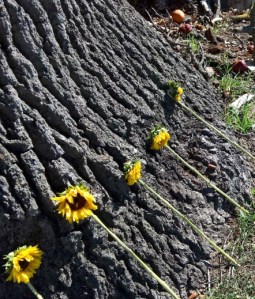
WP_20160220_13_36_30_Rich_LITo be confronted with a large Valley Oak that had shed its lowest limb in a recent storm. The wound, so evocative of a screaming face, shocked me into recollection of the frightening dark forest of the Witch of the East in the Wizard of Oz. The sight was leavened somewhat by the sunflowers propped up against the trunk. I stopped to place my hands against the deep bark, and willed the matriarch to live, but she was weary. It was time to let go. So I offered the hope that a new sprout would rise under her guidance to provide new expression.WP_20160220_13_38_33_Rich_LI
I wish I could say that it was an isolated experience, but not a hundred yards up the trail I encountered another casualty. This friend had lost its crown, probably more than a year ago. The lower limbs were thick with brushy twigs, made bare by the winter weather. This determined manifestation of the will to survive was contradicted by the evidence in the bark of a tree that stretched its lowest branch across Chesebro from the far side. The pattern of bark discoloration suggested that it, too, would be diminished in the near future.

While the Valley Oaks seemed doomed, the Coastal Live Oak, less grand in their ambitions, seem still to thrive. They lose their limbs, but even hollowed out, they channel water through the cambrium, reaching up and out to paint the sky with green.

But as I strode away from the arroyo to cut my way home along the road, the future was painted in bright green. After the last wildfire roared up Chesebro Canyon in 2004, the forest service attempted to demark and maintain native species restoration plots. Often no more than ten feet on a side, the chicken wire was often lost in a sea of mustard plant, and while steadfastly maintained, the drought yet murdered the native plants that had evolved to survive the dry months of our Mediterranean climate. The future was obvious on the slope above the trail head: stunted oak saplings, ringed by white plastic tubes to protect them from the deer, evoked a military graveyard against the backdrop of the European grass that coated the slope in a hyperactive green.WP_20160220_14_11_23_Rich_LI

Russian to the Brink

While Nikita Khrushchev once pounded a negotiating table with his shoe, promising that “[the USSR] will bury you,” Vladimir Putin seems committed to a course of “let’s all drown together.” Whether it be oil or violence or rising oceans, the real risks facing his people are clouded in his mind by the demands of keeping a nation of eight time zones under his thumb.

As an industrialized nation whose ports are locked in ice for six months each year, Russia has a mania for warm weather. That was expressed in the ’50s in currying favor with its neighbor Iran, and in the ’80s with the invasion of Afghanistan. As global warming gained steam, the failure to secure a warm-water port made Russian nominally the only nation standing to benefit from climate change.

That wasn’t enough for Putin, whose seizure of Crimea was a thinly-disguised grab for an outlet to the Mediterranean. Unfortunately, a good piece of Ukraine stood between Russia and its new acquisition. Western opposition to the dismemberment of the Ukraine has frustrated Putin’s ambition and exposed the weakness of his military. The flurry of airspace violations by Russian fighter jets has died down as the maintenance bill mounted.

Instead, Putin has shifted to support of Bashar Assad in Syria. This is an escalation of the asymmetrical warfare epitomized by suicide bombers, except in this case the walking dead are the refugees fleeing conflict. The cost of managing the millions fleeing the region is mounting, and borne almost exclusively by the European countries who have responded to Russian adventurism with diversification of their fossil fuel supply.

Again, this geopolitical aim is shrouded in a lofty rationale: Russian claims to be fighting Daesch, the Islamist caliphate that is looting the abandoned regions of eastern Syria and western Iraq. In reality Russian military might is strongly aligned with Assad in his battle with the rebellion again his criminal regime.

In the meantime, Russia continues to pump oil into the Chinese and other markets. Its primary competitor in supply is Saudi Arabia, whose cheap production costs and small population allowed flexibility to decrease production during an oil glut to stabilize global output. Unfortunately, Sunni Saudi Arabia is locked in a regional struggle for dominance with the Shiite regime of Iran, nominally a supporter of the Allawi regime in Syria. This has led it into military adventurism in Yemen, at the cost of $17 billion a month, and is now prompting the Suadi’s to consider intervention with ground troops against Daesch in eastern Syria. An obviously a side-effect is to secure the existence of a Sunni bastion in a region about to be dominated by Shiite states. But it also creates a drain on the Saudi treasury that forces it to sell oil, driving down the price even further.

Saudi Arabia is not the only threat to Russian control of Syria. The rebels being bombed by Russian jets are not going to go away should the regime reestablish control of their strongholds. They will melt into the population, and continue to operate as insurgents. And of course, there’s all those returning refugees to provide for. Just as in Ukraine, Putin is setting himself up to be trapped for the long term in the Middle Eastern quagmire.

Finally, we have the paradox of the melting Russian tundra, composed in no small part of methane crystals that are evaporating. How much of Russia’s oil and gas infrastructure will be swallowed in sinkholes is anybody’s guess. At the very least, we can expect roads and rail lines to be disrupted. Worse, some estimates are that the continental shelf along the Arctic Ocean will soon burp up enough methane to drive global temperatures up by 2 C in the next ten years. That will moderate as the methane burns off, but the effect will be to increase desertification of Russian agricultural land. While warming Siberia is huge, it is dominated by tundra and boreal forest, possessing only a thin layer of soil. It’s not going to be a breadbasket anytime in the next thousand years.

Russia has always been a marginal state, held together by the repressive fist of the tsars. As the last of that line, Putin is playing a game of personal power on the global stage driven by the need to prove his strength to the Russian people. While it’s anybody’s guess as to how soon the Russian state will collapse under the weight of his ambitions, all we can hope is that there’s something left for the Russian people to rebuild with.

Quantum Entanglement

John Markoff at the New York Times has been heralding an experiment at Delft as disproving Einstein’s view of the universe. While I have my own issues with Einstein, I am not as impressed with the Delft demonstration as Markoff and others appear to be.

The quantum world is incredibly mysterious to us – we cannot observe its inner workings directly, but only observe its side-effects. This means that we can’t make statements about the behavior of any one system of particles, but only about many systems in aggregate.

Let me give a classical example. When we toss a coin in the air, we know that there is a fifty percent chance that it will land “heads up.” If we could measure the coin’s position and rate of spinning and also knew precisely the properties of the floor that it would land on, as it was in flight we could calculate precisely which way it would land. But we can’t do that, so we believe that there is an element of “chance” in the outcome. In the terminology of quantum mechanics, we might say that the coin in flight is in a “quantum” state: 50% heads up and 50% heads down.

Now let’s say that we put two people in a room and asked them to toss a coin. Since we can’t observe the thoughts in their mind, we might consider them to be in an “entangled” state. We know that if we ask one the answer, we’ll receive the same answer from the other We then separate them by miles and ask the first one what the result of the toss was. If she says “heads,” we know instantaneously that the second person will also say “heads.” So we might say that the state of the pair has “collapsed” to “heads” instantaneously, and we know what answer will be given by the second person.

But the information didn’t travel instantaneously from one to the other. The two people from the room knew all along what the answer was.

If this is actually the nature of quantum entanglement of very small particles such as electrons (the subject of the experiment in Delft), why do scientists become so confused about the process of information transfer?

That chance in coin tossing actually reflects the randomness of the tossing process: the position of the coin on our thumb, the effort of our muscles, the condition of the floor: only with great practice could we ensure that all of these were identical on each toss. If that investment in discipline were made, we could actually control the outcome of the toss, achieving heads 100% of the time.

Now let’s say that, unbeknownst to us, the coin tossers are actually trained in this skill. How would we find out? We couldn’t find out from one experiment. Even after a second experiment, there’s still a one-in-four chance that a random toss would achieve “heads” in both cases. No, we’d have to run many experiments, and decide how improbable the outcome would have to be before we accepted that something was wrong with our theory of coin tossing.

In other words, the confusion comes in because the philosophy of quantum mechanics confuses the problem of proving the correctness of the theory with the actual behavior of the particles that produce any specific outcome. In our coin-tossing case, the quantum theory holds that we’ll get heads 50% of the time. But to prove that, we have to do many, many experiments.

Let’s extend this to the problem of Schroedinger’s cat: a cat is in a box with a vial of poison gas and a radioactive isotope. When the isotope decays (at some random time), a detector triggers a hammer to smash the vial. In the “accepted” philosophy of quantum mechanics, the state of the isotope evolves over time, being partially decayed. This means that the state of the cat is also partially dead. When we open the box, its “wave function” collapses to one state or the other.

We can clarify this confusion with a thought experiment: In our coin tossing example, let’s say that we put coins in boxes and had children run around the room to shake them up, randomizing their state. In quantum mechanical terms, we would say that the state of any one coin was “50% heads.” When we look in a box, the state of that coin is determined: it’s wave function collapses to either heads or tails. It is only by observing all of the coins, however, that we can determine whether the children actually were successful in randomizing the state of the coins.

By analogy with this, we can only prove Schrodinger’s theorem about the “deadness” of cats by performing many experiments. At any instant, however, each cat in its box is either alive or dead. It is unfortunate that we’d have to kill very many of them to determine whether the theory of radioactive decay was correct.

So I side with Einstein: I don’t see any mysterious “action at a distance” in the experiment at Delft, and I certainly don’t see it as proof that information can travel faster than the speed of light.

My own proposition is very different: it is that the dark energy that permeates space and constrains the speed of light can have holes opened in it by the action of our spirit. Once it is removed, the barriers of time and distance fall. When such bonds are created through fear, the subject of the fear seeks to escape them, and the strength of the bond dissipates. When the bonds are created in love, the entanglement persists by mutual consent, and grows inexorably in strength and power, eventually sweeping all else before it.

What kind of confirmation could the physicists at Delft provide of this? I’m not certain, but it would be an experiment in which the electrons were separated, and a manipulation of one was reflected in the other. In our coin-toss experiment, it would be if the two people in the room were separated before the coin toss, and the second knew instantly what the result was of the toss performed by the other. From the video they made, I don’t think that’s what is happening at Delft.

This post in memoriam of Professor Eugene Commins who taught my upper-division course in Quantum Mechanics at UC Berkeley in 1981, and who benefited during his doctoral studies at Princeton from conversations with Einstein.

Presenting Ourselves

When Parashakti runs her Dance of Liberation workshops down at LA Ecstatic Dance, she begins by facilitating the pairing of spirit buddies. While my first experience with her was pretty intense, more recently I’ve been working in service to others. That means that I am chosen, more often than choosing, when she finally says: “Look around and find a spirit buddy, someone close to you. Once you’ve found them, describe your intention for this dance.”

So I pivoted slowly and found myself hooked on the eyes of the really pretty woman, standing tall enough to almost cover my chin. Another gentleman tried to step between us, but she raised her hand to gesture to me.

I’ve never heard such a strongly worded statement of intention. It went on for nearly ten seconds as she spoke about preparing herself in this year to let love flow through her and into the world around her. I brought it to a close by holding my hands over her shoulders and then lowering them until they hovered over her chest, encouraging my angels to fill her heart to the brim. “Thank-you,” she murmured.

“That’s my intention.” Parashakti then told us to stand back-to-back. Feeling that I wasn’t quite connecting with my partner, I tilted my head back until it contacted her crown. She nestled in a little more closely.

I had been right behind her as we danced a circle earlier in the ritual, and had noticed her hands moving as though warding the space around her head. Asthe blindfolds went on, that image came back to me, and after the closing circle thirty minutes later, I told her that I had received something to share with her.

She was the object of a lot of masculine attention during the open dance, and I half expected her to avoid me. But forty minutes in she took a break for water, and gazed pointedly at me. I guided her into a corner, leaning in close to block the pressure of the music, and began, “Our culture projects a lot of ideas that negate a woman.”

“What?”

Not sure whether she was just buying time to process what I had said, I repeated myself. “When you were dancing next to me before the ritual, I noticed you doing a lot of work with your hands around your head, as though you were warding things away.” Stretching my right hand to touch the heavens, “We tend to look to each other for validation, but there is a source of eternal truth.” Hesitantly, I moved my hand closer to her crown, gauging her reaction. “I was offered a message from them: they want you to know that they are reaching out to you.” She just gazed at me, frozen. “When I went through this process, I had to surrender my thoughts and let my heart guide me.” I reached out with my left hand, palm upwards, and envisioned cupping her heart in it. “I had to let my heart energy rise until it merged with my mind.” Raising my left hand until it was just under her chin, I concluded “The heart guides the head, and the head protects the heart.”

I was shirtless and slimy with sweat, so she embraced the air around me, murmuring “Thank-you, thank-you so much,” fleeing and returning two or three times before returning to the floor.

She continued to be popular on the floor, mostly among the younger men that I can now only join briefly in frenzy. I worked the room in my usual manner, spreading joy and tenderness where it was accepted, but really wearing down at the end. As the afternoon drew to a close, I sat on the floor to down dinner, watching as she was intercepted by man after man. Getting up to change clothes for Contact Improv, I came back to sort through my backpack and offer my gratitude to Ataseia. She passed by and I caught her eye. “One more thing.”

She didn’t hesitate. “What you said earlier explained a lot to me about myself as a woman.”

Thinking of her confidence on the dance floor, “Yes, I could see that. But the challenge is hanging on to it. We have to stay focused on them. They have their own purpose, and if we fail in our devotion, they tend to wander away.”

She leaned into the frame of the closed doors, hands clasped before her. That wasn’t what she expected. But her lips offered a gentle bow of curiosity.

“You projected a great deal of positive energy into the room today, but when you began to dance with a man, it turned inwards. I could see you winding inwards, and the source of that energy was left adrift.”

She stopped to reflect, and voiced her agreement.

“If we want to hang on to them, we can’t do that. We have to present ourselves, and wait for the other person to open to us in turn. It’s not a winding into, it’s an expanding through.” She looked uncertain, so I reached out to cup understanding in my right hand, brushing it gently across her.

“I’m not sure that I understand.”

I stepped back. “I present myself. All of myself. And if you respond, I come closer, not directly, but slowly spiraling as my angels introduce themselves to your angels. It’s not always pleasant – some things really don’t belong together. But that’s what we do here. You danced with a lot of people today, as did I. We gently join our personalities, and then the magic happens. We go out into the world and draw upon our shared wisdom and energy.

“But we shouldn’t make too much of that. We need to stay devoted to ourselves, waiting for that encounter to which all of us announces ‘yes!'”

She raised her hand tentatively to demonstrate her understanding. Her eyes narrowed as my entourage resisted her, and I caught them sending “Not without our permission.”

We embrace twice, and she departed with a wistful “Maybe I’ll see you next time.”

“I look forward to it.”

Healing Time

I’ve been working my way into the LA Full Contact Improv community since last November. The experience is markedly different from LA Ecstatic Dance, which is guided by facilitators and DJs. The Improv Jam is introduced by Jeffrey, the organizer, and occasionally accompanied by the astral strains of the resident guitarist, but the goal and tenor of the experience is open-ended. People glide, skip, spin and roll around the dance floor until they feel a connection. Between friends, that may advance immediately into an embrace, unfolding through a lift or tumble with bodies entwined. For those yet to be awarded that intimacy, there’s a slow inward spiraling that concludes with a gentle touch. For me, that induces a sudden stillness while muscles feel their poise, broken by a release into a caress or the playful exploration of flexibility and strength.

With another recent newcomer, I explained that the challenge I often face in managing this engagement is getting people to let it feel good. Rolling over one another can be like a mutual full-body massage. Having gotten into that space with another dancer, I stilled suddenly as I felt a tension release from deep within him, and I muttered into his ear, “There can be healing here.”

So when Jeffrey announced at last week’s closing circle that he would be offering a facilitated healing experience every Friday night at 8:30 and prior to the Jam on Sundays at 4, I was prepped to jump right in.

It turned out to be really rewarding.

For the last fifteen years, I’ve been interpreting my spiritual experience through a model of physics that leads me to the conclusion that we have three kinds of experience available to us:

  • an experience of “life” that binds spirit to body, allowing us to wrestle with selfishness,
  • existence in pure spirit that frees us from the constraints of space and time, but limits our capacity for growth, and
  • release into a realm of unconditional love that seeks only to facilitate and safe-guard our relation.

So imagine my reaction when Jeffrey explained last night that we live in a material reality in which we struggle with our “me”-ness, navigate slowly into an astral realm of pure knowledge, and finally surrender the pursuit of goals to experience godhead.

This wisdom, offered in what seemed to be a Vedantic framework, came with a set of practices. They are unusually constrained: rather than engaging the deeply rooted powers of the Chakras, we began by opening the meridian gateways at our fingers and toes. Jeff then asked the group to offer whatever insights arose. We listened in witness as we “time traveled” with the speaker, offering our shared energy as support. Jeff asked whether the speaker could see that the emotion of the experience was itself the gateway to healing.

A young man last night, struggling with his conditioning, led us into an analysis of self-actualization and karma. Jeff shared his past frustration in trying to create outcomes through his practice (which allowed us to time travel with him – that was nice!), before realizing that he was forcing his experience to conform to his ideas, rather than the other way around. Subtle wisdom, and it didn’t sink in immediately, so I offered:

The reason that we suffer with each other in this life is because we are missing parts. Trapped here in our bodies, we can’t reach the source, so we try to steal them from each other. When we surrender our self-concern and focus on healing another, we are able to serve as a conduit for missing parts. True power and freedom arrives as we become accepted as a trustworthy provider of parts.

My intimates all complain that my writing is too abstract. I complain that they won’t open their hearts to me. I think that I’ve finally found a method for bridging the gap.

And even better, I left with ears full of the testimony of others that have found comfort and strength there. Come one, come all!