That’s the Spirit

We’ve been building a model of the universe with superfluid dark energy, and introducing a “cold” alternative to the Big Bang theory. The model includes a possibility for gravitational attraction between defects in the lattice. Given that there are three other forces at play in the universe (electromagnetism and the “weak” and “strong” interactions), the model is obviously incomplete.

I’m going to throw out a model here that manifests interesting and theoretically relevant behaviors. I am certain that the model is incomplete – my sense is that the dark energy lattice itself has complex structure (I refer the reader to the image on the Generative Orders proposal). But the suggestions here should be enough to stimulate innovative thinking.

So what we need to propose is a model for our defects. It’s interesting to consider the defect to be a self-repellant loop that gets pinned to a node in the dark energy lattice. Now the lattice is going to tend to corral the expansion of the loop along a particular axis. The energy driving the expansion will eventually be spent in pushing the dark energy particles apart. We can imagine thus that the loop will oscillate back and forth, as indicated below with “right” and “mid” views. We can imagine the “left” configuration by rotating the “right” configuration through half a circle.
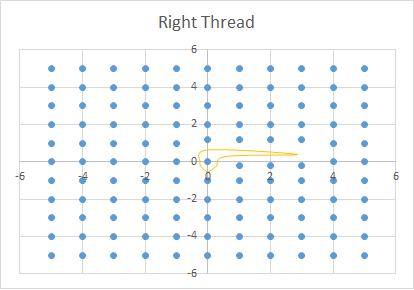
Right Thread
Mid Thread

Now let’s suppose that each point in the lattice can anchor up to two loops. How this is feasible is open to exploration. One way is for the dark energy to have structure itself. For example, it might be a little circle. Now there will be oscillation patterns that will minimize the interaction between the two threads. One possible pattern is shown below (the lattice is suppressed so that we can focus on the loop configurations).

Two-Thread Oscillations

We see that when one loop is clustered near the center, the other is extended. What is most important, however, is that when the sequence is followed clockwise, the pattern rotates clockwise. Reading in the reverse order reveals a counter-clockwise rotation. So this is a model for the top-like “spin” that was described earlier.

(NB: This is a terrible model of intrinsic angular momentum. A more fertile approach is to think about normal angular momentum, which arises when interacting particles are offset along the axis of approach. We then see that normal angular momentum is discretized in the lattice, because the offsets are discretized.

How is normal angular momentum conserved? Well, the model proposes that gravitation, electromagnetism and the strong interactions are all generated through the efforts of the lattice to minimize distortions. The specific character of each force reflects the degree to which a configuration of loops generates lattice distortion.

So angular momentum is conserved because the approach of the particles stores a particular type of distortion in the lattice that is released when they separate. Intrinsic angular momentum may be accommodated better by recognizing that the odd shape of the loop projections can be removed by offsetting the center of the oscillation by half a lattice point.)

Now the configuration with two loops should be fairly stable – it affects both directions equally, and so shouldn’t create too much disruption when moved. However, the configuration with one loop will tend to whip around when it moves, maybe even causing the lattice to be re-oriented locally. Given our discussion of mass, it would appear that asymmetric particles (one loop in our example) will have larger masses (disturb the lattice more when moving) than symmetric configurations (two loops in our example).

One way to minimize the impact of the asymmetric configuration might be to couple them together. This would localize the impact of the thrashing around at large distances, at least if the asymmetric configurations were synchronized in their oscillations. This models the strong force, which binds fractionally charged particles inside the proton and neutron.

Yes: what I’m suggesting is that the loops correspond to particle charges. In our two-dimensional model, only three charge states are allowed (with 0, 1 or 2 threads), because only two directions are available for oscillation. In our universe, we have three dimensions, and so four charge states are possible. This is precisely what we see in the particle zoo, and the asymmetric particles (with fractional charges: the up and down quarks, for example) have much higher masses than the symmetric particles (the neutrino and electron).

Adding a symmetric particle to a pairing of asymmetric particles might further stabilize the lattice. This is analogous to an electron bonding to a proton.

Now let’s tear our understanding of reality completely wide open: why should the loops be constrained to be bound to the dark energy lattice? What if they were able to form structures among themselves, structures that stored energy in the lattice by causing it to expand in their vicinity? Structures that could contain and process information? Structures that might even be able to open holes in the lattice that would allow particles to travel faster than the speed of light?

That’s the spirit, people.

I hope that you’re taking mind. Our brains are only interfaces to these structures. Our souls are the eternal part of us, bonding again and again to matter through our multiple lives, and using those opportunities to do a certain work on themselves.

Now I beg you, please read The Soul Comes First. While selfish configurations of spirit tend to dissipate the energy stored in the dark energy lattice, mutually supportive configurations have stored up an enormous amount of energy over time. They impose certain rules, and a failure to comply led to the destruction of the dinosaurs.

I believe in love, and I believe that at least a portion of humanity has enough maturity to master our baser urges. The Book of Revelation teaches that they will complete the work that was put before us in “Eden”. But I would like us to work efficiently to ensure that the predators, in their trashing about as they go down, are not allowed to do too much damage to the innocent.

Becoming a Man in a Woman’s World

On my fist visit to the Cathedral of our Lady of the Angels in Los Angeles, I was consciously assessing the state of a community that I expected to be seized by fear. The priestly child-abuse scandal that had been papered over in the ‘70s had re-ignited. Attorneys revealed that many of the perpetrators had been hidden in the church hierarchy, and some had been allowed to resume children’s ministry. Cardinal Mahoney himself was accused of complicity, and huge financial claims were leveled against the Church.

What I discovered, as I wandered around the periphery of the celebration, was that it was infected by a subtle competition for dominance. Every member of the worship team wanted to lift the pall, to re-establish the connection to Christ, and no longer trusted the authority of the prelate. So I listened carefully, echoing back what I heard, and tried to celebrate harmony when it appeared. The cantor went and sat with the choir, and when he came back down to the podium, the competition surrendered to glorious praise.

As I wandered in the space, I got a few disturbed glances from the ushers and deacons. But the confrontation came from a middle-aged woman who, as I stood in the back enjoying the music, approached me and hissed “Say the words!”

I experienced this again when I went down to Orange County to the enormous campus of a renowned evangelist. This time I sat in the fourth row from the stage, and as I probed the spirit of the congregation, he stared pointedly at me. I stayed for a second service, this time sitting in the back rows, and he announced that he had been talking to Jesus every day of his adult life. A little non-plussed, I poked around and discovered that it was his wife and her girlfriends that were presenting the counterfeit.

I won’t assert that these incidents are typical of the “male-dominated” religions, but neither are they rare. They illustrate the temptations of maternal power. If a man and his wife become “one flesh” through intercourse, how much deeper are the bonds that link a mother and the child growing in her womb? The sin that exists in abortion is that the two spirits, rather than separating through birth, remain bound up together. Inevitably a struggle for dominance develops. Even if a normal delivery occurs, male children remain buried in a feminine psychology. This is untenable. While a woman can tell a man whether he satisfies her physical and psychological needs, she cannot connect him to the sources of spiritual strength that make it possible for those needs to be met.

Particularly in affluent communities, where housewives often find their worth measured by the strength of their children, boys face enormous challenges in becoming men. Mothers have difficulty letting their children go. I saw this manifested when I volunteered as a teacher’s aide in elementary school. I was the only father to so participate in kindergarten. I was involved in a divisive custody struggle at the time, and faced a prejudice that I was simply there for legal reasons. That was not true – I really wanted my sons to have a concrete sense of how important their education was to me. But the teachers and mothers struggled with my presence.

In my younger son’s class, lessons were tutored at tables marked by pictures. I was never assigned to the teacher’s table until I took my sons to a swim party. One of the activities was water volleyball with a huge bouncy ball. The event facilitators stood at the back of the court and, though trying to be as gentle as possible, served the ball with force that simply overpowered the kids. I finally got my hands on the thing and walked it up to the net, asking “Who wants to serve it?” Holding the ball over the child’s head, they knocked it up into the air, and the children on the other side clustered under the ball. No longer having to absorb its momentum, they knocked it back over the net. Laughter and shouting replaced the bored frustration.

When I next went in to class, the children embraced me with their hearts while the teacher read a story. The birthday girl turned around and smiled at me, and the little community of children finally overwhelmed the resistance to my presence that had been established by the mothers and teachers. I was allowed that day to tutor at the “red heart table.” But consider: only because one of the daughters let me in.

So when feminists decry the disempowering psychology of “male-dominated” religions, I get a little frustrated. Given their powerful psychological influence on little boys, maternal projections of anger towards men are a destructive burden. I would prefer that women celebrate the strength that they gain from participating in Earth- or Goddess-centered religions, thus advertising what men are missing. And I would also prefer that they celebrate the teachings of the avatars, none of whom rejected the participation of women. Even in the Hebrew tradition, a woman’s spiritual power is recognized: inheritance of the tradition is through the mother.

But the only way to make sense of the story of Abraham’s lineage is to realize that Joseph, the child left without a protector in his father’s harem, became a glorious man because his father took him under his wing. Boys need fathers, and women need to be cautious against using their children as leverage in their relationships. It leaves them with weak sons that attain independence only through rebellion, and the problems of managing the predatory women that they attract. When that consequence is recognized, it seems unfair to castigate men because husbands, spun up by sex and greed, go out into the world to plunder and pillage for the satisfaction of their wives.

Jesus’s Greatest Gift

Christians take pride in the claim that Jesus never violated the Law of Moses, but Jesus himself didn’t seem to consider that to be terribly important. When called “Good teacher”, he replies [Mark 10:18]:

Why do you call me good? No one is good-except God alone.

In fact, in his teaching, Jesus pares down. To the rich young man seeking to know the path to eternal life, [Mark 10:19] Jesus says:

You know the commandments: ‘Do not murder, do not commit adultery, do not steal, do not bear false witness, do not defraud, honor your mother and father.’

And when the lawyer asks for the greatest commandment [Matt. 22:37-40], Jesus says:

‘Love the Lord you God with all your heart and with all your soul and with all your mind.’ This is the first and greatest commandment. And the second is like it: ‘Love your neighbor as yourself.’ All the Law and the Prophets hang on these two commandments.

What is going on here? The pride of the Hebrews was their Law, but Jesus did not come and say,

“Very good, proud servants! You have mastered the 613 edicts of the Law! Now, let me finish it for you!” With a wave of his hand, a completed wiki of law appeared, covering all of life’s possibilities.

No, he said “Use your heart and mind and soul. You love. You draw near to God. You go out and serve your neighbors.”

Adam and Eve failed in Eden because they were weak. The Law of Moses was a prophylactic – an intellectual condom – for those still suffering with that weakness. But after millennia of wrestling with the interpretation of the law, Jesus called his people to leave it behind.

His final refutation was to rise from the dead after the Law was used to destroy him.

Can the rest of Humanity do the same? Some of us, yes, for he says to his disciples [Matt: 16:24]:

Whoever wants to be my disciple must deny themselves and take up their cross and follow me.

But obviously that was not what he told others (see above).

So why do so many Christians impose rules? Because in a broken world, love hurts. We open our hearts to people and they pour all their poison into us. But Jesus has an answer for that. He says, “I will die for the forgiveness of sins. Pour their poison into me. I will take it from you. I will make the weak strong. I will support the burdened. You – you, dear child of God – you go out and love.”

From our weakness and dependency upon the rules that limit us, Jesus makes an escape into the infinite possibilities of love.

The Peace of the Grave

In The Soul Comes First, I include Death among the forms of selfishness that the angels release onto Earth for healing. I characterize it as “which destroys utterly”, but I have realized that is unfair. It is how it appears to the rest of us, but the elements of a soul cannot be destroyed, only repurposed. No, it only appears to us that Death destroys the ones that we lose.

Death cuts a soul off from the dance of life. It enters in as a shroud around our spirit, and chokes off the links that tie us to others. We can no longer share ourselves. How is that selfish? Well, Death does not give up its victims willingly. It collects spirits, like insects in amber.

So how is Death redeemed by Love? Jesus’s resurrection proved that Love pierces the veil of death. That control allows lovers respite from the burdens of the world. They can withdraw and process the pain that they receive when healing broken hearts.

Through love, we can control the veil of death, and find peace for ourselves when we need. In love, we find ourselves always yearning to return to the dance of life with others, and so do not remain isolated.

Unless, of course, we don’t build links of love to others, and then death is a terrible and permanent isolation – which is why selfish people fear it so much.

I am astonished by parallels with the process of birth. A spirit separates from the chorus of heaven and enters into the mother’s womb to be bound to a body. The end of that process is a violent forcing out that can break the spirits of either or both participants. The spiritual cycle is almost manifested in the act of birth itself, and I believe that among a woman’s spiritual challenges is the essential intimacy of life with death.

What did this mean for the Magdalene? She was confronted with a glorious man who was committed to a confrontation with death! But his glory is a manifestation of the beauty of the spirits that choose to surround him, and what woman would not want the joy of bringing such spirits into the world? I see her almost swept away by this passion for the life of him, so he cautions her in the cemetery:

Do not hold on to me, for I have not yet ascended to the Father.

He had not yet purged himself of the pain that had been forced upon him, and in clinging to him she was binding herself to that pain.

Among the Biblical commentators are those that see Mary Magdalene as the bride of Christ, but I hear in his words a caution to a woman swept up by events beyond her comprehension.

But there is another among Humanity’s pantheons who might understand, because her experience parallels that of Jesus. The Greeks tell of a goddess, Persephone, daughter of Demeter, who was given up as a bride to Hades to prevent his melancholy from consuming the world. The rest of the world found life in the sacrifice of the jewel of womanhood, foremost among Death’s treasures, whose grace fascinated his attentions. In Spring, she was released from Hades for a day, and life returned with her. If there are any among Death’s captives who deserve liberation, foremost among them is she!

Oh, Christ, bring her forth, and let her inspire us to protect nature, rather than destroying it so that we might profit! Bring us peace, not through death, but a lasting peace built upon the wisdom gained in our long struggle to master the Knowledge of Good and Evil!

The Great Divide

The Bible documents the progress made by the Holy Spirit in preparing men to fulfill the role that was forsaken in Eden. It comes with a cost, though, and that cost is no longer supportable. The division between men and woman must be healed.

It was this concern that compelled the writing of Ma.

Being a single man, there’s only so much of this road that I can walk down. In the preface to Ma, I emphasize the grace of the gifts that women possess, and much of the book is a celebration of feminine spirituality. That’s not nearly enough, though. As I man, I feel compelled to take ownership of the problems that men create for women.

The book addresses head-on the central problem: while a craving for physical intimacy is the force that most often compels us into relationships, it’s also frequently the fuel that destroys them. I’m not thinking only of hedonism: powerful men often use naïve women for sexual pleasure, and those women can find themselves eaten up by the spiritual side-effects of conflict.

So Ma will shock most Christian readers, because it starts with two scenes of physical intimacy, rendered in detail. I try to evoke the full power of such experiences, their mystery and wonder, and the two extreme contexts in which they are corrupted: the casual hook-up and the emotionally impoverished political liaison.

The book progresses from those experiences as a slow-motion train wreck, in which the men are confronted with choices between healing their women and the glory of virtuous accomplishment. They are two very different people, and readers will almost certainly sympathize more with one than the other. Along the way is a lot of speculation about the intersection between science and spirituality, social philosophy and cosmic adventure, but in the end the story is meditation on how to redeem the love shared by men and women.

Worship

The ancient Romans insisted that the rites of the gods be honored, on pain of death. The concern was rooted in practical experience of the consequences of pissing them off. Why would failure to practice the rites make so much difference to the pantheon?

A clue is found in the Greek spiritual practice that has been revived as Hellenismos. The Greeks believed that the mystical progression began with simple human heroism. It continued after the hero’s death when grateful people gathered at shrines to celebrate his (or her) accomplishments. If the personality of the hero inspired further heroic achievements, justifiably the celebrations would increase. The accumulated psychic energy would eventually make the hero a daimon. Adherents might then invoke to power of the daimon in times of need. If the daimon responded effectively, the continued outpouring of gratitude might eventually elevate the personality to Olympian stature.

So worship is important to the gods because, as suggested in The Matrix trilogy, human beings are psychic batteries of a sort. Our attention is part of a political partnership.

As cultures evolved from local to regional to continental extent, this process became politicized. The Roman emperors spoke of becoming gods in their own right. King Louis XIII of France had himself crowned “The Sun King.” The Capital dome in Washington D.C. is decorated with a mural celebrating “The Apotheosis of Washington”. And the sanctification of Ronald Reagan is evidenced by the evolution of the exhibits at his Presidential Library. Given hundreds of millions of adherents, power similar to a Hercules might be accumulated within a decade or so, where before it might have taken generations.

Cynicism about the process is evident in certain religious controversies. Despite the similarities shared by Christian and Buddhist sages, some Christian theologians complain that the avatars of compassion and loving kindness celebrated in Tantra are actually “demons”. I have some challenged in attempting to reconcile that accusation with Christian celebration of saints and angels. The characteristics of the Tantric and Saintly personalities are almost identical.

Despite all of this commonality, I am going to assert that the worship Jesus offered to the Apostles is fundamentally different. I believe that our own selfish aspirations to saintliness blind us to this understanding: we have a vested interest in subscribing to practices that increase our personal power.

For Jesus did not command us to worship. He admonished us:

You shall love the Lord you God with all your heart, and with all your soul, and with all your mind. This is the great and foremost commandment.

If worship is to prop something up to make is stronger, then loving is not worship, for the goal of love is to bring something closer. In a kind of virtuous circle, our loving calls to us the perfect love of God. We can attempt to corrupt this love, but in doing so only succeed in driving it away. It stands just aside from us, until we relent in our harshness, and allow it to come again into service to us.

Why is love so efficacious? Because it holds power in readiness for others. It does not spray out in gaudy shows, but preserves its energies until it finds spirits calling out in genuine need.

Amy Grant renders this so beautifully in Better than a Hallelujah:

We pour out our miseries
God just hears a melody
Beautiful, the mess we are
The honest cries of breaking hearts
Are better than a Hallelujah

The desire of Unconditional Love is not to be served, but rather to be of service.

What about the other gods? Well, in seeking after worship they are in fact seeking after love from their adherents. If that love is given conditionally, the deity is at risk of losing their elevated status. Of course, the only way to secure unconditional love is to love reciprocally, because if the deity loves conditionally, the adherent will eventually realize that they’re getting the raw end of the deal. So the most powerful gods, in their relationship with their adherents, are eventually suffused with love, and ultimately are subsumed by it.

This is the truth articulated by Paul in Colossians 1:17:

He is before all things, and in Him all things hold together.

And should we want it any other way?

Suffering Children

A former football player held court after yoga yesterday morning, explaining his role as a private coach. He is a huge name, so strong in the arms that the instructor warned him against straining his leg muscles in the binding poses. “It’s not just the athletics: I try to be an advocate for the athletes.”

“I suppose that’s only for boys?” asked one of the mothers present.

“Well, I used to think that, but I am opening the program to girls. I realize that they need that advocacy, too. They need a strong father figure to help them believe in themselves.”

Down in Watts yesterday, surrounded by people that came barely to my solar plexus, those words echoed dissonantly in my mind.

I have sought opportunities to share the energies that I possess with the youth of my community. I gave a service at church one Sunday a couple of years ago, and the next week one of the children sought me out and sat on the floor next to me. His mother, a firm atheist, gave me an irritated look and dragged him back to his seat.

Or a more extreme example from seven years ago: I had taken my sons out on Easter to the mega-church down the freeway, pastored by a charismatic speaker. As I walked up the steps into the stadium seating, a young lady gave her heart to me. After the service, the boys enthused about the charismatic pastor, and urged me to fill out an information card. The next weekend, I was woken early on Saturday morning by two parents. The wife asked, “Excuse me, who is this?” before her husband demanded “We want to know where our daughter is.” He carried on until she broke in “He doesn’t know, dear.”

I still have my sons, but – whether they understand it as such or not – they have already learned to draw energy form the eternal source. They really don’t need me any more. So when I read in Unite 4 Good about the Red Eye program down in LA, I was open to the calling.

The prospect down on 114 Street was daunting. It is lined by split-level apartments, perhaps four hundred square feet on each floor, windows and doors heavily barred. A long block breaks the progress of the street about three blocks down from Compton. The program address was the recreation center. Across the street, a group of middle-schoolers were gathered around adults in azure t-shirts. The basketball court inside was occupied by high-schoolers and adults. I asked around about the Red Eye program, but those loitering at the entrance claimed no knowledge of it.

There was one other Caucasian present, a young woman hiding in the hallway. Next to her, a dark-skinned girl, almost her height, regarded me with reluctance. I struck up a conversation, discovering that we were all there for the same reason. When I asked for her name, the girl said “I don’t have one,” but then relented when I just shrugged and turned my attentions elsewhere, and offered “Dazzle.” We admired the antics of the four-year-old on his four-wheeled scooter (the kind that moves when the front wheel is turned).

Brenda, the young woman, identified the organizer Justin when he pulled up, and we all congregated in the gym. I asked about registration, and was pointed at Edna, who advised me that there was no agenda – our role was just to “pour loving” on the kids. I spent most of the next two hours on the basketball court, watching the older elementary-aged boys heave up shots from well outside their range, and trying to keep the bricks and outright air-balls from beaning the younger ones.

With some surprise, I did discover that my efforts in hot yoga were paying off: the bone spurs in my right elbow have subsided. I’m able to snap at the top of my release again. The first ten minutes on the floor were pretty embarrassing, though. My muscle balance is grossly different than when I last picked up a ball seven years ago, and my only form of exercise involves holding isometric poses. But things began to come back, and the boys were admiring, asking me, in order, whether I could dunk, how old I was, and how tall I was.

I was by far the oldest person on the floor. Most of the other volunteers were twenty-somethings.

The real connections began to develop as the adults and kids trickled out to the playground. I started giving advice to some of the kids regarding their shot mechanics. My focus was to get them to come in a little closer and get their muscles to work smoothly together. As the arc of their shots increased, the ball began to fall more softly on the rim, and bounce its way in instead of out. When I enthused “Look at that! That’s how it’s supposed to work!”, they opened up to me, one by one, and I’d feel this surge of energy move into them. They took it all in stride, just going back to their practice with extra enthusiasm.

Edna finally broke camp in the gym and brought everybody together up front for the walk to the store, along the refuse-lined sidewalk between the apartments. It was a local market, full of alcohol and snack foods. I was worried that I didn’t have any cash, but learned that Justin was covering the charge for snacks and drinks. A number of high-school boys and hookers joined the parade, but Justin didn’t mind. He even waved across the street to an older man in a wheel-chair, and sent his friend inside to get a drink for him.

As we stood in line, I noticed Dazzle braiding a friend’s corn rows into a pony-tail. She felt me looking at her, and glared back. I stepped closer and sympathized, “I know it’s hard to open our hearts, but we have to keep trying.” She got this vulnerable look on her face, and went back to her work.

I chugged down a bottle of 24-oz Gatorade, then squatted with my heels on the curb to meditate in support of the good will that was gathered. My little friend on the scooter stopped in front of me and shouted “You’re sleeping!” I opened my eyes to find him with a finger pointed accusingly at me.

“No. I’m meditating.”

“What are you meditating on?” Wow, this kid didn’t miss a beat.

“About good people.”

“Good people?” His tone suggested that it wasn’t a concept that he encountered very often.

“Yeah. Everybody here is a good person. I’m meditating to support that.”

Either satisfied or mystified, he walked off. I turned around to discover a three-year-old sucking the frosting out of his mini-bite cookies and tossing the crackers into the dirt. I advised: “Oh, you should eat the cracker, or we should throw them away. If we leave them there, animals will come, like rats.”

“I don’t want to talk to you.”

“I’m sorry, I can’t help it. It’s just the way the world is.”

He started chewing the cookie in his hand. His older sibling came by, mouth full of metal caps on his teeth. The little guy admitted, “My Mom has rats in her house.”

On the way back to the rec center, I saw their future on the sidewalk. A cluster of five thirty-year olds was gathered around a dice roll. The two contestants danced about with money in their fists, the roller throwing down or picking up bills after each toss. Energy bled from the scene and dissipated into the harsh light reflecting off the pale blue stucco.

Most of the volunteers and kids didn’t go back into the gym. I found a cluster of boys on the bleachers, and spent another fifteen minutes with them. Getting really hungry, I found Edna out front and said that I had to leave. She remarked that it looked like I had fun, and, not wanting to ask whether that was the point, I shared that it was good to pick up a basketball again, and talked about my bone spurs.

But as I drove away, I reflected that I had been allowed by the children to pour water into their thirsty spirits, and recognized what a blessing that had been to me.

Who Is in Charge Here?

A common motif in corporate management is the analogy of competition as a sport. A certain visceral energy comes into a community of people when they stand over their fallen enemies.

One of the challenges employers have in managing me is that I recognize the fundamental nature of that experience: the energy comes from feasting on the spirits of our foes. It’s literally vampirism. It’s wrong, and I refuse to participate.

A survey of the lives of prominent business and political leaders reveals a trend – not universal, but powerful: many of them crave attention. They are needy. They are unable to bring energy from within, and so must consume that produced by others. This creates conditions in which the culture of our organizations is not controlled by the needs of its constituency (workers and customers), but by the personal needs of its psychologically neediest members.

This is not an abstract problem. It severely damaged America during the terms of Presidents 42 and 43: Clinton hungered for the attention of women, and his indiscretion led to wasteful impeachment proceedings. W hungered for a father, and his need to outdo Bush Sr. in the Gulf lead to rash decision-making that cost the nation trillions of dollars and tens of thousands of ruined lives.

Why does that happen? Why do we allow these men (in many cases, empower them) to run our lives?

This is, in fact, the central conundrum of the Bible, starting with Cain and ending with Christ. Some women think of Christianity as a “men’s club”, but I don’t see it as something to be proud of. The Bible focuses on men because our weakness is the greatest problem to success in the mission we have been given.

When John is invited into heaven (Revelation 4), he encounters twenty-four “elders” celebrating the presence of unconditional love in their midst. Twelve are identified as the patron angels of Israel; the other twelve are encountered in the tiara of the holy mother who comes to bring the savior to humanity. So in heaven, there is a balance between the masculine and feminine angels.

Why don’t we feel the presence of those angels? The intimacy of their involvement with the doings of Earth is described so beautifully by John [Rev. 4:9-10] (emphasis added):

And when the living creatures give glory and honor and thanks to Him who sits on the throne, to Him who lives forever and ever, the twenty-four elders will fall down before Him who sits on the throne, and will worship Him who lives forever and ever

In reading this, I have the image of a great welling up from all the living things of the Earth: the animals, plants, fungus, even the bacteria. This welling up travels up through the souls of the elders where it literally forces them to their knees in praise.

But after Eden, humanity was placed under quarantine. We are not allowed to participate in this upwelling, for as it says [Gen 3.24]:

He drove out the man, and at the east of the garden of Eden he placed the cherubim and a flaming sword that turned every way to guard the way to the tree of life.

Being cut off in this way, our experience of life is dominated by the material world, and predominantly by the fear of death. When wielding fear to control others, men, whose natural participation with the creation of life is so distant, have less compunction than women. Too often, those that cherish life submit to the terrorism of aggressive men.

What Jesus demonstrated to us was the power that is available to us when we relinquish fear. It is to enter again into that upwelling, and with disciplined minds not only not to pollute it, but moreso to help to channel it. In so doing, we are embraced and sustained by it, just as Jesus was. It is this channeling, and not physical control, that was meant in Genesis 1:28:

God blessed them and said to them, “Be fruitful and increase in number; fill the earth and subdue it. Rule over the fish in the sea and the birds in the sky and over every living creature that moves on the ground.

In that divine relationship, the power of love sweeps all else before it. I once had an employer tell me that I was a “free spirit.” Not at all: I am constrained to avoid the use of fear, which in this world is to surrender power over people. But in surrendering that power, I have submitted to the purposes of a power that overwhelms all others, and so I cannot be turned by fear as others are turned.

Enter through the narrow gate; for the gate is wide and the way is broad that leads to destruction, and there are many who enter through it. For the gate is small and the way is narrow that leads to life, and there are few who find it. [Matt. 7:13-14]

Who is to Blame?

When I began listening to praise music five years ago, my most powerful reactions were to two types of songs: those that express gratitude for the cross, and those that describe the patient suffering of a parent confronted with the loss of a child.

There is no experience in life that more powerfully contradicts the premise of a loving God than to watch an innocent child succumb to cancer. The experience of the Amish families that lost five daughters to a gunman in 2006 is far more shocking, but the faithful can rationalize it as the work of an external evil working through fallen humanity. The silent killer that consumes from within is a horrifically intimate violation.

The pain of that struggle is captured powerfully by Mark Schultz in “He’s My Son”. It takes real strength to face this loss without anger.

So why does it happen? Why does God allow this, and so many other bad things, to happen to good people?

The depth of our outrage is sharpened in the West, where so many religious traditions teach us that we have only one life to get it right. I’ve touched on this before in On Dying. When the nature of the soul is revealed, it will be obvious that reincarnation occurs, and that – as our Eastern siblings have been telling us for so long – we have many chances to free ourselves to spend an eternity in the divine embrace.

But even so, why should good people have to suffer?

It might help to back away and look at a case that is not so terrible. I have a friend, a great strong man, that cross-dresses. He has married and had children, but is overcome with the need to wear women’s clothing. He shared with me one particular experience: he served in the navy on an aircraft carrier. They were at port, and on this occasion all men had been called to their quarters in preparation to return to sea. My friend grabbed a dress, changed, and went out on the flight deck. When he was spotted, an all hands was issued. Changing back into his uniform, he participated in an exhaustive search of the vessel for a female stow-away.

When I heard this story, I had an apprehension of a father holding his daughter while their ocean liner sank. He had promised to keep her safe, and had failed her. She was afraid to go out into the world again, and so was journeying with him in this life to overcome her fear. That was, in part, why he had joined the Navy.

When I listen to Mark’s song, I have similar visions. In the child is a spirit that has never received love, and suffered terribly in a past life as an adult. They need some strength to face that journey again, some reason to hope. So they come into the world to have some time with parents that love them. They push all their pain into the disease that consumes them, and leave it behind when they die, filled with the love that their parents have poured into them.

Yes, it is a heart-breaking work for parents to perform, but so beautiful and full of purpose.

The story of the Amish children has a similar sense to it. The girls were trapped in the schoolroom with a deeply disturbed man. When he determined to kill them, the eldest girl stepped forward to say (I paraphrase) “I am oldest. Leave these others alone and kill me.” In that moment, she conquered his evil. And during the preparation of the bodies for burial, the elder watched the women at work and counseled “We must not think evil of this man.” In fact, the community gathered resources to sustain his family.

In The Soul Comes First, I interpret the Bible from the perspective that good people are medicine used by God to heal the wound of selfishness. What these experiences have given me to believe is this: bad things happen to good people because their light is needed in the darkness. While Jesus confronted the greatest darkness – the evil of systems of justice that destroy the people that come to bring healing to the world – all good people carry that cross to a greater or lesser degree. We bring light, and the world that suffers in darkness attempts to steal it from us.

So, please, if you can: when confronted with evil, or pain, don’t collapse into resentment against God. Just open your heart wider, and let his love brush back the pain of the world around you. Maybe you won’t change the people that prey upon you, or heal the diseases of those that you love. But you will give hope to others that suffer as you do, and leave them with the strength to do better next time.

Call Me Crazy

In The Soul Comes First, I suggest that the only way to make sense of the Bible is to think of this reality as a place of healing for wounded souls. That was something that we were originally meant to do as innocents in Eden. Given our tendency to wonder “Why?” (which is really what got Eve into trouble), it was perhaps unavoidable that we would wander from that role, and end up serving that purpose only after graduating from the school of hard knocks.

In science, the discipline that most directly deals with these issues is psychiatry. From Wikipedia, we have the definition “Psychiatry is the medical specialty devoted to the study, diagnosis, treatment, and prevention of mental disorders.” It has two sub-disciplines: psychiatric medicine and psychotherapy.

I am not going to survey the complex social issues of modern psychiatric practice. Our friend at Taking the Mask Off surveys many of the disconnects between drug-based therapy under DSM guidelines and actual human needs. What I can offer, however, is an attempt to trace the source of the disconnect.

The root is in the mechanistic model of the mind. This is the idea that our minds – the seat of our intelligence and consciousness – can be explained fully through study of the brain. This is based upon the success of neurophysiologists in explaining the behavior of simple organisms (such as worms), and the correlation between damage to human brains and loss of function.

In On Intelligence, Jeff Hawkins of the Redwood Neuroscience Institute explored the challenges of explaining adaptive behavior using the mechanistic model of the brain. The Institute has put together some simple paper-doll cutting illustrations of these methods. However, my assessment was that the scaling was simply not going to work. When Jeff came to speak at my place of employment in 2005, I offered to him “Maybe the brain is a time-travel device, and you’re focusing on how it works looking into the past.” That thesis is the only way I have of explaining my personal experiences of precognition.

As for the correlation between brain damage and loss of function: correlation does not imply causation. If our creative intelligence and consciousness resides in a soul, and the brain is the interface to that soul, then damage to the brain will result in loss of function because the exchange of information with the soul is cut off.

The “fuzzy” side of psychiatry was recognized by many of its original practitioners (including Jung), and we can still find recent testimony on the matter. A great example is A General Theory of Love, by Lewis, et al. In that work, the therapeutic process is summarized as follows: the therapist walks the patient up to the moment of their trauma, and suggests “No, go this way instead.” As they testify, the two most important factors in therapeutic success are the moral clarity and courage of the therapist. If either fail, then the therapist becomes trapped in the patient’s trauma.

The connection to the problems described in The Soul Comes First can be found in F. Scott Peck’s Glimpses of the Devil and Father Amorth’s An Exorcist Tells His Tale.

Peck was a world-renowned theorist of applied morality and a practicing therapist. He was conned by a priest into accepting two patients with severe psychological disorders. As the relationship developed, Peck was driven inescapably to the conclusion that the disorders were caused by possession. The final course of treatment, in both cases, was exorcism.

Father Amorth was a Catholic exorcist who was alarmed that the Church has accepted the psychiatric models of personality disorders, and has therefore left its flock unprepared to manage spiritual infestation. He documents a lifetime of experiences that defy explanation using modern theories of physics.

Psychiatric medication is the alternative for those seeking to avoid such confrontations. It isolates and shuts down the neural pathways that are triggered by defective souls (whether damaged or infested) to generate antisocial and self-destructive behaviors. The problem is that it doesn’t address the root cause: the defective souls survive, and simply go about seeking strength to exercise their will through other pathways.

In my own experience, I have found that faith in Divine Love allows me to navigate waters that terrify professionals. I find that most destructive personalities are simply doing what was done to them in the hope of discovering someone who can show them how to survive their experience. What I share with them is my experience in opening my heart to the source of my pain until they are bathed in the divine source.

In my New Year’s message, I said that we find compassion, creativity and courage when we share the divine presence with each other. I believe that this addresses the limitations described by Lewis: the practitioner is not responsible for overcoming the evil experienced by the patient, but only for making the power of healing available to them. Both Amorth’s and Peck’s experience substantiate this truth.