Dying in Peace

Standard Christian theology is that Christ died so that God could forgive our sins. But I think that Jesus said something a little more subtle: that he would die for “the forgiveness of sin.”

As I understand it, God is not about choosing those worthy to live in his presence, he is concerned with healing. A sin is a sin because it leaves a wound in the soul. That wound cannot be healed until we are ready to forgive the sin – to let it go so that it may be displaced by love. When that occurs, even the most vicious criminal becomes qualified to enter paradise.

Even better, though, is to hold on to the sin. It is to do as Jesus did – to allow the sin to take hold of us, and then to forgive it so that it may be suffused by love, and so made noble.

Death is a sin because is separates things that cherish one another. That cherishing reflects a mutually beneficial relationship. So for death to enforce such separation is to deny the parties those benefits, and thus to wound them.

In dying, Jesus allowed the servants of Death (the priests that slaughtered innocent creatures on the altar) to have their way with him, and forgave them. He suffused death with love, and so became the Prince of Peace.

How does that work? Because warring parties need to be separated. That can be accomplished in death, but what Jesus does is offer a spiritual refuge in which we can reflect until we figure out how to share strength with the ones we war against.

Sometimes, of course, that is our selves. Peace starts within, and when we accept Jesus, we allow him into our hearts and minds and grant him loving dominion over the conflicts that rage within us.

As Cain learned, it isn’t easy, but God understands that sin cannot be healed unless we wrestle with it. Terrible things happen: Cain murdered his brother Abel. But even then, that most heinous of sins was not punished with death. Instead, Cain was sent away to think, reflect, and become stronger.

From Grief to Power

A friend was offering a sermon on his birthday yesterday, dwelling on the contradiction between his grief over all the things that we are losing in this era, and the joy he finds in seeing his community interacting. When I had the opportunity to speak, I offered:

Grieving is the prequel to the opening of the door of our heart to a spirit that would otherwise be lost.

That opening is not easy, because the expression of Darwinian selfishness has left so many of them traumatized. But once they have settled in to the experience of being cherished, they look back into the world they have departed and reach out to those left behind, giving them assurance, strength and guidance.

“They” are trees, flowers, fish, birds, mice, whales, children: anything living that is being displaced by a disappearing or polluted ecosystem.

Over the years my conscious welcoming has gathered quite an entourage around me. From that community of displaced souls I draw my power, power that is expressed in the t-shirt I started wearing six months ago to dance celebrations. Across the shoulders are a right and left hand framing a head and a heart. The words are:

DANGER
Angel Gateways

They just want to be friends.
Please play nicely.

The Gospel of Life

In explaining the Parable of the Sower {Luke 8:4-15], Jesus says:

To you, it has been given to know the secrets of the kingdom of God, but to others I speak in parables, so that ‘looking they may not perceive, and listening they may not understand.’ Now the parable is this: The seed is the Word of God.
[Luke 8:10-11]

The passage begins with the report that people from many towns had gathered to hear Jesus speak. Clearly their hearts hungered for truth. But Jesus does not speak plainly to them of the things that they yearn to know. He offers them a parable designed to confuse. So why did they come?

In our day, it is even harder, for what do we have of Jesus’ words? He did not write a Gospel, leaving it to his disciples to collect fragments of his teaching in contradictory testimony. Worse, that testimony has been parsed and twisted for centuries by those seeking political authority. Of the three great Christian Inquisitions, all were enforced by political leaders seeking to oppress their enemies. Only in the second, longest episode – the Catholic Inquisition – did the Church in Rome send out priests as Inquisitors to counter politically-motivated dogma with true Christian teaching. As a result, many of the accused repented, received the sacraments, and were saved.

If Jesus had written a gospel, could this have been avoided?

The parable suggests not, for Jesus says:

The ones on the path are those who have heard; then the devil comes and takes the word away from their hearts, so that they may not believe and be saved.

This is a confusing image, that of words in the heart. It is repeated in the final verse, when Jesus speaks of those that “hold it fast in an honest and good heart.”

When speaking of the kingdom of heaven, of course, all earthly metaphors eventually must fail. Some hint of the grandeur of the Word of which Jesus speaks is given to us in the opening lines of John’s Gospel, in which he testifies:

In the beginning was the Word, and the Word was with God, and was God. [John 1:1]

Later Jesus offers the metaphor of living water:

If you knew the gift of God and who it is that asks you for a drink, you would have asked him and he would have given you living water. [John 4:10]

During a sermon in which he felt this presence moving through his congregation, I heard one pastor testify that it felt indeed like water pouring over his head, drenching every fiber of his body.

St. Teresa of Avila combines beautifully these metaphors when describing her experience of prayer in her spiritual autobiography, The Book of My Life (translated wondrously by Mirabai Starr). The holy woman talks of prayer as a means of bringing water to a garden. It progresses through stages, the first of which is like lifting a bucket. As we strengthen the mechanisms that process love, the water moves through us as though driven by a water wheel. When we learn to surrender our desires, the gates burst, and love moves through us as though a river, drenching us in “holy madness.” Finally, we enter a state of union and serenity, seeing love entering the world everywhere we go, doing the Father’s work. The word becomes a rain that falls on our garden, which has become the world. There we meet Jesus in the struggle to heal the pain of the world’s separation from Love.

In describing this growth into the Word, Teresa testifies:

O Lord of my soul and my Good! There are souls so determined to love you that they gladly abandon everything else to focus on nothing but loving you. Why don’t you want them to immediately ascend to a place where they may receive the gift of perfect love?

Indeed, the saint’s desire was so powerful that at times she had to order her sisters to sit on her to keep her attached to the ground!

But the answer to Teresa’s plea, of course, is that words such as she gave to the world are no less of the Word than were those that issued from Jesus’ lips. Jesus did not write a gospel because he knew that others would do it for him, not as a fixed testament crafted to a specific age, but ever renewed to reflect the needs of each person in their time. Not dead words captured on a page, but living words, lived with enduring trust, growing into an ever more joyful proclamation that love amplifies Life with majestic, glorious and infinite possibility!

Recidivism

When contemplating the selection from among the disciples of the Apostles, Luke records [6:12]:

Now during those days Jesus went out to the mountain to pray; and he spent the night in prayer to God.

Now this is an interesting proposition for prayer: the junior partner in the triune turning to himself for wisdom. Illogical, even bizarre? I can understand it only by assuming that Jesus was a pseudopod emitted from the Holy presence, not in possession of all his spiritual faculties.

Of course, as a demonstration it is instructive to read  of the devotion and trust that Jesus invested in the Father. If he was moved to pray, how should not we as well? And conceiving of him as a man, I would not rue Jesus that comfort.

A common elaboration of the Crucifixion is that it was not just physically agonizing, but also spiritually devastating. We have the great heart-rending cry:

Eloi! Eloi! Lama sabachthani?

[Mark 15:34]

There was no answer, because there could be none. God took on flesh because it was only through flesh that evil could be healed. Once Jesus assumed that burden, it was his and his alone.

The angels cannot change their nature – it is the grace and curse of humanity to possess that capacity. Thus God testified to Cain:

Sin is crouching at your door; it desires to have you, but you must rule over it.

[Gen. 4:7]

Jesus was the culmination of this seeking after strength. He arose out of a culture devoted to the seeking after purity, and chose to allow sin into his heart so that its consequences could be healed.

The bulk of the BIble demonstrates the difficulty of this accomplishment. The men raised to greatness always struggle with their frailty. Jacob’s lust makes him little more than a seed dispenser to two competing sisters and their handmaids, and his favorite Joseph leads monotheism into subjection to a polytheistic culture. David succumbs to desire, clearing the way for marriage by sending his friend into battle to die, and Solomon again opens the door to polytheistic practices.

This recidivism illuminates the challenge of loving unconditionally: to be merciful is to grant power to those lacking the ability to discipline their behavior. Every parent confronts this in the two-year-old and adolescent, but somehow we believe that grace given by God is proof against this corruption. To the wise, though, the recidivism of the Bible is the greatest possible proof of God’s compassion for us. He pursues the loving embrace even against the evidence of our unfaithfulness.

Of course, in demonstrating the infinite depths of divine compassion, the heroes of the Old Testament are problematical role models. This came to a head in Islam, which largely sanitizes the evidence of personal frailty. A Muslim scholar disputed with me over David’s betrayal of friendship, explaining that the sanitized history was enforced by Muhammed’s (pbuh) son-in-law, Ali, and justified in that opportunists used David’s behavior to justify their own lecherous license.

The consequence of this idealization of Biblical heroes is that the program of monotheistic escalation (the only God worth worshipping is perfect and infinite) extends to the heroes of the Bible. They are no longer human but gods themselves, immune to temptation and error.

So what of Jesus, absorbing the burden of human sin on the cross? We know that he showed reluctance and despair in the event. This supports my sense that divine love comes at the first possible moment. In the New Testament as in the Old, the manifestation of grace is subjected to pressures almost certain to destroy it. Among those are the unfaithfulness of those to whom salvation is offered. Returning to Nazareth early in his ministry, Jesus is astonished by their cynicism, which makes him unable to offer power in any great measure.

So I conclude: as monotheism is the pursuit of a truly human god, in that pursuit Jesus is truly our god, struggling against our sinfulness while healing us so that we may sin again. Paradoxically, as we approach more nearly to his grace, that struggle intensifies. The assault on his virtues are more focused, the wounds more intimate. As God cried out again and again in the Old Testament, would we not expect Christ to be tried by anger and fear?

Even perhaps, at times, to be overcome by human impatience and frustration?

Soul Cultivation

The parable of the vineyard [Matt. 20:1-16] begins:

For the kingdom of heaven is like a landowner who went out early in the morning to hire workers for his vineyard.

And ends with the non-sequitur:

So the last will be first, and the first will be last.

I call it a non-sequitur because the bulk of the parable is a caution against the assumption of religious privilege. At the very least, after doing our work for the landowner (Christ and the Father), we don’t want to screw up the relationships by challenging the generosity shown to those that come later. But in that context, the final line seems a little harsh to the Hebrews. Are they really to expect that as the original subscribers to God’s burdens, they are going to be lesser than the Gentiles brought into the fold through Jesus’ ministry?

That doesn’t seem fair.

To make sense of the final line, I recommend treating it as a bookend to the first. Jesus is suggesting the process by which God prepares fallen souls to enter the kingdom of heaven. Early in the “day,” when the spiritual condition of the “field” is most rugged, the strongest workers are brought in to uproot the weeds and remove the stones. They enlarge the perimeter in which cultivation can be done. As the day progresses, less hardy souls are brought in to plant and irrigate. As the crop develops, gentle and sensitive spirits are brought in to prune and guide the growth. Finally, at the very end of the process, the final workers are brought in to gather the harvest – in Jesus’ metaphor, to guide the cultivated souls into heaven.

The first workers are spiritual pioneers. Not only do they clear the land, they prevent corruption of the crop. If they were called in first, the efforts of the later workers would be overwhelmed. Thus they must stay out in the field, performing their roles, until the workers brought in later in the “day” are safe in the kingdom of heaven. Only then can the pioneers enjoy the fruits of their shared labor.

Will there be no honor in heaven accorded to those early workers? In this parable, Jesus is silent on that point. It is in the parable of the talents that the point is made that those that do the work accrue the gratitude of their fellows, and will receive honor in heaven. Here, Jesus is attempting more to give them strength not to carry privilege and pride back with them when they come to heaven. That corruption cannot be allowed through the gates. If they receive honor, it will be because their fellows grant it to them, and privilege and pride are the surest way to lose that boon.

Walking with Grace

Reply to this post by Caralyn out at Beauty Beyond Bones:


Hey, Caralyn-

Great post. I hope that somebody takes the time to stop you on the street and share what a light you are. I know that you get that here, but sometimes that affirmation doesn’t transfer until it’s expressed in the specific context.

This came to mind: a friend told me that one day she saw Princess Diana walking from her hotel to a limo in NYC. Diana stopped and simply waved her hand slowly along the street. My friend said that she felt the grace wash over her.

We can do that. We can call God into the world and allow his love to wash over others in a way that they can feel palpably. The trick is to only let go of the angels that are guided by our love when they land on somebody that will employ them to love others. Otherwise we need to pull them back into our hearts. As they come to trust our judgment with greater and greater certainty, they gather around us more densely. This is what Jesus meant when he said “To those that have, more will be given. And to those that have not, even what they have will be taken from them.”

I realize that for women this can be a little like walking off the end of the pier. Some men will misinterpret. But you don’t have to be visible to make it happen. You can be looking out a window, riding by in a car, or passing in a train.

I hope that you don’t mind my writing a sermon. I know that you’ve experienced this. I just want others to join in the process. When the joining of our little bubbles persists, the world will be changed. People will realize that they have a choice between the pain of the world the live in and the joy that surrounds those blessed by grace (which is to be given the support of angels in loving others).

Wishing joy, grace and love upon you in all things,

Brian

Me, Myself and Christ: Awakening

During the preteen years growing up in Palos Verdes, a recurring dream was of the five of us children gathered in the front yard. My sister jumped gently into the air and floated toward the hill above the school, and the rest of us followed.

I now recognize that dream as a plea from our over-stressed mother. While she was preparing dinner, we typically rambled over the chaparral-covered hill until our father came home and yelled “Children! Dinner-time!”

A number of factors contributed to my failure to recognize this and other early experiences of authentic spirituality. The most important were two instances of trying to open up to a new friend. I had this sense of them falling into an enormous space inside of me, which was followed by the panicked telepathic plea “Help! I’m falling!” My conclusion was that I was dangerous to people, and I did my best to shut them out.

My father made an attempt to make me aware of the impact I had on people. The force with which I followed ideas to their conclusions found me often finishing peoples’ sentences for them. After one such experience, he asked me whether I was aware of how I did that. I caught a glimpse of that larger self that has taken over my life in the last fifteen years, and shrugged my shoulders “I guess.” His advised me that I could use that power to get people to do what I wanted. The immediate reply was “But that wouldn’t be fair.”

This was echoed in a distinction I made in college between being a nice person and a good person. “Nice” people solve problems for others; “good” people give them the power to solve the problems themselves. While on the one hand the distinction recognizes the disaster that befalls a dependent when they lose their provider to mortality, it also reflected my sense that people come into life with a purpose to accomplish, and the lessons learned through that process could only be internalized if their free will was preserved.

But my avoidance of spiritual experience also had a dark side. When I left home, I was beset by a deep fear of intimacy. Contributing to that was the terrible eczema that disfigured me in high school, but the fear of intimacy affected even relatively impersonal communications over the phone and e-mail. When I attempted to address this fear, the voices that came out of my subconscious insisted that the consequence of intimacy was pain and suffering.

I have recounted the breaking of my psychic barriers elsewhere, but as the first really deep joy in my adult life, it bears repeating. I was under a great deal of legal, personal and professional pressure at the time, and dangerously deprived of sleep. About three weeks before Christmas, I began waking at four in the morning with the sense that there was a rhythmic pressure all over my body. The pressure became stronger and stronger each morning, and in the second week, was accompanied with a gentle encouragement. “Let me in. Let me in.” On the final morning, the encouragement became a demand. “LET ME IN! LET ME IN!” Deciding that either I needed to confront incipient insanity or that life had some secrets that I desperately needed to know, I submitted. I felt as though a wall had collapsed around me. I had a dim vision of a woman looking over her left shoulder at me. She said:

You are a beautiful man. Do not allow yourself to be destroyed.

Much of the last fifteen years has been an elaboration of that command.

Exorcising the demon of my fear was a major part of the effort, principally through blogging in various forums. I started at Gaia, the spirituality social network, under the soubriquet “Trichronos.” I described in fair detail my spiritual experiences, thinking that I was publishing anonymously, only to discover that the URLs for the posts contained my full name. When Gaia rolled over to ning, I re-published the posts as “Imaginings” at http://www.everdeepening.org, and began blogging at Gaia under my real name. I received strong affirmations from members of that group, but a number of them were refugees from Christianity (some traumatically so), and almost all of them were retired or ministers, which meant that my thoughts in the discussion groups were lost in a blizzard of socializing. Frustrated by the spread of pseudo-science and misinformation about Christianity, I finally began blogging at WordPress where I could have greater control over the framing of the conversation.

This might seem a long and indirect process for dealing with a fairly simple problem. But the shedding of my inhibitions came with increasing closeness to that “larger self” mentioned in my recounting of that conversation with my father. Under the influence of a group of people desperately opposed to my manifestation, my father always spoke deprecatingly of my spiritual journey. So it was to him that this message was finally revealed:

I have conducted myself as I have in this life in order to give my opposition the chance to do the right thing.

Of course, that assertion can only be justifiable if they knew that an authority had come to relieve them of their confusion. In the final post under this heading, I’ll explain how that has evolved.

But first, I have to share how I finally came to Christ.

Infestation

In decrying injustice, we tend to focus on the tall nails – the people with power that misuse it. In the end, though, these people really do not amount to much, because the power accumulated in love is so much greater than the power that they can scrape together here on Earth.

Rather, it’s the “scraping together” that is so hard to overcome. It’s like a disease of a certain type. We have these gifts all around us to use in healing the wounds left in us by selfishness. These gifts include food, air, light and companionship. The disease is to consume those gifts and do nothing with them while others do the work of bringing love into the world.

Anyone that has had the flu knows what it’s like to host this kind of activity. Jesus’ teaching on the matter reflects that reality. At the end of the parable of the talents, he commands [ESV Matt. 25:30]:

…cast the worthless servant into the outer darkness. In that place there will be weeping and gnashing of teeth.

This metaphor is the prop for conservative political philosophy. Indeed, the only coherent definition of “Conservatism” holds that institutions are extremely difficult to create, and are the first thing to collapse when resources are wanting. Therefore they must be conserved at all cost against the locust-like masses.

Unfortunately , the trap that has snared so many Christian Conservatives is built right into the parable of the talents. It is the convention that money is the measure of value, and so we weigh the contributions of our companions by the wealth they have accumulated. As explained in The Soul Comes First, however, Jesus’ reference to wealth was intended to be ironical. The parable was offered to a collection of disciples that didn’t have two minahs to rub together on the road to Jerusalem. Jesus didn’t inspire them with wealth – he inspired them with courage, purpose and faith. The disciples were being cautioned to mind that investment, and seek to expand its reach.

If on the cross Jesus took sin into himself to heal its effects, how would infestation have manifested in the project of Christ? Today I see it in ministers that substitute rigid rules for compassionate and creative problem-solving. It manifests more subtly in the queen bee that organizes social pressure to protect husbands and ministers threatened by those that seek to put love before convention. But it is also in those that come to church on Sunday seeking forgiveness for the sins they commit every other day of the week.

In my own case, I’ve been struggling for some time with another manifestation of infestation – a purely spiritual manifestation. In the great struggle against selfishness, there are personalities that live by the zones in which pressure builds. They siphon away energy, creating little kingdoms without contributing to the creation of a world guided by love.

Addicts call theirs “the monkey on my back.” In my own case, it’s been described as a fairy that chops at the side of my head with an axe. It’s been a source of injury to me. I’m not certain that was its intention, but in trying to manage my influence on the community I love, it’s drawn in all kinds of sin. Inevitably, it’s become infected itself.

Down at LA Ecstatic Dance yesterday (my last dance with them, unfortunately), Ataseia got me on the massage table and tried to push it out. He was really conscious of the process, pulling its roots out of my back and arms to push it up into my left shoulder, and then through my neck and up toward the crown chakra.

The immediate benefit has been a greater sense of connection to the left side of my body. But I’m not ready to let it go yet. It’s tied to one of those kingdoms I mentioned, and now that I’ve got it up in my mind, it’s time to cast some light into that realm. They’ve had their reasons for hiding, but now it’s time to put their talents to good use. While the rulers of that realm will resist the loss of autonomy, I’ve found that most subjects will embrace enthusiastically the opportunities presented to them.

It’s not the last such problem I’ve got to deal with – there is something wound about my waist that doesn’t respond to reason.

I offer this today to stimulate similar introspection in others. Each of us has a world inside, and some of those worlds are rich enough to support independent personalities. To discipline them to loving is necessary to our own immersion in Christ.

Sexual Modesty

I’ve signed up with the Universal Life Church, and came across this post on female sexual modesty. It tends to emphasize the negative impact of religion as implemented in repressive cultures: I am aware that many religions have teachings that celebrate and heighten sexual experience, most commonly known through the discipline of the Tantra. But I also think that the post tends to see religion principally as a political activity, which misses its purpose.

My response follows:


Much of what is presented here is not limited to religion – modesty in dress and control of women’s bodies has a long cultural pedigree. This should not be surprising: perhaps the most powerful biological urge we have inherited from our Darwinian past is the procreative urge. Religion is not the source of the difficulty we have in managing it, nor is it surprising that people with principally secular motives (property inheritance, for example) often project their program into the religious sphere.

But I think that there’s also a talking past the point of the religious proscriptions. Let me offer a definition: taking religion as management of our spirituality, and spirituality as the negotiation of the boundaries between the “I” and the “we,” the proscriptions have to do with preventing our spiritual landscape from being polluted by lust.

Our society tends to facilitate that pollution in two ways: by celebrating adolescent sexual license, and by limiting our opportunities to express self-love. Intercourse is often the only time that we are allowed to really enjoy our bodies. Even in exercise, our culture has so objectified the outcomes of that effort (both in terms of our self-image and competition) that we rarely enjoy sports.

Here’s an experience: I was doing child-care at a battered woman’s shelter, and the children liked to have me push them on the swing. One night, I was pushing a seven-year-old on the swing, and began to get a distinct feeling of sexual arousal. I stopped pushing the swing and said “I would appreciate it if you would keep your energy HERE” – placing my hands on her heart – “and HERE” – putting my hands on either side of here cranium. The sexual feelings evaporated, and when I began pushing her again, she shook her head and laughed with joy.

You see, she was managing me in the same way that her mother managed her abusive father. I was mature enough to recognize that and demonstrate that a caring man encourages women to manifest other potentials.

So I tend to side with the Rabbi here: little girls should cover their bodies. I also understand why some women in orthodox religions wish to avoid revealing their bodies to lust-filled men. On the other side, I have explained to my sons how to manage unwanted attentions coming from women.

As science currently offers us no explanation or tools for managing our spirituality (except drugs, unfortunately), we need religion. I would also agree that we need religion to do better that command prohibition. But I don’t think that the spiritual aspect of the problem can be ignored. I recommend the chakra model in the vedantic traditions

In Coherence

The philosopher Ludwig Wittgenstein proposed a final solution for philosophy in his twenties, and then took up teaching and gardening until he realized that people were abusing his intellectual authority. Strangely, that authority arose from his insistence that much of what philosophers wrote shouldn’t be considered philosophy, because it was concerned with matters that could not be decided. Taking a less charitable perspective, Wittgenstein set himself up as arbiter of what was and was not philosophy, and his desperate peers submitted to the force of his intellect.

I wonder whether Wittgenstein recognized the similarities to the program undertaken by Socrates in ancient Athens. Socrates, assuming that he knew nothing, went about seeking wisdom. In questioning the ethical reasoning of his peers, he exposed the inconsistency of their precepts. Having clarified the relationships between theory and practice, Socrates (as represented by Plato) then proposed his own solutions to the ethical problems of the day.

To the outside observer, the similarity between Wittgenstein and Socrates might be cause for despair. After nearly three millennia, the same fundamental problem remains: no philosophy has stood the test of its application. Actually, that’s not entirely true: philosophy spins off independent disciplines, many of which are phenomenally successful. Philosophy is left with the hard questions, questions concerning ultimate truth and meaning that are difficult to pin down in a rapidly evolving culture. Where in tribal societies the concerns of the parent are inherited by the child, the information age has decoupled the generations. Thus every generation must invent anew – and necessarily either reformulate the truths of the past, or relearn them after decrying their irrelevance.

In general, we find two threads of philosophical practice in response to this dilemma: play the role of Socrates in every generation, or seek to narrow the scope of philosophy to matters susceptible to the fashionable tools of the day. Strangely, the histories of philosophy are dominated by the latter, though the arguments become more and more arcane in every generation. Each luminary writes principally in opposition to his or her immediate predecessors, and so can often be understood only in that context. This leads to some repetition in every third of fourth generation, as the reaction against the reaction re-iterates the original thinker, although the increasingly obscure terminology may hide that fact. Thus around 1800 we find Kant speaking of phenomena (our description of events) and noumena (the events in themselves), and concluding that while we cannot guarantee that the former reflects accurately the latter, our survival as a species implies that there must be some correspondence. Of course, this is just what Socrates offered 2600 years earlier in his parable of the cave.

Socrates proposed that universal education should be offered to ensure that citizens possessed the skills to maximize the correspondence between experience and description. Following Kant, it was the psychologists and neurophysiologists that took up the problem, seeking to illuminate the physiology that links experience to thoughts. The first flowering of that effort was in the work of Sigmund Freud. As presented in Ideas: Invention from Fire to Freud, the early psychoanalysts stood on the brink of building a complete theory of human culture, but Freud drew back when confronted with the non-local spiritual experience of women that reported being molested by men at a distance. Freud’s conclusion was that he was being manipulated by his patients, and he abandoned his inquiries.

One consistent thread in philosophy is fertilization by its progeny. The insights of physics, chemistry and biology illuminate and constrain the forms of experience, and so clarify the analysis of the philosopher. The progeny, however, also narrow the scope of their study to exclude that which cannot be explained. For this reason, I tend to trust the original thinkers – the ancient Greeks, Hindus and Chinese – who reported their experience without the filter of professional respectability. I assert that Freud was hamstrung by this prejudice. As regards the matter of spirituality, I’ll defer to the ancients.

This long introduction serves to motivate what follows: I believe that the program of the early philosophers had an element that was missing in latter generations. They recognized the potential of the intellect, and sought to strengthen it. They were not concerned narrowly with truth, which seduces with its promises of certain deduction. Instead, they sought to build power in humanity as a whole – perhaps simply so they could have more interesting conversations. Be that as it may, in reading the history of philosophy, I believe that much controversy can be settled by advancing a model of intellect, and recognizing that philosophers that spoke with greatest certainty were those predisposed to focus on specific aspects of the intellect, thereby simplifying what evidently is an intractably complex problem.

That they belittled their predecessors reflected the assumption that all minds operate alike, an error that our autistic brothers and sisters are now forcing us to confront. Taking individual variation in the intellect as a given, the history of philosophical study can be mined to reveal its full richness.

This post builds on the propositions originally formulated in Ideas, Ideally. It adds pretty pictures that will hopefully make the model of intellect more apprehensible.

The Role of Intellect

Recognizing that humanity’s evolutionary advantage is in the power of our minds, I have proposed to define intellect as the faculty that synthesizes our mental states. To understand the operation of intellect, we must first characterize our mental states, and then explore the possibilities for their synthesis.

Survival is a manifestation of successful relation to the world. When beginning to enumerate mental states, we benefit by considering the structure of those relationships. As concerns the mind, I recognize four immediate categories of relation, three of which are exhibited in equal degree by most animals. Of those first three, I differentiate sensory perception of our environment from the intimate physiological response of emotions. These two are most immediately concerned with our survival – the latter as the feedback signal that regulates our interaction with the world around us. The third category consists of spiritual influences that organize collective behaviors – such as the swarming attacks of bees – that may not serve the survival of the individual.

These three categories define the intellectual dynamic of Darwinian evolution, behaviors that we classify as instinctual. Even among creatures lacking a nervous system, intellect still operates, just through tissues and organs that are either less malleable or less effective at encoding information. In an herbivore, the emotion of hunger stimulates foraging, a complex interaction of muscles to navigate the sensed physical environment to locate food. Success is rewarded by satiation, and possibly sufficient surplus of energy to trigger the emotions that drive mating. As this simple illustration suggests, the intellect manifests as behaviors that couple sensation and emotion.

AnimalBut the feedback is more widespread than the example suggests. Modern ecosystems are chemically determined by the existence of life: free oxygen, soil and the food chain are all side effects of biochemistry. The physical and chemical environment determines sensation. More subtly, the same holds true in the realm of spirit, which contains reservoirs of energy and intention that can become enmeshed in the external world, influencing the emotions of living things, and consequently their behaviors. Through that interaction, the spiritual reservoirs are themselves modified. In part, that reflects that physical commonality of spiritual interaction with metabolic activity (See That’s the Spirit). Spiritual forms can gain energy and spread influence through their interaction with matter, including biological forms. Finally, emotion drives the behavior of living creatures, determining how they modify their ecosystem. Successful individuals achieve dominance in part by attracting spiritual energies that force others to support their behavior.

Recognizing the significance of the interaction between biological and spiritual forms, I find it useful to think of life as their co-evolution. Without that coupling, geology and chemistry would hold sway over the earth without any meaningful purpose.

O, Humanity!

Multicellular organisms dominate their ecosystem by optimizing the chemical environment of cells specialized to perform specific functions. Most obvious in many cases is the differentiation between the protective dermis and the organs of digestion that produce refined foodstuff for the dermis. In the case of the higher animals, of course, the specialization and organization of cells is wondrous. The layers of skin, the placement and density of follicles and sensory bulbs of nerves: these boggle our comprehension.

The evolution of multicellular organisms reflects two requirements: distribution and coordination. The first is obviously seen in the circulatory systems that distribute gases and fluids, but it is also manifested in the skeletal system that translates muscle contractions into motion. Coordination is also implemented through the circulatory system via the release of hormones that affect the organism as a whole. The nervous system is far more refined in its targeting, using the transmission of electrical signals to coordinate the behavior of specific tissues.

While the history of cellular innovation may never be known, the miracle of thought became inevitable when nerves evolved structures that chained the transmission of electrical signals along networks of nerves. This meant that the instinctual behaviors once triggered by sensation and spirit could be induced without the original stimulus by the firing of a nerve. This is accomplished most efficiently by the clustering of nerves in nodes, the most significant being the brain. In the higher animals, the progressive reallocation of metabolic resources to the brain is evidence of the benefits of signal processing by networks of nerves.

In the early stages, the signal processing provided by the brain stem was focused primarily on individual survival and procreation. Even today, reptiles are rarely social creatures. In birds and mammals, the limbic system manages social behaviors, while the cortex supports higher forms of thought.
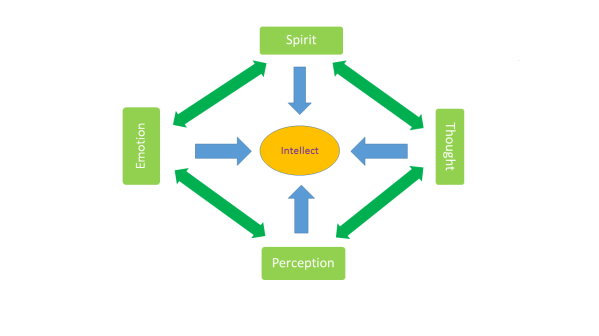
IntellectSo what is thought? In On Intellect, Jeff Hawkins of the Redwood Neuroscience Institute summarized the science that demonstrates that the cortex is a structure that categorizes experience to coordinate behavior. While initially that categorization would have been focused on the first three categories of intellectual stimulus, by the mechanism of network stimulation, eventually the internal operation of the network would have become an independent source of intellectual stimulus. Thus arose thought: the stimulation of the intellect by the brain.

Obviously thought has an ancient lineage, dating back even to insects. But full expression of its potentiality required coupling of that capacity to skills that could be used to reorganize the environment and thus control sensation. Birds and octopi manifest that to a limited extent, but primates to a degree that flowered to environmental dominance with the arrival of homo sapiens sapiens. We create tools that allow us to enhance our biology in real time, where every prior creature was allowed that opportunity – and then only imprecisely – through procreation.

While today we tend to emphasize the power of our material tools, the brain also allows a far more precise interaction with the spiritual realm. I understand that souls are composed of electrical charge decoupled from mass. Nerves channel and interpret the flow of electrical charge. As regards the emotions, nerves also affect our endocrine glands, muscles, organs and metabolism. Thus the brain provides methods for coupling thought to spirit and emotion, methods that are far more powerful than the couplings previously available to intellect.

As the influence of spirit is most evident in social activity, we should note the importance of language in facilitating the coupling of spirit to thought. While all mental states are abstractions of the underlying reality, words alone are capable of conveying our apprehension of that reality to another. Modern cultures are rooted in the conventions adopted for the association of words with experience. The ability of communities to coordinate effort to solve problems depends on the consistency and integrity of their use. Communities that honor clarity and honesty evolve social structures that may manifest as completely new forms of spirit. The ancients recognized these as “gods.”

Love of Wisdom

I have proposed to characterize Philosophy – the “love of wisdom” sought by the ancient Greeks – as study of the operation of the intellect. Here I understand intellect not narrowly as a manifestation of reason, but broadly as any process that couples the behavior of a living organism to the world around it. Intellect, in this view, mediates the interplay of the elements of reality through living creatures. Bringing together in humanity the dexterity and strength to create tools with the capacity of thought, nature manifested the potential to outgrow Darwin’s evolution through natural selection. Philosophers seek to organize that effort.

If that effort occurred in a vacuum, we might better be able to measure our progress. But it does not. Humanity is the culmination of a billion years over which life insinuated itself into the material substrate of the earth. That integration involves enormous amounts of energy, and disruption of the natural order threatens all of the higher lifeforms with extinction. The complexity of ecosystems makes it almost impossible to predict accurately the consequences of human intervention, and our facility with tools means that often we are the last creatures to feel the full force of disruption. Whether through clear-cutting of forests, the suffocation of once-fertile soils with covers of asphalt and concrete or the ubiquity of air conditioning, in fact our disruption of ecosystems often produces immediate advantage for us.

Our indulgence of those opportunities is a sign of dangerous immaturity. That immaturity is most dangerous in two scenarios. The first is when our primitive animal instincts infect our thinking, causing us to engage in contests for dominance using the most sophisticated tools that we can create. During the Cold War, the world as a whole was threatened by the nuclear arms race. While most nations appear to have recognized the insanity of direct military conflict, many nations still seek to define spheres of cultural hegemony through practices that require profligate consumption of fossil fuels. Unless reversed, that consumption will see human civilization destroyed by global warming. This second threat – the danger of inattention – manifests over many generations, and while no less deadly is far harder to address, not least because in the short term many beneficial outcomes accrue to the exploiting communities.

Under such circumstances, most parents deny children access to firearms and matches. And so it is with our spiritual predecessors. As they began to understand our potential by exploration of our minds, they have been forced to resist our head-long rush to Darwinian dominance.

If this sounds incredibly complex and ambiguous, it is. Most of the early philosophers counseled their peers to reticence. They sought to create a safe preserve for the operation of thought. Over time, that manifested through the formation of ideas that stood as bastions against disruption of human intellect by base motivations.
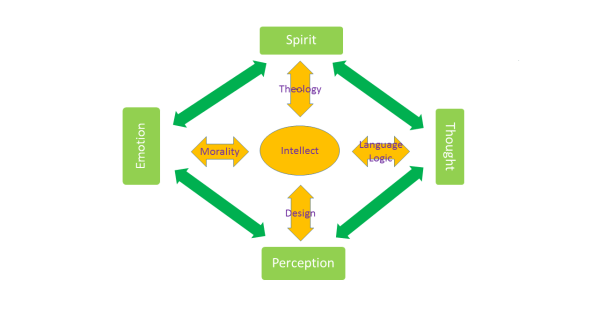
PhilosophyThe principal threads of philosophical discourse can be understood as filters through which the human intellect manages its interaction with the sources of our mental states. At the interface to the physical world, we have the discipline of design that encompasses art as well as science and engineering. Design is concerned not only with the limits of practical possibility, but with ensuring that the environment that we create accommodates our emotional needs. Ethics attempts to organize and discipline our emotional experience, building reserves of good will that facilitate collaboration. Language and logic tame the profligate domain of thought, which if left unchecked devolves into incoherence or insanity. And at the interface between intellect and spirit, we have the bastion of theology that ensures that our faith is invested with personalities that respect our potential and seek to facilitate its flowering into mature judgment.

The history of philosophy demonstrates the difficulty of expanding the scope of human intellect. In the early days of Christianity, theology was considered dominant, but today design seems to be the most powerful method for bringing reality under human control. The unbridgeable gulf between physical reality as interpreted by our senses and the abstract realm of thought has long frustrated philosophers, and Aristotle’s dominance of intellectual discourse for 2000 years reflected in large part his belief that careful observation and logic could narrow that gap. Unfortunately, the strides made by technological innovation have allowed the spread of narcissism that undermines the work done by political theorists most concerned with the balance between morality and theology (nations being gods of a sort). Perhaps recognizing the futility of imposing purpose in the world, Post-Modernism celebrates the interplay of thoughts without reference to other experience.

And so it has been in age after age: profound thinkers set off to expand the scope of human intellect by focusing narrowly on opportunities in one discipline or another, only to have their successors shout “But you forgot about this!” In making clear the complexity of the philosophical quest, I hope that I will encourage future generations to humility, and the realization that no single mind can hold all the answers. Rather, not just the richness of human experience but our very survival is dependent upon the degree to which we allow our intellect to be disciplined by compassion in our hearts.

The Philosophical State

In parting, I offer these conclusions regarding my sense of where we should focus in the next era of philosophical discourse.

Concerning design: While nature holds its secrets, the Promethean fecundity of creative intelligence allows us to explore configurations of matter that could never be attained through other means. The sublime divinity of that capability must be yoked to compassionate service to life.

Concerning language and logic: No intellectual activity is sustainable unless we seek to honestly, clearly and precisely express our experience and expectations of this reality. In debate, we must avoid egotism that prompts us to consider our perspective to be superior to the perspective of other living things.

Concerning ethics: Morality is found in any system of values that expands the domain in which love is expressed.

Concerning theology: If love is a seeking after opportunities for the object of our affection to receive affirmation, then in its selflessness unconditional love is the only incorruptible unifying principle worthy of our faith.

Blessings and honor are due any that undertake to further the project of philosophy. I pray that some benefit may be found in the thoughts that I have here offered.