Loving Ourselves For Who We Are

My first encounter with transgender reality came when I was in graduate school. I worked on the top floor of the physics building at Lawrence Berkeley Laboratory. This was not a stuffy community – facility announcements were prefaced by a breathless woman asking “May I have your attention please? May I have your attention, please?!” But on the floor just above, at the end of a long dark hallway, the only female technician in the building had her workroom. Nobody seemed to spend much time down there, and a machinist finally clued me in “He went away one summer and came back a woman.”

I have to admit that this choice is problematical to me.

Here’s a less extreme example: I met a man who explained that he felt like he had two personalities, one male and one female. He was a large man, but felt compelled on occasion to wear women’s clothes. What I eventually came to understand was that as a father in a previous life, he had gone down in a ship with his young daughter. The girl had hidden herself in him as they drowned, and part of the work he was doing in this life was to give her the opportunity to work her way out again.

There are men that spend all their lives trying to get into a women’s bodies, and often they do so using methods that are psychologically or physically abusive. There’s a certain symmetry in being reincarnated as a woman. Should we have sympathy for their desires to become men again? That was the opinion expressed by a Unitarian Universalist minister. The UU movement famously supports LGBT choices, and the minister asked us on that day to try “walking in his shoes.” I had to hold my tongue, knowing that she wouldn’t understand, but what came to mind was: “But that’s just what he’s doing – learning what it’s like to be a woman so that he can have some respect for their needs! How is that end going to be furthered by supporting him as he – yet again – mutilates a woman’s body?”

Carlos Castaneda described the view of the Yaqui sorcerers regarding gender. Masculine and feminine souls have different topologies – one projecting and one receiving. His adherents evolved a discipline called “tensegrity”, and believed that the womb gave women enormous spiritual power, power that a man’s genitals could never challenge. But the Yaqui view was that all such power originated in the soul – in fact Castaneda encountered a masculine sorcerer that had turned himself inside out, and so presented as a woman.

If the soul is what matters and persists, then a man like Bruce Jenner will find himself back in a woman’s body again. In this life, why not get as much benefit from being a man as he can? He was put here in a man’s body for a reason.

But his struggle to become a woman may be of help to the rest of us. Science can’t really explain our sense of gender identity. Maybe Jenner’s choice creates another opportunity for society to recognize that gender is not simply about biological form.

Sexual arousal is a consequence of a yearning of one spirit for another that causes blood to pool in the parts of our bodies that feel most pleasure. That yearning is complicated by procreation, which at this point is overburdening the carrying capacity of the earth. Perhaps homosexuality is a way of freeing our ecosystems of the physical side-effects of the deepening of our spiritual relations?

But isn’t that a distorted view of life – that our sexuality defines our deepest relationships? In my thirties, I was taken aside on two occasions and warned that gay men weren’t accepted in the top levels of the institution that I was working in. Being someone that dreamed every night about women, I never got the message: my failure to engage sexually made people assume that I was gay. That I was committed to a relationship built upon intellectual and emotional compatibility seemed to escape them.

I know that my workmate in college was a terribly unhappy person – their physical transformation was incomplete, and therefore unsatisfying. It also came with terrible social ostracism. Why do doctors then pursue this craft? Is it merely so that the superficial external presentation matches the internal reality, so that those that see sex as a mechanical activity will not be surprised when the inner personality – the very soul of the man or woman they are loving – comes to the fore? Wouldn’t it just be better to prepare people to recognize the nature of the soul that they are pursuing, and thus to learn something about their inner selves at the same time?

In spite of all of my questions, I feel no hostility to the transformation being pursued by Jenner and others, unless that it seems to involve an enormous investment of energy. I guess that as long as they can afford it, it’s just another experiment in living. Let us know how it works for you!
The Battle Over Personality

In attempting to penetrate the cultural prejudices against spiritual experience, I sometimes feel a certain historical sympathy for those arguing against flat-earthers. The doubter could argue against the roundness of the earth by insisting that he has never had any reason to believe that the world isn’t flat. That his experience was limited to a ten-mile radius around his place of birth didn’t matter much.

Against declarations of faith in the existence of God, the scientific materialist will often say things like “Well, I know that when I jump off a bridge, I’ll fall into the river. You can’t say that about God.” When I describe my experience of spirituality, including events that can’t be explained by accepted scientific theory, I am told “Well, it’s OK for you to believe in God.” That these events are just as real to me (and others that have witnessed them) as jumping off a bridge seems to escape their grasp. I really don’t need anyone’s permission to have them – and as scientists shouldn’t they be at least at little bit curious as to why I do and they don’t?

I have suggested that Christ doesn’t create faith through force – but rather by posing people a problem bigger than they can solve, and then giving the power to solve it. When my children worried to me about my financial circumstances, I always said to them “Well, money is only a means of storing power – and all my power is wrapped up in trying to solve a very, very difficult problem. There’s just none left over to save.” But because love does not wait, I am confident that if the problem can be solved at this point in history, it will be solved. Otherwise, well, I’ll have left some bread on the water for when I come back to try again.

So I might suggest that the difference between me and those that judge my faith is humility. Scientists are really proud of their science, and of the skills and strength of mind that allows them to apply it. Conversely, my experience includes being told by a fortune teller one night “Brian, we know that you think that you’re failing, but try and remember what it would have been like if you hadn’t been here at all.”

So if the problem for the scientist is pride, do they have no basis for their pride? I would say that, yes, they do have a basis for pride. We have turned the world into a garden, and so tend to forget that nature is just a terribly destructive place. Science – which is the study of the behavior of things that don’t have personality – has allowed us to mitigate against disease, predation and the elements, and helped us to anticipate and manage natural disasters. That success is obtained with theories that completely ignore personality. So we think of the animals in a stock yard as simple meat factories. The trees that we chop down are just wood.

The value of the scientific pursuit is, of course, to extend our lives, but it does so at the cost of our spirituality. Living is the opportunity to do work on our souls through the experience of having a body. We need to reclaim that ground from the scientific mindset that sees us as simple flesh popsicles, dancing on the axonic threads that originate in our brains. We need to reclaim our personality – which is to say the conscious engineering of our souls through engagement with the physical reality around us.

And when we have surrendered our pride and greed, an even greater adventure awaits us: calling out of hiding those spirits that we have terrorized with our science, and bringing their skills to bear in creating a garden that serves all the forms of life on Earth, rather than just humanity.

The Relative Incoherence of Special Quantum Spirituality

We in the West see the attempt to reconcile physics and spirituality as an Eastern concern. Indeed, it is the Vedantic philosopher Deepak Chopra who most vigorously engages Western science in that debate. The Western prejudice, however, is supportable only for those with a selective memory. Following the discovery of magnetism in the 19th century, “Mesmerists” were popular in Europe. The practitioners would demonstrate their mind-control abilities by touching the cranium of a susceptible assistant. When one was brought to trial for fraud, the scientists of the era actually testitfied in his defense.

Keeping in mind that history, I tend to be sympathetic to Chopra and his partisans. Unfortunately, they are chasing after rainbows, and creating a lot of confusion as a result.

Richard Feynman, brilliant quantum theorist, observed that quantum mechanics was a mathematical procedure without philosophical foundation. That’s pretty unique to 20th century physics. Prior to that time, the scientist could always build mental pictures of the interactions between the elements of the model. This was a practice that they attempted to apply to Quantum Mechanics and Special Relativity as they evolved, with unfortunate results.

This desire to provide explanations was carried forward during an era in which the basic tenets of the theory were still being worked out. Sometimes the preliminary theory would be applied in way that later scientists would consider incomplete, but a sensible answer would be obtained. The answers were published, often with popular interpretations of what was going on in the underlying reality. What is perhaps not surprising is that the popular interpretations are more widely known today than the actual theory itself. Because the interpretations were based upon bad science, they create confusion in the public mind.

To illustrate: in Special Relativity, Einstein held that clocks appear to tick more slowly when they move rapidly with respect to the observer. Based upon this, a thought experiment was constructed involving two twins, one of whom travels to a distant star and returns much younger than his sibling that stayed home on Earth. The calculation assumes, however, that the traveling twin reverses instantaneously his speed and direction upon arrival at the distant star. Obviously, if this was the way that the space ship was designed, the traveling twin would be just so much pate upon returning to Earth. No, the ship must decelerate and accelerate. When that part of the mission plan is included in the calculations, it turns out that the special relativistic effects disappear completely. The twin paradox is a hoax.

In quantum mechanics, we have the famous “wave-particle duality” and “wave function collapse”. Wave-particle duality was “proven” by electron self-interference: an electron impinging upon a screen with two closely-spaced slits will not be seen in two spots on the far side of the screen, as though it had passed through one slit or the other, but instead be distributed over numerous islands of intensity, as though it was a wave that had passed through both slits. The problem in this calculation is that in quantum mechanics, the behavior of any one electron can only be understood by considering the behavior of all the electrons in the system. The failure to include the electrons in the screen in the calculation leads to at least one paradox, and precludes alternative explanations of the observations.

“Wave function collapse” was an extension of “wave-particle duality” to scattering problems. In classical mechanics, when two billiard balls collide, we can predict the final state of the balls from the initial state. Not so in quantum mechanics: scattering objects spray about more broadly. However, the rules of energy and momentum conservation still apply. Therefore, measuring the final state of one of the scattered particles determines the state of the second. The first measurement causes the possible final states of the second to “collapse” to a single allowed result. This led to the idea that the conscious act of observation affects the behavior of physical systems. The “Schrodinger’s cat” thought experiment is the popular expression of this idea. But there are many types of uncertainty in quantum mechanics, and just because the observer doesn’t know the final state of the particles doesn’t mean that they particles don’t have a definite state. They may “know” perfectly well what their direction and speed of motion is.

The weak practice and explanations offered by early quantum and relativity theorists open the door to mystics seeking to explain their experience of reality. The acausal connectedness of mystical events (what Jung called “synchronicity”) seems to correspond to the complex structure of time in special relativity. The interaction between consciousness and physical events in Schrodinger’s world corresponds to the mental powers of the guru.

But the fact is that the theories, while describing unfamiliar behavior in fundamental particles, are completely inapplicable to the behavior of macroscopic composites such as people. The probability of seeing quantum behavior in a macroscopic object is so minute that the Eastern mystic must hold his experience as a refutation of quantum mechanics. That leads in the direction of new physics.

At this point, I would argue that the most powerful laboratories of the modern era will be our minds, rather than the billion-dollar observatories that the scientific-industrial establishment insists the public must fund. The ultimate proof of the power of a theory will be not in how it empowers us to manipulate objects without personality, but rather in the degree to which it makes us transparent to the flow of Divine Love.

In God’s Hands

My book signing on Saturday started off slowly. The venue is a wonderful place to browse, though. (If you live in the Thousand Oaks area, please stop by and check out The Open Book in the Oaks Mall.) So, to avoid filling the air up with anxiety, I tried to find the second part of The Tales of Genji (alas – they had sold the collection of vintage books that I had pulled it from), and ended up perusing a collection of 19th century horror stories.

Being clever people, the staff had set my table up in front of the New Age and religious inspiration section. I had a few chances to say “hello” to those that stopped to browse the blog posts I had reprinted or look at the book covers. The reactions weren’t always encouraging: one man simply scowled and went around to the New Age section. Another woman engaged me with a hostile tone of voice, asserting “Love works because people make it work.”

This was beginning to feel like my first book signing, when I spent most of the day dealing with the baggage brought by people who had found reasons to stop believing. Feeling a little food coma along with the disappointment, I stepped out to buy myself a coffee. When I came back up from the lower floor, I found the scowler with a new book, sitting in an armchair across from the store. I smiled and remarked “Well, you found something!”

A little uncertainly, he said that his brother had survived a near-death experience, and while he wasn’t quite sure about the whole business, he wanted to investigate. As we discussed religion and spirituality, I learned that he had been raised Christian, but was an atheist. Without prompting on my part, he explained that he suffered from a form of spinal arthritis. For most of his life, he had prayed to God for relief, and never received an answer. Then he had found a doctor who took interest in his case, and received treatment that made life bearable.

I couldn’t preach in the face of this testimony. There is nothing more difficult to bear than suffering that has been laid in the hands of God. But I did offer that God works through people, and that I was glad that his doctor had shown the compassion to take interest in his case. Then, hoping that somehow he’d find his way back to the source of Divine Love, I encouraged him to continue to study spirituality.

We parted amicably, and I went back into the store. When I reached the table, all of his loss and pain came pouring down on me. All I can do in those situations is try to breath, and let it settle through me into the floor. It passed in two great waves, and then I looked back into the doorway. He was staring at me, and I lowered my gaze to the floor. When I looked back up, he was gone.

For those in similar situations: don’t keep your eyes turned up to heaven. Yes, leave your suffering in God’s hands, but understand that, as Paul experienced in Damascus, his response is often to allow a compassionate person the opportunity to receive your gratitude. That is the great gift that the meek offer to those that bring them respite. Don’t deny it to the world!

Dawn of the Soul

Midi Berry’s newly published Nights of the Road examines the mystical power of feminine devotion. The nominal protagonist of the tale is Sarah, a British refugee from bad relationship mojo, taking up a life as a psychotherapist in Los Angeles. The power driving her spiritual awakening, however, arises from the 17th century, where her ancestor Frances Coke earns the regard of those surrounding the Stewart court as its excesses succumb to Parliamentary discipline.

When I was a child, my father declaimed modern music by observing that it was the discipline of classical forms that allowed composers to create pieces that challenged listeners without alienating them. This seems a suitable metaphor for the structure of Midi’s work.

In both time streams, Berry injects the theme of a woman committed to a natural love with a devoted partner, but challenged in her course by the passionate attentions of an unstable and possessive creative genius. In the Stewart Court, Frances is frustrated in her love by an arranged marriage, albeit to a man who – as long as the forms of the relationship are honored – kindly accepts her devotion to another. In modern Los Angeles, Sarah escapes a political marriage through emigration, and falls captive to the reborn creative genius whose attentions were frustrated by social strictures in the Stewart Court.

The novel evolves through a series of tetes-a-tetes between the romantic interests. Sarah employs the language of modern psychology as a shield against strong emotions, eventually drawing her two competitors – both previously members of a band called Nights of the Road (whence the title, in part) – into collaborative reconciliation. As for Frances, I found myself thinking that her attitudes were entirely too modern, but then realized that so were the attitudes of Beethoven and Brahms. Frances makes a decision early on in the book to believe in herself, and thus speaks her mind honestly throughout, and so perhaps reveals wisdom of the feminine heart that has been long suppressed.

I found myself at times wishing that Berry would bring us into some of the historical experiences discussed by Frances and her lover Robert. However, the emphasis of the book is on transformation of relationships, and there is a lot of valuable relationship modeling in the story line.

The most significant flaw in the story – and this is nit-picking – may be the lack of forecasting of Frances’s mystical ascension as her death nears. For those familiar with such events, this is foreshadowed by the affirmation by a noble protector that Frances’s beauty, compassion and devotion have brought her unsuspected admiration from the royal entourage. Unfortunately, for some the connection may be lost, and so her wandering down the psychic road as she nears death (whence again the title) may seem a little jarring, if not deus ex machina.

But the book’s final chapter is golden. Antony, the creative genius of Nights of the Road, manipulates masterfully Sarah’s emotions, and precious are the lyrics sung as reflections upon her impact on the men that love her.

Berry’s heart-felt tribute to reconciliation and redemption casts light on the challenges of being a muse, and presents wisdom that readers will usefully apply when seeking to understand and deepen their relationships. As the Brits would say: “Give it a go!”

That’s the Spirit

We’ve been building a model of the universe with superfluid dark energy, and introducing a “cold” alternative to the Big Bang theory. The model includes a possibility for gravitational attraction between defects in the lattice. Given that there are three other forces at play in the universe (electromagnetism and the “weak” and “strong” interactions), the model is obviously incomplete.

I’m going to throw out a model here that manifests interesting and theoretically relevant behaviors. I am certain that the model is incomplete – my sense is that the dark energy lattice itself has complex structure (I refer the reader to the image on the Generative Orders proposal). But the suggestions here should be enough to stimulate innovative thinking.

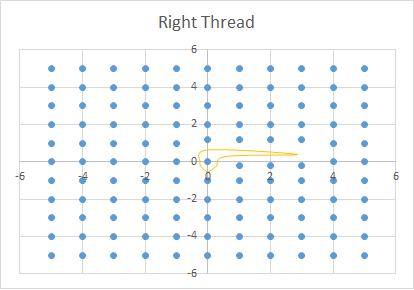
So what we need to propose is a model for our defects. It’s interesting to consider the defect to be a self-repellant loop that gets pinned to a node in the dark energy lattice. Now the lattice is going to tend to corral the expansion of the loop along a particular axis. The energy driving the expansion will eventually be spent in pushing the dark energy particles apart. We can imagine thus that the loop will oscillate back and forth, as indicated below with “right” and “mid” views. We can imagine the “left” configuration by rotating the “right” configuration through half a circle.

Right Thread
Mid Thread

Now let’s suppose that each point in the lattice can anchor up to two loops. How this is feasible is open to exploration. One way is for the dark energy to have structure itself. For example, it might be a little circle. Now there will be oscillation patterns that will minimize the interaction between the two threads. One possible pattern is shown below (the lattice is suppressed so that we can focus on the loop configurations).

Two-Thread Oscillations

We see that when one loop is clustered near the center, the other is extended. What is most important, however, is that when the sequence is followed clockwise, the pattern rotates clockwise. Reading in the reverse order reveals a counter-clockwise rotation. So this is a model for the top-like “spin” that was described earlier.

(NB: This is a terrible model of intrinsic angular momentum. A more fertile approach is to think about normal angular momentum, which arises when interacting particles are offset along the axis of approach. We then see that normal angular momentum is discretized in the lattice, because the offsets are discretized.

How is normal angular momentum conserved? Well, the model proposes that gravitation, electromagnetism and the strong interactions are all generated through the efforts of the lattice to minimize distortions. The specific character of each force reflects the degree to which a configuration of loops generates lattice distortion.

So angular momentum is conserved because the approach of the particles stores a particular type of distortion in the lattice that is released when they separate. Intrinsic angular momentum may be accommodated better by recognizing that the odd shape of the loop projections can be removed by offsetting the center of the oscillation by half a lattice point.)

Now the configuration with two loops should be fairly stable – it affects both directions equally, and so shouldn’t create too much disruption when moved. However, the configuration with one loop will tend to whip around when it moves, maybe even causing the lattice to be re-oriented locally. Given our discussion of mass, it would appear that asymmetric particles (one loop in our example) will have larger masses (disturb the lattice more when moving) than symmetric configurations (two loops in our example).

One way to minimize the impact of the asymmetric configuration might be to couple them together. This would localize the impact of the thrashing around at large distances, at least if the asymmetric configurations were synchronized in their oscillations. This models the strong force, which binds fractionally charged particles inside the proton and neutron.

Yes: what I’m suggesting is that the loops correspond to particle charges. In our two-dimensional model, only three charge states are allowed (with 0, 1 or 2 threads), because only two directions are available for oscillation. In our universe, we have three dimensions, and so four charge states are possible. This is precisely what we see in the particle zoo, and the asymmetric particles (with fractional charges: the up and down quarks, for example) have much higher masses than the symmetric particles (the neutrino and electron).

Adding a symmetric particle to a pairing of asymmetric particles might further stabilize the lattice. This is analogous to an electron bonding to a proton.

Now let’s tear our understanding of reality completely wide open: why should the loops be constrained to be bound to the dark energy lattice? What if they were able to form structures among themselves, structures that stored energy in the lattice by causing it to expand in their vicinity? Structures that could contain and process information? Structures that might even be able to open holes in the lattice that would allow particles to travel faster than the speed of light?

That’s the spirit, people.

I hope that you’re taking mind. Our brains are only interfaces to these structures. Our souls are the eternal part of us, bonding again and again to matter through our multiple lives, and using those opportunities to do a certain work on themselves.

Now I beg you, please read The Soul Comes First. While selfish configurations of spirit tend to dissipate the energy stored in the dark energy lattice, mutually supportive configurations have stored up an enormous amount of energy over time. They impose certain rules, and a failure to comply led to the destruction of the dinosaurs.

I believe in love, and I believe that at least a portion of humanity has enough maturity to master our baser urges. The Book of Revelation teaches that they will complete the work that was put before us in “Eden”. But I would like us to work efficiently to ensure that the predators, in their trashing about as they go down, are not allowed to do too much damage to the innocent.

Becoming a Man in a Woman’s World

On my fist visit to the Cathedral of our Lady of the Angels in Los Angeles, I was consciously assessing the state of a community that I expected to be seized by fear. The priestly child-abuse scandal that had been papered over in the ‘70s had re-ignited. Attorneys revealed that many of the perpetrators had been hidden in the church hierarchy, and some had been allowed to resume children’s ministry. Cardinal Mahoney himself was accused of complicity, and huge financial claims were leveled against the Church.

What I discovered, as I wandered around the periphery of the celebration, was that it was infected by a subtle competition for dominance. Every member of the worship team wanted to lift the pall, to re-establish the connection to Christ, and no longer trusted the authority of the prelate. So I listened carefully, echoing back what I heard, and tried to celebrate harmony when it appeared. The cantor went and sat with the choir, and when he came back down to the podium, the competition surrendered to glorious praise.

As I wandered in the space, I got a few disturbed glances from the ushers and deacons. But the confrontation came from a middle-aged woman who, as I stood in the back enjoying the music, approached me and hissed “Say the words!”

I experienced this again when I went down to Orange County to the enormous campus of a renowned evangelist. This time I sat in the fourth row from the stage, and as I probed the spirit of the congregation, he stared pointedly at me. I stayed for a second service, this time sitting in the back rows, and he announced that he had been talking to Jesus every day of his adult life. A little non-plussed, I poked around and discovered that it was his wife and her girlfriends that were presenting the counterfeit.

I won’t assert that these incidents are typical of the “male-dominated” religions, but neither are they rare. They illustrate the temptations of maternal power. If a man and his wife become “one flesh” through intercourse, how much deeper are the bonds that link a mother and the child growing in her womb? The sin that exists in abortion is that the two spirits, rather than separating through birth, remain bound up together. Inevitably a struggle for dominance develops. Even if a normal delivery occurs, male children remain buried in a feminine psychology. This is untenable. While a woman can tell a man whether he satisfies her physical and psychological needs, she cannot connect him to the sources of spiritual strength that make it possible for those needs to be met.

Particularly in affluent communities, where housewives often find their worth measured by the strength of their children, boys face enormous challenges in becoming men. Mothers have difficulty letting their children go. I saw this manifested when I volunteered as a teacher’s aide in elementary school. I was the only father to so participate in kindergarten. I was involved in a divisive custody struggle at the time, and faced a prejudice that I was simply there for legal reasons. That was not true – I really wanted my sons to have a concrete sense of how important their education was to me. But the teachers and mothers struggled with my presence.

In my younger son’s class, lessons were tutored at tables marked by pictures. I was never assigned to the teacher’s table until I took my sons to a swim party. One of the activities was water volleyball with a huge bouncy ball. The event facilitators stood at the back of the court and, though trying to be as gentle as possible, served the ball with force that simply overpowered the kids. I finally got my hands on the thing and walked it up to the net, asking “Who wants to serve it?” Holding the ball over the child’s head, they knocked it up into the air, and the children on the other side clustered under the ball. No longer having to absorb its momentum, they knocked it back over the net. Laughter and shouting replaced the bored frustration.

When I next went in to class, the children embraced me with their hearts while the teacher read a story. The birthday girl turned around and smiled at me, and the little community of children finally overwhelmed the resistance to my presence that had been established by the mothers and teachers. I was allowed that day to tutor at the “red heart table.” But consider: only because one of the daughters let me in.

So when feminists decry the disempowering psychology of “male-dominated” religions, I get a little frustrated. Given their powerful psychological influence on little boys, maternal projections of anger towards men are a destructive burden. I would prefer that women celebrate the strength that they gain from participating in Earth- or Goddess-centered religions, thus advertising what men are missing. And I would also prefer that they celebrate the teachings of the avatars, none of whom rejected the participation of women. Even in the Hebrew tradition, a woman’s spiritual power is recognized: inheritance of the tradition is through the mother.

But the only way to make sense of the story of Abraham’s lineage is to realize that Joseph, the child left without a protector in his father’s harem, became a glorious man because his father took him under his wing. Boys need fathers, and women need to be cautious against using their children as leverage in their relationships. It leaves them with weak sons that attain independence only through rebellion, and the problems of managing the predatory women that they attract. When that consequence is recognized, it seems unfair to castigate men because husbands, spun up by sex and greed, go out into the world to plunder and pillage for the satisfaction of their wives.

Jesus’s Greatest Gift

Christians take pride in the claim that Jesus never violated the Law of Moses, but Jesus himself didn’t seem to consider that to be terribly important. When called “Good teacher”, he replies [Mark 10:18]:

Why do you call me good? No one is good-except God alone.

In fact, in his teaching, Jesus pares down. To the rich young man seeking to know the path to eternal life, [Mark 10:19] Jesus says:

You know the commandments: ‘Do not murder, do not commit adultery, do not steal, do not bear false witness, do not defraud, honor your mother and father.’

And when the lawyer asks for the greatest commandment [Matt. 22:37-40], Jesus says:

‘Love the Lord you God with all your heart and with all your soul and with all your mind.’ This is the first and greatest commandment. And the second is like it: ‘Love your neighbor as yourself.’ All the Law and the Prophets hang on these two commandments.

What is going on here? The pride of the Hebrews was their Law, but Jesus did not come and say,

“Very good, proud servants! You have mastered the 613 edicts of the Law! Now, let me finish it for you!” With a wave of his hand, a completed wiki of law appeared, covering all of life’s possibilities.

No, he said “Use your heart and mind and soul. You love. You draw near to God. You go out and serve your neighbors.”

Adam and Eve failed in Eden because they were weak. The Law of Moses was a prophylactic – an intellectual condom – for those still suffering with that weakness. But after millennia of wrestling with the interpretation of the law, Jesus called his people to leave it behind.

His final refutation was to rise from the dead after the Law was used to destroy him.

Can the rest of Humanity do the same? Some of us, yes, for he says to his disciples [Matt: 16:24]:

Whoever wants to be my disciple must deny themselves and take up their cross and follow me.

But obviously that was not what he told others (see above).

So why do so many Christians impose rules? Because in a broken world, love hurts. We open our hearts to people and they pour all their poison into us. But Jesus has an answer for that. He says, “I will die for the forgiveness of sins. Pour their poison into me. I will take it from you. I will make the weak strong. I will support the burdened. You – you, dear child of God – you go out and love.”

From our weakness and dependency upon the rules that limit us, Jesus makes an escape into the infinite possibilities of love.

The Peace of the Grave

In The Soul Comes First, I include Death among the forms of selfishness that the angels release onto Earth for healing. I characterize it as “which destroys utterly”, but I have realized that is unfair. It is how it appears to the rest of us, but the elements of a soul cannot be destroyed, only repurposed. No, it only appears to us that Death destroys the ones that we lose.

Death cuts a soul off from the dance of life. It enters in as a shroud around our spirit, and chokes off the links that tie us to others. We can no longer share ourselves. How is that selfish? Well, Death does not give up its victims willingly. It collects spirits, like insects in amber.

So how is Death redeemed by Love? Jesus’s resurrection proved that Love pierces the veil of death. That control allows lovers respite from the burdens of the world. They can withdraw and process the pain that they receive when healing broken hearts.

Through love, we can control the veil of death, and find peace for ourselves when we need. In love, we find ourselves always yearning to return to the dance of life with others, and so do not remain isolated.

Unless, of course, we don’t build links of love to others, and then death is a terrible and permanent isolation – which is why selfish people fear it so much.

I am astonished by parallels with the process of birth. A spirit separates from the chorus of heaven and enters into the mother’s womb to be bound to a body. The end of that process is a violent forcing out that can break the spirits of either or both participants. The spiritual cycle is almost manifested in the act of birth itself, and I believe that among a woman’s spiritual challenges is the essential intimacy of life with death.

What did this mean for the Magdalene? She was confronted with a glorious man who was committed to a confrontation with death! But his glory is a manifestation of the beauty of the spirits that choose to surround him, and what woman would not want the joy of bringing such spirits into the world? I see her almost swept away by this passion for the life of him, so he cautions her in the cemetery:

Do not hold on to me, for I have not yet ascended to the Father.

He had not yet purged himself of the pain that had been forced upon him, and in clinging to him she was binding herself to that pain.

Among the Biblical commentators are those that see Mary Magdalene as the bride of Christ, but I hear in his words a caution to a woman swept up by events beyond her comprehension.

But there is another among Humanity’s pantheons who might understand, because her experience parallels that of Jesus. The Greeks tell of a goddess, Persephone, daughter of Demeter, who was given up as a bride to Hades to prevent his melancholy from consuming the world. The rest of the world found life in the sacrifice of the jewel of womanhood, foremost among Death’s treasures, whose grace fascinated his attentions. In Spring, she was released from Hades for a day, and life returned with her. If there are any among Death’s captives who deserve liberation, foremost among them is she!

Oh, Christ, bring her forth, and let her inspire us to protect nature, rather than destroying it so that we might profit! Bring us peace, not through death, but a lasting peace built upon the wisdom gained in our long struggle to master the Knowledge of Good and Evil!

The Great Divide

The Bible documents the progress made by the Holy Spirit in preparing men to fulfill the role that was forsaken in Eden. It comes with a cost, though, and that cost is no longer supportable. The division between men and woman must be healed.

It was this concern that compelled the writing of Ma.

Being a single man, there’s only so much of this road that I can walk down. In the preface to Ma, I emphasize the grace of the gifts that women possess, and much of the book is a celebration of feminine spirituality. That’s not nearly enough, though. As I man, I feel compelled to take ownership of the problems that men create for women.

The book addresses head-on the central problem: while a craving for physical intimacy is the force that most often compels us into relationships, it’s also frequently the fuel that destroys them. I’m not thinking only of hedonism: powerful men often use naïve women for sexual pleasure, and those women can find themselves eaten up by the spiritual side-effects of conflict.

So Ma will shock most Christian readers, because it starts with two scenes of physical intimacy, rendered in detail. I try to evoke the full power of such experiences, their mystery and wonder, and the two extreme contexts in which they are corrupted: the casual hook-up and the emotionally impoverished political liaison.

The book progresses from those experiences as a slow-motion train wreck, in which the men are confronted with choices between healing their women and the glory of virtuous accomplishment. They are two very different people, and readers will almost certainly sympathize more with one than the other. Along the way is a lot of speculation about the intersection between science and spirituality, social philosophy and cosmic adventure, but in the end the story is meditation on how to redeem the love shared by men and women.