Spirituality without Religion: Hope or Hoax?

Sam Harris has amassed a fortune decrying religion. His latest best-seller, Waking Up: A Guide to Spirituality without Religion, describes a journey that I must herald as a step towards personal maturity. I won’t consider the details, because his preface was enough to let me know that he’s got a long, long way to go. Harris asserts that our minds are the only tools that we have to manage life’s challenges. That’s a sort of lobotomy, and the best response I can offer is that of Hume. Following Hobbes’s characterization that the experience of most is of:

continual fear and danger of violent death, and the life of man solitary, poor, nasty, brutish and short

Hume diagnosed that Hobbes had forgotten “the operation of his own heart.”

That may seem a small point, but a compassionate heart is the singular difference between a monstrous ego and a great personality. In its lack, the rational mind tends to the conclusion that everything that violates its logic is error, possesses no value, and thus should be destroyed.

This is the conclusion that the anti-religious have indulged in for far too long.

Now I hope that Harris will eventually confront the errors of the axioms that allow him to conclude that religion has no value. Foremost is the confusion of correlation with causation: the fact that the brain is essential to the physical manifestation of our will does not mean that our will arises from the brain. The soul does exist. When that is recognized, the heart becomes full, and logic leads us to a different set of conclusions.

For example: Harris’s book bears the picture of a face superimposed on the cloudy heavens. What happens when spirits collide in that space? How do we negotiate conflicts? Only by resort to institutional structures staffed by experienced arbiters. That is religion.

The second erroneous axiom is that the mythical aspect of scripture proves the unscientific world view of our intellectual predecessors. Far be that from the truth: those men and women were investigating aspects of reality that Harris has yet to encounter, and doing it using practices that, if one strips away the branding, are scientific in their core. That wisdom was transmitted to us from the past through – you guessed it – religion. The alternative offered us in the modern age – schools – are prey to short-term political fashion, also known as propaganda, and pit students in a competition that places knowledge above compassion.

The alternatives to religion that Harris offers, at least in his preface, are use of psychotropic substances (a.k.a. – illegal drugs) and meditation. The former is pathetic: I raised my sons with the wisdom that love is the anti-drug. Using drugs to temporarily achieve an elevated psychological state is no substitute for submitting to the discipline required to sustain loving relationships. Lacking that discipline, the craving for love, which is built deep into our hearts, leads to abuse of drugs and self-destruction. What institutional structures confront us most meaningfully with the practice of emotional discipline? Well – religions.

Meditation is where I find hope for Harris. Meditation serves to reveal the preconditioning of our minds that prevents us from accurately perceiving experience. Through it, as Deepak Chopra inveighs in The Future of God, the seeker after truth eventually confronts the reality that love exists even when no person is present, even when no drug stimulates our senses and minds, even when we do nothing. That is the nature of God – and for reasons I have outlined elsewhere, that is the only God that could ever exist. Nothing but unconditional love can bind together things that want to be apart: the Greek word religio meaning to bind anew.

When Harris encounters that presence, I am certain that he will want to find a place in which to share his joy. That would be, of course, to find religion.

My Marvel-ous World

I was a serious comic book collector while I was in college, and have been impressed with the movies that have been built around those titles. They are an introduction to the problems of growing into the powers that humanity must manage if it is to serve the purpose that the avatars of the great religions have put before us – to liberate ourselves from fear and master the skill of spiritual healing. They fall down terribly, however, in suggesting that childish mayhem will be supported by the elements of reality that empower such work, and tolerated by those that manage it.

While the Bible is of interest to me as a record of progress made in the past, it doesn’t provide much insight regarding the psychology that liberates us from fear and empowers us to perform great acts of spiritual healing. So I decided to make an attempt to describe that state of being. The first part of that exploration is the book Ma. I have now finished its sequel, Golem. The latter proposes a challenge to humanity – something that we can consider doing – as well as trying to illuminate the challenges of godhood, and the sense I have that it is a cycle.

Christian readers will be scandalized, perhaps, by my version of the second coming. More broadly, one of my readers has offered that I write great sex scenes. That was apparent in Ma, and in Golem the joyous claiming by Leelay of her right over Corin may lead some to cry “pornography”. C’est la vie. The author has his rights.

So I’ll be picking up my flute again, cleaning and dusting my apartment, and trying to figure out what to do with Golem. To this point, Ma and The Soul Comes First are commercial failures – which was pretty much as I expected. I had to give them a chance, though, and invested a lot of money in the effort. I may append Golem to Ma, which is only 50,000 words, and republish the latter. I’m sure that Trafford would like me to publish it as a separate volume. But I may also just give it away – putting it up on Good Reads and here.

As well as finishing the last 40,000 words of Golem, since November I’ve put up another 100,000 or so here. I’m going to be creating reference pages for that material. The first bookmarks the posts in my series on new directions in fundamental physics. Another will focus on Christian theology. It’s pretty heavy going, I understand. I should be able to shift to a lighter mode now that the basic message is out in the world.

Thanks to all of you that have been reading!

That’s the Spirit

We’ve been building a model of the universe with superfluid dark energy, and introducing a “cold” alternative to the Big Bang theory. The model includes a possibility for gravitational attraction between defects in the lattice. Given that there are three other forces at play in the universe (electromagnetism and the “weak” and “strong” interactions), the model is obviously incomplete.

I’m going to throw out a model here that manifests interesting and theoretically relevant behaviors. I am certain that the model is incomplete – my sense is that the dark energy lattice itself has complex structure (I refer the reader to the image on the Generative Orders proposal). But the suggestions here should be enough to stimulate innovative thinking.

So what we need to propose is a model for our defects. It’s interesting to consider the defect to be a self-repellant loop that gets pinned to a node in the dark energy lattice. Now the lattice is going to tend to corral the expansion of the loop along a particular axis. The energy driving the expansion will eventually be spent in pushing the dark energy particles apart. We can imagine thus that the loop will oscillate back and forth, as indicated below with “right” and “mid” views. We can imagine the “left” configuration by rotating the “right” configuration through half a circle.

Right Thread
Mid Thread

Now let’s suppose that each point in the lattice can anchor up to two loops. How this is feasible is open to exploration. One way is for the dark energy to have structure itself. For example, it might be a little circle. Now there will be oscillation patterns that will minimize the interaction between the two threads. One possible pattern is shown below (the lattice is suppressed so that we can focus on the loop configurations).

Two-Thread Oscillations

We see that when one loop is clustered near the center, the other is extended. What is most important, however, is that when the sequence is followed clockwise, the pattern rotates clockwise. Reading in the reverse order reveals a counter-clockwise rotation. So this is a model for the top-like “spin” that was described earlier.

(NB: This is a terrible model of intrinsic angular momentum. A more fertile approach is to think about normal angular momentum, which arises when interacting particles are offset along the axis of approach. We then see that normal angular momentum is discretized in the lattice, because the offsets are discretized.

How is normal angular momentum conserved? Well, the model proposes that gravitation, electromagnetism and the strong interactions are all generated through the efforts of the lattice to minimize distortions. The specific character of each force reflects the degree to which a configuration of loops generates lattice distortion.

So angular momentum is conserved because the approach of the particles stores a particular type of distortion in the lattice that is released when they separate. Intrinsic angular momentum may be accommodated better by recognizing that the odd shape of the loop projections can be removed by offsetting the center of the oscillation by half a lattice point.)

Now the configuration with two loops should be fairly stable – it affects both directions equally, and so shouldn’t create too much disruption when moved. However, the configuration with one loop will tend to whip around when it moves, maybe even causing the lattice to be re-oriented locally. Given our discussion of mass, it would appear that asymmetric particles (one loop in our example) will have larger masses (disturb the lattice more when moving) than symmetric configurations (two loops in our example).

One way to minimize the impact of the asymmetric configuration might be to couple them together. This would localize the impact of the thrashing around at large distances, at least if the asymmetric configurations were synchronized in their oscillations. This models the strong force, which binds fractionally charged particles inside the proton and neutron.

Yes: what I’m suggesting is that the loops correspond to particle charges. In our two-dimensional model, only three charge states are allowed (with 0, 1 or 2 threads), because only two directions are available for oscillation. In our universe, we have three dimensions, and so four charge states are possible. This is precisely what we see in the particle zoo, and the asymmetric particles (with fractional charges: the up and down quarks, for example) have much higher masses than the symmetric particles (the neutrino and electron).

Adding a symmetric particle to a pairing of asymmetric particles might further stabilize the lattice. This is analogous to an electron bonding to a proton.

Now let’s tear our understanding of reality completely wide open: why should the loops be constrained to be bound to the dark energy lattice? What if they were able to form structures among themselves, structures that stored energy in the lattice by causing it to expand in their vicinity? Structures that could contain and process information? Structures that might even be able to open holes in the lattice that would allow particles to travel faster than the speed of light?

That’s the spirit, people.

I hope that you’re taking mind. Our brains are only interfaces to these structures. Our souls are the eternal part of us, bonding again and again to matter through our multiple lives, and using those opportunities to do a certain work on themselves.

Now I beg you, please read The Soul Comes First. While selfish configurations of spirit tend to dissipate the energy stored in the dark energy lattice, mutually supportive configurations have stored up an enormous amount of energy over time. They impose certain rules, and a failure to comply led to the destruction of the dinosaurs.

I believe in love, and I believe that at least a portion of humanity has enough maturity to master our baser urges. The Book of Revelation teaches that they will complete the work that was put before us in “Eden”. But I would like us to work efficiently to ensure that the predators, in their trashing about as they go down, are not allowed to do too much damage to the innocent.

Bibi, Stay Home

I wrote previously about the balance of powers problem in the federal government. As Congress continues to refuse to act on the pressing issues confronting the nation, President Obama has chosen to take executive action under existing laws to mitigate the developing crises in competitiveness (education), immigration and global climate change. The Republican-held Congress continues to complain.

While I believe that the House of Representatives under Boehner “dost protesteth too much” – after all, they have the opportunity to pass legislation – it seems more and more obvious that they pursue an agenda driven by narrow political calculation. I see the shadow of Karl Rove still lurking in the background. Rove was the campaign adviser that filtered for political impact all Cabinet decisions in W’s first term. He or his ilk appear to be doing the same for the Congress.

This began with the “poison pill” terms in the first-term budget negotiations that preserved high-income tax breaks. It continues with leaving Obama to wrestle with the nation’s intractable problems, and crying “foul” on separation of powers whenever a Republican constituent has an ox gored. And it proceeds now with a clear trespass on the President’s foreign policy remit with the invitation to Benjamin Netanyahu, Israel’s prime minister, to speak before the Congress.

Netanyahu is involved in his own political shenanigans at home. Prior to his election as prime minister, Israel was the target of frequent suicide bombing attacks. The terrorist attacks were the asymmetrical Palestinian response to ongoing Israeli settlement of the occupied territories. The stupidity of the strategy was evidenced in Netanyahu’s election in 2000, as the Israeli public eventually accepted his long-established “greater Israel” policy as the only way to restore internal security. However, years of secure living and the growing problem of domestic intimidation by Orthodox Jews is causing the Israeli public to broaden their concerns, and think fundamentally about justice. Raising the specter of Iranian attack preserves the political psychology that brought Netanyahu into office.

Israel has benefited from the action of both US presidents to serve in the 21st century. The removal of Saddam Hussein from Iraq ended a bounty program that paid $30,000 to the families of suicide bombers. US-led global sanctions against Iran have also prevented an end to Israel’s nuclear monopoly in the region. John Kerry has already made clear that the U.S. was motivated to a great extent by concerns for Israeli security, and Netanyahu’s panicked protests against diplomatic reconciliation between the US and Iran seems untrusting.

What other issues could be driving Netanyahu’s move? Obama has embarrassed him on at least one occasion in memory – letting comments regarding Netanyahu’s honesty slip out to the press during an open-mike chat with the French President. The rise of a respectable Palestinian counter-part in Mahoud Abbas has allowed the US to apply pressure against Israel to bring concessions to the negotiating table. (The lack of such concessions continues to place Abbas in danger from Palestinian extremists, making him dependent upon Israeli security, and thus undermining his authority.)

But the pro-Israel vote in America includes the historically Democratic Jews, and as we saw in 2000, that vote is enough to swing key states. So Netanyahu and Boehner have common cause in this engagement: embarrass Demcratic Foreign Policy to improve Republican chances for the 2016 presidential elections, and reinforce the ability of Israel to be the tail that wags America’s Middle Eastern policy.

Given this complicated political calculus, Netanyahu would be best advised to stay home, pursuing his agenda in coordination with the Administration’s Foreign Policy team. If this issue becomes a Republican talking point, placing the Jewish vote as a token to trade in the 2016 presidential election is going to reduce its strength over the long run. This is reflected in the decision by Democratic Representatives of Jewish heritage to boycott his speech. Once the Jewish vote is divided, there is less and less reason for any presidential candidate to cater to the concerns of Israel, while currently they get the best of both worlds: respected collaborators for Democratic presidents, and a justification for Republican hawkishness.

Hang It Up, Rudy

There’s nothing more mortifying than for a presidential hopeful to generate press by attacking the patriotism of a sitting president. Rudy Giuliani’s comments about President Obama “not loving” his country are just terribly pathetic.

The Republican Party, with it’s Neo-conservative economic policies (what Reagan extolled as “trickle-down” economics) has presided over a huge transfer of wealth from the middle class to the ultra-rich (what I decry as “tinkle-down” economics). Now, the only way that I have been able to make sense of “love” is as an investment in creating power in people. Taking their money is exactly the opposite of that.

Contrast this with the centerpiece of Obama’s domestic policy: the Affordable Health Care Act. This is an investment in the people of America. It ensures that individuals can get medical care before their ailments become debilitating, and thus that they can remain active contributors to our economy. It lessens health care costs because it keeps people out of the emergency room, and thus will lower rates for everyone over the long term.

Now that – that is loving.

So why isn’t that perspective shared by Giuliani and his cronies?

There are two kinds of people: those that project themselves upon the world (narcissists) and those that allow the world into themselves (empaths). The Republican Party is beholden to the former: people that believe that whatever works for them is what is right for the country. The Affordable Health Care Act created some losers – very wealthy people that made their money by ensuring that they minimized the number of sick people on their plans. This left a back-log that has to be paid down as coverage is extended without regard for preexisting conditions. This means that, in the short term, rates will go up – particularly for those people that were on preferred coverage plans.

Giuliani represents those people, and all I have to offer is that it is un-Christian to ensure that sick people cannot rely upon society to invest in their healing. When Giuliani has the courage to recognize the inherent selfishness of that attitude, then I might have some confidence that, if elected president, he might actually love the people of this nation. And I don’t mean just the rich cronies that line his campaign coffers. I mean all of the people.

Shedding Light on Light Mysteries

In the last post, I identified correspondences between superfluid motion and the phenomenon that are described by the equations of quantum mechanics and special relativity. The discussion leads to the assumption that light is a disturbance in a cold – and therefore highly ordered (“crystal-like”) – sea of dark energy.

The illustration in that post showed a perfect lattice, but given what we know about the universe, we’d expect the dark energy lattice to be a little less regular. For example, we know from the Michelson-Morley experiment that dark energy is entrained with massive objects, which tend to be round. There’s an old adage about “pounding a round peg into a square hole” (or was it the other way around) that fits here: the distortion created by the spherical Earth requires accommodation from the rectangular lattice, which will introduce defects.

And then we have the early history of the universe: unless the universe was unfolded from a single location, dark energy will organize itself locally, just as we see in crystals formed in solution. Here’s a picture of insulin crystals:

Insulin crystals grown in solution
Now obviously as these crystals grow to fill in the volume, there’s going to be some places where they don’t fit together nicely, which is going to leave defects in the final mass. So it would happen with the dark energy lattice.

What would we expect to happen when light encounters such a defect? Well, a reasonable analogy is what happens when a water wave encounters a rock. While most of the wave will continue around the rock, ripples will be cast off all around.

Do we see evidence of this in our study of the universe? Well, yes we do. First of all is the cosmic microwave background. But there’s more than than. Recent studies reveal that there is too much light coming from the empty space between galaxies (see Galaxies Aren’t Bright Enough). Astronomers originally assumed that the light had to come from early sources (back around the “Big Bang”, which I think is hokum), but that early light should should be “stretched”, and therefore redder than it is. So the light must be coming from modern sources. Without any other proof, astronomers suppose that there must be many stars between galaxies.

In the lattice model, the cosmic microwave background and extra light between galaxies actually go together: if light is scattered by dark energy, it will lose a little bit of its energy (perhaps into microwaves) and change its direction. Therefore, some of the light coming from a distant galaxy will appear to have originated from empty space, and space will seem to be filled with microwaves.

Finally, the loss of energy from scattering in the lattice explains why light emitted from distant galaxies appears redder than light from nearer galaxies. In current theory, this is explained as due to the relativistic Doppler effect (similar to what we experience when a car passes us with its horn blaring, the pitch drops after the car passes us). But with the discovery of Dark Energy, other mechanisms may exist to explain this effect.

I will admit that the last two paragraphs are a “have you cake and eat it too” situation. If light from distant galaxies loses energy to scattering, it would be diffused as it passes, which would make the galaxies indistinct. But remember that the volume around galaxies is expected to have many more defects in the lattice than the intergalactic medium, which would cause stronger scattering in their vicinity. And when defects exist, radiation may also be emitted when the lattice reorganizes itself to close the defect. The point is that there is a whole set of new phenomena to consider when explaining astrophysical observations.

All this without needing to suppose a Big Bang at all.

Way Beyond Teflon

In imagining a universe filled with an invisible substance, it is natural to use air as an analogy. We then run immediately into trouble with Newton’s first law of motion, which is also an assumption in Einstein’s theories:

Every object in a state of uniform motion tends to remain in that state unless acted upon by an external force.

We know that air actively slows the movement of objects passing through it. Why aren’t moving objects slowed as they pass through Dark Energy?

One way around the problem is to assert that Dark Energy is a wall-flower: it doesn’t interact with anything else. That’s a prevalent assumption, and it causes me to remember the early history of thermodynamics. In building a theory of heat, early investigators, noticing that heat moved from place to place without changing the substance it occupied, conceived of caloric, an invisible field that permeated the spaces between atoms. That didn’t have much explanatory power, and was rapidly replaced by theories that explained heat as disordered motion of atoms.

Astrophysicists tell us that the universe is a pretty cold place – only a few degrees centigrade away from the coldest temperatures possible. Study of systems at these temperatures have revealed some amazing behaviors. For purposes of our discussion, liquid helium is an interesting example because it exhibits superfluidity, which allows objects to move through it without resistance. But superconductivity – materials that pass electricity without resistance – is another consequence of the basic principles that determine the behavior of really cold systems. Both liquid helium and superconductivity, by the way, are extremely important technologies in building facilities such as CERN.

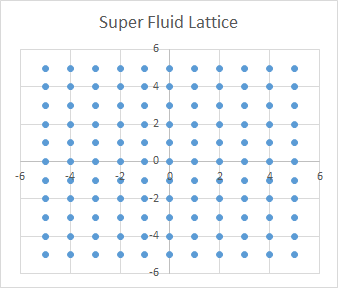
Liquid helium is particularly simple because it bonds only very weakly, which is why it is liquid at temperatures that cause almost every other element to freeze. For illustration, I’m going to show a model system that shows atoms in a square two-dimensional lattice. The details may not apply to liquid helium, but I have reason to believe that they might to dark energy.

Imagine that we have a tank filled with liquid helium. At very cold temperatures, the atoms stack uniformly in the tank.
Super Fluid Lattice
Such arrangements are said to have high order. They are typical of crystalline materials, including many solids. One of the upshots is that it’s difficult to move a single atom without moving the entire collection. That’s because gravity presses the volume into a compact mass, which means that that atoms are compacted slightly, and therefore repelling each other. So moving one helium atom causes the atom it’s moving towards to move away. The cold here is important: if the lattice were vibrating somewhat, there would be little gaps that could absorb some of the distortion, and so the parts of the lattice could change independently. It’s the lack of such vibrations that forces the lattice as a whole to respond to changes.

Now let’s imagine that we place an impurity into the lattice.
Impurity in Super Fluid
This time a slight distortion of the arrangement will occur. The atoms nearest the impurity will indeed shift their positions slightly. Since the atoms at the walls of the container can’t move, they will tend to remain in place. So the distortion will be localized. What’s interesting to consider is what might happen if two defects are created. Will the disturbance to the lattice be minimized if the defects are brought together, or if the lattice acts to separate them? The astute student of physics will see that this thought leads to a model for gravity.

Now let’s propose that somehow our impurity begins to move.
Slow Impurity
How will the lattice react? Well, again, the atoms at the walls can’t move. The impurity will push against the atom in front of it, and leave a gap behind it. So long as the speed of the impurity is much less than the speed of the sound in the lattice, it is only the nearest atoms that will be disturbed. Obviously, the solution to restoring the order of the lattice is for the forward atoms to migrate to the sides as the impurity passes, displacing the atoms already on the side so that they fill the gap left by the passing impurity. When they reach the back, the atoms will come to rest by giving their energy back to the impurity. This is the essence of superfluidity: the impurity loses energy to the lattice only temporarily.

What is interesting to note is that in quantum mechanics, when calculating collisions between two charged particles, we have to assume that the particles are constantly emitting and re-absorbing photons. This is analogous to the situation in the superfluid: the impurity is constantly losing energy and then regaining it.

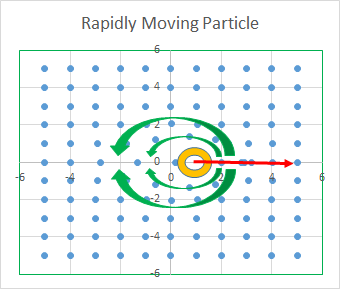
Finally, let’s consider an impurity moving closer to the speed of sound in the lattice. In this case, the distortions affect more than the nearest atoms, and the circulation becomes more widespread.
Fast Impurity
It’s important to note that energy is stored in the circulatory motion of the helium atoms. They are moving, just as the impurity is moving – but in the opposite direction, of course. The closer to the speed of sound, the more energy is stored in the circulation. This means that it becomes harder and harder to make the impurity move faster as it moves more and more nearly at the speed of sound.

In Special Relativity, Einstein showed that particles become harder and harder to accelerate as they come closer and closer to the speed of light. The relationship is (m0 is the mass of the particle at rest):

m = m0/(1-v2/c2)1/2

Again, we see some strong correspondence between superfluidity and the behavior of particles in both special relativity and quantum mechanics. The big difference is that, while Richard Feynman famously stated that quantum mechanics was merely a mathematical procedure without any explanation, when applying the superfluid analogy to dark energy, it seems that at least some previously mysterious quantum and relativistic phenomena are simple to understand.

For more on models of particle mass, see That’s the Spirit.

Becoming a Man in a Woman’s World

On my fist visit to the Cathedral of our Lady of the Angels in Los Angeles, I was consciously assessing the state of a community that I expected to be seized by fear. The priestly child-abuse scandal that had been papered over in the ‘70s had re-ignited. Attorneys revealed that many of the perpetrators had been hidden in the church hierarchy, and some had been allowed to resume children’s ministry. Cardinal Mahoney himself was accused of complicity, and huge financial claims were leveled against the Church.

What I discovered, as I wandered around the periphery of the celebration, was that it was infected by a subtle competition for dominance. Every member of the worship team wanted to lift the pall, to re-establish the connection to Christ, and no longer trusted the authority of the prelate. So I listened carefully, echoing back what I heard, and tried to celebrate harmony when it appeared. The cantor went and sat with the choir, and when he came back down to the podium, the competition surrendered to glorious praise.

As I wandered in the space, I got a few disturbed glances from the ushers and deacons. But the confrontation came from a middle-aged woman who, as I stood in the back enjoying the music, approached me and hissed “Say the words!”

I experienced this again when I went down to Orange County to the enormous campus of a renowned evangelist. This time I sat in the fourth row from the stage, and as I probed the spirit of the congregation, he stared pointedly at me. I stayed for a second service, this time sitting in the back rows, and he announced that he had been talking to Jesus every day of his adult life. A little non-plussed, I poked around and discovered that it was his wife and her girlfriends that were presenting the counterfeit.

I won’t assert that these incidents are typical of the “male-dominated” religions, but neither are they rare. They illustrate the temptations of maternal power. If a man and his wife become “one flesh” through intercourse, how much deeper are the bonds that link a mother and the child growing in her womb? The sin that exists in abortion is that the two spirits, rather than separating through birth, remain bound up together. Inevitably a struggle for dominance develops. Even if a normal delivery occurs, male children remain buried in a feminine psychology. This is untenable. While a woman can tell a man whether he satisfies her physical and psychological needs, she cannot connect him to the sources of spiritual strength that make it possible for those needs to be met.

Particularly in affluent communities, where housewives often find their worth measured by the strength of their children, boys face enormous challenges in becoming men. Mothers have difficulty letting their children go. I saw this manifested when I volunteered as a teacher’s aide in elementary school. I was the only father to so participate in kindergarten. I was involved in a divisive custody struggle at the time, and faced a prejudice that I was simply there for legal reasons. That was not true – I really wanted my sons to have a concrete sense of how important their education was to me. But the teachers and mothers struggled with my presence.

In my younger son’s class, lessons were tutored at tables marked by pictures. I was never assigned to the teacher’s table until I took my sons to a swim party. One of the activities was water volleyball with a huge bouncy ball. The event facilitators stood at the back of the court and, though trying to be as gentle as possible, served the ball with force that simply overpowered the kids. I finally got my hands on the thing and walked it up to the net, asking “Who wants to serve it?” Holding the ball over the child’s head, they knocked it up into the air, and the children on the other side clustered under the ball. No longer having to absorb its momentum, they knocked it back over the net. Laughter and shouting replaced the bored frustration.

When I next went in to class, the children embraced me with their hearts while the teacher read a story. The birthday girl turned around and smiled at me, and the little community of children finally overwhelmed the resistance to my presence that had been established by the mothers and teachers. I was allowed that day to tutor at the “red heart table.” But consider: only because one of the daughters let me in.

So when feminists decry the disempowering psychology of “male-dominated” religions, I get a little frustrated. Given their powerful psychological influence on little boys, maternal projections of anger towards men are a destructive burden. I would prefer that women celebrate the strength that they gain from participating in Earth- or Goddess-centered religions, thus advertising what men are missing. And I would also prefer that they celebrate the teachings of the avatars, none of whom rejected the participation of women. Even in the Hebrew tradition, a woman’s spiritual power is recognized: inheritance of the tradition is through the mother.

But the only way to make sense of the story of Abraham’s lineage is to realize that Joseph, the child left without a protector in his father’s harem, became a glorious man because his father took him under his wing. Boys need fathers, and women need to be cautious against using their children as leverage in their relationships. It leaves them with weak sons that attain independence only through rebellion, and the problems of managing the predatory women that they attract. When that consequence is recognized, it seems unfair to castigate men because husbands, spun up by sex and greed, go out into the world to plunder and pillage for the satisfaction of their wives.

A Massive Mystery

Quantum Mechanics describes particles as vibrations in time and space. The intensity of the vibration in time (i.e. – when it is) reflects the particle’s energy; the intensity of the vibration in space (i.e. – where it is) reflects its momentum.

In large-scale reality, such as baseballs and buildings, those vibrations are way too small to influence the results of experiments. In studying these “classical” systems, physicists discovered certain mathematical laws that govern the relationship between momentum (p) and energy (E). Believing that these rules should still be manifested in the quantum realm, they were used as guidelines in building theories of vibration.

In Special Relativity, that relationship is (m is the mass of the particle):

m2 = E2 – p2

In the case of electromagnetic waves, we have m = 0. Using a fairly simple mathematical analogy, the equation above becomes a wave equation for the electromagnetic potential, A. An electric field (that drives electricity down a wire) arises from the gradient of the potential; a magnetic field (that causes the electricity to want to turn) arises from the twisting of the potential.

The contribution of P.A.M. Dirac was to find a mathematical analogy that would describe the massive particles that interact with the electromagnetic potential. When the meaning of the symbols is understood, that equation is not hard to write down, but explaining the symbols is the subject of advanced courses in physics. So here I’ll focus on describing the nature of the equation. Let’s pick an electron for this discussion. The electron is a wave, and so is represented by a distribution ψ.

Physically, the electron is like a little top: it behaves as though it is spinning. When it is moving, it is convenient to describe the spin with respect to the motion. If we point our right thumb in the direction of motion, a “right-handed” electron spins in the direction of our fingers; a “left-handed” electron spins in the opposite direction. To accommodate this, the distribution ψ has four components: one each for right- and left-handed motion propagating forward in time, and two more for propagation backwards in time.

Dirac’s equation describes the self-interaction of the particle as it moves freely through space (without interacting with anything else). Now from the last post, we know that nothing moves freely through space, because space is filled with Dark Energy. But when Dirac wrote his equation, Einstein’s axiom that space was empty still ruled the day, so it was thought of as “self-interaction”. That self-interaction causes the components of the electron to mix according to m, E and p. When the self-interaction is applied twice, we get Einstein’s equation, relating the squares of those terms.

So what does the mass term do? Well, it causes right-hand and left-hand components to mix. But here’s the funny thing: imagine watching the electron move in a mirror. If you hold up your hands in a mirror the thumbs pointed to the right, you’ll notice that the reflection of the right hand looks like your left hand. This “mirror inversion” operation causes right and left to switch. In physics, this is known as “parity inversion”. The problem in the Dirac equation is that when this is applied mathematically to the interaction, the effect of the mass term changes sign. That means that physics is different in the mirror world than it is in the normal world. Since there is no fundamental reason to prefer left and right in a universe built on empty space, the theorists were upset by this conclusion, which they call “parity violation”.

Should they have been? For the universe indeed manifests handedness. This is seen in the orientation of the magnetic field created by a moving charged particle, and also in the interactions that cause fusion in the stars and radioactive decay of uranium and other heavy elements.

But in purely mathematical terms, parity violation is a little ugly. So how did the theorists make it go away? Well, by making the mass change sign in the mirror world. It wasn’t really that simple: they invented another field, called the Higgs field (named after its inventor), and arbitrarily decided that it would change sign under parity inversion. Why would it do this? Well, there’s really no explanation – it’s just an arbitrary decision that Higgs made in order to prevent the problem in the Dirac equation. The mass was taken away and replaced with the Higgs density and a random number (a below) that characterized its interaction with the electron: m ψ was replaced with a H ψ.

Now here’s a second problem: if space was empty, why would the Higgs be expected to have a non-zero strength so that it could create mass for the electron? To make this happen, the theory holds that empty space would like to create the Higgs field out of nothingness. This creation process was described by a “vacuum” potential with says that when the Higgs density is zero, some energy is available to generate a density, until a limit is reached, and then increasing the density consumes energy. So space has a preferred density for the Higgs field. Why should this happen? No reason, except to get rid of the problem in the Dirac equation.

And what about the other spinning particles? Along with the electron, we have the muon, tau, up, down, strange, charm, bottom, top and three neutrinos, all with their own masses. Does each particle have its own Higgs field? Or do they each have their own random number? Well, having one field spewing out of nothingness is bad enough, so the theory holds that each particle has its own random number. But that begs the question: where do the random numbers come from?

So now you understand the concept of the Higgs, and its theoretical motivations.

Through its self-interaction, the Higgs also has a mass. In the initial theory, the Higgs field was pretty “squishy”. What does this mean? Well, Einstein’s equation says that mass and energy are interchangeable. Light is pure energy, and we see that light can be converted into particle and anti-particle pairs. Those pairs can be recombined to create pure energy again in the form of a photon. Conversely, to get high-energy photons, we can smash together particles and anti-particles with equal and opposite momentum, so that all of their momentum is also converted to pure energy (this is the essential goal of all particle colliders, such as those at CERN). If the energy is just right, the photons can then convert to massive particles that aren’t moving anywhere, which makes their decay easier to detect. So saying that the Higgs was “squishy” meant that the colliding pairs wouldn’t have to have a specific energy to create a Higgs particle at rest.

Of course, there’s a lot of other stuff going on when high-energy particles collide. So a squishy Higgs is hard to detect at high energies: it gets lost in the noise of other kinds of collisions. When I was in graduate school, a lot of theses were written on computer simulations that said that the “standard” Higgs would be almost impossible to detect if its mass was in the energy range probed by CERN.

So it was with great surprise that I read the reports that the Higgs discovered at CERN had a really sharp energy distribution. My first impression, in fact, was that what CERN had found was another particle like the electron. How can they tell the difference? Well, by looking at the branching rations. All the higher-mass particles decay, and the Higgs should decay into the different particle types based upon their masses (which describe the strength of the interaction between the Higgs field and the particles). The signal detected at CERN was a decay into two photons (which is also allowed in the theory). I am assuming that the researchers at CERN will continue to study the Higgs signal until the branching ratios to other particles are known.

But I have my concerns. You see, after Peter Higgs was awarded the Nobel Prize, his predecessor on the podium, Carlo Rubia (leader of the collaboration that reported the top particle discovery) was in front of a funding panel claiming that the Higgs seemed to be a bizarre object – it wasn’t a standard Higgs at all, and the funding nations should come up with money to build another even more powerful machine to study its properties. Imagine the concern of the Nobel committee: was it a Higgs or not? Well, there was first a retraction of Rubia’s claim, but then a recent paper that came out saying that the discovery was not a Higgs, but a “techni-Higgs”.

One of the characteristics of the scientific process is that the human tendency to lie our way to power is managed by the ability of other scientists to expose fraud by checking the facts. Nobody can check the facts at CERN: it is the only facility of its kind in the world. It is staffed by people whose primary interest is not in the physics, but in building and running huge machines. That’s a really dangerous combination, as the world discovered in cleaning up the mess left by Ivan Boesky and his world-wide community of financial supporters.


Always Check with the First Guys First

I wrote previously about the awe-inspiring intuition of Douglas Adams (see The Answer to Life, the Universe, and Everything). But today, after posting my blog entry, one of my colleagues pulled the page off his Dilbert desk calendar and came to show me what Scott Adams decided to write about today.

I have this sudden urge to watch that TV show. You know, the one with the lady in the creepy black dress and the groaning butler? Not to mention that cousin with the hair growth problem.