Charcoal Explosion

One of the artistic expressions available in the management of value is emotional tone. The instructor in the course that I follow exhorts us to do geometric studies using only three values from our scale, starting on the light end and progressing to the dark.

The dark end, of course, demands charcoal. I admit to being intimidated by the mess associated with the medium. Experiments with printer paper revealed that blending with stumps grinds it down, making it a challenge to lighten. Once the stumps are loaded with charcoal, they tend to smear darkness when used elsewhere, created a mass.

So, I avoided the medium.

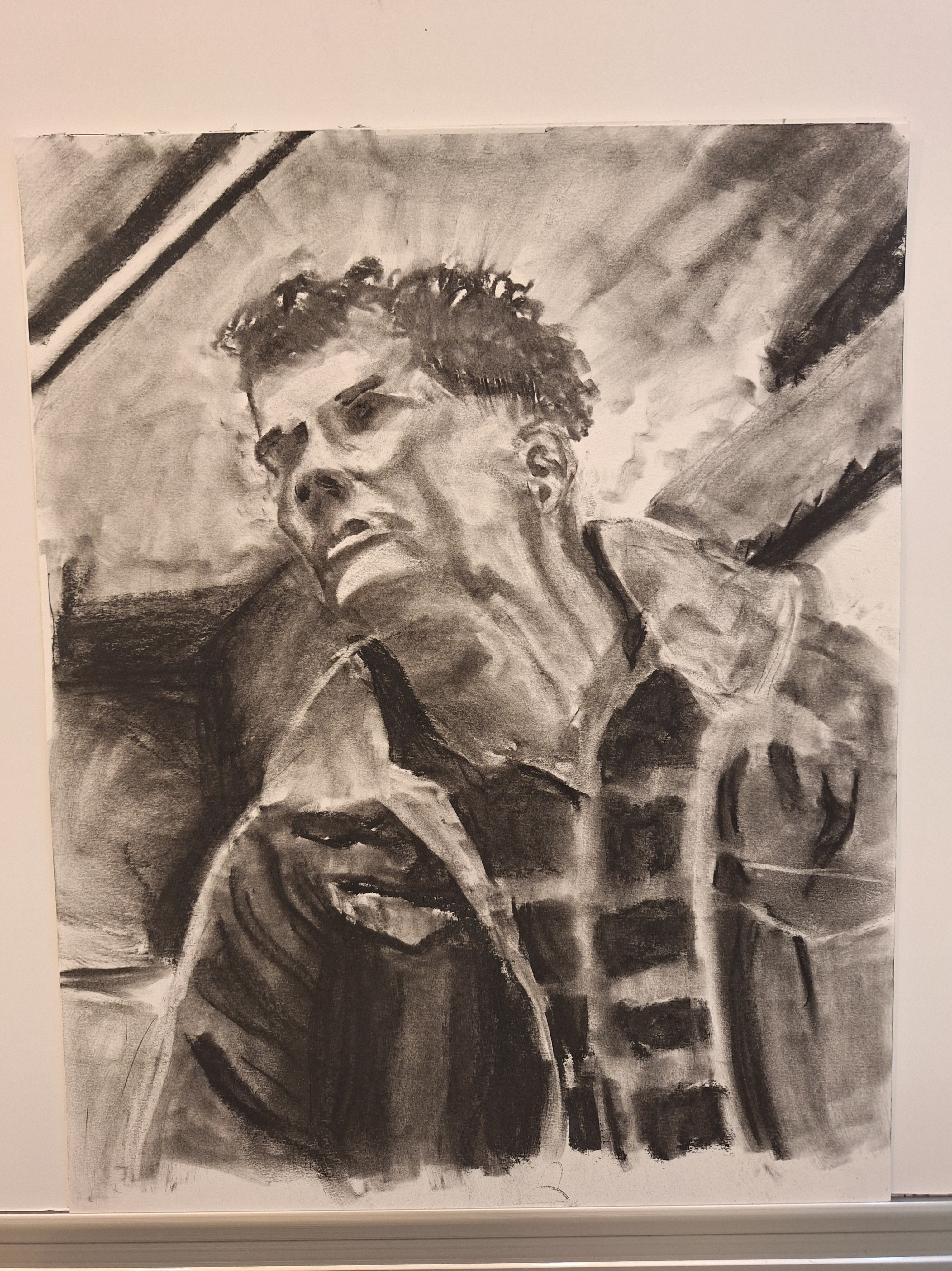
After the graphite sketch of the girl with the coffee cup, I bought a fresh set of tortillons and stumps and segregated them into plastic bags for dedicated use with different media. Then I found a night-time portrait and began throwing down charcoal.

The result is shown here. The process was fascinating. With high-quality paper and clean tools, I found myself refining details by pushing the charcoal around before lifting it away with various types of erasers. The process produced happy accidents like the radiation around the hairline and the light/dark juxtaposition of the jacket pockets.

The source image was a glamor shot outside a nightclub or casino. The model sported wire-rim glasses. Dropping into a darker tone and abandoning the glasses, the image expresses a kind of grim determination that is sympathetic to my personal journey of service to humanity’s redemption.

First Value Portrait

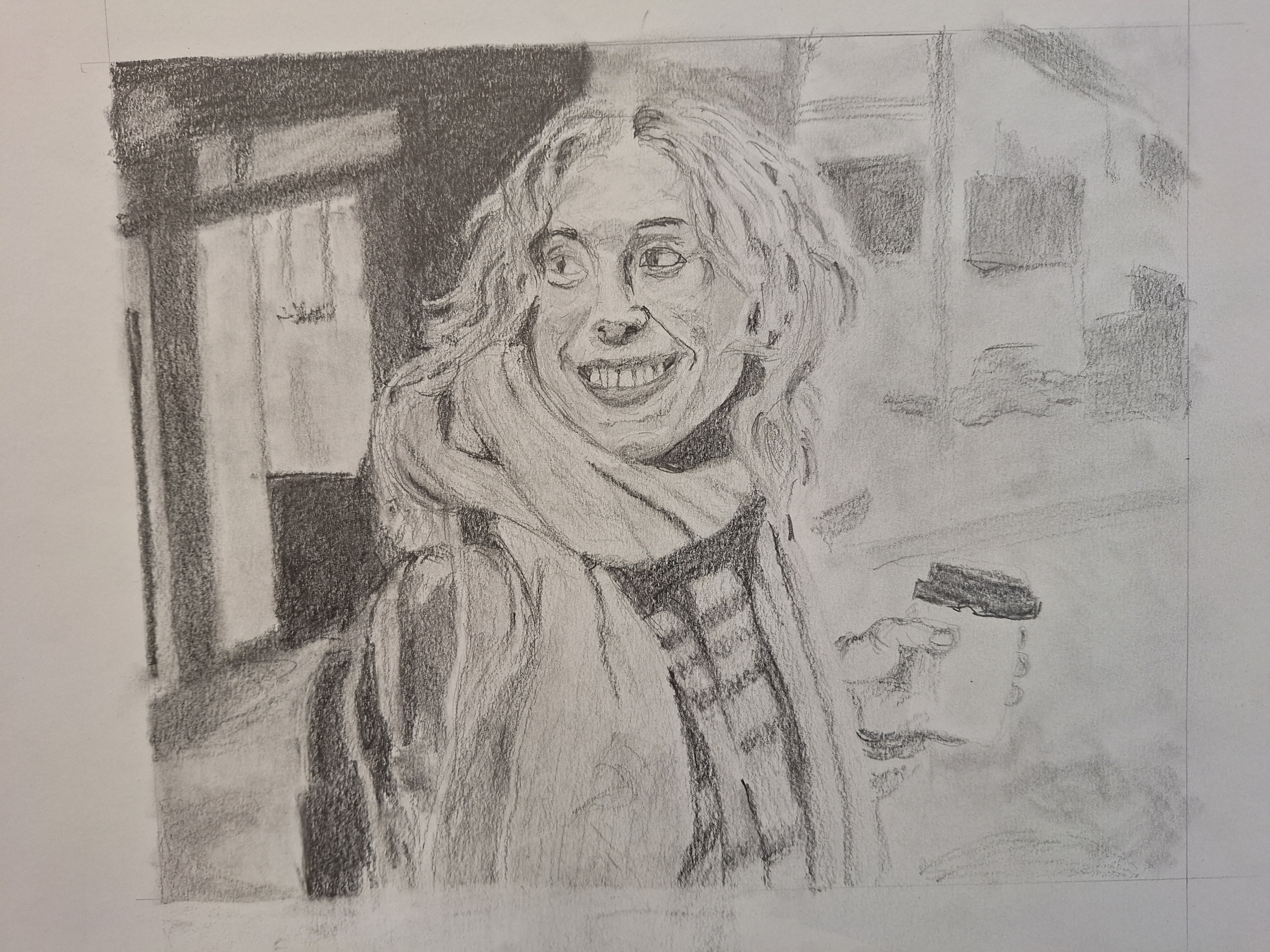
The human figure is intimidating in the subtlety of its dance with light. From geometrical forms, this study begins to grapple with that challenge. Taken from a photo, the principle compositional challenges were already addressed in by the photographer (although I did crop the setting). In particular, the lid of the coffee cup that provides some ballast against the darkness in the upper left.

This study followed the construction of a ten-step grey scale using graphite, willow sticks, and charcoal. In trying to achieve smooth fields, I loaded up my supply of paper blending sticks (tortillons and stumps) with graphite and charcoal. I tried cleaning them against a sanding block, with limited success. This study, then, was done only with pencil and eraser. This frustrated my ability to achieve uniform and graduated transitions in tone.

Still, from a distance, the rendering is tender. Most challenging was actually the curly hair and its highlights. This could only be rendered approximately, but I feel that I achieved some success. This had to be balanced against the scarf, which has its own fascinations. The heightened tonal contrast in the face and eyes (I hope, at any rate) sustains the subject as the focus.

Getty Santa Monica Sketch Day

One of the challenges of value is a sensitive handling of shadow. The video series instructor breaks light intensity into nine categories, including light reflected off the setting onto the object, the effect of that light on the object’s cast shadow, and deepening of the object shadow due to the lack of light from the setting where the cast shadow falls.

To facilitate understanding of these interactions in a natural setting, architectural studies are recommended. This gave me an excuse to visit the Getty Santa Monica for in what seems like forever.

Culturally, the visit was a disappointment. In hard winter, many of the galleries close to prepare exhibitions for the Spring season. Arriving in mid-morning, many of the nooks that I had planned to settle in were in full shadow, so I ended up settling by the rock fountain on the main plaza.

As I sketched happily, using an HB graphite pencil on printer paper, a couple attempted to interrupt my work. I engaged them while continuing to sketch, realizing only after they had left that she was an art instructor. She was offended by my report that I was following an online video course. In retrospect, I was irritated that she took the chance encounter on the plaza to attempt to recruit me as a student.

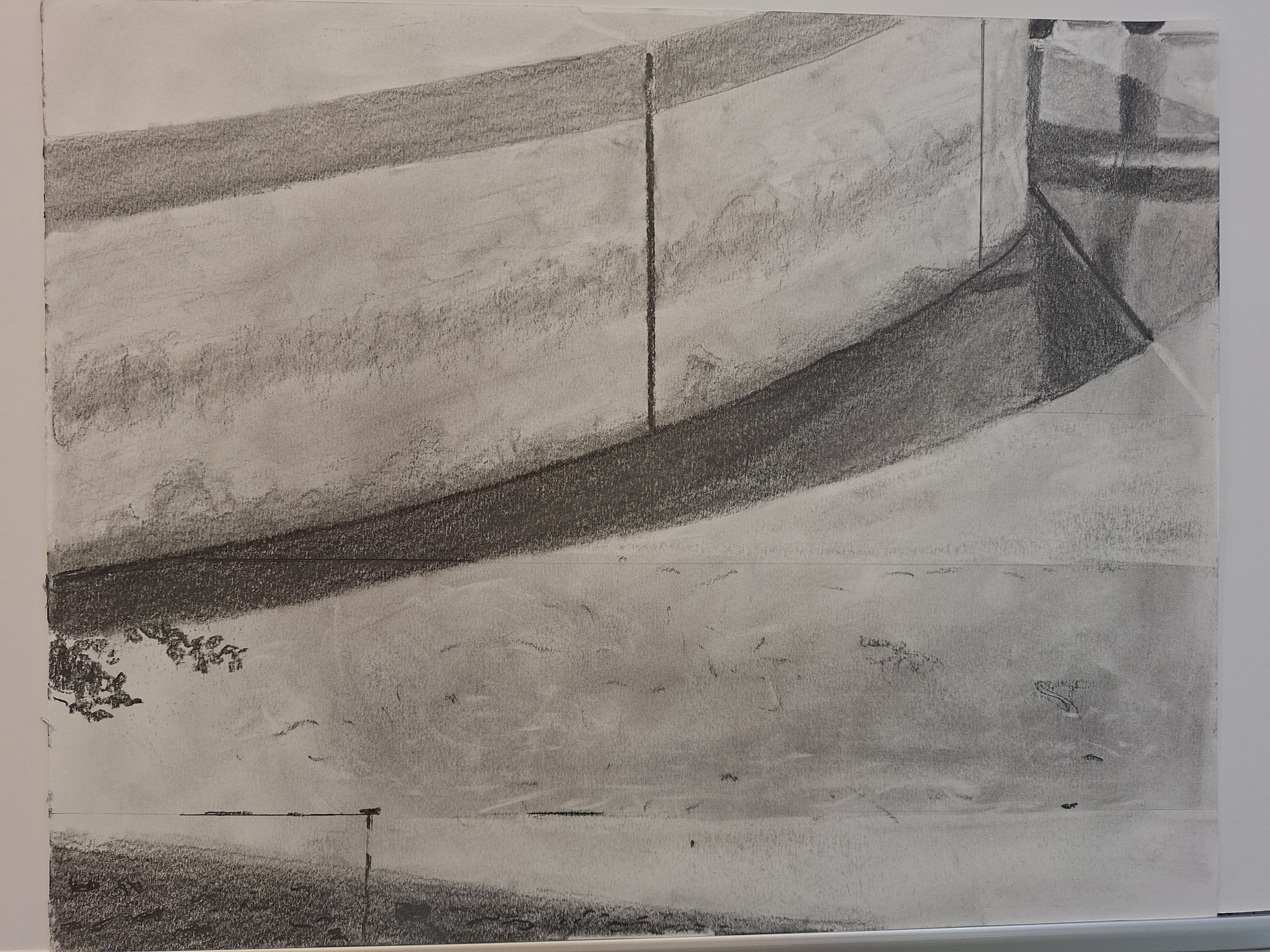
At the end of the day, I returned to the back side of the fountain and took the source photo for this study. The semi-gloss surface of the arcade’s stone was ideal for the purpose. Visual interest focuses on the pair of shoes and reflected legs in the upper right.

I started with a graphite powder wash, but realized that it hid the slab breaks in the foreground. Graphite powder is hard to remove, so I scrubbed with an eraser, leaving the middle slab in the foreground. This yielded speckling in the slab above it – a pleasant surprise.

All of the curves were done free-hand. The straight lines were done with pencil or eraser against a ruler

Cliff Face

My perceptions of reality are focused on cultivation of loving engagements. That has its downsides: self-destructive people try to coerce me into solving their problems for them. Fortunately, for the most part the experiences are sublime.

Unfortunately, the terror generated by self-destructive personalities appears to captivate the world’s imagination.

I have cultivated a number of practices to try to encourage people to focus on the good. Explaining the physical basis of spirituality, philosophy, Christian exegesis, ministry to gun violence, dance, and hypnotherapy are all instances. None has been compelling. The response to my encouragements tends to be, “Thanks for projecting love into the world. Let me know when you’ve succeeded in lighting the darkness.”

What has been missing is the demonstration of a loving relationship. For decades, I have been telling people that “I am a half a thing.” If, as a projection of the divine masculine, I express Love, my correspondent would manifest Life. That is daunting – the world is undergoing an anthropogenic extinction. While many beautiful and wealthy women have offered to take care of me, they have all walked away from the weight of healing that wrong.

It is in dance that I come closest to cultivating that commitment in women, but the conceptual bandwidth is limited. The communion of dance is limited to the expressive potential of bodies. Healing Creation involves spiritual abstractions. No woman has ever had the temerity to demand, “I’d like to understand what you are doing when you are dancing by yourself.”

This void in my heart has been subject to diagnosis, of course. As I explain at love-returns.org, John’s Revelation describes the resolution. But John offers the male perspective. To understand the feminine grace necessary to the transition, I turned to the Sacred Mother who waits in a spiritual desert on the moon.

But how to communicate those insights? There is no proof, only manifestation.

The only discipline that I have not explored is art. So, I have been learning to draw. The inspiration is a lecture series out at The Great Courses (“How to Draw for Beginners”). After two months and twenty lectures, the course moved into value (defining shape through shading).

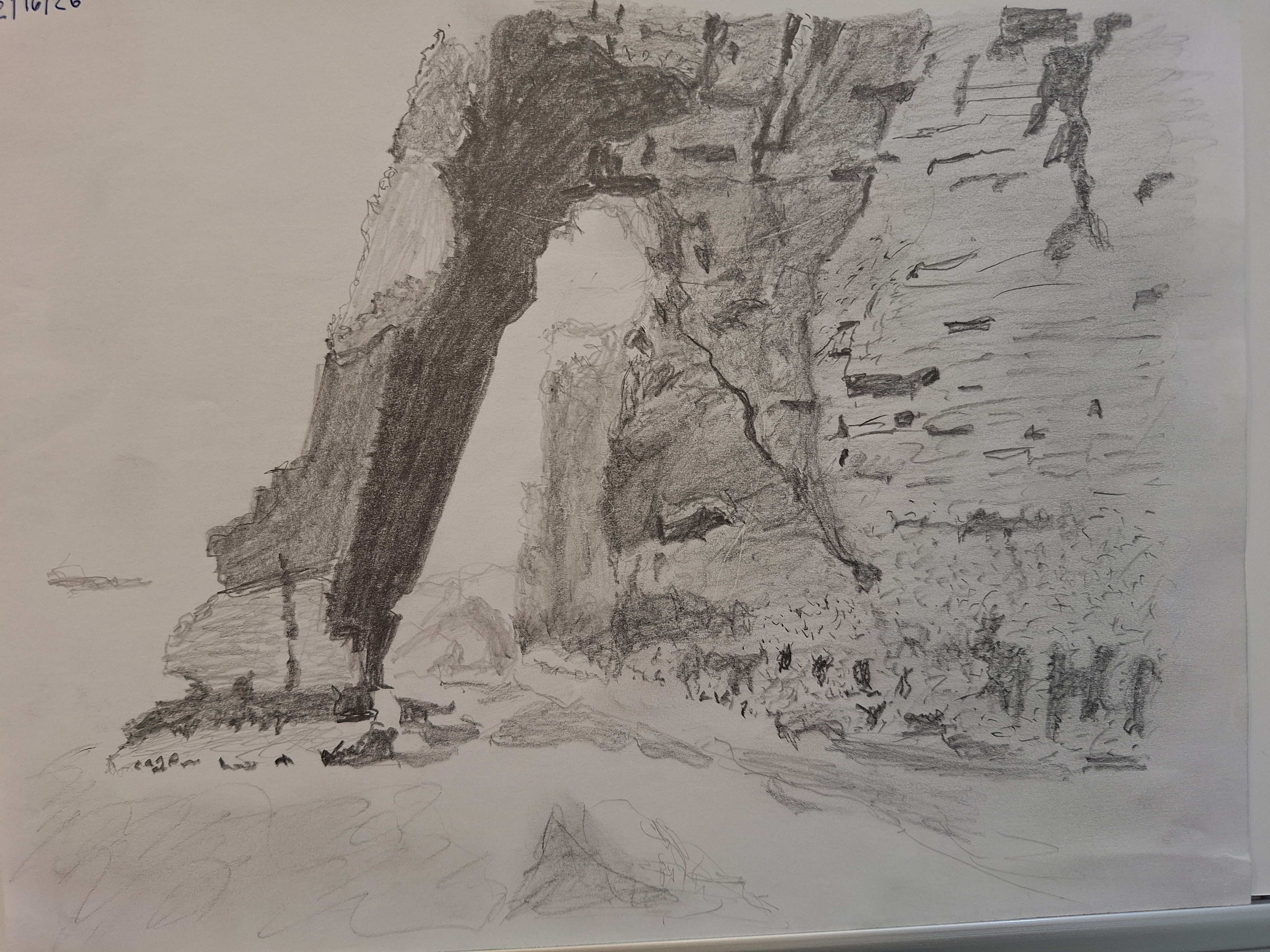
I present here the first work that I might consider actual art. It was from a photo. What surprised me was the playful enjoyment of learning to use pencils to capture variations in smoothness and texture, as well as value.

Drawing of dark slate cliff arch. Graphite pencil on printer paper.

I have three other pieces to share over the next week. After that, I have committed myself to a huge leap in ambition that is going to take a month or more to execute.

Orpheus and Eurydice

My son Kevin and I had an amazing weekend. He wanted to take me to a trap concert down in LA, and on Wednesday and Thursday we trawled around on the web looking for things to do to fill up the time between Saturday morning and Sunday evening. We hit kind of a perfect cultural storm, with the play Water by the Spoonful closing and the opera Orpheus and Eurydice opening at the Music Center on the same weekend.

We didn’t see the opera, but got tickets (for $35 each) at the Getty Villa on Sunday to hear the reflections of curators, musical historians and the opera director James Conlon on the mythical and cultural significance of Orpheus. The event closed with an abridged offering of Gluck’s original score, rewritten for piano accompaniment and sung by two women: an alto as Orpheus and a very pregnant soprano as Amor and Eurydice.

For those that don’t know the myth: on their wedding day, Orpheus entertains the guests with lyre and song, and Eurydice is found alone by a spurned suitor who chases her into the marsh, where she is stung by a serpent and dies. Orpheus is overcome with grief until counseled by Eros (Amor) to use his skills to beguile the guardians of Hades and inspire its master to allow Eurydice to return to life. He succeeds, but the condition is that he neither look at nor speak to Eurydice on the journey out of Hades. Taken from the Elysian fields of eternal happiness, Eurydice is confused, and beseeches Orpheus to explain until becoming angry. Tormented, Orpheus emerges from the cave and turns a moment too soon. Eurydice is still within, and falls into oblivion.

Orpheus wanders the land grieving, renouncing the company of women. His music still enflames their desire, though, and eventually he encounters a company in whom frustration kindles violence. The women beat and dismember him, throwing his head into the river where it floats away still singing.

In Ancient Athens, women were denied access to society, cloistered to ensure the bloodline of the patriarchs. Culturally, Eurydice was an afterthought, and Orpheus celebrated principally for his music and the understanding of the afterlife that was stamped into golden foil to guide the dead on their passage to Hades.

With the resurrection of Greek culture during the Renaissance, the Greek tragedy was recast as Opera, and Orpheus and Eurydice was a staple. Perhaps in part due to that popularity, Gluck adopted it as a set-piece for operatic reforms intended to clarify dramatic focus. The intellectual controversy, the popularity of the myth and the image of art living on after death made the story a mainstay in the plastic arts as well, particularly among those that felt that the Enlightenment was extinguishing the sacred embers that once permeated the world.

In early Christian iconography, it is not uncommon for Orpheus and Christ to be transposed. The torment of Orpheus, destroyed by those whose virtuous exemplar he honors, evokes the Cross. The myth also has parallels with the Garden of Eden: the inattentive male, the trusting spouse, and the serpent that sunders their bliss.

So I found myself, as the Italian libretto was summarized, confronting the same frustration that caused me to write this, when re-iterating God’s motivations in bringing Eve into being:

Get a clue, guys!

Calzabigi (the librettist) charts Eurydice’s descent into doubt and vanity. She is a torment to Orpheus, who eventually sings “I knew that this would happen.” But from the intonations of the soprano on Sunday afternoon, I inferred this: “Orpheus, what is my place in your world?”

It was to explore answers to that question that I had Kevin help me chase down Professor Morris at the reception. I was distressed by the conversation, though not surprised: no one has wrestled meaningfully with the problem of feminine virtue except in juxtaposition to masculine virtue.

What Orpheus must have understood, having lost her again, is that the opportunities she had surrendered to death were things he had not celebrated, for if he did, Elysium would have had no pull on her. Motherhood, gentleness, healing, compassion, inspiration: why did he not sing of these before? Why did he not turn his every effort to bringing Elysium to the world in song, rather than indulging his virtuosity?

For nothing of virtue lasts unless a woman brings it to flower.
Live!

My friend Steve is fighting cancer. I won’t expand, but among his friends we’ve all been worried about financial resources. This came to a point tonight when he invited me down to his studio. He pulled out several pieces that he had been working on before his illness sidelined him, and offered me my pick at a bargain-basement discount.

Completely floored, I kept on digging. Painting after painting reflected the culmination the I extolled previously in Designed, Seen, Felt, Expressed. It wasn’t just the landscapes – it’s also showing up in his paintings of tribal women.

Steve had a fascination for Native American culture in his childhood, and recently traced it to a prior life. The tribal experience of immersion in the natural world goes beyond the sensory perceptions. It includes awareness of the powerful interconnectedness of things. From that root he also carries a deep sense of the injustice that European culture has wreaked upon the natural world.

The work I saw tonight threads the needle between representation and abstraction. Through color contrasts and plastic layering, he vitality and energy of the natural world seem to leap off the canvas – and yet delicate washes and luminous backgrounds preserve the sense of ecological harmony and balance.

Yin and Yang. Masculine and Feminine. Design and Expression.

The problem was evident when another friend showed up. She immediately pointed to a boat picture on the wall, the most concrete representation. I praised that work when Steve put it on display, but it’s a confrontation with nature, not an awed celebration. She didn’t seem to recognize that power in his recent work.

Will others? Can Steve explain it to them?

In the end, I couldn’t buy anything. The works need to be seen, and I don’t have a place for that appreciation to occur. Those that are incomplete need to be finished.

They bear witness to the relationships that our artificial reality has sundered. They prepare us to process the intensity of the natural world when it must be confronted. They celebrate its beauty and honor its power.

If we do not integrate those truths into the manner of our living, none of us will survive. Steve: we need your witness!

The Joy of Non-Attachment

Neal Crosbie tries not to take himself too seriously. I am an irritation, then, in that I see things revealed in his work that reflect the struggle to bring love into the world.

Which I take very seriously.

The challenge is to moderate our natural instincts, with the cerebral cortex being the tool that brings discipline. It’s a struggle because our bodies are designed to enjoy animalistic behavior. It’s a war because the spirits that preceded us don’t want to cede the stage of evolution to us.

And why should they? Evolution is about competition, and they serve a purpose is resisting our rise to dominance.

In the Native American tradition, the coyote is the most pitiful of the animal gods, getting his way only by tricking his betters. Trickery is a way of transforming situations, and so through his weakness, eventually coyote becomes the most influential of the gods.

As climate change withers the ecosystem that supported them, how is this supposed to happen? Animal gods have fewer bodies to manipulate, and so less means for reorganizing spirit.

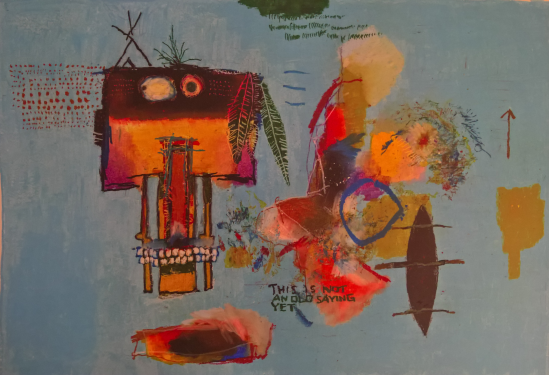
A possible answer was proposed in some of Neal’s recent work. Compelled by a dream, I bought this one two weeks ago (sorry for this drab image; the color is vivid in the original):

CoyoteTransform

What struck me is the shadowing of Coyoteman’s color fields in the abstract construct on the right. I read this as a soul shadow. In this image, the color sprays emanate most obviously from the soul shadow. It’s not clear whether they are being assimilated, projected or expelled. That a transformation is being undertaken is suggested more strongly by the two elements on the right: the Buddhist circle of completion and the “greater vehicle” of Mahayana practice.

In conversation on Sunday, Neal explained that he is completely worn out upon returning home from the Art Walk. He has many deep conversations, his booth and eclectic art serving as a magnet. His joy is infectious. When I tried to suggest that he was engaged in spiritual service, he became hostile – and more so when I illustrated my point with Christian scripture.

But trickery is amusing. It provides us a release from tragedy. Contrast this with Siddhartha, who sought to conquer pain through asceticism. What’s the attraction in self renunciation? Joy has qualities that make it the more potent tool to achieve non-attachment

.I see this, then, as coyote’s essential contribution: through absurdity to guide us away from suffering into the harbor of joy. While the construction of that harbor is a weighty matter, I wouldn’t denigrate the guide. In fact, I wouldn’t want more to serve for any purpose than to shelter the spirits he inspires – not least because they inspire by their creativity.

Is Neal’s art then a method for implementing coyote’s transformation? I believe so.

Things Beloved

ThingsBelovedI went out to Ventura yesterday afternoon for my Bikram Yoga class, and discovered that the Saturday afternoon class had been cancelled for the holiday. A picture in the window of a new second-hand store had caught my eye on the way up Oak Street, so I decided to check out the shops.
At “B on Main” I found two things. The first was a little silly – a ceramic glaze rendering of two mermaids. It’s hanging on the wall right now beside my other feminine objects. The others are objects of power, and they needed some lightening up.

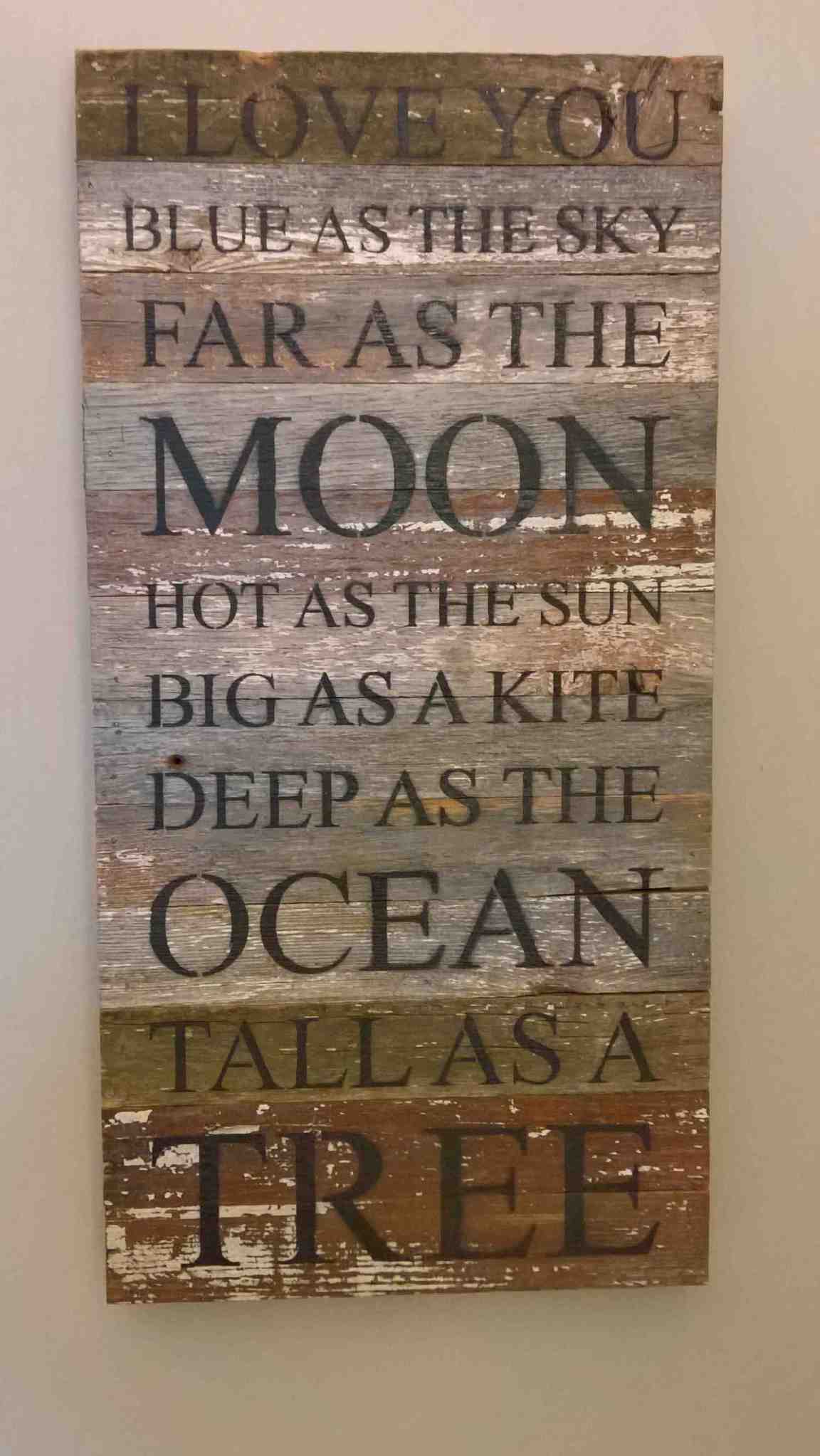
And I found this. The store has a number of these messages, many of them about parenting. It reads like a child’s braggadocio. But my response wasn’t that of a parent. It wasn’t remembrance of my sons’ innocent declarations of affection that caused the lump in my throat or the flash of warmth on my skin.

I don’t buy things until I figure out where I’m going to hang them. Walking up and down Main Street, it occurred to me that this should go on the wall by my pillow. That’s kind of prominent, so it’s been working on me overnight. At first I thought that it was a declaration of my love for the world, and then I realized that it was a list of things that I loved. From there, it was only a short step to realizing that the qualities were not a description of my love, but descriptions of the things.

So now I read it:

I love the sky because it is blue enough to protect us from space, but not so blue that the light doesn’t get through..
I love the moon because it is just far enough away to move the ocean tides.
I love the sun for it is just warm enough for life to survive.
I love kites because they are the size for a child to fly.
I love the ocean because sometimes it is shallow enough to swim in, but other times deep enough to keep secrets.
I love trees because they are tall enough to give us shade.

And that is how I love all of you, dear readers. I love you for what you are.

Final Advice

Kevin – eldest son – is graduating in three weeks from UCLA. I’ve been trying to figure out what to do for his graduation present. I’m conflicted, naturally, as he is heading off to Google and will probably be making more money than I do next year.

Overcoming that is the richness of the experience that I had parenting him. That role has attenuated over the last four years. But there are wonderful memories. They start with keeping the Legos sorted in the drawer organizers so that he could exercise his imagination knowing exactly where the perfect piece was waiting. They include the two boys whacking each other on the butt with tennis rackets after stuffing their Pokémon comforters into their one-piece jamies. They peak with him lecturing me on morality at dinner at UCLA during his sophomore year – myself taking great satisfaction that he had internalized the lessons that I offered him a decade earlier as we struggled through a destructive divorce. And they conclude with me becoming aware of his painful struggle as IEEE president trying to manage a 300% increase in membership, and wondering why he hadn’t called for advice.

My first intention was to put together a scrap book, but the memorabilia ends with elementary school. I considered buying him a piece of art, but that’s such a personal choice.

As I considered this problem over the last two weeks, I’ve had occasion to ride down into the crafts section on the Santa Barbara Art Walk, looking for Olga Hortujac and Rio, two new presenters. Out of the corner of my eye, I saw what appeared to be Native American banners. That came with a strong pull to stop and take a look, but I pushed it off.

Yesterday, though, when I stopped to explain my quest to Steve Richardson, he recommended that I visit Neal Crosbie’s booth. His directions were explicit, and I found myself at just the booth I had been passing.

The first thing Neil asked me is what I did, and I told him “Love people.” Pause. “But if you mean ‘How do I make money?’ – writing software.”

Neal does primitive drawings with crayon – not pastels, but actual wax crayon. They are demanding pieces: crude stick-like outlines filled with delicate detail that is overlaid with chaotic sprays. The visual focus of each piece is a blocky figure with expressive eyes and knobbly knees.

Neal writes an aphorism onto each piece. Fittingly – as he labels the figure “Coyoteman” – most are tongue-in-check. That Amerindian god seems to channel through Neal. We spent a half an hour together while I picked two pieces for my son, laughing merrily. How good a time we were having was related to me later by Steve, who told me “the laughter in that booth went all up and down the Art Walk today.”

Primitive art has the quality of not imposing specifics on the viewer. It is thus a potent means of expressing relationships.

So I have these two pieces for my son.

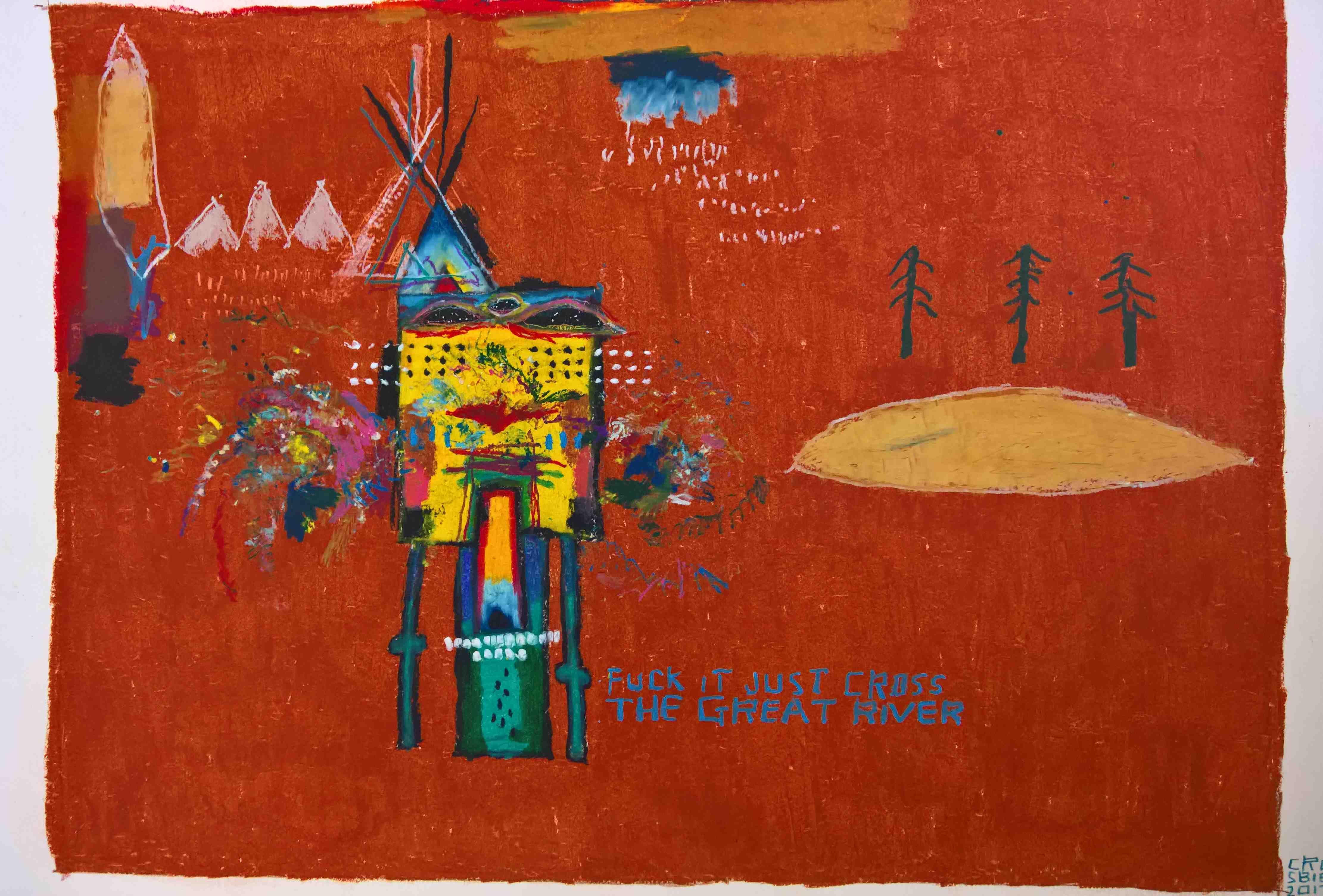
The first “Fuck It Cross the Great River” evokes our scouting experiences, my pride in the courage he demonstrates, and an exhortation to project his virtues into the world.

CrossTheGreatRiver

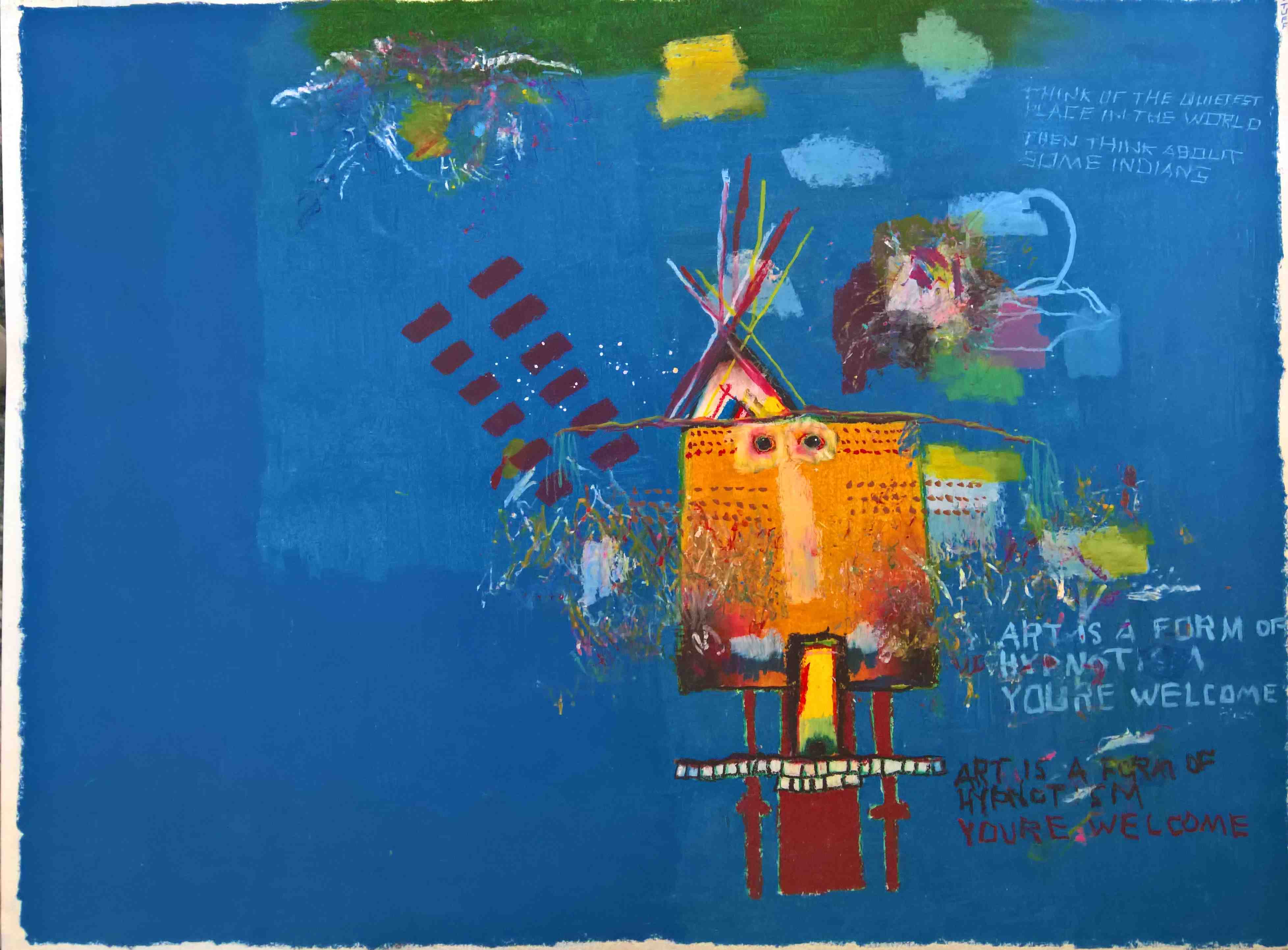
The second “Art is a Form of Hypnotism. You’re Welcome” encapsulates my hope that he will learn to swim in the deep pool of mysticism that I navigate.

ArtIsAFormOfHypnotism

Congratulations on your accomplishments! I am a very proud father.

Designed, Seen, Felt, Expressed

When the technology of painterly representation had approached photo-realism in the 1700’s, academic art filled the museums and sitting rooms, but eventually its practitioners came under attack for their trite formulations. A series of movements attempted to recapture the experience of a scene: Impressionism its atmospheric qualities; Expressionism the observer’s sensitivities; Cubism the fragmentary memory; and Fauvism the raw sensation. Progressively, the artist sought not to render a scene, but to evoke a response in the viewer.

When I met Steve Richardson out at the Santa Barbara Art Walk, he lamented his popular pieces. Steve had been taught in a style similar to that of George Inness, an 1800s American that celebrated the tamed landscape. Eventually, Inness represented the world as a garden, and so did Steve. The paintings were harmonious, soothing, beautiful.

The patch that Steve extolled to me was in the background of a field. In front of the tree line, a crudely painted bush demanded attention. The colors were not blended in the strokes, but asserted their own identify before submitting to life-like hues.

Steve has come back to that canvas again and again. The soothing grass now argues among the blades, as living grass does. The backlit trees grumble at the passage of the light. But that patch of brush still shouts over it all. It is out of character.

Crude brushwork is not the only technique that Steve has exercised in his expressive aggression. The palette knife is a favorite on boats – one thrusting boldly from a chaotic pier – and on monuments. Clouded shores and skies are summarized with thin washes that pool in gesso ridges. On trees silhouetted against sunlight, leaves dance as spatter drops.

I’ve argued with Steve without effect. He pleases his eye – and his eye is discerning. But art is a way of expressing the inner nature of things.  Rather than incomprehension, I sense a real resistance to this idea. He seems to not want to reveal himself that deeply to the world.

So I was astonished when, having pulled two art boards painted on the shore with the same palette, he pulled up two more. I think he was interested in which I liked the most, and I sorted them and said: “Steve, this is absolutely amazing.”

The first, largest piece is in his original style: designed to please, but generic – almost trite. It doesn’t convey the reality of the subject but an idea of a relationship we have with nature. Nature is to soothe. Nature is to conform to our sensibilities.

WP_20170415_15_18_28_Rich

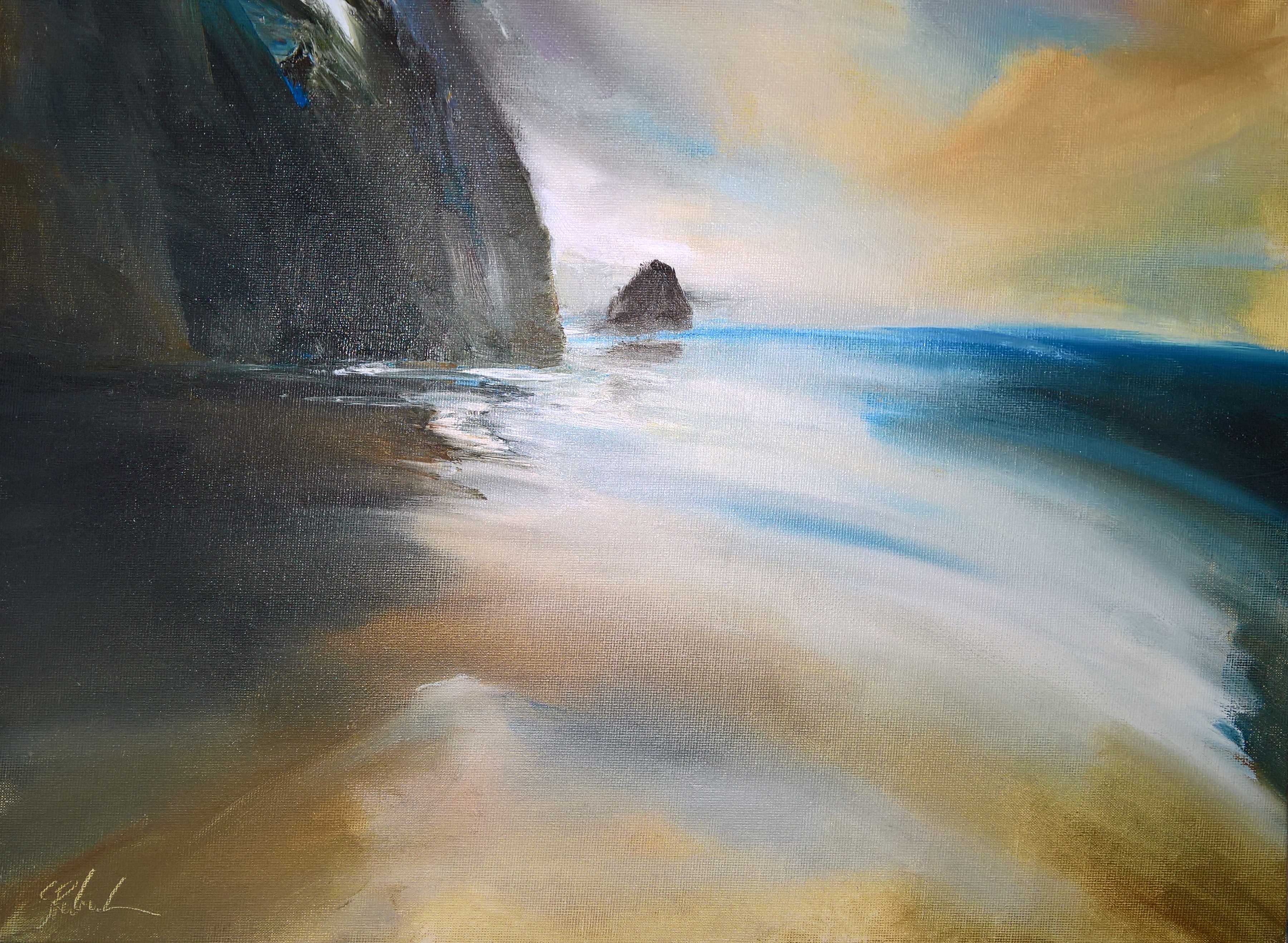
The next piece is obviously representative of a specific setting, but the textures of the paint still show the artist’s caution. Things shouldn’t bump too harshly against one another. The large fields caress one another even when they don’t yield.

CliffscapeSeen

And then the third: the action of the finger is obvious, the fog imposing itself on the rock. In the foreground the energy of the wash is suggested by in the blurred vigor of the finger’s path. The paint reveals the physical feeling of its application. The eye submits to touch.

CliffscapeFelt

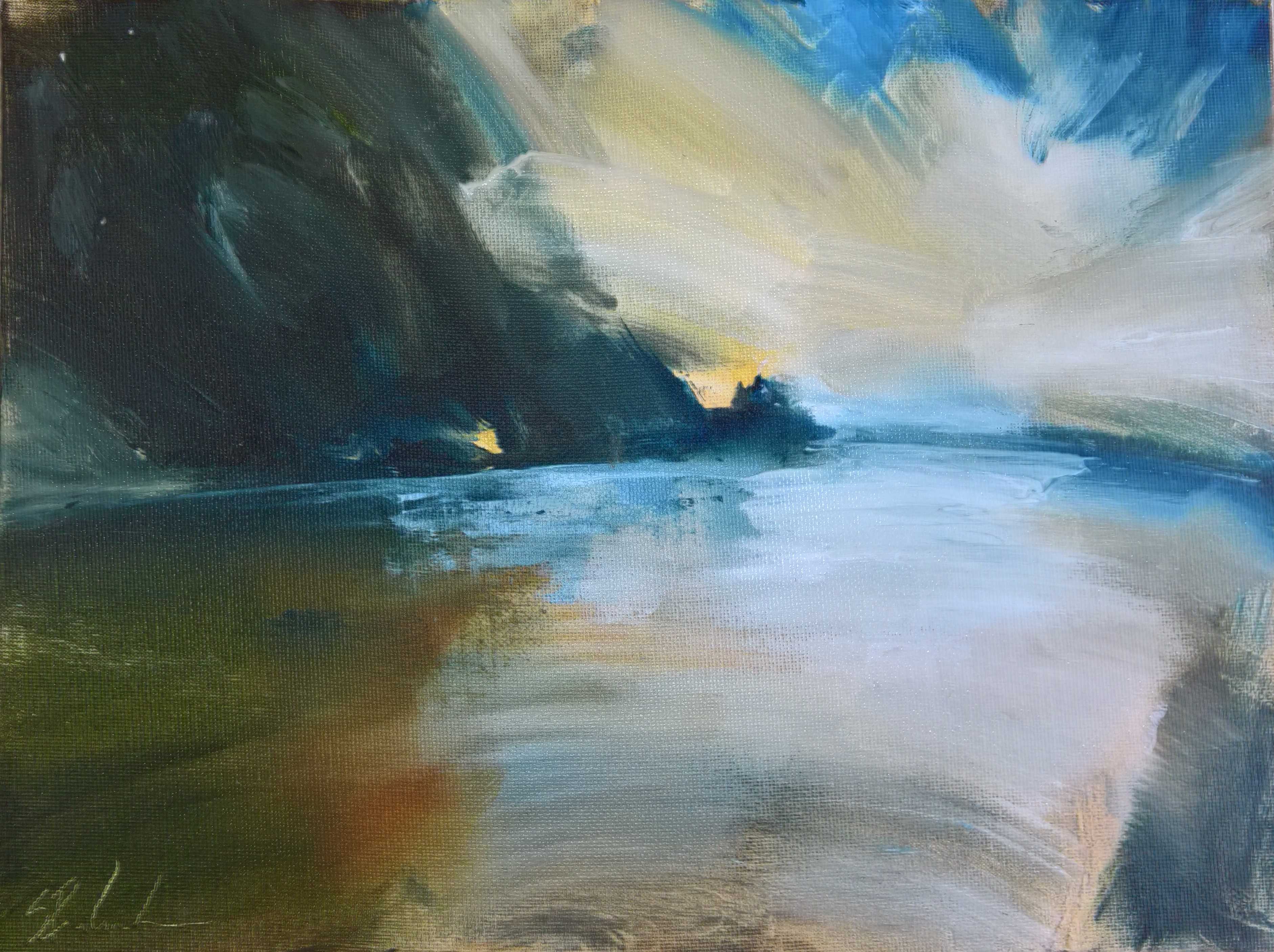
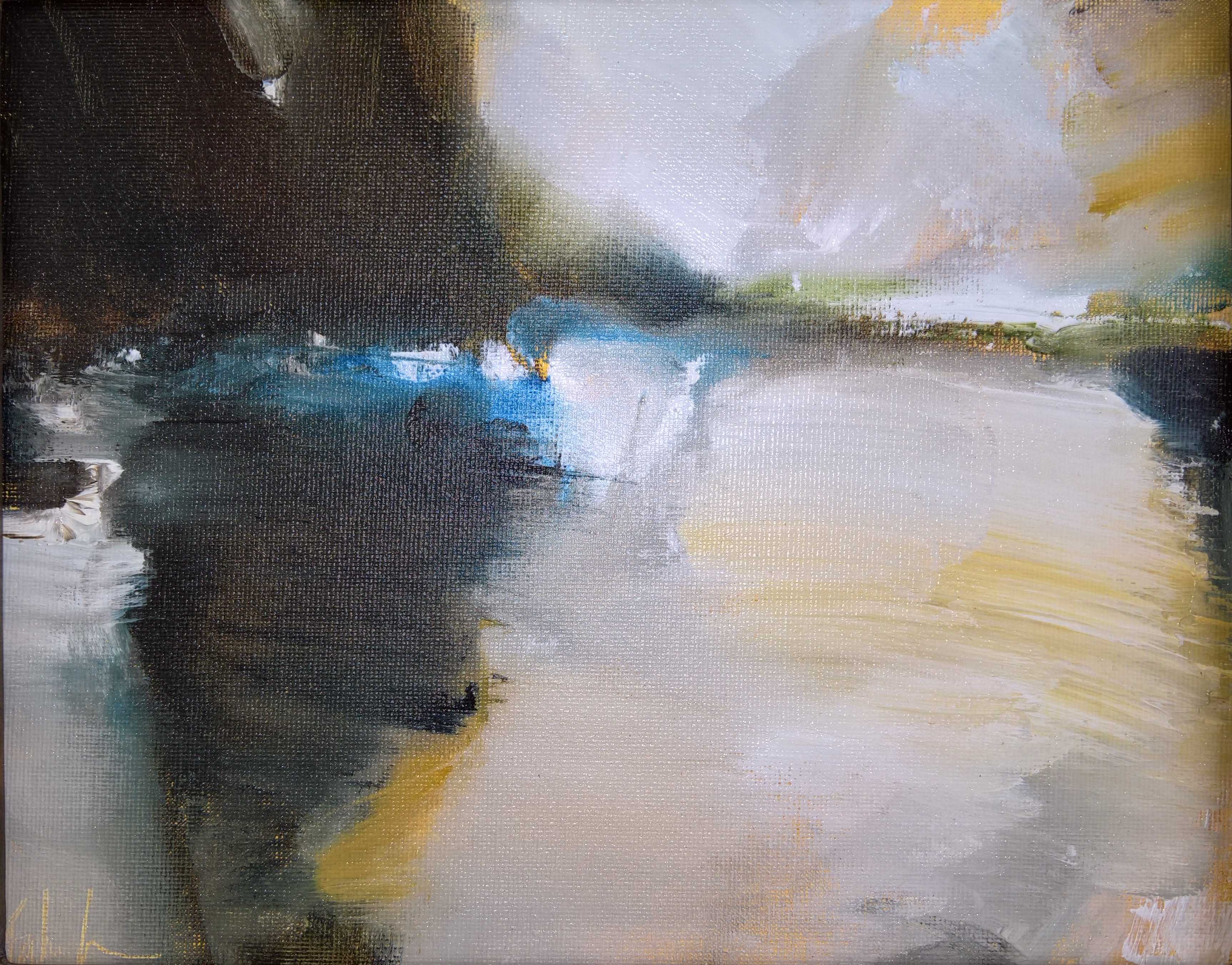
And finally, the artistic sensibility completely surrenders. The elements of the scene are offered in blotches. The rough edges of the rock argue with the sky and water – the stark blue of the latter only visible as a breaker that crashes against the cliff. The brownish sunlight blares from the wash and the billowed fog. The elements express their nature in contrast each to the other.

CLiffscapeExpressed

Seeming to me, as it were, as they were before they were ever seen at all – knowing each other only as fields of force, some less obdurate, but all seeking to assert their nature.

This is not the artist’s sensibility; it is not the human response: it is the expression of things in of themselves working through the artist.